Key takeaways
- Searchable offers AI search visibility tracking with built-in content generation, but several alternatives match or exceed its capabilities in specific areas.
- Model coverage varies significantly across platforms: some track only ChatGPT and Perplexity, while others cover 10+ AI engines including Claude, Gemini, Grok, DeepSeek, and Copilot.
- Most tools stop at monitoring. The ones worth paying for help you actually fix visibility gaps through content creation, crawler analysis, and optimization workflows.
- Pricing ranges from free tiers to $500+/month, so the right choice depends on how many sites you manage, how many prompts you track, and whether you need content generation.
- Promptwatch is the only platform rated "Leader" across all categories in a 2026 comparison of 12 GEO platforms, largely because it closes the loop from gap analysis to content creation to result tracking.
Searchable has carved out a reasonable position in the AI visibility space. It tracks how brands appear in AI-generated answers, offers some content generation features, and covers a handful of major AI engines. For teams just getting started with GEO (Generative Engine Optimization), it's a workable starting point.
But "workable" isn't the same as "best fit." Depending on what you actually need, Searchable might fall short on model coverage, prompt depth, content tooling, or the ability to connect visibility data to real traffic and revenue.
The AI visibility market has exploded. There are now dozens of platforms claiming to track your brand across ChatGPT, Claude, Gemini, and Perplexity. Most of them are monitoring dashboards with a nice UI. Very few help you do anything with the data.
Here's a clear-eyed look at 10 Searchable alternatives worth considering in 2026, what they're actually good at, and where they fall short.
What to look for in a Searchable alternative
Before diving into specific tools, it helps to know what separates a useful AI visibility platform from a glorified prompt-runner.
The questions that matter most:
- Which AI engines does it actually monitor? (ChatGPT, Claude, Gemini, Perplexity, Grok, DeepSeek, Copilot, Google AI Overviews, Meta AI, Mistral)
- Does it track real user-facing responses, or just API outputs? These can differ significantly.
- Can it identify gaps -- prompts where competitors appear but you don't?
- Does it help you create content to close those gaps, or just show you the problem?
- Does it track AI crawler activity on your site?
- Can it connect AI visibility to actual traffic and revenue?
Most tools answer "yes" to the first two questions and "no" to everything else. Keep that in mind as you read through these alternatives.
The 10 best Searchable alternatives in 2026
1. Promptwatch
Promptwatch is the most complete AI visibility platform available in 2026. Where Searchable and most competitors stop at monitoring, Promptwatch runs a full optimization loop: find gaps, create content, track results.

The Answer Gap Analysis shows you exactly which prompts competitors rank for in AI search but you don't -- and crucially, what content your site is missing to compete. Content Agents then generate articles, listicles, and comparison pieces grounded in real prompt data, citation patterns, and competitor analysis. This isn't generic AI writing; it's content engineered to answer the specific questions AI models are already exposing as gaps.
On top of that, Promptwatch's AI Crawler Logs show real-time data on when ChatGPT, Claude, Perplexity, and other crawlers visit your pages, which pages they read, what errors they hit, and when a crawled page converts to a citation. Most competitors don't have this at all.
It monitors 10 AI engines (ChatGPT, Perplexity, Google AI Overviews, Google AI Mode, Claude, Gemini, Meta/Llama, DeepSeek, Grok, Mistral, Copilot), tracks Reddit and YouTube as citation sources, and includes ChatGPT Shopping tracking for e-commerce brands.
Pricing starts at $99/month for the Essential plan (1 site, 50 prompts, 5 articles), $249/month for Professional (2 sites, 150 prompts, crawler logs), and $579/month for Business (5 sites, 350 prompts). A free trial is available.
In a 2026 comparison of 12 GEO platforms, Promptwatch was the only one rated "Leader" across all categories. The core reason: it's built around action, not just observation.
2. Profound
Profound is one of the original players in AI visibility tracking and still has genuinely strong features: real-user prompt volume data, front-end response capture (not just API), and an Amazon Rufus shopping module that most competitors don't offer.
Profound

The catch is pricing. The Starter plan at $99/month covers ChatGPT only. Adding Perplexity and Google AI Overviews jumps to $399/month. Claude, Gemini, Grok, and the rest require enterprise pricing that isn't published. You're also capped at 100 tracked prompts and 3 user seats at the Growth tier.
If you need broad model coverage at a reasonable price, Profound gets expensive fast. It's a strong choice for enterprise teams with specific requirements around Amazon and shopping visibility, but for most marketing teams, the cost-to-coverage ratio is hard to justify.
3. Otterly.AI
Otterly.AI is a clean, accessible monitoring tool that covers ChatGPT, Perplexity, and Google AI Overviews. It's popular with smaller teams and agencies that want a simple dashboard without a steep learning curve.
Otterly.AI

The limitation is that Otterly.AI is monitoring-only. There's no content generation, no crawler log analysis, no gap analysis that tells you what to do next. You can see where you're invisible, but you're on your own to fix it. For teams that already have strong content workflows and just need visibility data, that's fine. For teams that want the platform to help them improve, it falls short.
4. Peec AI
Peec AI focuses on share-of-voice tracking across AI engines, with a clean interface and reasonable pricing for teams getting started with AI search monitoring.
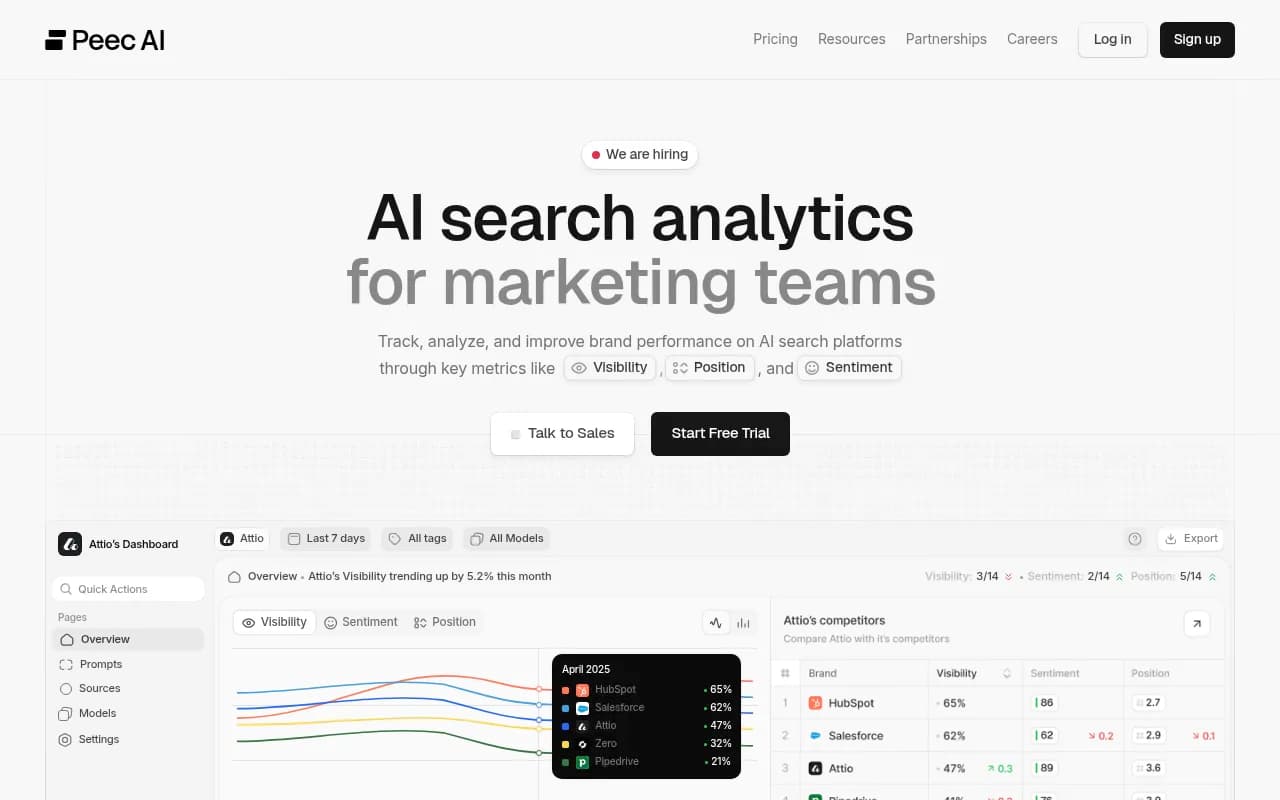
Like Otterly.AI, it's primarily a monitoring tool. Prompt coverage and model support are more limited than platforms like Promptwatch or Profound. It doesn't offer content generation, crawler logs, or traffic attribution. Worth considering if you want a lightweight, affordable way to start tracking AI visibility without committing to a full GEO platform.
5. AthenaHQ
AthenaHQ positions itself as an enterprise-grade AI visibility platform with strong brand mention tracking and competitive analysis features.

It covers multiple AI engines and offers solid share-of-voice reporting. Where it falls short is on the optimization side -- AthenaHQ is monitoring-focused and doesn't offer the content generation or gap-closing tools that make a platform genuinely useful for improving visibility over time. It's a good fit for enterprise teams that need detailed reporting and already have content teams to act on the data.
6. Scrunch AI
Scrunch AI is an AI search visibility platform that tracks brand mentions across LLMs and offers some competitive analysis features.
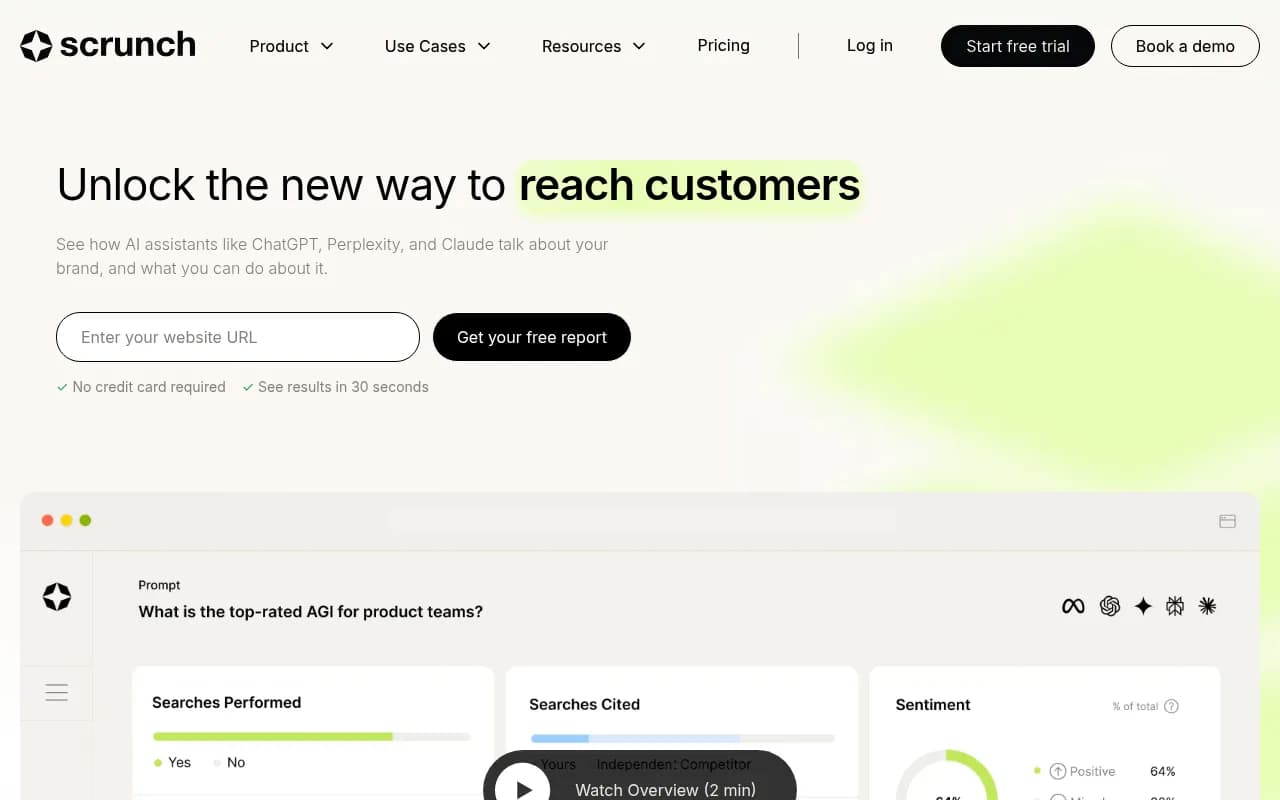
It has a stronger feature set than basic monitoring tools and covers a reasonable range of AI engines. Pricing tends to be higher than mid-market alternatives, and it lacks some of the deeper capabilities you'd find in Promptwatch -- specifically crawler logs, Reddit/YouTube citation tracking, and integrated content generation. A reasonable choice for teams that need more than basic monitoring but aren't ready for a full-stack GEO platform.
7. SE Ranking (AI Visibility Tracker)
SE Ranking is primarily a traditional SEO platform that has added AI visibility tracking features. If your team already uses SE Ranking for rank tracking, site audits, and keyword research, the AI visibility module is a natural addition.
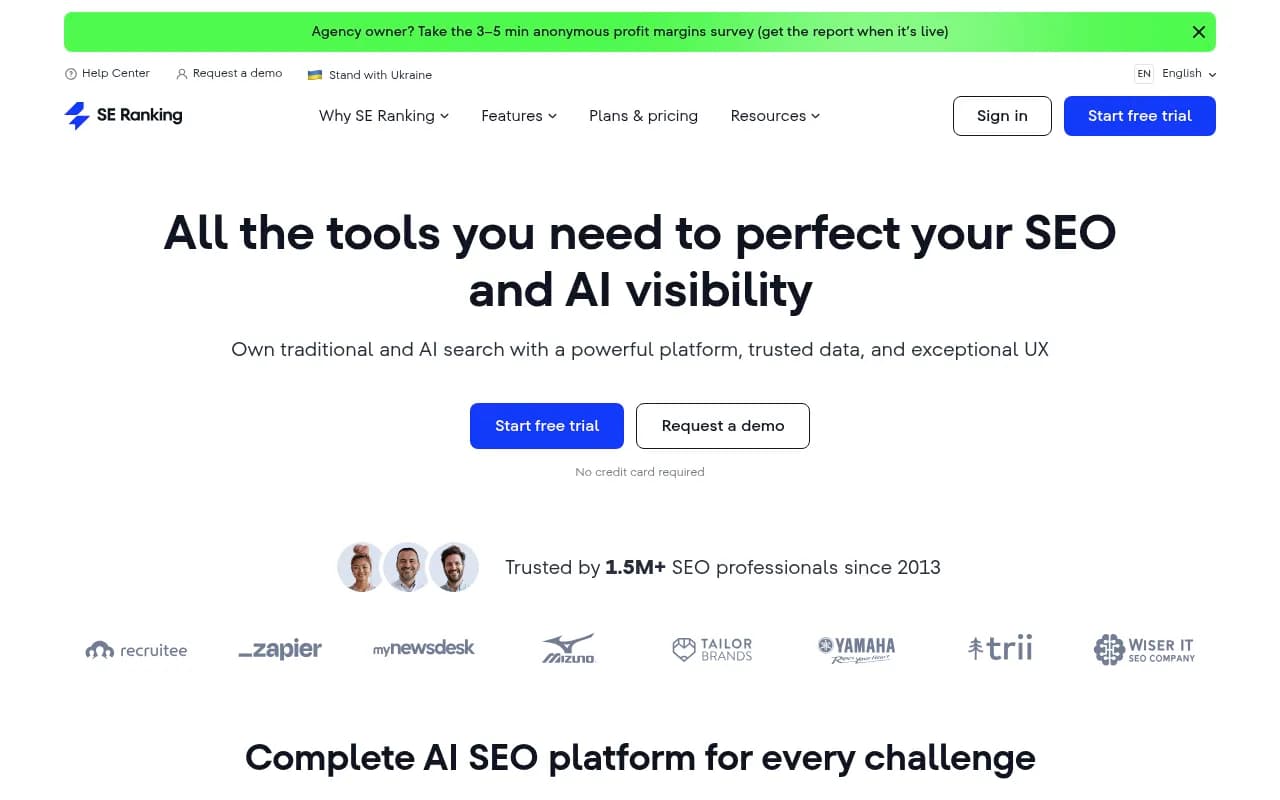
The AI tracking features are more limited than dedicated GEO platforms -- fewer AI engines, less prompt depth, and no content generation specifically engineered for AI search. But the value proposition is clear: one platform for both traditional SEO and AI visibility, at a price point that's competitive with standalone tools.
8. Semrush (AI Visibility Toolkit)
Semrush has built AI visibility features into its existing platform, making it attractive for teams that already pay for Semrush and want to add AI search monitoring without a separate subscription.
The limitation is that Semrush uses fixed prompts rather than custom prompt tracking, which means you're monitoring a predetermined set of queries rather than the specific questions your customers actually ask. There's also no AI traffic attribution connecting visibility to revenue. For teams deeply invested in the Semrush ecosystem, it's a convenient add-on. For teams that need serious GEO capabilities, it's not a primary solution.
9. LLM Pulse
LLM Pulse is a focused AI visibility tracker that covers ChatGPT, Perplexity, and a handful of other AI engines. It's positioned as a lightweight, affordable option for teams that want basic brand monitoring across LLMs.
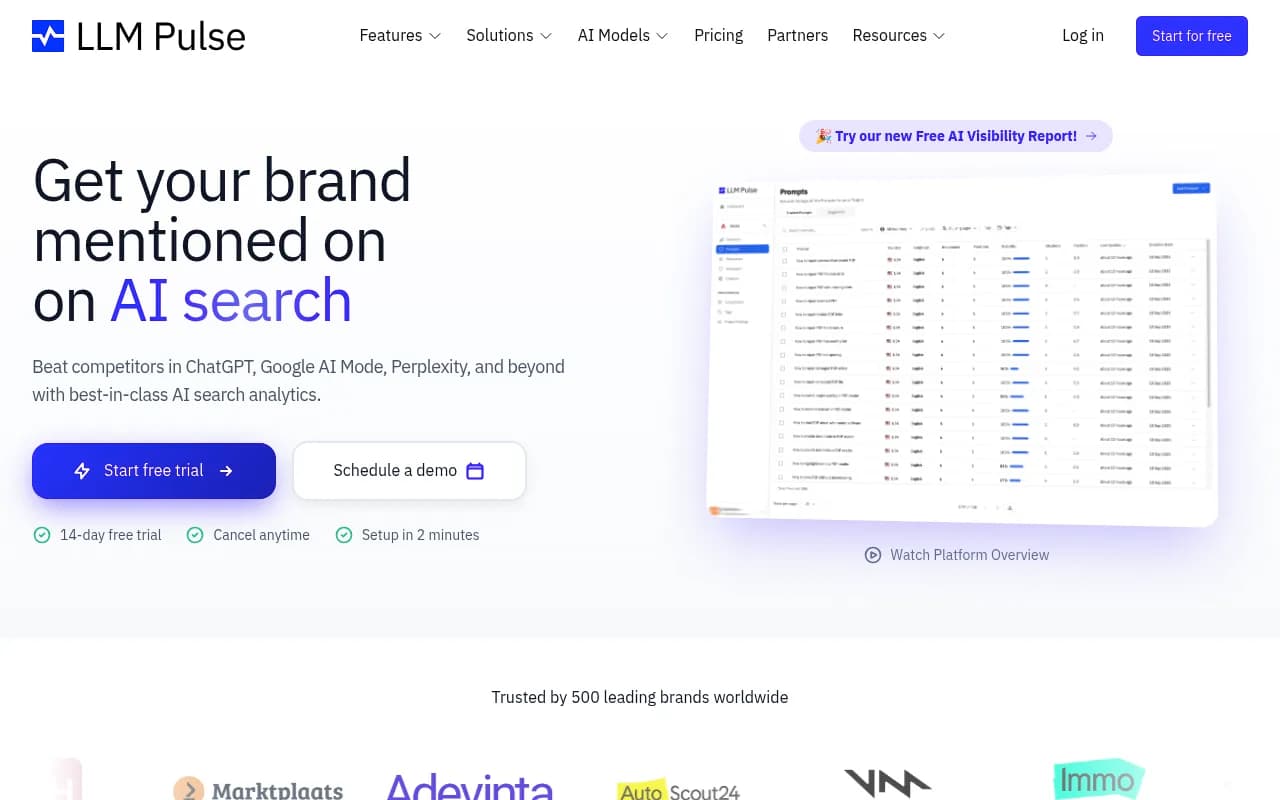
It doesn't offer content generation, crawler analysis, or deep competitive gap analysis. The prompt limits on entry-level plans are restrictive. But for small teams or solo marketers who want to start tracking AI visibility without a significant investment, it's a reasonable entry point.
10. Omnia
Omnia is an AI visibility platform focused on measuring brand presence in AI-generated answers, with a clean interface and solid multi-engine coverage.
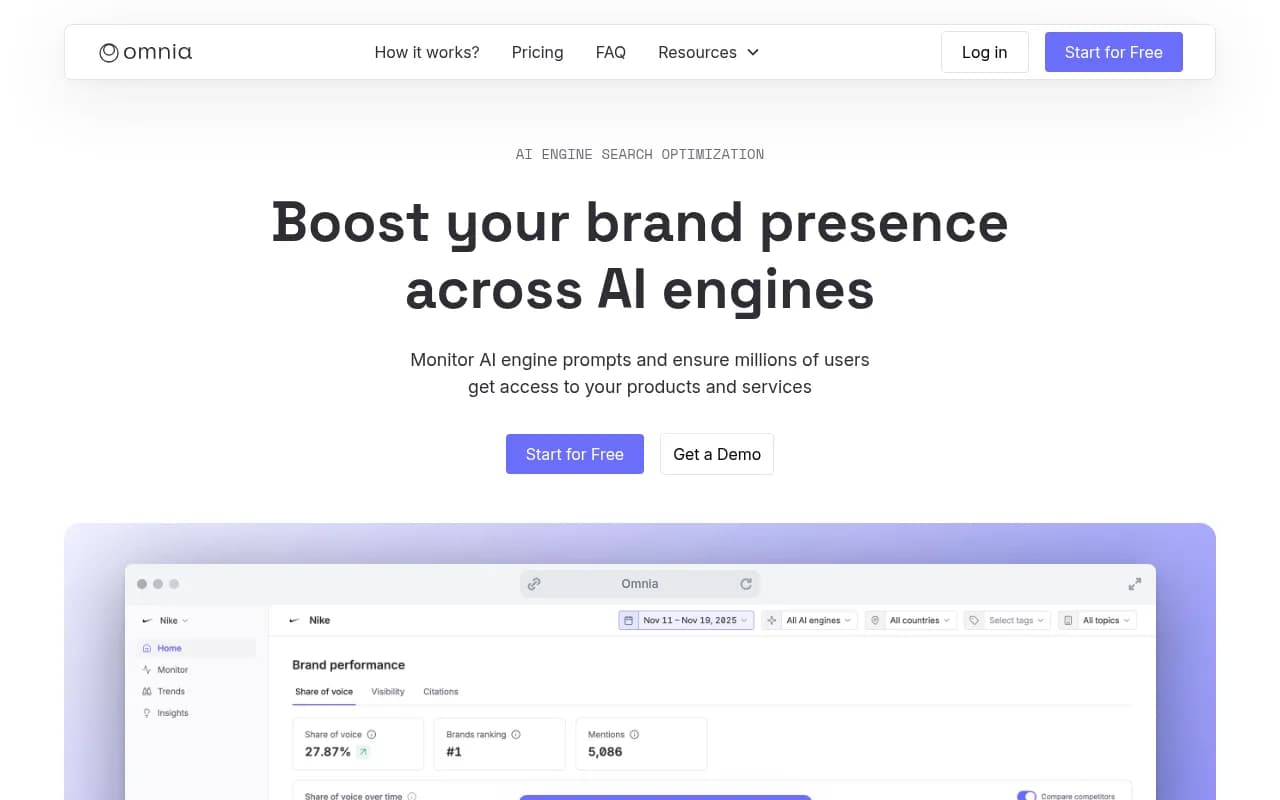
It covers a good range of AI engines and offers brand mention tracking and share-of-voice analysis. Like several others on this list, it's primarily a monitoring tool -- the platform shows you where you stand but doesn't generate content or close visibility gaps directly. Worth evaluating if you want a dedicated AI visibility dashboard with good reporting capabilities.
Side-by-side comparison
| Platform | AI engines covered | Content generation | Crawler logs | Traffic attribution | Reddit/YouTube tracking | Starting price |
|---|---|---|---|---|---|---|
| Promptwatch | 10+ | Yes (Content Agents) | Yes | Yes | Yes | $99/mo |
| Profound | ChatGPT only (Starter) | No | No | No | No | $99/mo |
| Otterly.AI | ChatGPT, Perplexity, AIO | No | No | No | No | ~$49/mo |
| Peec AI | Limited | No | No | No | No | ~$49/mo |
| AthenaHQ | Multiple | No | No | No | No | Custom |
| Scrunch AI | Multiple | No | No | No | No | Custom |
| SE Ranking | Limited | No | No | No | No | ~$65/mo |
| Semrush | Multiple (fixed prompts) | No | No | No | No | $139/mo+ |
| LLM Pulse | ChatGPT, Perplexity | No | No | No | No | ~$29/mo |
| Omnia | Multiple | No | No | No | No | Custom |
| Searchable | Multiple | Yes (basic) | No | No | No | Custom |
The pattern is hard to miss. Most platforms in this space are monitoring dashboards. They show you data. They don't help you act on it.
Which tool should you actually use?
The answer depends on what you're trying to accomplish.
If you want to start tracking AI visibility cheaply and don't need content tools, Otterly.AI or LLM Pulse are reasonable starting points. They're simple, affordable, and cover the basics.
If you're already in the Semrush or SE Ranking ecosystem, their AI visibility features are worth activating -- not as primary GEO tools, but as a convenient add-on to your existing workflow.
If you need enterprise-grade reporting with strong brand mention tracking and have a content team to act on the data, AthenaHQ or Scrunch AI are worth evaluating.
If you want a platform that actually helps you improve your AI visibility -- not just measure it -- Promptwatch is the only option that closes the full loop. The combination of Answer Gap Analysis, Content Agents, AI Crawler Logs, and traffic attribution puts it in a different category from the monitoring-only tools that dominate this market.
The distinction matters more than it sounds. Knowing you're invisible in Perplexity for a high-value prompt is useful. Knowing exactly what content to create to fix that, having the platform generate a first draft grounded in real citation data, and then watching your visibility score improve as AI crawlers pick up the new page -- that's a workflow that actually moves the needle.
Most Searchable alternatives give you the first part. Very few give you all of it.
The bottom line
Searchable is a reasonable tool, but it's not the most capable platform in this category. If you're evaluating alternatives, the most important question isn't which tool has the best dashboard -- it's which tool helps you do something with the data.
Monitoring your AI visibility is table stakes in 2026. The brands that will win in AI search are the ones that can identify gaps faster and fill them with content that AI engines actually want to cite. That requires more than a tracking dashboard.
Start with what you need now. But build toward a platform that can grow with you as AI search becomes a larger share of your traffic.