Key takeaways
- Peec AI is a solid AI visibility tracker, but teams frequently hit its limits around cost at scale, content optimization, and multi-engine depth.
- Most alternatives fall into two camps: monitoring-only dashboards and full-stack optimization platforms. The distinction matters a lot.
- Promptwatch is the only platform in this comparison that closes the full loop — find gaps, generate content, track results — rather than just showing you data.
- Evertune and Relixir are the strongest enterprise picks if you need dedicated support and custom workflows.
- Otterly.AI and Rankshift are the most accessible entry points for smaller teams or solo marketers.
Peec AI got a lot of attention when it launched. It was one of the first tools to give marketers a clear view of how their brand appeared in AI-generated answers, and for a while, that was enough. Track your prompts, see your mentions, report to leadership.
But the market has moved fast. In 2026, AI search isn't a curiosity — it's a meaningful traffic channel for most brands. And "monitoring" alone doesn't cut it anymore. Teams want to know why they're not being cited, what content they need to create, and whether their fixes are actually working.
That's where Peec AI starts to show its seams. The pricing gets steep as you scale up prompt tracking, the platform doesn't generate content or tell you what to fix, and multi-engine coverage has gaps depending on your industry. Teams on Reddit's r/SEO and in Slack communities like TrafficThinkTank have been reporting the same frustrations: cost creep, limited actionability, and a need for tools that do more than display dashboards.
This guide covers 9 alternatives worth considering in 2026 — what each one does well, where it falls short, and who it's actually built for.
What Peec AI does (and where it falls short)
Peec AI tracks brand visibility across AI models, monitors prompt-level responses, and gives you a view of how competitors appear in the same answers. Its pricing runs from $95/month (Starter, 50 prompts, 3 AI models) up to $495/month (Advanced, 350 prompts, multi-country, GSC/GA integrations), with enterprise pricing on request.
For a team that just needs basic monitoring, it's functional. The problems show up when you want to:
- Understand why you're not being cited (not just that you aren't)
- Generate content to close visibility gaps
- Track AI crawler behavior on your site
- Monitor Reddit, YouTube, or other sources that influence AI recommendations
- Scale to hundreds of prompts without the bill ballooning
That's the gap most of these alternatives are trying to fill.
The 9 best Peec AI alternatives in 2026
1. Promptwatch — best overall for AI visibility optimization
Promptwatch is the most complete platform in this space. Where Peec AI stops at monitoring, Promptwatch runs the full cycle: find gaps, create content, track results.

The Answer Gap Analysis shows you exactly which prompts competitors rank for that you don't — not as a vague "you're missing coverage here" signal, but as specific prompts with volume estimates and difficulty scores. From there, the built-in AI writing agent generates articles, listicles, and comparisons grounded in citation data from 880M+ analyzed citations. You're not writing generic SEO content; you're writing content engineered to get cited by ChatGPT, Claude, Perplexity, and others.
On top of that, Promptwatch logs AI crawler activity in real time — which pages ChatGPT, Claude, and Perplexity are reading, how often they return, and what errors they hit. Most competitors don't have this at all. It also tracks Reddit and YouTube discussions that directly influence AI recommendations, monitors ChatGPT Shopping carousels, and supports 10 AI models including Google AI Mode and DeepSeek.
Pricing starts at $99/month (Essential: 1 site, 50 prompts, 5 articles), $249/month (Professional: 2 sites, 150 prompts, crawler logs), and $579/month (Business: 5 sites, 350 prompts). A free trial is available.
The honest caveat: if you genuinely only need monitoring and have no interest in content generation or optimization, you're paying for features you won't use. But for most growth-focused teams, the action loop is exactly what's missing from tools like Peec AI.
2. Profound — best for enterprise AI visibility reporting
Profound tracks brand mentions across 9+ AI search engines with strong entity extraction and attribution mapping. It's built for enterprise teams that need detailed reporting and stakeholder-ready dashboards.
Profound

Where Profound shines is in the depth of its analytics — you can see not just whether you're mentioned, but how your brand is described, what context surrounds it, and how that changes over time. The competitor presence monitoring is solid.
The limitation is that Profound is primarily a monitoring and reporting tool. It doesn't generate content or tell you what to create to improve your visibility. For teams that already have strong content operations and just need better data to inform them, that's fine. For teams that want the platform to help them act on the data, it falls short.
Pricing starts around $99/month, though enterprise plans scale significantly.
3. Otterly.AI — best for focused AI search monitoring on a budget
Otterly.AI is one of the cleaner, more straightforward monitoring tools in this space. It tracks brand mentions across ChatGPT, Perplexity, and Google AI Overviews, with a UI that's genuinely easy to navigate.
Otterly.AI

It's a good fit for smaller teams or agencies that want reliable AI mention tracking without a complex setup. The prompt management is intuitive, and the reporting is clear enough to share with clients.
The trade-off is that Otterly.AI is monitoring-only. No content generation, no crawler logs, no gap analysis. It shows you where you stand; it doesn't help you improve. If that's all you need, it's a solid choice. If you want the platform to drive action, you'll outgrow it quickly.
4. AthenaHQ — best for multi-engine AI visibility analysis
AthenaHQ covers Google AI Overviews, Perplexity, ChatGPT, and Claude with a focus on competitive intelligence. It's positioned for brands that are actively competing in AI-native search and want to understand the landscape across multiple engines.

The multi-engine coverage is genuinely good, and the competitive analysis features give you a clear picture of where you stand relative to specific competitors. It's more analytically rigorous than Otterly.AI or Peec AI.
That said, AthenaHQ is monitoring-focused. It doesn't have content generation or crawler log analysis. Pricing starts at $295/month, which is on the higher end for a monitoring-only tool. Teams that need both analysis depth and optimization support will likely find themselves pairing it with another tool.
5. Scrunch AI — best for brand narrative analysis
Scrunch AI takes a different angle than most tools here. Rather than just tracking whether you're mentioned, it analyzes how your brand is described — the descriptors, the sentiment, the narrative that AI models have built around you.
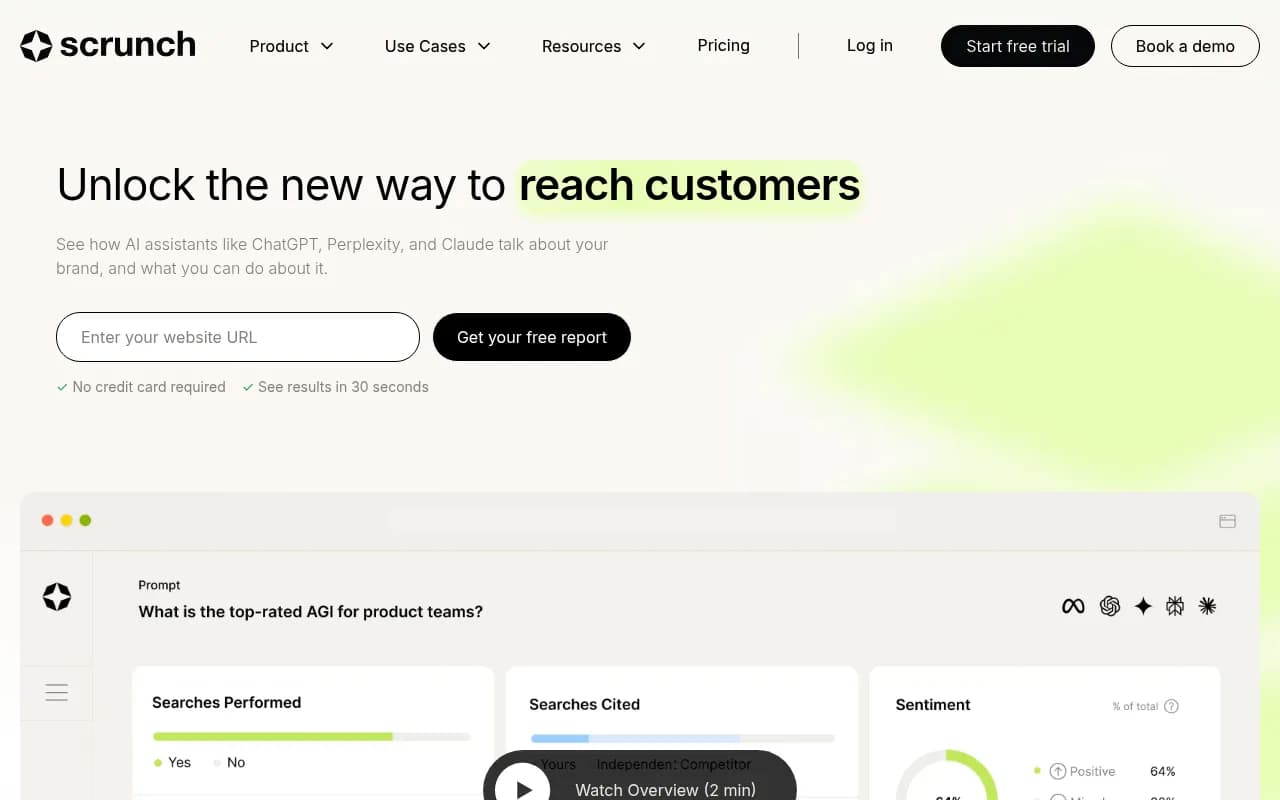
This is genuinely useful for brand teams and communications professionals who care about perception, not just presence. If your goal is to understand and shape the story AI models tell about your brand, Scrunch AI has capabilities that most monitoring tools don't.
The limitation is scope. It's strong on brand narrative analysis, weaker on prompt-level tracking and content optimization. It's a specialist tool, not a generalist platform.
6. AirOps — best for content engineering at scale
AirOps is less of a visibility tracker and more of a content operations platform with strong AI search optimization features. It's built for teams that need to produce content at scale and want that content to perform in AI search.
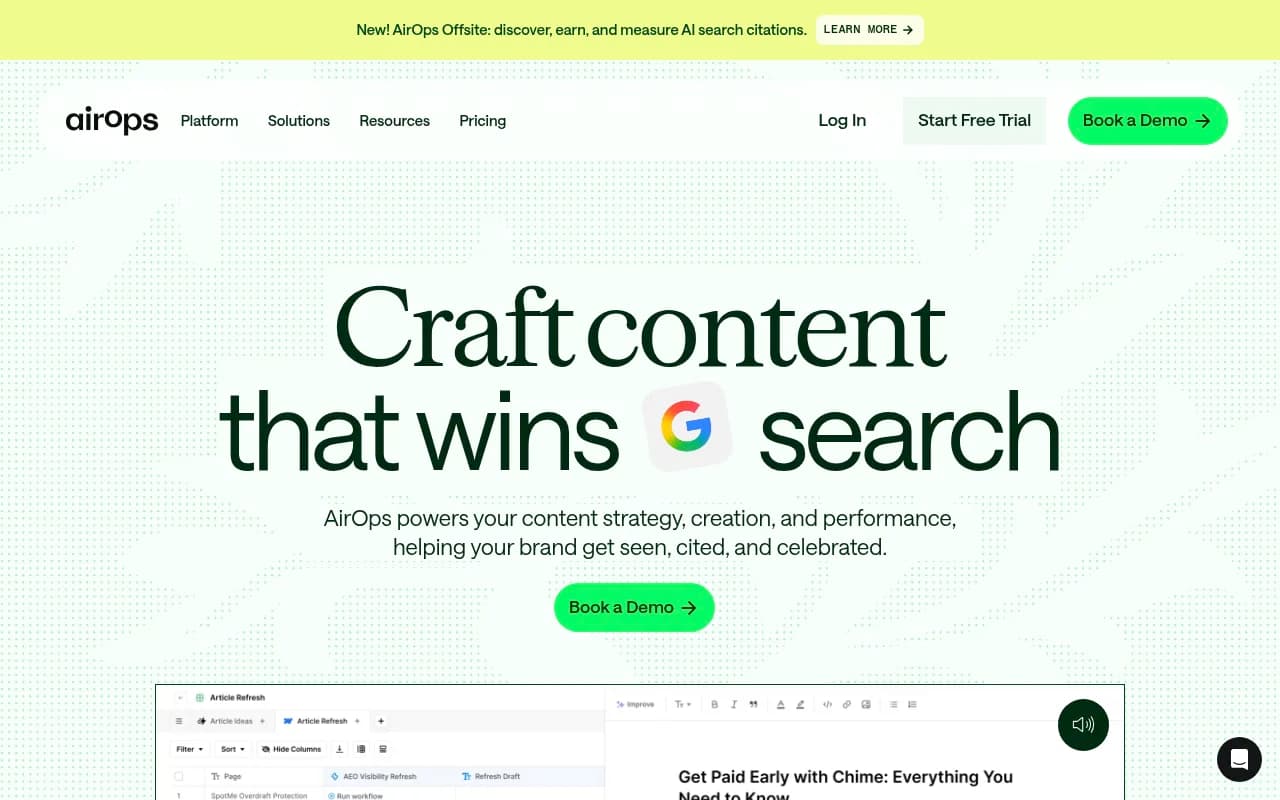
The platform lets you build content workflows, automate production, and optimize for AI citations. If you have a large content team and need to systematize how you create and optimize content for AI search, AirOps is worth a serious look.
The gap is on the monitoring side. AirOps doesn't give you the same depth of brand visibility tracking or competitor analysis that a dedicated GEO platform does. It's best used alongside a monitoring tool, or by teams where content production is the primary bottleneck.
7. Relixir — best for enterprise GEO with hands-on support
Relixir is an end-to-end GEO engine built specifically for enterprise brands. It combines visibility tracking with content optimization and offers more hands-on implementation support than most self-serve platforms.
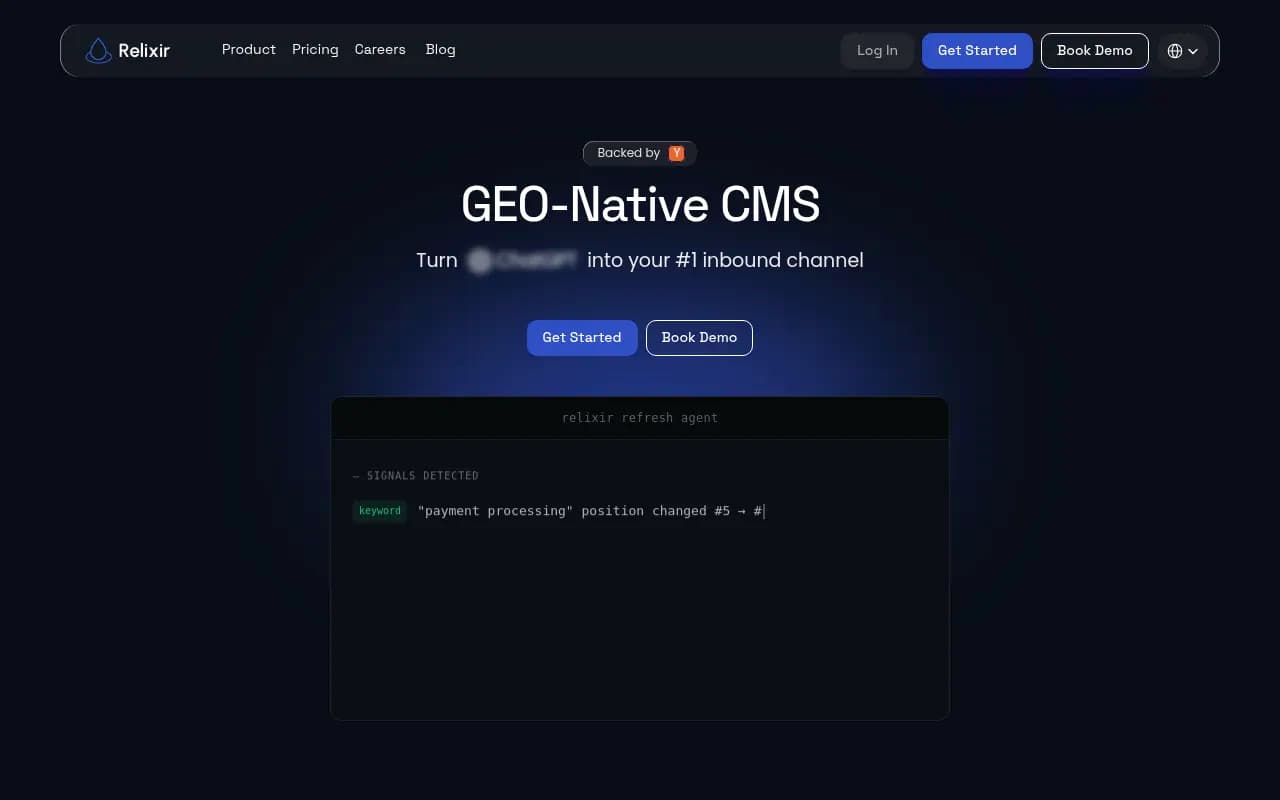
For large organizations that want a vendor to help them build and execute an AI search strategy — not just hand them a dashboard — Relixir is one of the stronger options. The platform handles prompt tracking, gap analysis, and content recommendations, and the team is involved in helping you act on the data.
The trade-off is accessibility. Relixir is priced and structured for enterprise, which means it's not the right fit for mid-market teams or agencies looking for a self-serve tool they can spin up quickly.
8. Evertune — best for Fortune 500 brand visibility management
Evertune is the most enterprise-oriented platform in this list. It's built for large brands with complex visibility needs across multiple markets, languages, and AI models.
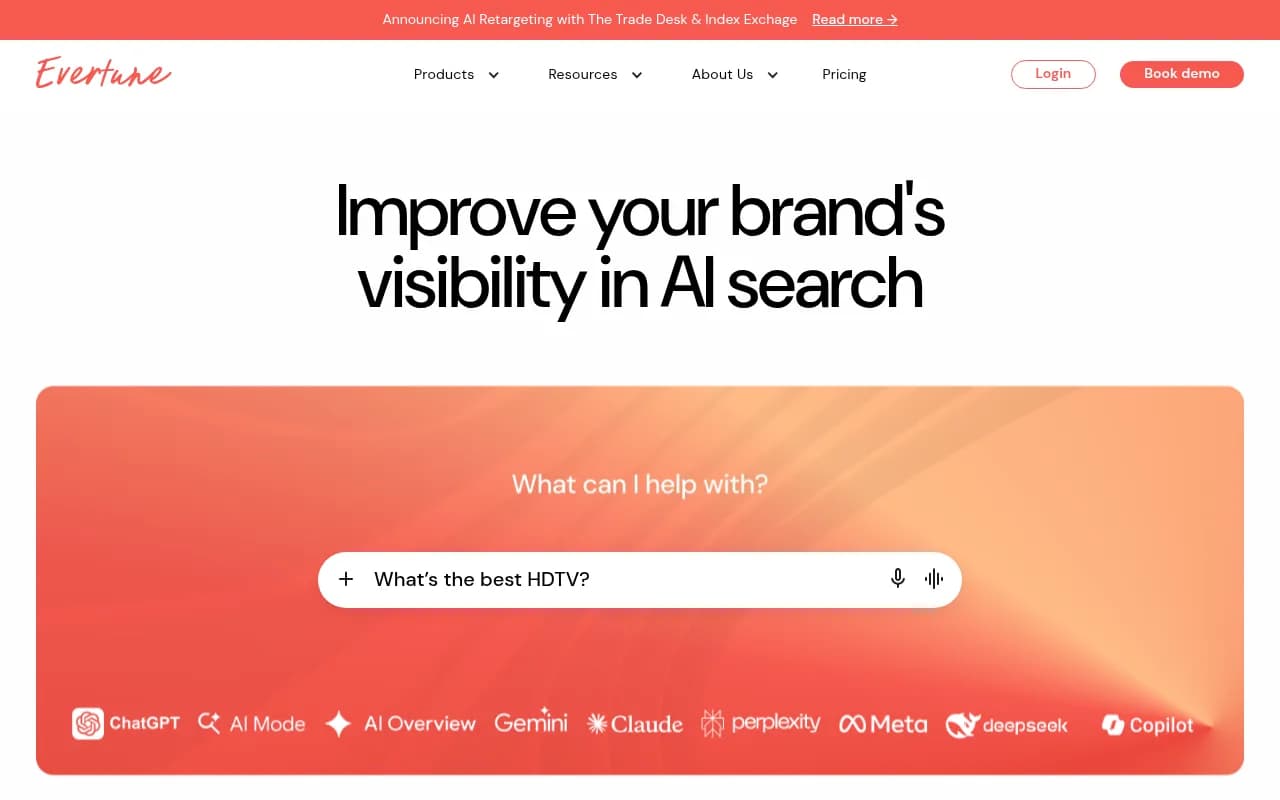
The platform tracks AI visibility at scale, with features designed for the reporting and governance requirements of large organizations. If you're managing AI search visibility for a Fortune 500 brand with multiple product lines and regional teams, Evertune has the infrastructure for it.
For smaller organizations, it's overkill. The pricing and implementation complexity reflect its enterprise positioning. But for the right buyer, it's one of the most capable platforms available.
9. Rankshift — best for lightweight brand tracking in ChatGPT and Perplexity
Rankshift focuses on tracking brand visibility across ChatGPT and Perplexity specifically. It's a lighter-weight tool compared to most others on this list, with a simpler setup and lower price point.

For solo marketers, small businesses, or teams that are just getting started with AI visibility tracking, Rankshift is an accessible entry point. It won't give you the depth of a platform like Promptwatch or Profound, but it gives you a clear view of your basic brand presence in the two most-used AI search tools.
The ceiling is low. As your needs grow — more models, more prompts, content optimization, competitor analysis — you'll likely need to move to a more capable platform.
Side-by-side comparison
| Tool | AI models covered | Content generation | Crawler logs | Gap analysis | Best for | Starting price |
|---|---|---|---|---|---|---|
| Promptwatch | 10 (ChatGPT, Claude, Perplexity, Gemini, Grok, DeepSeek, Copilot, Meta AI, Google AI Overviews, Google AI Mode) | Yes | Yes | Yes | Full-stack AI visibility optimization | $99/mo |
| Peec AI | 3–all (plan-dependent) | No | No | No | Basic AI visibility monitoring | $95/mo |
| Profound | 9+ | No | No | Limited | Enterprise reporting and analytics | ~$99/mo |
| Otterly.AI | ChatGPT, Perplexity, Google AIO | No | No | No | Budget-friendly monitoring | Lower tiers available |
| AthenaHQ | Google AIO, Perplexity, ChatGPT, Claude | No | No | No | Multi-engine competitive analysis | $295/mo |
| Scrunch AI | Multiple | No | No | No | Brand narrative and sentiment | Custom |
| AirOps | Multiple | Yes | No | Partial | Content engineering at scale | Custom |
| Relixir | Multiple | Yes | No | Yes | Enterprise GEO with support | Enterprise |
| Evertune | Multiple | No | No | No | Fortune 500 brand visibility | Enterprise |
| Rankshift | ChatGPT, Perplexity | No | No | No | Entry-level brand tracking | Low |
How to choose
The most important question isn't "which tool has the most features" — it's "what do I actually need to do?"
If you're a marketing or SEO team that wants to improve your AI search visibility (not just measure it), you need a platform that helps you act on the data. That means gap analysis, content generation, and result tracking. Promptwatch is the only tool in this comparison that covers all three in one platform.
If you're an enterprise brand with complex reporting needs and a dedicated team to execute the strategy, Profound, Relixir, or Evertune may be better fits depending on your budget and how much hands-on support you want.
If you're a smaller team or agency that just needs reliable monitoring without a lot of complexity, Otterly.AI or Rankshift are reasonable starting points — just go in knowing you'll eventually want more.
The monitoring-only tools in this list aren't bad. They do what they say. But in 2026, knowing where you're invisible isn't the hard part. Fixing it is.
Final thought
Peec AI is a reasonable tool for teams that need basic AI visibility monitoring. But if you've hit its ceiling — on price, on depth, or on the fact that it doesn't help you actually improve your visibility — the alternatives above give you real options.
The tools that will matter most in 2026 aren't the ones with the prettiest dashboards. They're the ones that help you close the gap between "we're not being cited" and "now we are."