Key takeaways
- Most AI search and SEO platforms stop at gap detection — they show you what's missing but don't help you fix it.
- A genuine content brief generator goes beyond flagging topics: it outputs structured briefs with headings, target keywords, competitor analysis, word counts, and ideally persona context.
- Tools like Frase, Surfer SEO, MarketMuse, and Content Harmony are purpose-built for brief generation; others bolt it on as an afterthought.
- For teams that care about AI search visibility specifically (ChatGPT, Perplexity, Google AI Overviews), Promptwatch generates briefs grounded in real prompt data and answer gap analysis — not just traditional keyword research.
- The right tool depends on your pipeline: pure SEO teams need different things than teams optimizing for AI search citations.
The gap between "flagging" and "briefing"
There's a version of this problem every content team knows. You run an audit, the tool spits out a list of topics your competitors rank for that you don't, and then... nothing. You're staring at a spreadsheet of gaps with no clear path to fixing them.
That's the dirty secret of most AI SEO and visibility platforms in 2026. They're excellent at analysis. They're terrible at handing the baton to your writers.
A content brief isn't just a topic title. A real brief tells a writer: what angle to take, which questions to answer, what the competing content looks like, what word count to target, which entities and terms to include, and who the audience is. Without that, you haven't saved your writer any time — you've just moved the research burden from the tool to them.
This guide focuses specifically on platforms that generate briefs your writers can actually open and start working from. Not tools that produce a keyword list and call it a brief.

What makes a content brief actually useful?
Before comparing tools, it's worth being precise about what "automated content brief generation" means in practice. A useful brief should include most of the following:
- A clear target keyword or prompt cluster
- Recommended headings and subheadings (H2/H3 structure)
- Competitor content summary — what the top-ranking pages cover
- Recommended word count or content depth
- Key entities, terms, and questions to address
- Audience or persona context
- Internal linking suggestions
- A content angle or differentiation point
The more of these a tool generates automatically, the less your writer has to reconstruct from scratch. Some tools nail three or four of these. A few get close to all of them.
The tools that actually generate briefs
Frase
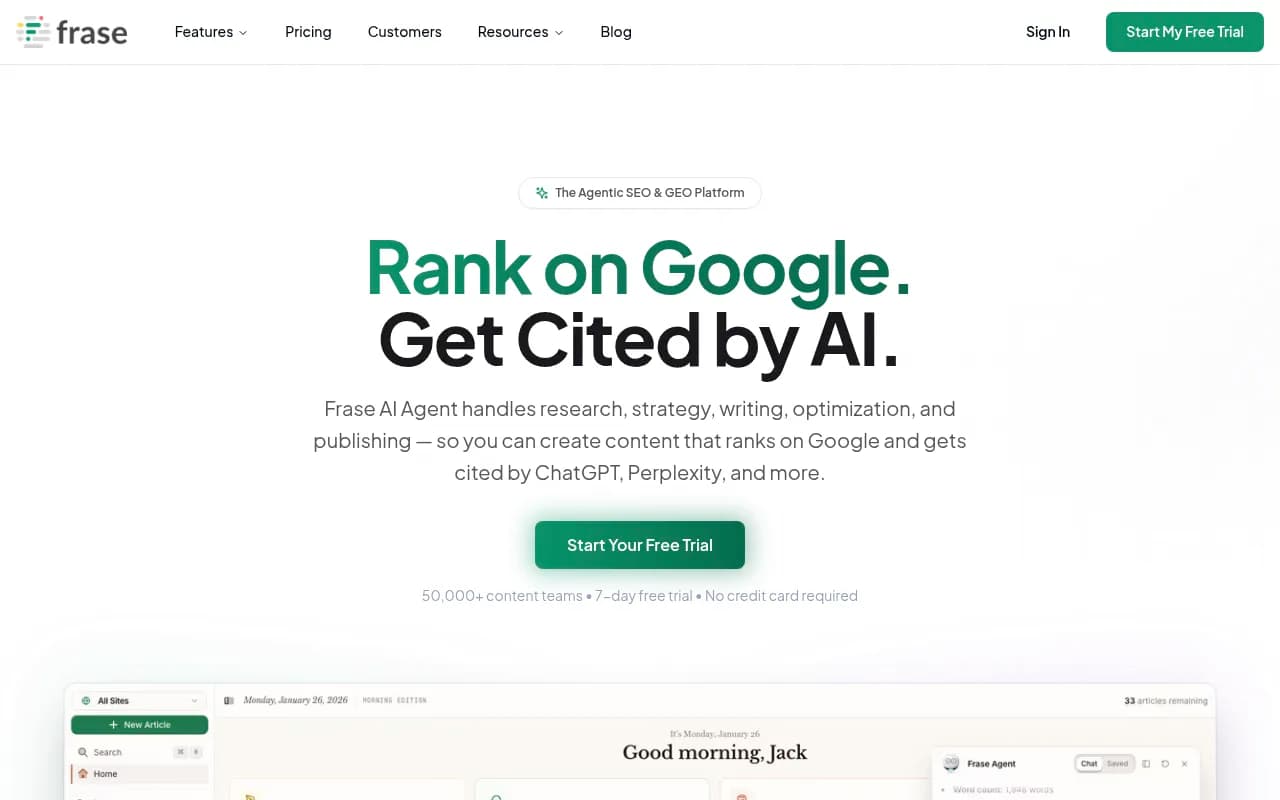
Frase is one of the most complete brief-generation tools available. It pulls the top-ranking pages for a query, summarizes what they cover, and builds a structured brief with recommended headings, questions from "People Also Ask," and topic coverage scores. Writers get a side-by-side editor that shows them exactly what topics they're missing as they write.
What sets Frase apart is the research-to-brief pipeline. You enter a topic, it scrapes and analyzes the SERP, and within a minute you have a brief that reflects what Google currently rewards for that query. The AI writing features are decent but secondary — the brief scaffolding is the real value.
Frase covers what their own analysis calls 6 out of 6 pipeline stages for SEO automation, which is more than any other tool they tested in their 2026 comparison. That's a bold claim from a company reviewing itself, but the brief quality does hold up.
Surfer SEO
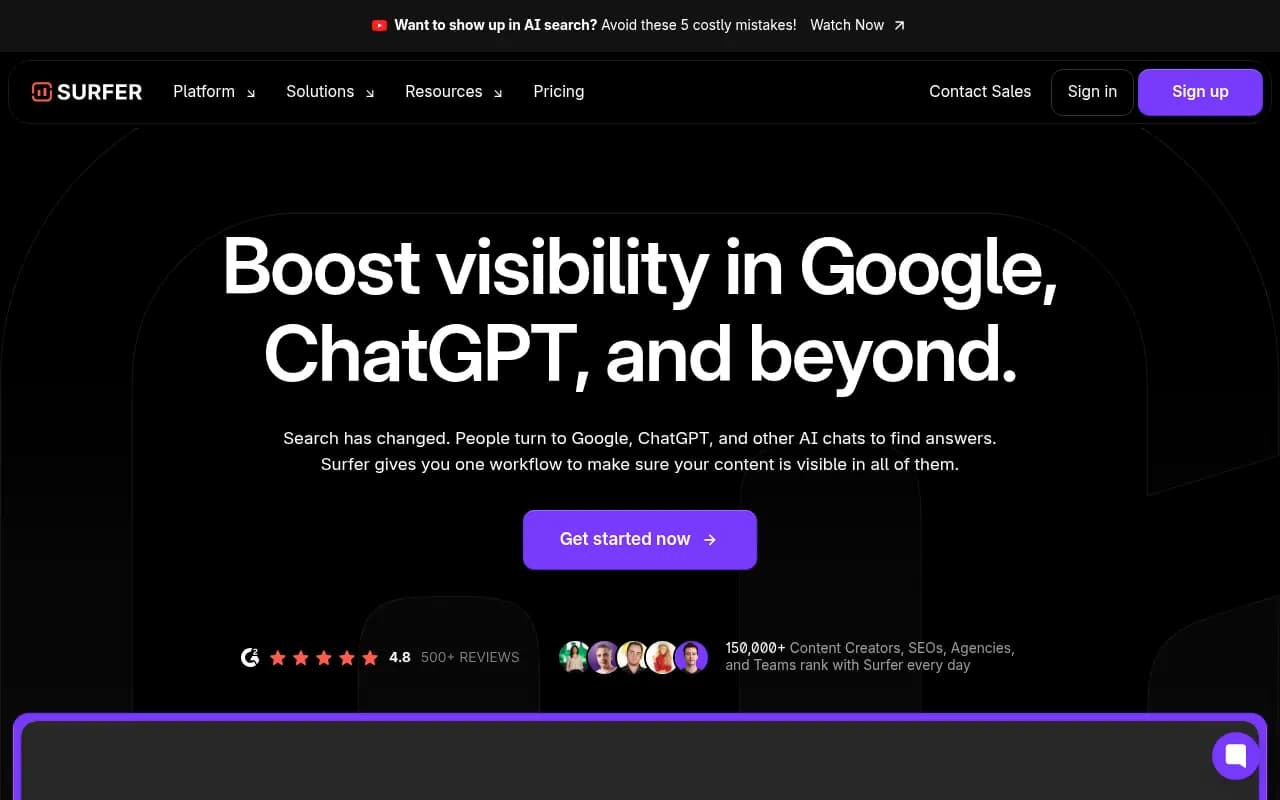
Surfer's Content Editor is the most widely used brief-generation tool in traditional SEO. It analyzes the top 20 results for a keyword, calculates an NLP-based content score, and gives writers a list of terms to include with recommended densities. The brief output includes a suggested structure, word count range, and a real-time score that updates as you write.
Where Surfer is strong: the term recommendations are genuinely useful, and the integration with Google Docs and WordPress means writers can work in their existing environment. Where it falls short: the briefs are more "optimization checklist" than "strategic brief." You get the what, but not much of the why or the angle.
Surfer scored 3 out of 6 pipeline stages in the same Frase comparison — solid for the writing and optimization stages, weaker on research, monitoring, and recovery.
MarketMuse
MarketMuse takes a different approach. Instead of brief-per-keyword, it builds content strategy at the topic cluster level. It scores your existing content against what it calls "topic authority," identifies gaps across your entire site, and generates briefs that account for your competitive position — not just the SERP.
The briefs include recommended topics to cover, questions to answer, related concepts, and a difficulty score that helps you prioritize. For content teams managing large sites, the cluster-level view is genuinely valuable. You're not just filling individual gaps; you're building authority.
The tradeoff is price. MarketMuse sits at the higher end of the market, and the full brief-generation features are locked behind the more expensive plans. For a small team running a single blog, it's probably overkill.
Content Harmony
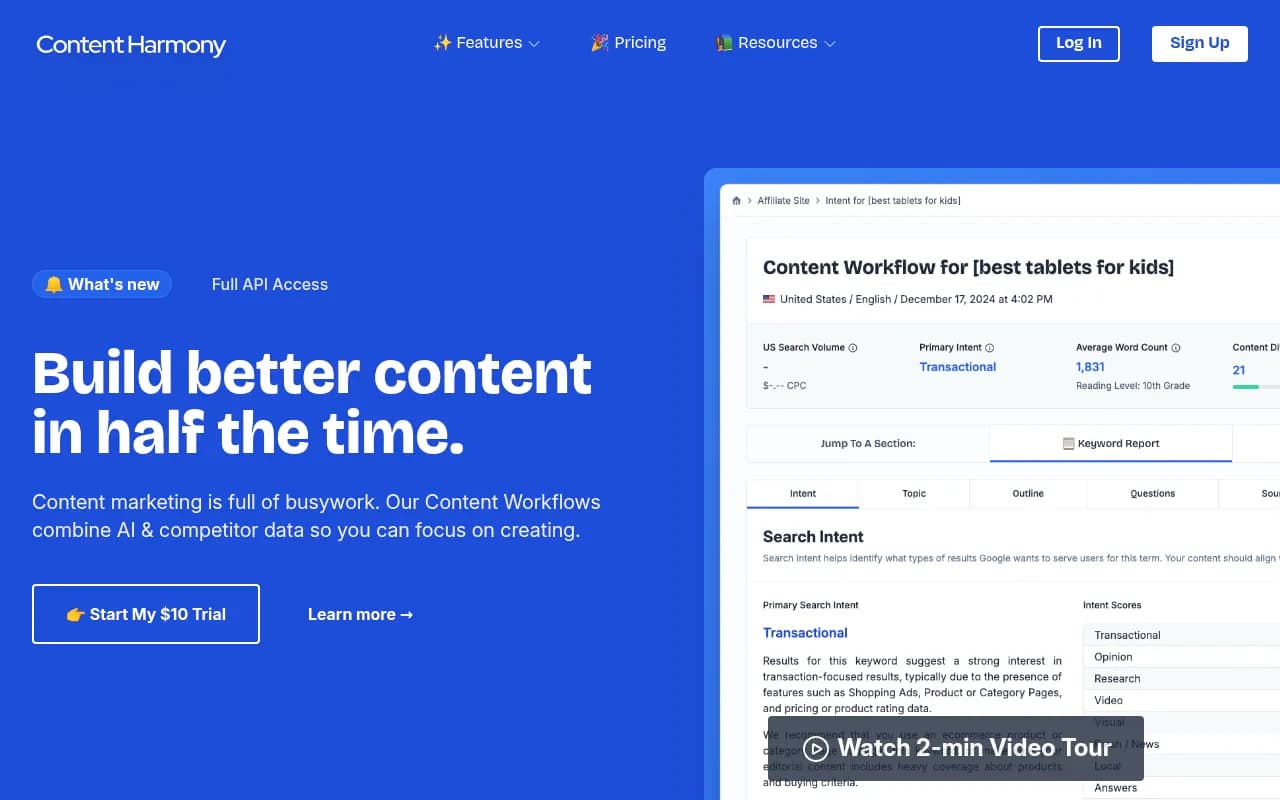
Content Harmony is purpose-built for content brief generation, which makes it unusually focused compared to the all-in-one platforms. You enter a keyword, it analyzes the SERP, and outputs a structured brief with a content angle, recommended headings, questions to answer, and a competitive summary. It also includes search intent classification — whether the query is informational, commercial, or navigational — which helps writers calibrate tone.
The briefs are genuinely writer-ready. They're formatted to hand off directly, not to interpret. For teams that use external writers or freelancers, this matters a lot. A brief that requires explanation isn't a brief.
Clearscope
Clearscope focuses on the optimization side of brief generation. It analyzes top-ranking content and produces a graded report of terms and topics your content should cover. Writers get a real-time grade as they write or paste content in.
It's less "brief" and more "optimization checklist," but for teams with strong editors who can translate a term list into a writing direction, it works well. The Google Docs integration is clean, and the term recommendations are among the most accurate in the market.

SE Ranking
SE Ranking's Content Marketing Platform includes a brief generator that pulls competitor data, suggests headings, and scores content in real time. It's a more affordable option than Surfer or MarketMuse, and the brief quality is solid for the price. The platform also covers keyword research, rank tracking, and site auditing, so teams that want one tool for most of their SEO workflow will find it practical.
Semrush (SEO Content Template + Writing Assistant)
Semrush's SEO Content Template generates a brief based on your target keywords — including recommended semantically related terms, backlink targets, and readability benchmarks. The Writing Assistant then scores your content against those recommendations in real time.
The briefs aren't as deep as Frase or Content Harmony, but Semrush's data advantage (one of the largest keyword databases in the industry) means the competitive context is strong. If your team already lives in Semrush, using the brief tools is a natural extension.
For teams optimizing for AI search, not just Google
Here's where the landscape gets more interesting. Traditional brief generators are built around Google SERPs. They analyze what ranks on page one, reverse-engineer the content structure, and help you match it. That works for Google.
But if your goal is to appear in ChatGPT answers, Perplexity citations, Google AI Overviews, or Gemini responses, the brief requirements are different. AI models don't rank pages the way Google does. They cite sources that answer questions directly, comprehensively, and with clear entity relationships. A brief built from Google SERP analysis won't necessarily tell you how to get cited by an LLM.
This is where Promptwatch takes a different approach. Its Content Agents generate briefs grounded in real prompt data — the actual questions users are typing into AI search engines — combined with answer gap analysis that shows which prompts your competitors are being cited for but you aren't. The briefs include brand guidance, competitor analysis, search result screenshots, and persona targeting based on how your actual customers prompt.
That's a meaningfully different input than "here are the top 20 Google results for this keyword." It's asking: what is the AI model currently saying when someone asks this question, and what would your content need to include to get cited instead?

Comparison table: brief generation features by tool
| Tool | Brief type | Competitor analysis | AI search focus | Persona targeting | Price range |
|---|---|---|---|---|---|
| Frase | Full structured brief | Yes (SERP scrape) | No | No | $15–$115/mo |
| Surfer SEO | Optimization checklist | Yes (NLP terms) | No | No | $89–$219/mo |
| MarketMuse | Cluster-level briefs | Yes (topic authority) | No | No | $149–$399/mo |
| Content Harmony | Writer-ready brief | Yes (SERP summary) | No | No | $99–$299/mo |
| Clearscope | Term optimization report | Yes (term analysis) | No | No | $170+/mo |
| SE Ranking | Structured brief | Yes (competitor pages) | No | No | $65–$259/mo |
| Semrush | Template + checklist | Yes (large database) | Partial | No | $140–$500/mo |
| Promptwatch | AI-prompt-grounded brief | Yes (LLM citations) | Yes (10 AI models) | Yes | $99–$579/mo |
How to choose the right tool for your team
The right choice depends on what you're optimizing for and how your content team works.
If you're a traditional SEO team producing content for Google rankings, Frase or Content Harmony will give you the most complete brief output for the price. Frase is better if your writers need research support; Content Harmony is better if you're briefing external writers who need a clean, self-contained document.
If you're managing a large site with hundreds of pages and need to think about topic authority across clusters, MarketMuse is worth the higher price. The cluster-level view changes how you prioritize content investment.
If your team already uses Surfer or Semrush for other SEO tasks, the built-in brief tools are good enough to avoid adding another subscription. They won't produce the most detailed briefs, but they're integrated and fast.
If your goal is visibility in AI search — getting cited by ChatGPT, Perplexity, or Google AI Overviews — none of the traditional brief generators are built for that. They're analyzing the wrong data source. Promptwatch is the only platform in this comparison that generates briefs from actual AI prompt data and citation gaps, which is a fundamentally different starting point.
The workflow question most teams skip
One thing that rarely gets discussed: brief generation is only valuable if it connects to your publishing workflow. A brief that lives in a separate tool and has to be copy-pasted into a Google Doc, then reformatted for your CMS, then tracked in a spreadsheet, creates friction that teams quietly stop using.
The best setups have the brief tool integrated with where writers actually work. Frase has a built-in editor. Surfer integrates with Google Docs and WordPress. Clearscope works inside Google Docs. Semrush's Writing Assistant runs as a browser extension.
Promptwatch's Content Agents output briefs that feed into its broader content pipeline — from gap identification through to tracking which pages AI models start citing after you publish. That closed loop (find gap, generate brief, publish, track citation) is harder to replicate by stitching together separate tools.
A note on "AI-generated briefs" vs. "briefs for AI search"
These are two different things that often get conflated.
Most tools in this guide use AI to generate the brief — they use language models to summarize competitor content, suggest headings, and cluster related topics. That's useful, but it's a generation method.
Briefs for AI search are briefs designed to produce content that gets cited by AI models. The inputs are different (prompt data, LLM citation patterns, answer gap analysis), and the outputs are different (content structured to answer questions directly, with clear entity relationships and authoritative sourcing).
If you're trying to rank in Google, the first category is what you need. If you're trying to appear in AI-generated answers, you need the second. Most teams in 2026 need both, which is why platforms that bridge traditional SEO brief generation with AI search optimization are becoming more valuable.
Bottom line
The tools that actually brief your writers — rather than just flagging gaps — are Frase, Content Harmony, MarketMuse, and Surfer SEO for traditional SEO workflows. Each has a different strength: Frase for research depth, Content Harmony for writer-readiness, MarketMuse for cluster strategy, Surfer for optimization scoring.
For teams that need briefs grounded in AI search behavior rather than Google SERPs, Promptwatch's Content Agents are the only option in this comparison built specifically for that use case. The distinction matters more than it did a year ago, because AI search is no longer a secondary channel for most brands.
Pick the tool that matches where your traffic is coming from — and where you want it to come from next.