Key takeaways
- Most AI visibility tools track brand mentions using a single, generic set of prompts — they don't account for how different buyer personas actually phrase their questions to AI models.
- Persona-based tracking matters because a CFO, a developer, and a procurement manager will all prompt ChatGPT differently, and your brand may appear (or disappear) depending on who's asking.
- A small number of platforms — including Promptwatch, Scrunch AI, and Profound — offer meaningful persona customization. Most others don't.
- The best approach combines persona-specific prompt sets, multi-model coverage, and content gap analysis so you can fix visibility problems, not just observe them.
- If you're choosing a platform in 2026, the persona feature alone isn't enough — you need to know what to do when a persona isn't seeing your brand.
Why persona-based tracking is a different problem than basic AI monitoring
Most AI visibility tools work like this: you enter a list of prompts, the tool runs them across ChatGPT, Perplexity, Gemini, and a few others, and you get a report showing how often your brand appears. That's useful. But it misses something important.
Real buyers don't all ask the same questions. A VP of Finance evaluating a new SaaS tool asks ChatGPT something like "what's the most cost-effective enterprise contract management software?" A developer on the same buying committee asks "which contract management tools have the best API?" A procurement manager asks "which vendors are SOC 2 compliant and integrate with SAP?"
Three people, one buying decision, three completely different prompts. If you're only tracking one generic set of queries, you might look visible when you're actually invisible to the people who matter most.
This is the core problem that persona-based AI visibility tracking is designed to solve. It's not just about knowing whether your brand shows up — it's about knowing whether it shows up for the right people asking the right questions.
The category is still maturing. Some platforms have built genuine persona simulation into their core product. Others have bolted on a basic "custom prompt" feature and called it persona tracking. The difference matters a lot in practice.
What to look for in a persona-based AI visibility platform
Before comparing tools, it helps to know what "persona-based tracking" actually requires. There are a few distinct capabilities:
Custom prompt sets per persona. The most basic requirement. You need to be able to define different prompt libraries for different buyer types — not just one master list.
Role and context simulation. Some tools let you configure the persona's context more deeply: their job title, industry, location, or even the phrasing style they'd use. This produces more realistic results than just swapping out keywords.
Multi-model coverage. A CFO might use ChatGPT. A developer might use Perplexity or Claude. Tracking across 5-10 AI models matters if you want to understand persona-level visibility accurately.
Segment-level reporting. It's not enough to run persona-specific prompts — you need to see the results broken out by persona, not lumped together in a single share-of-voice number.
Content gap analysis tied to personas. The real payoff comes when you can see which prompts a specific persona is running where you're invisible, then understand what content would fix that. This is where most tools fall short.
Volume and difficulty data. Not all persona prompts are equal. Some are asked by thousands of buyers; others are niche. Knowing which persona-specific gaps are worth closing first requires prompt volume data.
The platforms that actually support persona-based tracking
Promptwatch
Promptwatch is the most complete option for teams that want to go beyond monitoring and actually fix persona-level visibility gaps.

The platform lets you configure custom personas with specific prompts, locations, and languages — so you can track how AI models respond to a mid-market IT buyer in Germany versus an enterprise procurement lead in the US. That's not just a cosmetic feature. It changes the data you get back.
What sets Promptwatch apart from most persona-tracking tools is what happens after you identify a gap. The Answer Gap Analysis shows exactly which prompts your competitors are visible for but you're not, broken down by persona if you've set them up that way. Then the Content Agents can generate articles, comparisons, or briefs specifically engineered to close those gaps — grounded in real prompt data, not guesswork.
The AI Crawler Logs are also relevant here: you can see which pages AI models are actually reading when they respond to persona-specific queries, which tells you whether your content is even being considered before it gets cited.
Pricing starts at $99/month (Essential), with the Professional plan at $249/month adding crawler logs and state/city-level tracking — useful if your personas vary by geography.
Scrunch AI
Scrunch AI has built persona-based monitoring into its core product in a way that's worth noting. According to GrowthOS's 2026 roundup, Scrunch takes a "persona-based approach to LLM monitoring, allowing you to track how AI responds to queries from different audience segments." That's a meaningful differentiator in a category where most tools treat all prompts as equivalent.
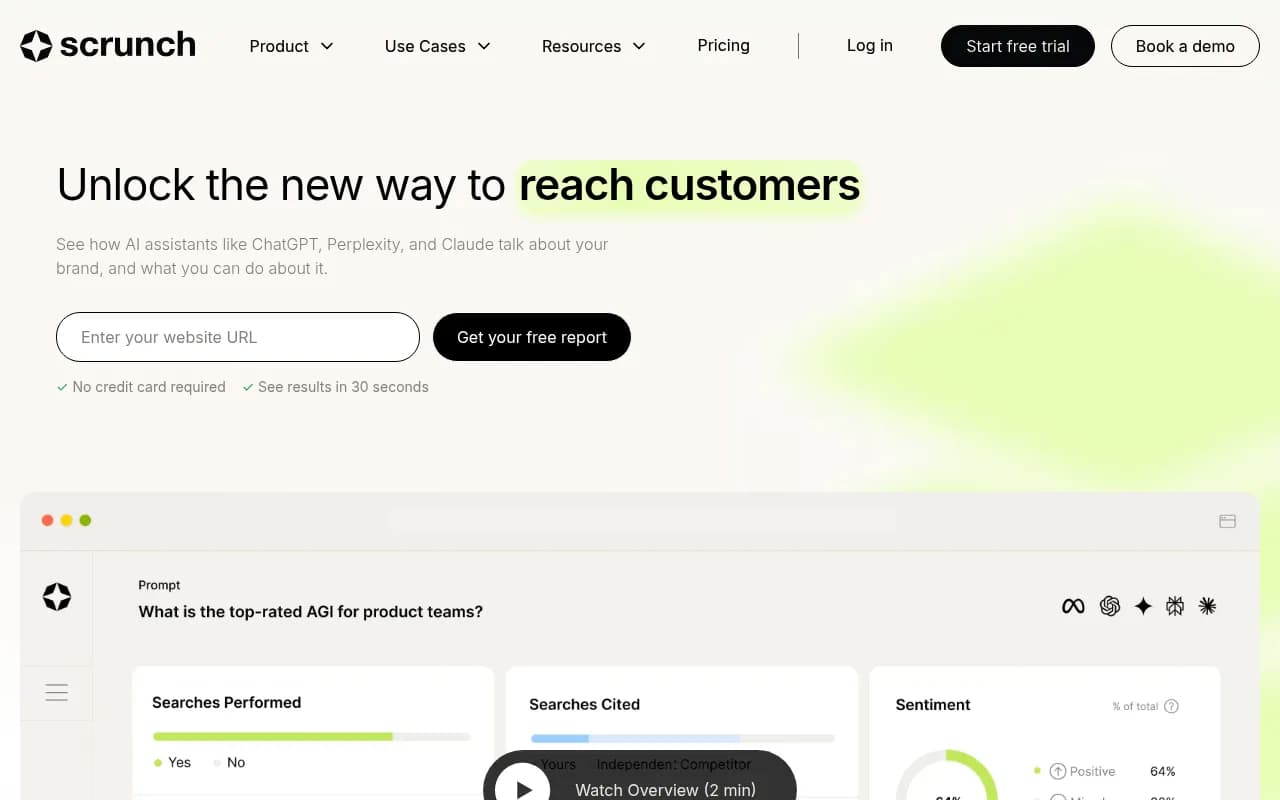
Scrunch is positioned more toward monitoring than optimization — it shows you what's happening by persona but doesn't have the same content generation capabilities as Promptwatch. For teams that primarily want visibility data and handle content creation separately, that's a reasonable trade-off.
Profound
Profound is one of the more established enterprise platforms in this space, with 400M+ prompt insights and coverage across 10+ AI engines. It supports custom prompt configuration, which you can use to approximate persona-based tracking even if the feature isn't explicitly framed that way.
Profound

The platform scores well on depth of data — sentiment analysis, citation tracking, competitive benchmarking — but it sits at the higher end of the pricing range and is primarily a monitoring tool. You get excellent data about where you stand; you don't get built-in tools to improve it.
Evertune
Evertune positions itself as an enterprise GEO platform and supports custom prompt configuration across multiple AI models. It's aimed at Fortune 500 brands and agencies that need detailed brand perception data alongside visibility metrics.
The platform's strength is breadth of coverage and depth of brand analysis. Persona simulation is possible through custom prompt sets, though it's not as explicitly structured as Promptwatch's persona configuration. Enterprise pricing puts it out of reach for smaller teams.
Peec AI
Peec AI offers flexible model selection and custom prompt tracking, which means you can build persona-specific prompt sets manually. It's a solid mid-market option with coverage across up to 10 AI models and a starting price of €85/month.

The persona functionality here is more DIY than structured — you're essentially creating separate prompt groups and labeling them yourself. That works fine if you're disciplined about it, but there's no native persona reporting layer that breaks out results by buyer type automatically.
Otterly.AI
Otterly.AI is one of the most accessible entry points into AI visibility tracking, starting at $29/month. It supports custom prompts, so persona-based tracking is technically possible.
Otterly.AI

The honest caveat: Otterly is a monitoring tool. It tracks four AI models at the base tier, doesn't have crawler logs, and doesn't have content generation. For a small team that wants to manually set up persona prompt groups and check in on visibility, it works. For teams that want automated persona reporting and content recommendations, it's not the right fit.
SE Ranking (SE Visible)
SE Ranking's AI visibility module (SE Visible) supports multi-brand and multi-country tracking, which is useful for persona work that varies by geography or market segment.
Like most of the tools in this category, SE Visible is primarily a monitoring platform. The persona angle requires manual prompt organization. The integration with SE Ranking's broader SEO toolkit is a plus for teams that want traditional and AI visibility data in one place.
Comparison table: persona-based AI visibility platforms
| Platform | Explicit persona config | Multi-model coverage | Content gap analysis | Content generation | Starting price |
|---|---|---|---|---|---|
| Promptwatch | Yes (personas + locations) | 10+ models | Yes | Yes (AI Content Agents) | $99/mo |
| Scrunch AI | Yes (audience segments) | Multiple | Limited | No | Custom |
| Profound | Custom prompts (manual) | 10+ models | Limited | No | $99/mo |
| Evertune | Custom prompts (manual) | Multiple | Limited | No | Enterprise |
| Peec AI | Custom prompts (manual) | Up to 10 | No | No | €85/mo |
| Otterly.AI | Custom prompts (manual) | 4 (base) | No | No | $29/mo |
| SE Visible | Custom prompts (manual) | 5 | No | No | $99/mo |
How to actually set up persona-based tracking
The mechanics differ by platform, but the underlying approach is the same. Here's how to do it properly.
Step 1: Define your buyer personas with specificity
Generic personas don't produce useful data. "IT decision-maker" is too broad. "Director of IT Infrastructure at a 500-person manufacturing company evaluating cloud migration tools" is specific enough to generate realistic prompt variations.
For each persona, document:
- Their job title and function
- The stage of the buying journey they're typically in when they use AI search
- The language they'd use (technical vs. business-oriented)
- The specific questions they'd ask an AI model
Step 2: Build persona-specific prompt sets
Take each persona's questions and turn them into 10-20 trackable prompts. These should reflect how that person actually talks, not how your marketing team describes your product.
A CFO persona might generate prompts like:
- "What's the ROI of [category] software for mid-market companies?"
- "Which [category] vendors offer transparent pricing?"
- "What are the hidden costs of [category] implementation?"
A developer persona from the same company might generate:
- "Does [category] software have a REST API?"
- "Which [category] tools integrate with Kubernetes?"
- "What are the rate limits on [category] API calls?"
Step 3: Run across multiple AI models
Different personas may use different AI tools. Developers skew toward Perplexity and Claude. Executives often use ChatGPT. Run your persona prompts across at least 3-4 models to get a realistic picture.
Step 4: Identify the gaps by persona
Once you have data, the question isn't just "where am I invisible?" — it's "which persona can't find me, and on which AI model?" That specificity tells you exactly what content to create and where to publish it.
Step 5: Create content that closes persona-specific gaps
This is where most teams get stuck. They have the data but not the workflow to act on it. Tools like Promptwatch's Content Agents can generate content briefs and articles tied to specific prompt gaps — which means you're not writing generically for "AI search" but specifically for the questions a CFO asks Perplexity on a Tuesday afternoon.
The tools that don't support persona tracking (and when that's fine)
Many solid AI visibility tools don't have persona features at all. That's worth being honest about.
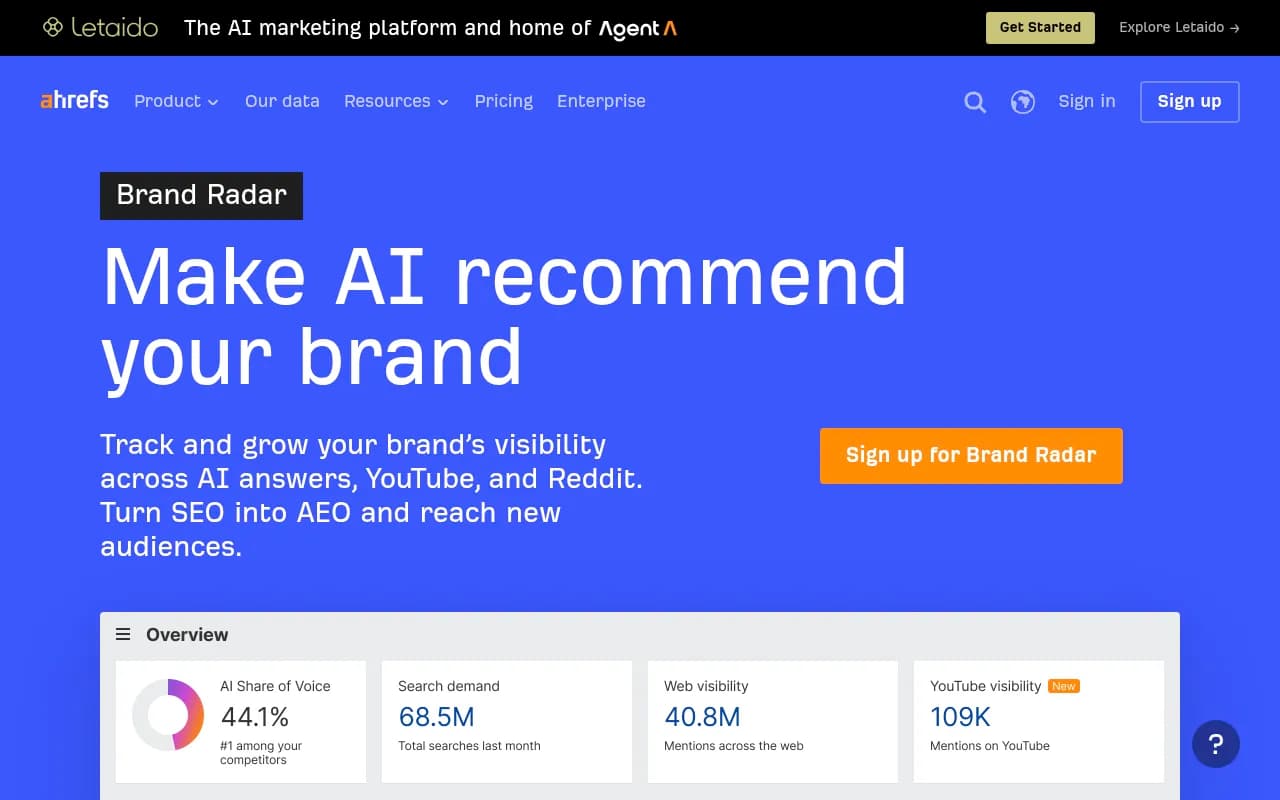
Ahrefs Brand Radar uses fixed prompts, which means you can't customize by persona. It's useful for broad brand visibility benchmarking but not for persona-level analysis.
Semrush's AI Toolkit also uses fixed prompts. Great for teams already in the Semrush ecosystem who want a quick read on AI visibility, but not designed for persona simulation.
Nightwatch combines traditional rank tracking with AI visibility monitoring. Custom prompts are supported, so persona tracking is possible with manual setup, but there's no native persona reporting layer.
For teams with simple use cases — one product, one audience, one market — these tools are perfectly adequate. Persona-based tracking becomes important when you have multiple buyer types, multiple markets, or a complex B2B buying committee where different stakeholders use AI differently.
What the data actually tells you
Here's a concrete example of why persona tracking changes the picture.
Suppose you're a B2B cybersecurity vendor. You run a standard set of prompts and see 40% brand mention rate across ChatGPT and Perplexity. Looks decent.
Then you break it down by persona. Your CISO-targeted prompts ("best enterprise endpoint security for financial services") show 65% mention rate. But your DevSecOps-targeted prompts ("which security tools integrate with GitHub Actions CI/CD pipelines") show 8% mention rate.
Without persona tracking, you'd think you're doing fine. With it, you know you have a specific gap with a technical buyer who influences the purchase decision. That's a very different strategic situation.
The fix isn't to "create more content." It's to create specific content that answers the exact questions DevSecOps engineers are asking AI models — and to make sure that content gets crawled and cited. That's the loop that persona-based tracking enables.
Choosing the right platform for your situation
If you're a marketing or SEO team that wants to track and improve AI visibility across multiple buyer personas, Promptwatch is the most complete option in 2026. It's the only platform that combines structured persona configuration, multi-model tracking, content gap analysis, and AI content generation in one workflow.
If you're primarily a monitoring shop and handle content strategy separately, Scrunch AI or Profound are worth evaluating — both have meaningful persona or custom prompt capabilities without the content generation layer.
If you're just getting started and want to test the concept before committing to a full platform, Otterly.AI or Peec AI let you manually set up persona prompt groups at a lower price point.
The key question to ask any vendor: "Can I see visibility data broken out by persona, not just by prompt?" If the answer is "you can filter by prompt group," that's manual persona tracking. If the answer is "yes, we have native persona reporting," that's the real thing. In 2026, very few platforms can honestly say the latter.