Key takeaways
- AirOps is a solid content engineering platform, but it doesn't track how your brand appears in AI search engines like ChatGPT, Perplexity, or Google AI Overviews.
- The best alternatives in 2026 either add AI citation tracking on top of content creation, or combine both in a single platform.
- Most "GEO tools" only monitor — they show you where you're invisible but don't help you fix it. The tools worth paying for close that loop.
- If AI search visibility is your priority, look for platforms with citation analysis, content gap detection, and actual content generation grounded in real citation data.
- Pricing ranges from free tiers to $500+/month for enterprise platforms, so there's a realistic option for most team sizes.
AirOps built its reputation as a content engineering platform: you connect your data, build AI workflows, and produce content at scale. It's genuinely useful for teams that need to systematize how they write and publish.
But here's the problem. In 2026, "content at scale" isn't enough on its own. The question isn't just whether you're publishing — it's whether ChatGPT, Perplexity, Claude, and Google AI Overviews are actually citing your content when users ask questions in your category. AirOps doesn't answer that question. It has no AI citation tracking, no visibility scoring across LLMs, and no way to tell you which prompts your competitors are winning that you're not.
That's the gap this guide addresses. The nine alternatives below either add that AI visibility layer, combine it with content creation, or do both better than AirOps for specific use cases.
What to look for in an AirOps alternative
Before jumping into the list, it's worth being clear about what actually matters here. Most teams evaluating AirOps alternatives are looking for one or more of these:
- Citation tracking across AI engines (ChatGPT, Perplexity, Gemini, etc.)
- Content gap analysis — which prompts are competitors winning that you're not?
- Content generation grounded in real citation data, not generic SEO signals
- Traffic attribution from AI search to actual revenue
- Competitive visibility benchmarking
The tools below are grouped loosely by what they do best. Some are pure AI visibility trackers. Some are content creation platforms. A few do both.
The 9 best AirOps alternatives in 2026
1. Promptwatch — best for closing the full loop from gap to content to results
Promptwatch is the most complete alternative if your goal is to actually improve your AI search visibility, not just measure it. Most GEO tools stop at the monitoring step — they show you a dashboard of where you're invisible and leave you to figure out the rest. Promptwatch is built around what happens after you see the data.

The core workflow: Answer Gap Analysis identifies which prompts competitors are being cited for that you're not. Then the built-in AI writing agent generates articles, listicles, and comparisons grounded in 880M+ citations analyzed — content engineered to get cited by AI models, not just ranked in blue links. Then page-level tracking shows you exactly which new pages are getting picked up, by which models, and how often. Traffic attribution (via code snippet, GSC integration, or server log analysis) connects that visibility to actual revenue.
It also has features most competitors don't touch: real-time AI crawler logs showing which pages ChatGPT and Perplexity are actually reading, Reddit and YouTube citation tracking, ChatGPT Shopping monitoring, and prompt volume/difficulty scoring so you know which prompts are worth targeting.
Covers 10 AI models including ChatGPT, Claude, Perplexity, Gemini, Grok, DeepSeek, Copilot, and Google AI Overviews. Pricing starts at $99/month.
Best for: Marketing and SEO teams that want to move from "we know we're invisible" to "we fixed it and can prove it."
2. Surfer SEO — best for on-page content optimization
Surfer is the most established tool in the content optimization category. It analyzes top-ranking pages for a given keyword and gives you a content score based on how well your draft matches the patterns of what's ranking. The workflow is fast and the feedback is concrete.
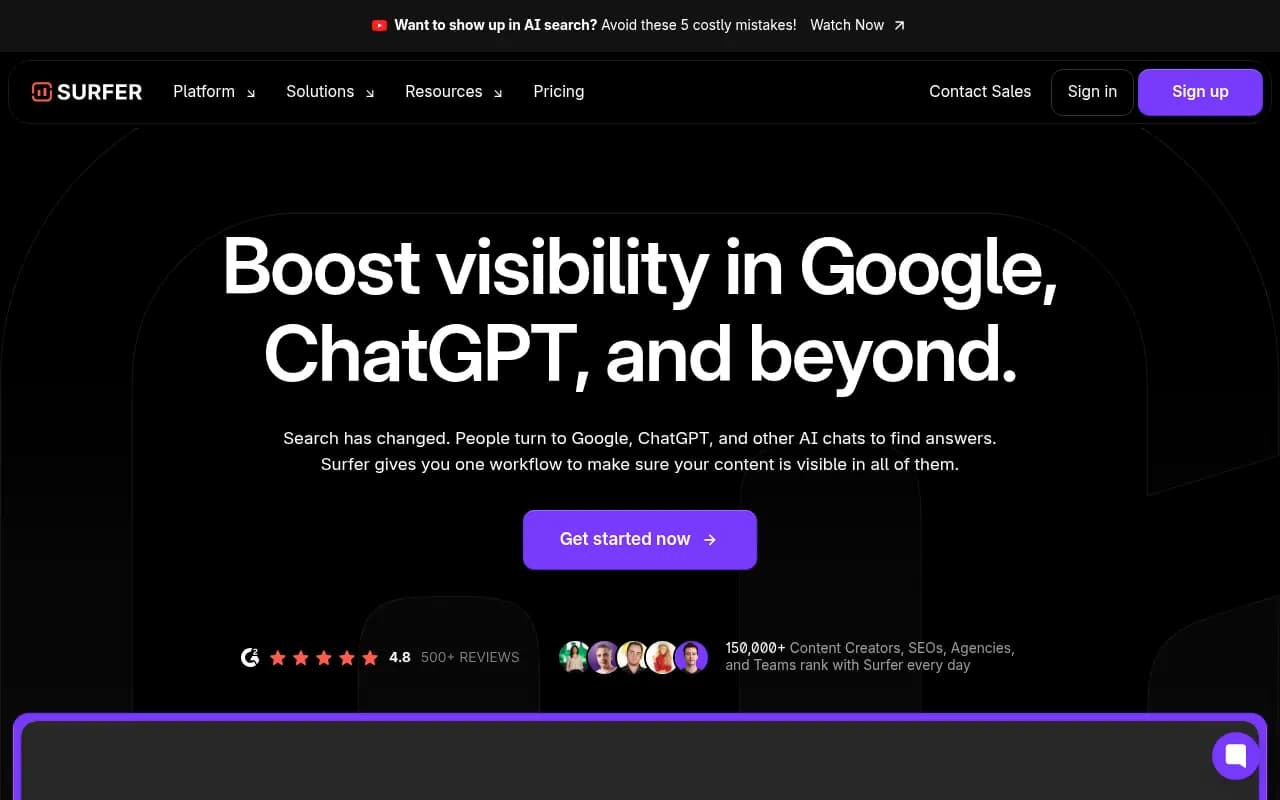
What it doesn't do: track AI citations. Surfer optimizes for Google rankings, not for whether Perplexity or ChatGPT will cite your page. If you're a team that still primarily cares about traditional search with some AI search awareness, Surfer is a strong choice. If AI citation tracking is your main need, you'll want to pair it with something else or look further down this list.
Best for: Content teams optimizing for Google rankings who want a proven, well-supported tool.
3. Semrush — best for teams that want everything in one traditional SEO platform
Semrush has added AI search features over the past year, but its core strength is still traditional SEO: keyword research, rank tracking, site audits, backlink analysis, and competitive intelligence. The breadth is hard to match.
The AI search features are real but limited compared to dedicated GEO platforms. Semrush uses fixed prompt sets rather than letting you define your own, and there's no AI traffic attribution. For teams that live in Semrush already and want basic AI visibility data without adding another tool, it's a reasonable choice. For teams where AI search is the primary focus, it's not deep enough.
Best for: SEO teams already on Semrush who want to add basic AI visibility without switching platforms.
4. Jasper — best for high-volume marketing content production
Jasper has evolved from a simple AI writer into a more complete marketing platform with agents, brand voice controls, and content pipelines. If you're producing large volumes of marketing copy — emails, social posts, landing pages, blog drafts — Jasper's workflow tooling is mature and the output quality is consistently good.
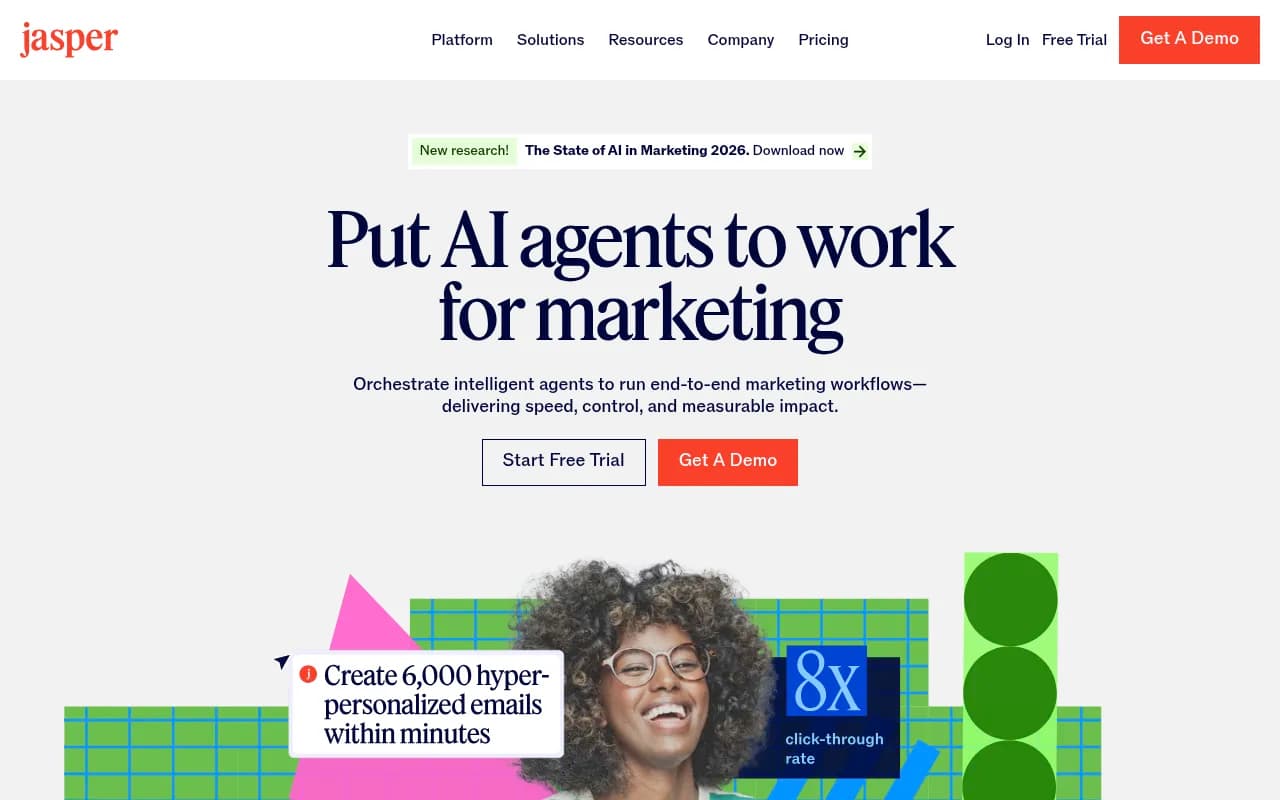
The gap: Jasper doesn't track AI citations or tell you what content to create based on where you're invisible in AI search. It's a production tool, not a strategy tool. If you know what you need to write and just need to write a lot of it efficiently, Jasper delivers. If you need to figure out what to write based on AI citation gaps, you need something else first.
Best for: Marketing teams with high content volume needs and established content strategy.
5. MarketMuse — best for content strategy and topic authority
MarketMuse takes a different angle from most content tools: it focuses on topic authority rather than individual keyword optimization. It analyzes your existing content, identifies gaps in your coverage of a topic area, and recommends what to create to build authority.
This approach maps reasonably well to how AI models evaluate sources — they tend to cite sites that cover a topic comprehensively, not just sites that rank for individual keywords. So MarketMuse's topic modeling is more aligned with AI search than pure keyword tools. But it still doesn't directly track AI citations or tell you which prompts competitors are winning.
Best for: Content strategists building long-term topic authority, especially at enterprise scale.
6. Frase — best for research-heavy content briefs
Frase is built around the research and briefing phase of content creation. It pulls together what's ranking, what questions people are asking, and what competitors are covering, then helps you build a brief and write against it. The SERP analysis is fast and the brief quality is solid.
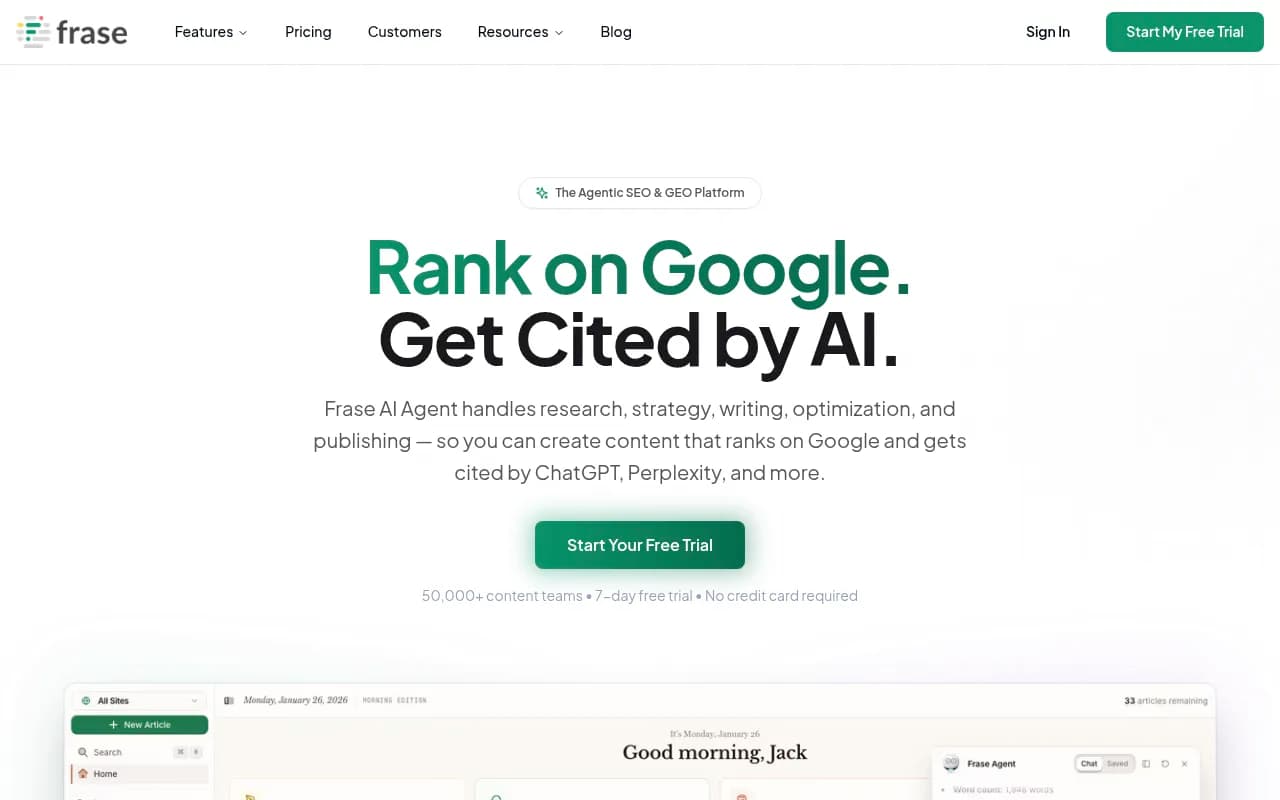
Like most content tools, Frase is Google-focused. It doesn't track AI model citations or help you understand why Perplexity is citing a competitor instead of you. But for teams that spend a lot of time on content research and briefing, it cuts that time significantly.
Best for: Writers and content managers who want faster, more structured research and briefing.
7. Clearscope — best for enterprise content quality control
Clearscope is the go-to tool for enterprise content teams that need to maintain quality and consistency at scale. It integrates with Google Docs and WordPress, gives writers real-time feedback on content relevance, and makes it easy to enforce standards across a large team.

It's polished, reliable, and well-supported. The limitation is the same as most content optimization tools: it optimizes for Google, not AI search engines. If you're running a content team of 10+ people and need a quality control layer, Clearscope is hard to beat for that specific job.
Best for: Enterprise content teams that need scalable quality control for Google-focused content.
8. Atomic AGI — best for AI-native SEO workflows
Atomic AGI is a newer platform that combines multi-engine AI tracking with workflow automation. It's positioned as an AI-native SEO platform, meaning it's built from the ground up for the current environment rather than retrofitting AI features onto a traditional SEO tool.
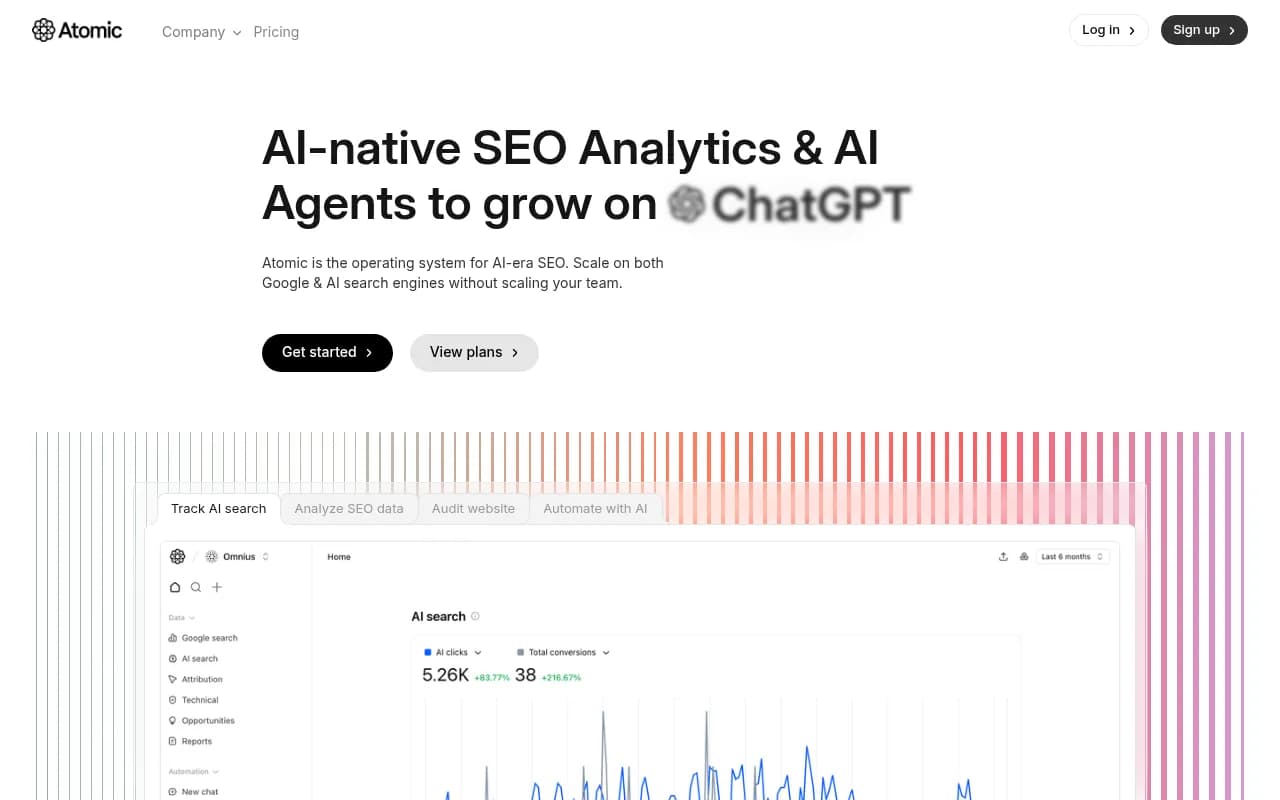
The tracking covers multiple AI engines and the workflow automation lets you build custom processes around the data. It's worth evaluating if you want a platform that treats AI search as the primary use case rather than an add-on. The ecosystem is less mature than established players, but the architecture is more forward-looking.
Best for: Technical SEO teams that want to build custom AI search workflows.
9. Search Atlas — best for combining AI automation with traditional SEO
Search Atlas has built a reputation for combining AI-powered content generation with traditional SEO features. It can research, write, and publish content, and it has rank tracking features that cover both traditional and AI search.

The platform is ambitious in scope — it tries to cover a lot of ground. For teams that want a single tool handling both traditional SEO and some AI search visibility, it's worth a look. The depth on AI citation tracking specifically isn't as strong as dedicated GEO platforms, but the breadth is useful for teams that don't want to manage multiple tools.
Best for: Small to mid-size teams that want one platform covering traditional SEO and basic AI search.
Side-by-side comparison
| Tool | AI citation tracking | Content generation | Content gap analysis | AI traffic attribution | Traditional SEO | Starting price |
|---|---|---|---|---|---|---|
| Promptwatch | Yes (10 models) | Yes (AI writing agent) | Yes | Yes | No | $99/mo |
| Surfer SEO | No | Yes (AI assist) | Partial (Google) | No | Yes | ~$89/mo |
| Semrush | Basic | Yes (ContentShake) | Partial | No | Yes | $139/mo |
| Jasper | No | Yes | No | No | No | $49/mo |
| MarketMuse | No | Yes | Yes (topic gaps) | No | Partial | $149/mo |
| Frase | No | Yes | Partial | No | Partial | $45/mo |
| Clearscope | No | No | No | No | Partial | $189/mo |
| Atomic AGI | Yes | Yes | Partial | No | Yes | Custom |
| Search Atlas | Partial | Yes | Partial | No | Yes | ~$99/mo |
The real question: monitoring vs. optimization
One thing worth saying directly: there's a meaningful difference between tools that monitor AI visibility and tools that help you improve it.
Most GEO tools launched in 2024-2025 are monitoring dashboards. They show you a share-of-voice score, a list of prompts where competitors appear and you don't, and maybe a sentiment breakdown. That data is useful. But it doesn't tell you what to do next, and it doesn't help you do it.
The tools that are actually moving the needle for marketing teams in 2026 are the ones that close the loop: find the gap, create content designed to fill it, track whether that content gets cited, and connect citations to revenue. That's a harder product to build, which is why most platforms haven't done it.
If you're evaluating AirOps alternatives purely for content production, Jasper, Surfer, or Frase will likely serve you well depending on your workflow. If you're evaluating because you want to understand and improve your AI search visibility, the list narrows considerably.
How to choose
A few questions that should guide your decision:
Do you already know what content to create? If yes, a production-focused tool like Jasper or Surfer is probably sufficient. If no — if you need to figure out which topics and prompts to target based on where competitors are winning — you need a platform with citation and gap analysis built in.
Is AI search a primary channel or a secondary one? If your traffic and leads still come primarily from Google, a traditional SEO tool with some AI features (Semrush, Search Atlas) might be enough for now. If AI search is already driving meaningful traffic or you're in a category where AI recommendations matter, a dedicated GEO platform is worth the investment.
Do you need to prove ROI? If someone is going to ask you to justify the spend, you need traffic attribution. Most monitoring-only tools can't connect AI citations to actual visits or conversions. Promptwatch's attribution features (GSC integration, server log analysis, code snippet) are specifically designed for this.
What's your team size and budget? Frase and Surfer are accessible for small teams. MarketMuse and Clearscope are better suited to larger content operations. Promptwatch's $99/month entry point is reasonable for a single site with 50 prompts, scaling up from there.
Bottom line
AirOps is a capable content engineering platform, but it was built for a world where "good content" meant "content that ranks on Google." That world still exists, but it's no longer the whole picture.
The alternatives above cover the full spectrum from pure content production to full-stack AI visibility optimization. Which one fits depends on where your traffic comes from, how much you care about AI citations specifically, and whether you need to show results or just show data.
If you want to start with the most complete option — one that finds your gaps, helps you create content to fill them, and tracks whether it worked — Promptwatch is worth evaluating first. Everything else on this list does a subset of that job well.