Key takeaways
- Enterprise is a procurement definition first. SSO, role-based access, audit logs, an API and a support SLA decide whether a tool clears security review, however good the data is.
- Governance features are usually gated by tier. SSO and audit logs often sit on a custom Enterprise plan, not the entry plan, so read the pricing page and the security page together.
- ChatGPT has no stable "position 1". Almost half of responses cite 10 or more domains, so a useful tracker measures share of answer, citations and sentiment across many prompts, not one rank.
- Ask every vendor how a prompt is counted, how often it runs, and whether data comes from the real ChatGPT interface or an API.
- Run a two-week pilot on a few dozen revenue-driving prompts before you sign anything.
What "enterprise" means for a ChatGPT rank tracker
Most reviews of enterprise trackers compare dashboards. That is the wrong place to start. A security team will not care how pretty the chart is if the tool cannot enforce SSO or show who changed a monitor last Tuesday.
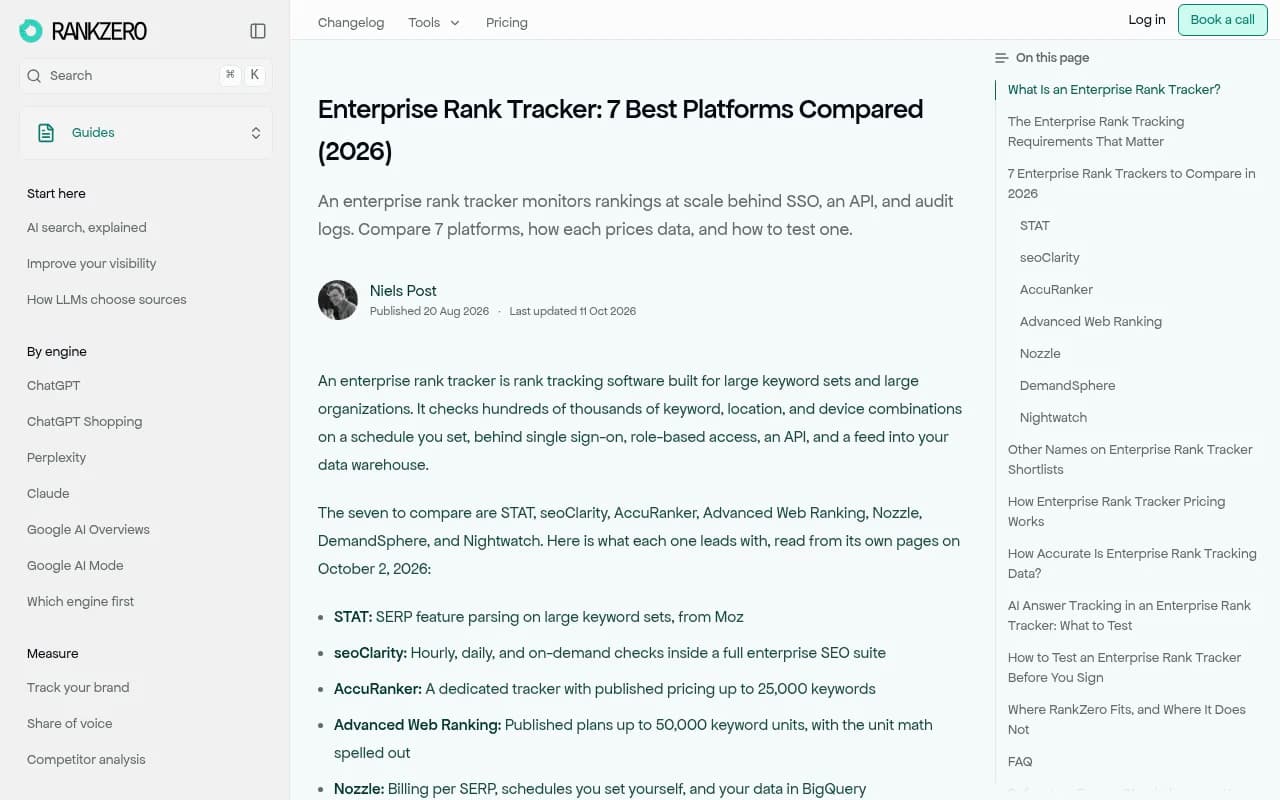
The RankZero guide on enterprise rank trackers puts it well: enterprise is a procurement definition before it is a feature one. I agree with that, and it holds even more for AI search, where the tools are young and the governance features are uneven.
For ChatGPT tracking specifically, I would split the requirements into two lists.
Governance and security:
- SSO through SAML or OIDC, ideally with the option to block password logins
- Role-based access with project-level permissions
- An audit log that shows every change and where it came from (UI, API, or an agent)
- Compliance certifications such as ISO/IEC 27001 or SOC 2, plus GDPR handling
- A support SLA you can put in a contract
Scale and data:
- Enough prompts and responses per month for every market and language you operate in
- Tracking frequency beyond daily when you need it for launches
- An API and export path so history can flow into your warehouse
- Data collected from the real ChatGPT interface, since user-facing answers and citations can differ from API output
Why ChatGPT tracking is not classic rank tracking
A classic rank tracker runs one keyword, in one location, on one device, and records a position. That model breaks down in ChatGPT.
Promptwatch Data shows that 47.6% of ChatGPT responses with citations cite 10 or more unique domains, and 66.1% cite at least eight (Sep 28 to Oct 4, 2026). Only 6% cite three domains or fewer. You can read the full breakdown in Promptwatch's report on unique domains per ChatGPT response. The split by prompt type matters too: organic prompts are the most crowded (52.5% cite 10 or more), while brand-specific prompts are narrower, with 5 domains the most common count.
What that means for a buyer:
- Track your position inside a crowded answer, and which competitors appear next to you, not only whether you were cited.
- Segment prompts into organic, brand-specific and competitor-comparison types, because the source sets differ a lot.
- Measure across many prompts. One prompt tells you almost nothing.
Retrieval behaviour also shifts in steps. Promptwatch's ChatGPT query fanout data shows average fanouts per response falling from 2.15 in early December to about 1.84 by early March, and average fanout query length falling from roughly 117 characters to the high 80s. On August 8, 2026, ChatGPT started using the site: operator at scale, jumping from about 0.4% to about 17% of fanout queries (report). A tracker that does not re-sample continuously and log the date will mislead you after the next change.
The enterprise evaluation checklist
Before you look at any demo, send vendors these questions. The answers sort the field quickly.
Identity and access
Which tier carries SSO? On several products in this category it sits on the Enterprise plan only. Peec AI lists SAML 2.0 SSO on Enterprise with the option to block password logins and require SSO sessions across the app, its MCP server and its Looker Studio connector. AthenaHQ lists SSO, audit logs and a 2-hour SLA on Enterprise, not on its $295 Starter plan. Profound lists SOC 2, SSO and SAML on Enterprise. Verify each against the vendor's own security page, because these details change.
Audit trail
An audit log should record whether a change came from the dashboard, the API, an MCP client or an AI agent. That last part is new. As more teams let agents edit monitors and publish content, you need to know which actor did what.
Counting and sampling
DemandSphere's model, where one prompt counts as 10 keywords, is a useful reminder that vendors count differently. Ask how a prompt is counted, how many responses it generates per run, and whether you can run it every few hours rather than daily.
Data collection method
API-only collection is cheaper for vendors and less faithful for you. Ask directly whether answers come from the live ChatGPT interface in each country and language you care about.
Export and integration
Check for a REST API, a BI connector and CSV export. If the data cannot leave the tool, your history is hostage to the contract.
Comparison table
The table below summarises what the vendors publish about governance. Treat pricing as a starting point and confirm on each pricing page, since several sources I reviewed disagree on figures for some tools.
| Tool | Enterprise governance | Data approach | Best for |
|---|---|---|---|
| Promptwatch | ISO/IEC 27001, GDPR, audit log on Business and above, SSO and white-label portal on Enterprise | Real-UI collection plus crawler logs and visitor analytics | Teams that want tracking and fixing in one product |
| Profound | SOC 2, SSO and SAML on Enterprise | Up to 9 AI platforms on Enterprise | Fast security review, large budgets |
| Peec AI | SAML 2.0 SSO on Enterprise, password-login blocking | Multi-engine prompt tracking | All-in-one monitoring for enterprise marketing |
| AthenaHQ | SSO (SAML, OIDC), audit logs, 2-hour SLA on Enterprise | Monitoring plus drafted follow-up work | BI dashboards and drafted actions |
| Rankscale | Custom plan | Widest engine list, published enterprise price | Teams that need a published number |
| Semrush | Enterprise controls inside a broader SEO suite | AI visibility toolkit as an add-on | Teams already standardised on Semrush |
The tools worth shortlisting
Promptwatch
Promptwatch is the option I would put first for teams that want the whole loop in one place, and I will be upfront that it is the platform 1001 SEO Media uses itself. It monitors ChatGPT, Gemini, Perplexity, Claude, Google AI Overviews, AI Mode, Copilot and others from the real interfaces, then traces which of your pages get cited and which Reddit, YouTube and LinkedIn sources AI relies on. That matters for enterprise, because most trackers stop at a dashboard.

On the governance side, it is ISO/IEC 27001 certified and GDPR compliant with an EU-based data handler, which tends to shorten security reviews. Every plan has unlimited seats, owner/editor/viewer roles with project-level access, scoped API keys, and MCP and API access. Business ($579/mo) adds the organization audit log, which lists every change and whether it came from the dashboard, the API, an MCP client or Agent Chat. Enterprise adds SSO, a white-label dashboard and client portal, a dedicated success manager and 50,000 API/MCP requests per hour.
On scale, Business tracks 350 prompts and 42,000 responses a month and can run monitors every 12, 6 or 1 hours, which is useful during a launch. State and city tracking and local targeting at exact coordinates help multi-location brands. IP-verified AI crawler logs show whether GPTBot and ChatGPT-User can actually read your pages, which separates an access problem from a content problem. Pricing and plan details are at promptwatch.com/pricing. The Promptwatch vs Profound page covers the head-to-head. A practical next step is the 7-day free trial or a demo.
Profound
Profound is the shortest path through a security review according to the SitePoint comparison I reviewed: it lists SOC 2, SSO and SAML on Enterprise and raised a $96M Series C in February 2026, which settles vendor-risk questions quickly. It tracks up to nine AI platforms on Enterprise, including ChatGPT Shopping. The trade-off is price and a monitoring-first posture. Pricing is custom.
Profound

Peec AI
Peec AI gets a strong write-up for enterprise teams, mainly because its SSO is thorough. SAML 2.0, password-login blocking, and SSO enforcement across the app, MCP server and Looker Studio connector is the kind of detail IT teams ask about. It is a solid monitor. Verify what else sits on the Enterprise tier.

AthenaHQ
AthenaHQ puts BI dashboards, audit logs and drafted follow-up work on Enterprise. The gating is the catch: SSO, audit logs and the 2-hour SLA are not on the $295 Starter plan, so budget for the custom tier from day one.

Rankscale
Rankscale publishes an enterprise price, which is rare, and lists the widest engine coverage. Sources I found disagree on its numbers ($99/mo entry in one, $385 Growth and $780 Enterprise in another), so get a current quote.
Semrush and Ahrefs Brand Radar
If your SEO team already lives in Semrush or Ahrefs, adding their AI modules is the low-friction route and inherits the existing SSO setup. The compromise is depth: fixed prompt sets and less AI-specific data than a purpose-built platform.

Evertune, Bluefish and Conductor
For Fortune 500 brands with procurement-heavy buying, Evertune and Bluefish AI position themselves at the top end, and Conductor and BrightEdge add AI tracking to established enterprise SEO suites.
Traditional rank trackers still matter
ChatGPT is one channel. The enterprise trackers in the classic category, such as AccuRanker, Advanced Web Ranking, seoClarity and BrightEdge, still handle the Google organic side with large keyword sets, an API and warehouse feeds. Advanced Web Ranking's published plans, for example, only list SSO on the 50,000-unit plan, which is a good example of how tier gating works in practice.
The Olostep and RankZero guides both make a point I agree with: compare on cost per data point and data portability, not headline keyword counts.
If you want a wider list of GEO platforms to compare, the directory at bestgeosoftware.com is a decent place to browse.
How to run a two-week pilot
A demo shows the best day of a product. A pilot shows the average one.
- Pick 30 to 50 prompts that map to revenue: category searches, comparisons against your top three competitors, and brand questions. Tag them as organic, brand or comparison.
- Run the same prompts manually in ChatGPT from a clean session in your main country. Save screenshots as a control.
- Load them into two shortlisted tools and let them run for 14 days.
- Compare the tool's output with your control. Check mention rate, cited domains and the order of brands.
- Test the governance claims. Turn on SSO with your identity provider, change a monitor, and confirm the audit log shows it with the right actor.
- Pull data through the API into your warehouse or BI tool. If this is painful in a trial, it will be worse in production.
- Ask for the contract terms: SLA, data retention, what happens to history on cancellation.
Which tool for which team
| Situation | Likely fit |
|---|---|
| You want monitoring, content fixes and crawler visibility in one tool | Promptwatch |
| Security review is the main blocker and budget is large | Profound |
| IT wants strict SSO enforcement across every surface | Peec AI |
| You want drafted follow-up work next to BI dashboards | AthenaHQ |
| Your SEO team already runs on Semrush or Ahrefs | Their AI modules, then reassess |
| You need a published enterprise price to get budget approved | Rankscale |
Bottom line
Pick on governance fit first, sampling method second and dashboard third. Shortlist two tools, run the pilot, and make the vendor prove SSO, the audit log and the API in your own environment before the contract is signed. Prices and tier gating in this space move quickly, so confirm every figure on the vendor's own pricing and security pages.
For teams that would rather have an agency run the programme, 1001 SEO Media offers GEO and AI search consulting, and for a broader look at AI rank trackers see ai-rank-tools.com.