Key takeaways
- A weekly cadence means you need a tool that closes the loop from insight to published page, not just a dashboard that says you are invisible.
- Promptwatch's data (Sep 28 to Oct 4, 2026) shows product pages, landing pages and listicles earn most ChatGPT citations, so your weekly queue should lean that way.
- News content decays fast in ChatGPT: half of cited news pages are gone after 36 days. Comparisons, landing pages and docs last far longer.
- Budget trackers like Otterly AI and Peec AI are fine for monitoring. They do not write, refresh or publish anything for you.
- Many "best GEO tools" lists are written by vendors who rank themselves first. Check who published the list before trusting the order.
What a weekly content team actually needs from a GEO tool
Most GEO tool reviews are written for someone buying a dashboard. A content team shipping one to five pieces a week has a different problem. You do not need another chart of mentions. You need to know what to write on Monday, whether last week's piece got picked up, and which old pages are slipping.
That breaks the job into four steps:
- Find the prompts where AI answers cite competitors and not you.
- Turn those gaps into briefs and drafts without a week of research per article.
- Publish on a schedule.
- Check whether the page got crawled, cited and clicked, then refresh what fades.
Most tools cover step 1 and stop. A few cover step 2. Very few cover all four. That is the real dividing line in this category, and it matters more than the number of engines a tool tracks.
Why the cadence should follow what AI cites
Before picking a tool, look at what ChatGPT actually cites. Promptwatch Data (Sep 28 to Oct 4, 2026) found product pages are the most cited content type at 22.4%, with landing pages at 16.8% and listicles at 13.6%. How-tos get 8.7%, comparisons 5.9%, news 5.7%.
It also varies by prompt intent. For commercial prompts, product pages (26.0%), landing pages (20.6%), listicles (15.0%) and comparisons (7.9%) make up almost 70% of citations. For informational prompts, how-tos and docs climb.
Then there is shelf life. In Promptwatch's content half-life study, pages cited on July 6, 2026 were tracked for 90 days:
| Content type | Still cited after 30 days | Still cited after 60 days | Note |
|---|---|---|---|
| Landing pages | 78% | 69% | Real half-life likely beyond 90 days |
| Docs | 76% | 67% | Same |
| Comparisons | 72% | 63% | Strong long-term performer |
| Listicles | n/a | 60% | Crossed 50% only in the final week |
| Product pages, reviews, how-tos | n/a | about 55% | Half-life of 74 to 77 days |
| News | n/a | 41% | Half gone after 36 days |
For a weekly team, the implication is simple. Use news and press content for short bursts. Put most of your effort into comparisons, listicles, landing pages and docs. Put product pages and how-tos on a refresh schedule, since they lose citations at a similar rate. Your GEO tool should make that easy, which is why refresh features matter as much as creation features.
Three kinds of GEO tools
The lists I read while researching this (Olostep, Goodie, Shadow, Nick Lafferty's roundup) all land on roughly the same split, and it holds up.
- Trackers. They run prompts across AI engines and report mentions, citations, sentiment and share of voice.
- Content optimizers. They score a draft against topical coverage and answer structure. They know nothing about whether AI engines cite you.
- Platforms that do both, plus execution. They find gaps, draft content, publish it and measure the result.
A weekly team can run on a tracker plus an optimizer, stitched together by hand. It works, but someone has to carry insight from one tab to the next every single week. That is where cadence tends to break.
Full-loop platforms
Promptwatch
Promptwatch is the one I would put first for a team that publishes weekly, because it is built around the loop above rather than the monitoring part alone. It tracks the real interfaces of ChatGPT, Google AI Overviews, AI Mode, Gemini, Perplexity, Copilot and others, then maps your pages against the prompts AI answers to find content gaps. From there, the Content Agent plans, writes and publishes articles to WordPress, Webflow or Framer on a schedule you set, with a review inbox if you want a human to approve each piece or fully hands-off if you do not.
The part weekly teams tend to miss in other tools is the feedback. Published pages are tracked through IP-verified AI crawler logs, citations and AI-referred traffic, and underperformers come back as items on the Action Board. Content Refresh gives git-diff-style updates for existing pages, which suits the product page and how-to maintenance described above. Crisp reported 2x higher conversion from AI traffic versus traditional channels and scaled to 5 to 10 articles a day using it.
The automated Content Agent is on the Business plan ($579/mo) and Enterprise. Essential ($95/mo) and Professional ($245/mo) include AEO articles and content gap analysis but not the fully automated agent. Confirm current pricing at promptwatch.com/pricing.

AirOps
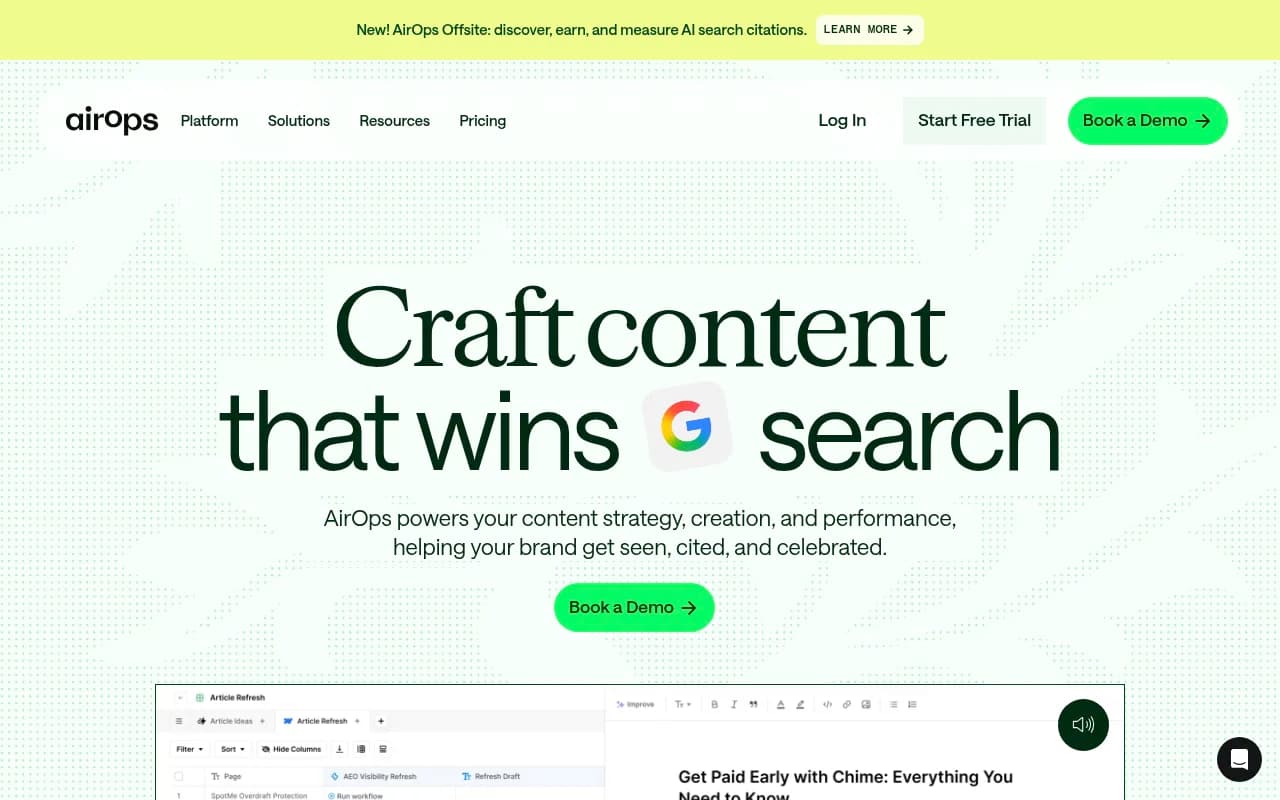
AirOps is a content engineering platform aimed at AI search visibility. It sits closer to the production side: workflows, templates and scaled content generation. If your team already has strong processes and wants to systematize output, it is worth a look. Check what monitoring and crawler-level data it gives you before assuming it can tell you whether a page got cited.
Searchable and Gushwork
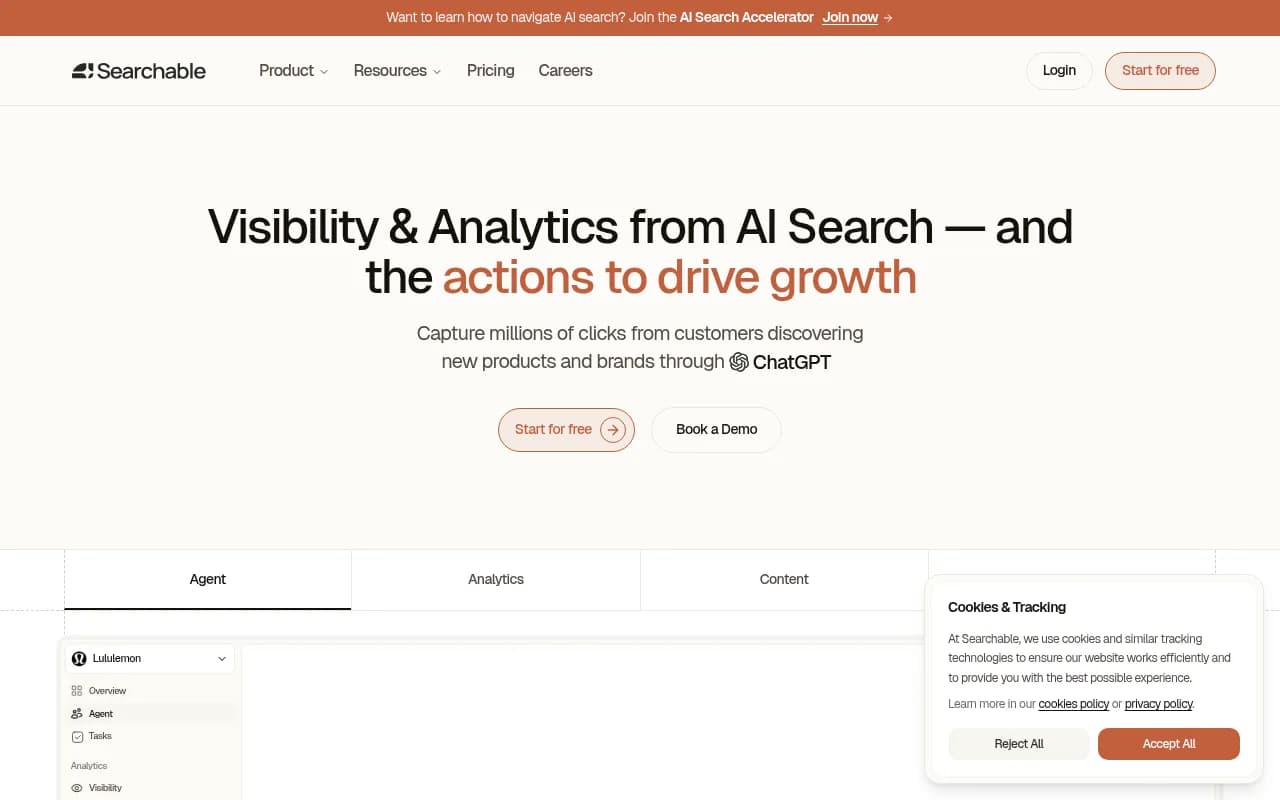
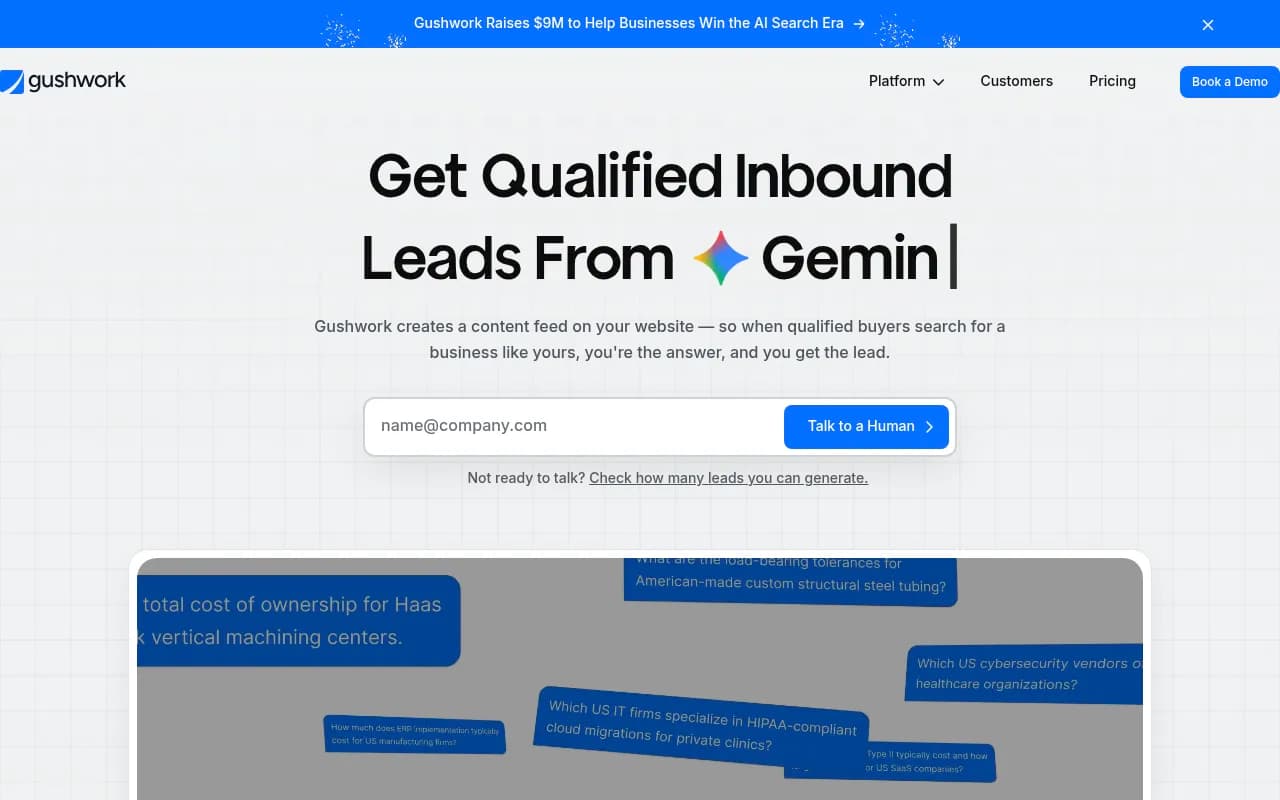
Searchable pairs AI visibility tracking with built-in content generation, and Gushwork is a content engine that generates large volumes of pages. Both are narrower than a full platform. They suit teams that mostly want volume with a light measurement layer.
Gushwork
Trackers worth considering
If you already have a writing process and only need to know where you stand, a tracker is cheaper and simpler. The prices below come from a vendor-authored guide (Goodie, published Oct 22, 2026) and were not re-verified on vendor pages, so check each site before buying.
| Tool | Reported starting price | Good for | Gap for weekly publishers |
|---|---|---|---|
| Otterly AI | $29/mo | Cheap ongoing monitoring | No content creation or publishing |
| Peec AI | about $95/mo | Agencies, multi-market tracking | Monitoring focus |
| Scrunch AI | $250/mo | Brand safety, hallucination detection | Monitoring focus |
| Semrush AI Visibility Toolkit | $99/mo per domain | Teams already on Semrush | Fixed prompt sets, shallow AI-specific data |
| Ahrefs Brand Radar | $199/mo per AI index plus base plan | SEO teams wanting backlink data alongside AI data | Costs add up fast |
| Writesonic | $79/mo | Creation plus light monitoring | Fewer engines tracked |
Otterly.AI





Trackers are honest about what they are. The problem is only that a tracker tells you on Friday that you lost a citation, and then your team still has to work out why, write the fix and ship it. If you are comparing more trackers, the directories at ai-rank-tools.com and bestgeosoftware.com list far more options than I can cover here.
Content optimizers for the drafting step
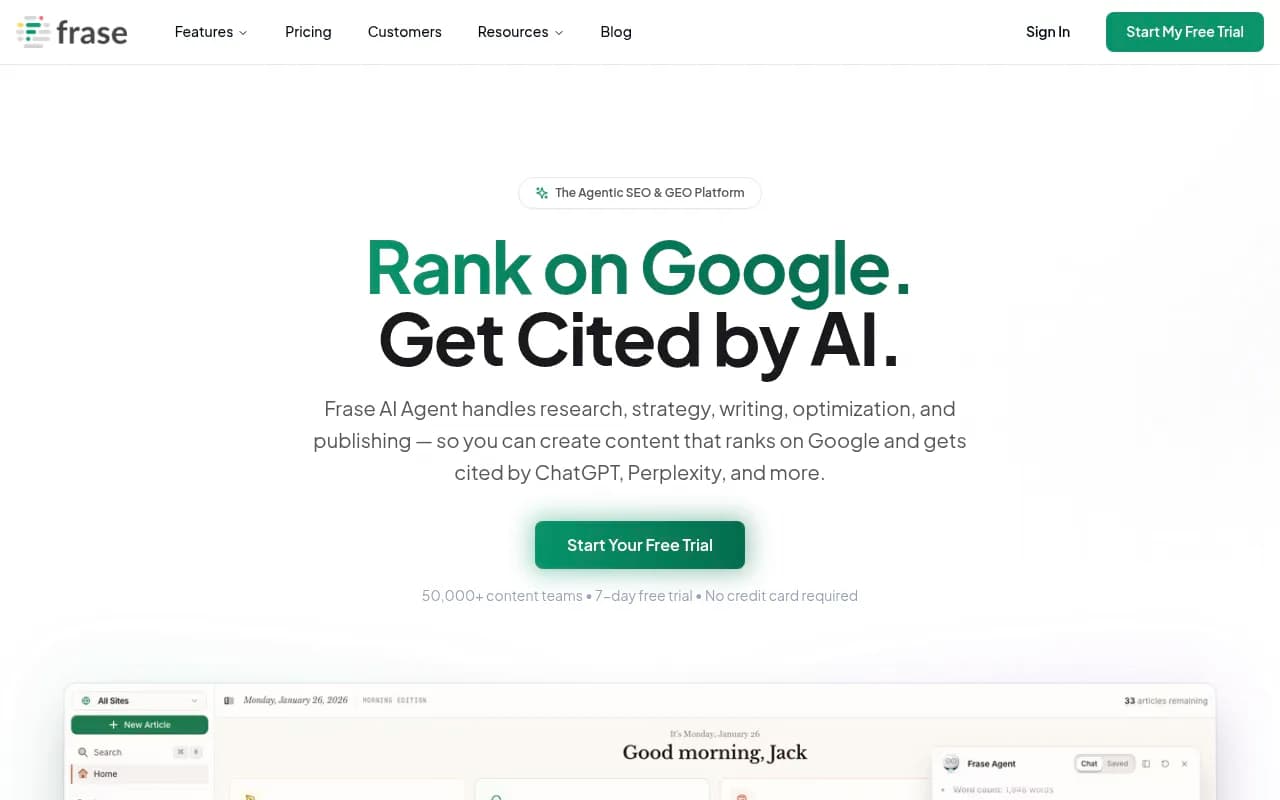
Optimizers do not monitor AI engines at all. They help each draft cover its topic well, which still matters because AI engines pull from pages that answer questions completely. Frase is the one that comes up most in GEO roundups because it scores answer structure alongside topical coverage.
Clearscope, MarketMuse and Surfer SEO do similar jobs from an SEO angle.

Use these if your team writes by hand and wants a quality gate before publishing. Pair them with a tracker so you know whether the optimized pages are being cited.
A realistic weekly workflow
Here is a rhythm I would run for a team of three or four people shipping a few pieces a week.
Monday: pick the gaps
Pull the prompts where competitors are cited and you are not. Prioritize commercial prompts, since those lean on comparisons, listicles and landing pages, the formats with the longest shelf life. A tool with an action list, like Promptwatch's Action Board, saves the manual sorting.
Tuesday to Thursday: write and review
Brief from the prompt, not from a keyword. Keep product and landing pages complete and factual. Make comparisons honest, because AI engines cite pages that give a direct answer. If you use a content agent, treat the review inbox as an editor's desk and actually read what lands there.
Friday: publish and check last week's pages
Publish, then look at whether pages from two or three weeks ago have been crawled. If an AI crawler never visited, the issue is access, not content. Crawler logs are the only way to see that. Most trackers cannot.
Monthly: refresh
Pick the product pages and how-tos older than about 60 days and update them. Refresh any news-style pieces only if they still carry evergreen value, since they decay fastest.
How to read vendor-written "best of" lists
A lot of the top-ranking GEO tool lists are published by the vendors they rank. Goodie's guide ranks Goodie first. ZipTie's ranks ZipTie first, and says so. That does not make the facts wrong, but it does mean the order and the framing lean toward the author. Treat the pricing tables as a starting point and verify on the vendor's own page.
The Olostep guide is more vendor-neutral in tone and is useful for understanding the category. Shadow's guide is aimed at communications teams and judges tools by workflow fit, which is a sensible lens that I have borrowed here.
What to ask before you buy
- Does it track real interfaces or only API outputs? Answers in ChatGPT's actual UI can differ from API responses.
- Can it publish to your CMS, or does a human copy and paste every week?
- Does it show crawler activity, so you know whether AI systems can read what you publish?
- Does it connect citations to traffic and conversions, or stop at mentions?
- How does it count usage? Prompt limits and response caps matter if you track several markets.
If you want hands-on help rather than another login, an agency can run the loop for you. 1001 SEO Media runs GEO programs for teams that would rather have senior specialists on it, and it uses Promptwatch as its visibility platform.
Which setup fits which team
| Team situation | Setup I would pick |
|---|---|
| 1 to 2 writers, tight budget, need baseline data | Otterly AI or Peec AI plus Frase |
| Already live in Semrush or Ahrefs | Their AI add-ons for baseline, plus a content optimizer |
| 3 or more people, weekly or daily publishing | Promptwatch (Professional or Business) for the full loop |
| Agency running multiple clients | Promptwatch Agencies plans, or a tracker like Peec AI for pure monitoring |
| Enterprise with brand-safety needs | Scrunch AI or Promptwatch Enterprise |
Bottom line
If your team publishes weekly, the question is not which tool has the prettiest dashboard. It is which one removes the most manual handoffs between finding a gap and shipping a page that gets cited. Trackers are cheap and fine for visibility checks. Optimizers help individual drafts. A full-loop platform like Promptwatch earns its price when the bottleneck is turning insight into published content every week. Start with the free scan or the lowest paid tier, run it for a month against one content cluster, and judge it on how many gaps you actually closed.