Key takeaways
- Peec AI is a solid monitoring tool, but it stops at reporting -- agencies managing multiple clients need platforms that can also identify content gaps and generate content that gets cited by AI models.
- Most alternatives in this space share the same limitation: they show you where you're invisible but don't help you fix it.
- Promptwatch is the only platform in this comparison rated as a "Leader" across all GEO categories, with built-in content generation, crawler logs, and traffic attribution.
- For agencies specifically, look for multi-site support, white-label reporting, prompt volume data, and the ability to take action -- not just observe.
- Pricing ranges from ~$29/month for basic trackers to $579+/month for full-featured platforms with content generation and attribution.
If you're running an agency and you've been using Peec AI, you've probably hit the same wall. The dashboards look clean. The brand mention tracking works. But when a client asks "so what do we do about this?" -- you're left building the answer from scratch, outside the tool.
That's the core problem with most AI visibility platforms right now. They were built to answer the question "where do we show up?" They weren't built to answer "how do we show up more?"
For agencies, that gap is expensive. You're paying for a monitoring tool, then spending hours doing the actual strategy work manually. This guide covers 8 platforms that do more -- some go deeper on data, some add content workflows, and one closes the loop entirely from gap analysis to published content to revenue attribution.
What Peec AI actually does (and where it falls short for agencies)
Peec AI tracks how your brand appears across AI engines like ChatGPT, Perplexity, Claude, and Gemini. It uses UI-level scraping for more realistic results, lets you monitor prompts and citations, and gives you competitor comparisons. Pricing starts around €89/month for the Starter plan.
For a single brand with an in-house team, that's fine. For an agency managing 5, 10, or 20 clients, the limitations stack up:
- No built-in content generation to act on what you find
- Limited multi-site management for agency workflows
- No AI crawler logs to understand how bots are actually reading client sites
- No traffic attribution to connect AI visibility to real revenue
- Prompt volume data is thin, making it hard to prioritize which gaps matter most
The alternatives below address these gaps in different ways. Some are cheaper and simpler. Some are more expensive but genuinely more capable. None of them are perfect -- but they're worth knowing about.
The 8 best Peec AI alternatives for agencies
1. Promptwatch -- best for agencies that want to actually fix visibility, not just track it
Promptwatch is the most complete platform in this space, and the one most worth understanding if you're serious about AI search as a service offering.

The difference from Peec AI (and most other tools) is the action loop. Promptwatch doesn't just show you where clients are missing -- it shows you the exact prompts competitors rank for that your client doesn't, then helps you create content engineered to fill those gaps. The built-in AI writing agent generates articles grounded in 880M+ real citation data points, not generic SEO templates.
For agencies specifically:
- Multi-site support across Essential ($99/mo), Professional ($249/mo), and Business ($579/mo) plans
- AI crawler logs show which pages ChatGPT, Claude, and Perplexity are actually reading -- and which ones are being ignored
- Page-level tracking shows exactly which URLs are getting cited and by which models
- Traffic attribution via code snippet, GSC integration, or server log analysis connects AI visibility to actual client revenue
- Prompt volume and difficulty scoring helps you prioritize which gaps to fix first
- Reddit and YouTube tracking surfaces the discussions that influence AI recommendations -- a channel most tools ignore entirely
The Business plan at $579/month covers 5 sites, 350 prompts, and 30 AI-generated articles per month. For agencies with larger portfolios, custom enterprise pricing is available.
It's the only platform in a 2026 comparison of 12 GEO tools rated as a "Leader" across all categories. That's not because it has the most features -- it's because it's built around taking action, not just generating reports.
2. Profound -- best for enterprise clients with complex monitoring needs
Profound

Profound is a strong enterprise-grade option with solid multi-engine tracking across 9+ AI search engines. It has good share-of-voice data and competitive benchmarking, and it's been used by larger brands that need reliable, consistent monitoring at scale.
Where it falls short for agencies: it's expensive (pricing isn't publicly listed, but it's positioned at the enterprise end), and like most platforms in this category, it's primarily a monitoring tool. You get good data about where you stand. You don't get much help changing it.
If you have enterprise clients with large budgets who mainly need reliable tracking and executive-level reporting, Profound is worth evaluating. If your clients need to actually improve their AI visibility, you'll still need to build the content strategy yourself.
3. Otterly.AI -- best for agencies on a tight budget
Otterly.AI

Otterly.AI is one of the more affordable options in the space, with a cleaner interface than many competitors and decent coverage across ChatGPT, Perplexity, and Google AI Overviews. It's frequently cited as a good starting point for teams new to AI visibility tracking.
The honest limitation: it's a monitoring-only tool. There's no content generation, no crawler logs, no traffic attribution. For agencies that just need to show clients "here's where you appear in AI answers" without a deeper optimization workflow, it works. For agencies trying to build a real GEO service offering, you'll outgrow it quickly.
Pricing is more accessible than most competitors, which makes it worth considering if you're testing the waters before committing to a full platform.
4. Scrunch AI -- best for enterprise-wide AI monitoring across large organizations
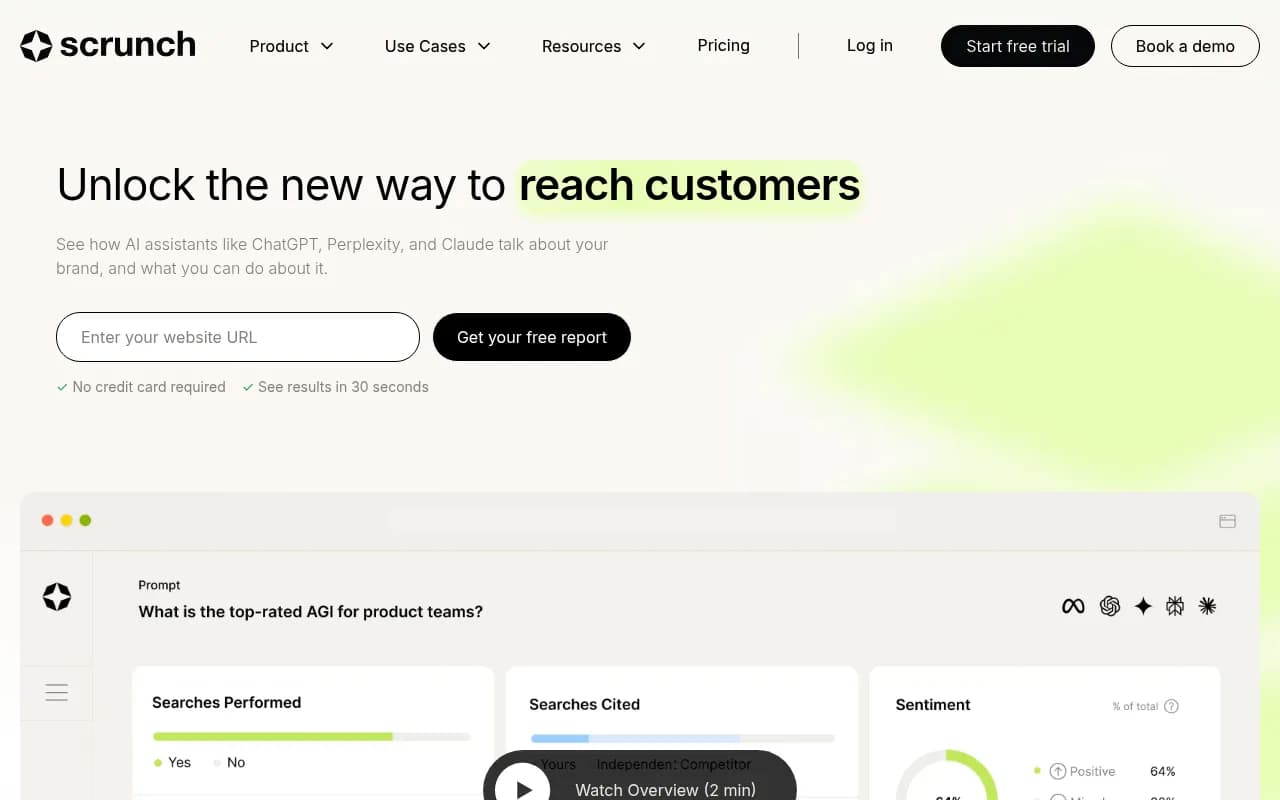
Scrunch AI focuses on enterprise-scale monitoring, with particular strength in tracking brand mentions and sentiment across AI engines. It's a good fit for agencies with large corporate clients who need to monitor AI visibility across multiple product lines or geographies.
The platform has decent competitive benchmarking and is positioned toward the higher end of the market. Like Profound, it's more of a monitoring and reporting tool than an optimization platform -- you'll see what's happening, but the "what to do about it" is largely left to you.
No Reddit or YouTube tracking, no content generation, and pricing reflects its enterprise positioning.
5. AthenaHQ -- best for sentiment-led brand control

AthenaHQ takes a slightly different angle than most tools in this space. It focuses on how AI models characterize your brand -- the sentiment, the framing, the specific language used in AI-generated responses. That's genuinely useful for brand-sensitive clients who care not just about whether they appear, but how they appear.
It's monitoring-focused, which is the recurring theme in this category. AthenaHQ doesn't have content generation or traffic attribution. But if a client is dealing with reputation issues in AI responses -- incorrect information, negative framing, missing context -- AthenaHQ gives you more nuance than most trackers.
6. Rankscale -- best for competitive AI visibility benchmarking
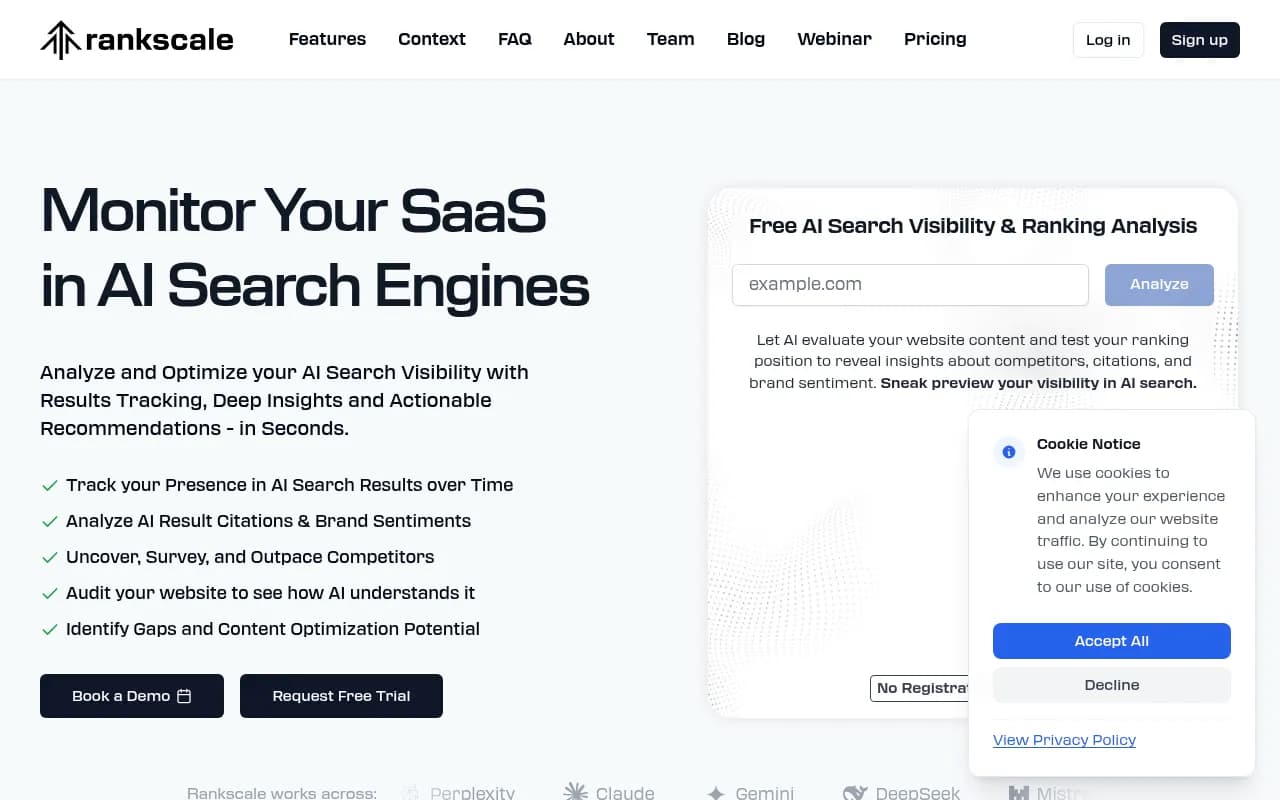
Rankscale is built with agencies in mind, with a focus on competitive benchmarking and share-of-voice comparisons across AI engines. It's one of the more agency-friendly interfaces in this space, with multi-client management and reporting features that make it easier to present data to clients.
The platform is solid for showing clients how they compare to competitors in AI search. Where it's weaker: prompt volume data is limited, there's no content generation, and the depth of citation analysis doesn't match what you get from Promptwatch or Profound.
Still, for agencies that primarily need competitive reporting rather than full optimization workflows, Rankscale is worth a look.
7. SE Visible (by SE Ranking) -- best for agencies already using SE Ranking
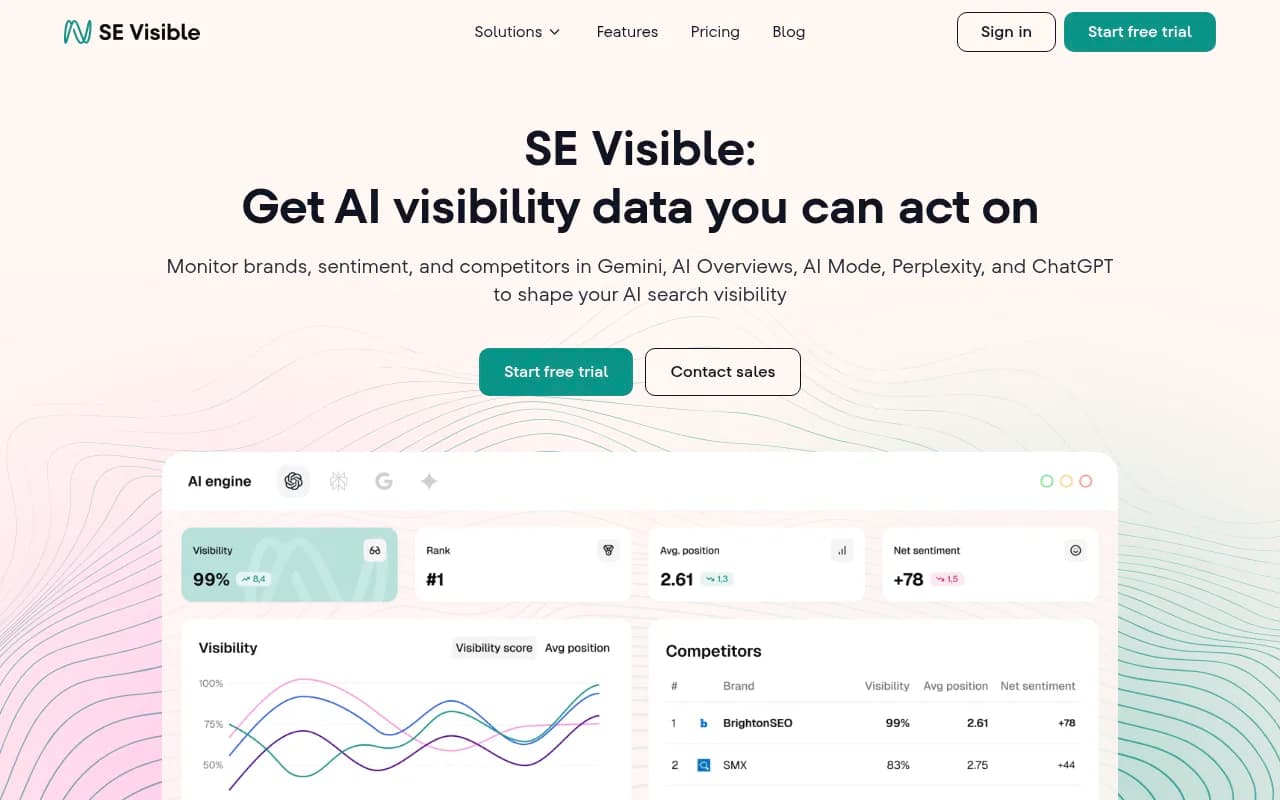
SE Visible is SE Ranking's AI visibility module, which means if you're already paying for SE Ranking's traditional SEO suite, this is a natural extension. It tracks brand mentions in AI search engines and integrates with the broader SE Ranking platform for keyword research, site audits, and rank tracking.
The advantage is consolidation -- one platform for traditional SEO and AI visibility. The limitation is that SE Visible is still primarily a monitoring tool within a traditional SEO framework. It doesn't have the depth of citation analysis, prompt intelligence, or content generation that purpose-built GEO platforms offer.
For agencies that want to add AI visibility to an existing SE Ranking workflow without switching platforms, it's a reasonable option.
8. Omnia -- best for scaleup brands tracking share of voice
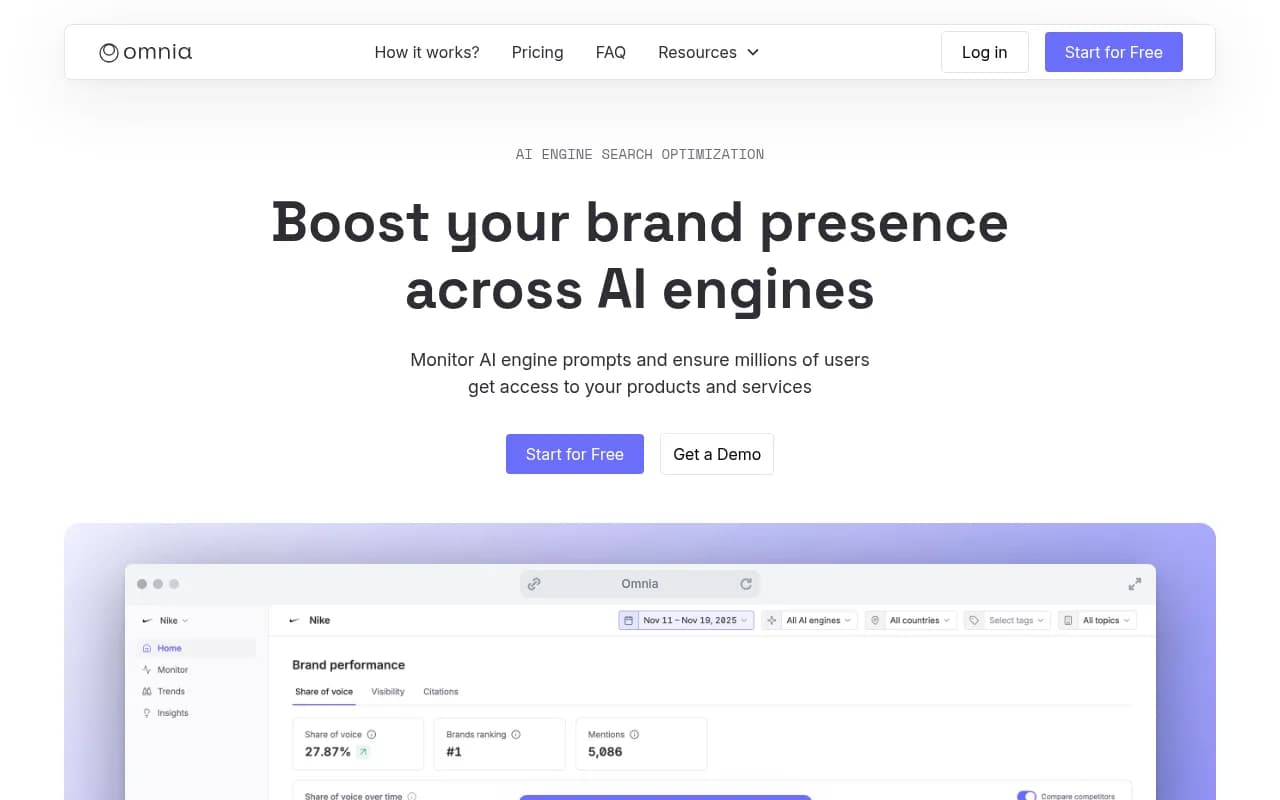
Omnia tracks brand visibility across ChatGPT, Perplexity, Google AI Overviews, and Google AI Mode, with a particular focus on share-of-voice metrics. It's positioned toward scaleup brands and has a clean interface that makes it easier to communicate AI visibility data to non-technical stakeholders.
Like most tools in this list, it's primarily a monitoring platform. The share-of-voice focus makes it useful for clients who want to understand their position relative to competitors, but you'll need to build your own content strategy to act on what you find.
Side-by-side comparison
| Platform | Multi-site | Content generation | Crawler logs | Traffic attribution | Prompt volume data | Reddit/YouTube tracking | Best for |
|---|---|---|---|---|---|---|---|
| Promptwatch | Yes (up to 5+) | Yes (built-in AI writer) | Yes | Yes | Yes | Yes | Full-cycle GEO optimization |
| Profound | Yes | No | No | No | Limited | No | Enterprise monitoring |
| Otterly.AI | Limited | No | No | No | No | No | Budget monitoring |
| Scrunch AI | Yes | No | No | No | No | No | Enterprise brand monitoring |
| AthenaHQ | Yes | No | No | No | No | No | Sentiment tracking |
| Rankscale | Yes | No | No | No | Limited | No | Competitive benchmarking |
| SE Visible | Yes (via SE Ranking) | No | No | No | No | No | SE Ranking users |
| Omnia | Yes | No | No | No | No | No | Share-of-voice tracking |
| Peec AI | Limited | No | No | No | Limited | No | Basic AI visibility |
How to choose the right platform for your agency
The honest answer is that it depends on what you're selling.
If your agency is adding AI visibility as a reporting add-on -- showing clients where they appear in AI answers as part of a broader SEO retainer -- then a monitoring-only tool like Otterly.AI or Rankscale might be enough. They're cheaper, easier to set up, and give you data to put in a slide deck.
If you're building a real GEO service -- one where you're actually improving client visibility in AI search over time -- you need a platform that helps you take action. That means content gap analysis, some form of content generation or brief creation, and attribution that connects your work to results.
The gap between "we track AI visibility" and "we improve AI visibility" is where most agencies are right now. The tools that help you bridge that gap are worth paying more for, because they're what make the service defensible.
A few questions worth asking before you commit to any platform:
- Can I manage multiple client sites from one account, or do I need separate logins?
- Does the platform tell me which specific content gaps to fill, or just that gaps exist?
- Can I show a client that our work led to more AI citations and more traffic?
- Does it track prompt volume so I can prioritize high-value opportunities?
- Does it monitor AI crawler activity on client sites, so I know if there are indexing issues?
Most platforms in this space answer "no" to most of those questions. That's not a criticism -- the market is still early. But it's worth being clear-eyed about what you're buying.
The agency use case that most tools miss
Here's something that rarely gets discussed in these comparisons: the difference between tracking prompts and understanding prompt intent.
When a user asks ChatGPT "what's the best project management software for remote teams," that single prompt fans out into dozens of sub-queries the model considers before generating a response. Which sources does it pull? What topics does it look for? What's missing from the top-cited pages?
Most tools show you whether your brand appeared in the response. They don't show you why it appeared (or didn't), which sub-queries drove the decision, or what content you'd need to create to change the outcome.
That's the level of depth agencies need to build a real optimization service. Tools like Promptwatch are starting to address this with query fan-out analysis and prompt intelligence. Most others aren't there yet.
Bottom line
Peec AI is a reasonable starting point for AI visibility monitoring. But for agencies building a GEO service offering in 2026, "reasonable starting point" isn't enough. Your clients are asking for results, not reports.
The platforms worth serious consideration are the ones that help you answer the follow-up question: "Now what do we do?" Right now, that's a short list. Promptwatch is the most complete answer to that question -- it's built around the full cycle of finding gaps, creating content, and tracking results. The others in this guide are worth knowing about depending on your budget, your client mix, and how deep you want to go.
Start with what your clients actually need. If they need to understand where they stand, most tools in this list will do the job. If they need to actually improve -- and they will, eventually -- plan for a platform that can take you there.