
Key takeaways
- Byword is the most straightforward bulk writer of the three: published per-article pricing, a 5-article free trial, and publishing integrations that leave you in control of what goes live.
- Outrank is the riskiest setup because it combines auto-publishing with automated backlink building. Its $99/month base plan includes 30 articles, and the human-reviewed tier costs $1,399/month.
- SurgeGraph now markets itself as an AEO and AI-visibility platform for agencies. I could not confirm current writer pricing, so check its pricing page before you budget.
- I found no independent head-to-head quality tests, AI-detection results or penalty case studies for any of the three. Anyone claiming a definitive winner is guessing.
- Whichever tool you choose, keep a human edit step. Promptwatch's data shows generic articles are a small slice of what ChatGPT cites.
What this comparison is (and is not)
I did not run a controlled experiment. The research behind this guide is pricing pages, feature lists and Google's published spam policies, and I found no credible third-party quality benchmarks for these specific tools. So "tested" here means tested against the things you can actually verify: what each tool automates, what it costs per article, and how much of the publishing decision it takes away from you.
That last point matters most. Quality problems are fixable. A site full of unreviewed, auto-published pages with bought or automated links is much harder to recover.
The three tools at a glance
| Byword | Outrank | SurgeGraph | |
|---|---|---|---|
| Core pitch | Bulk article generation with programmatic SEO | Fully automated content plus backlinks | AEO and AI-visibility platform with content scoring |
| Entry price | Starter, 25 articles/month (about $83 annual, $99 monthly per listing) | $99/month for 30 articles | Not confirmed, check live page |
| Cost per article | $3.32 / $3.11 / $2.78 on annual plans | About $3.30 on the base plan | Unknown |
| Free trial | 5 free articles, no card | None seen | 14-day money-back guarantee |
| Auto-publish | Via integrations | Yes, by default | Not a headline feature |
| Backlinks | No | Automated backlink building | No |
| Human editing option | Bring your own | $1,399/month add-on | Content scoring to guide edits |
| Risk level | Moderate | High | Lower |
Treat the pricing rows as a snapshot. Byword's page shows different monthly numbers in its meta description versus its body, which looks like a monthly versus annual toggle, so verify on the live page.
Byword: the cleanest bulk writer
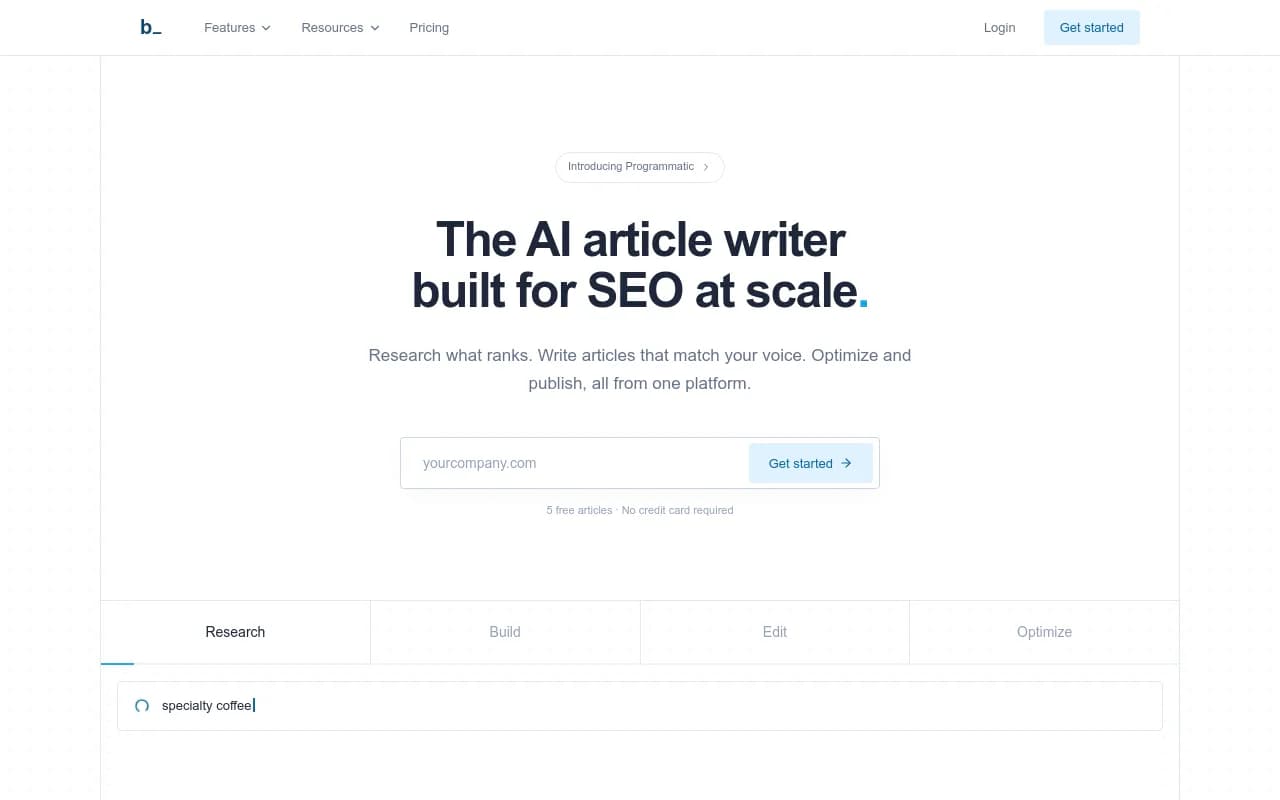
Byword is built for one job: generate lots of articles from keywords or lists. Its pricing page at byword.ai/pricing lists three monthly plans.
- Starter: 25 articles a month, extra articles at $3.50, 5 domains, no API.
- Standard: 80 articles a month, extra at $3.00, 3 seats, unlimited domains and API.
- Scale: 300 articles a month, extra at $2.50, 10 seats, unlimited domains, priority support.
On annual billing that works out to roughly $3.32, $3.11 and $2.78 per article. There is also a bring-your-own-keys Unlimited tier for 500+ articles a month, though the price figures on the page were garbled when I checked.
Paid plans include internal linking, programmatic SEO, voice matching, 17 image styles and Google indexing, with integrations for WordPress, Webflow, Ghost, HubSpot, Medium, Airtable, Notion, Google Docs and webhooks. The feature grid was ambiguous about which plan gets which feature, so confirm before buying.
The vendor claims 85,000+ users, 3M+ articles generated and 47 languages. Those are marketing numbers, not audited ones. It also says freelancers cost $50 to $200 per article, which is the comparison it wants you to make.
Where Byword is lower risk
Byword does not do backlinks, and nothing in its pricing frames auto-publishing as the main product. You can send drafts to Google Docs or Notion and have a person look at them first. The 5 free articles are also a fair way to judge output before paying.
Where it bites
Programmatic SEO is the dangerous feature. Generating hundreds of near-identical pages from a template is exactly what Google's spam policies treat as scaled content abuse when the pages exist mainly to rank. The tool does not stop you from doing that. At $3 an article, it is very easy to publish 300 pages nobody reads.
Outrank: the most aggressive setup
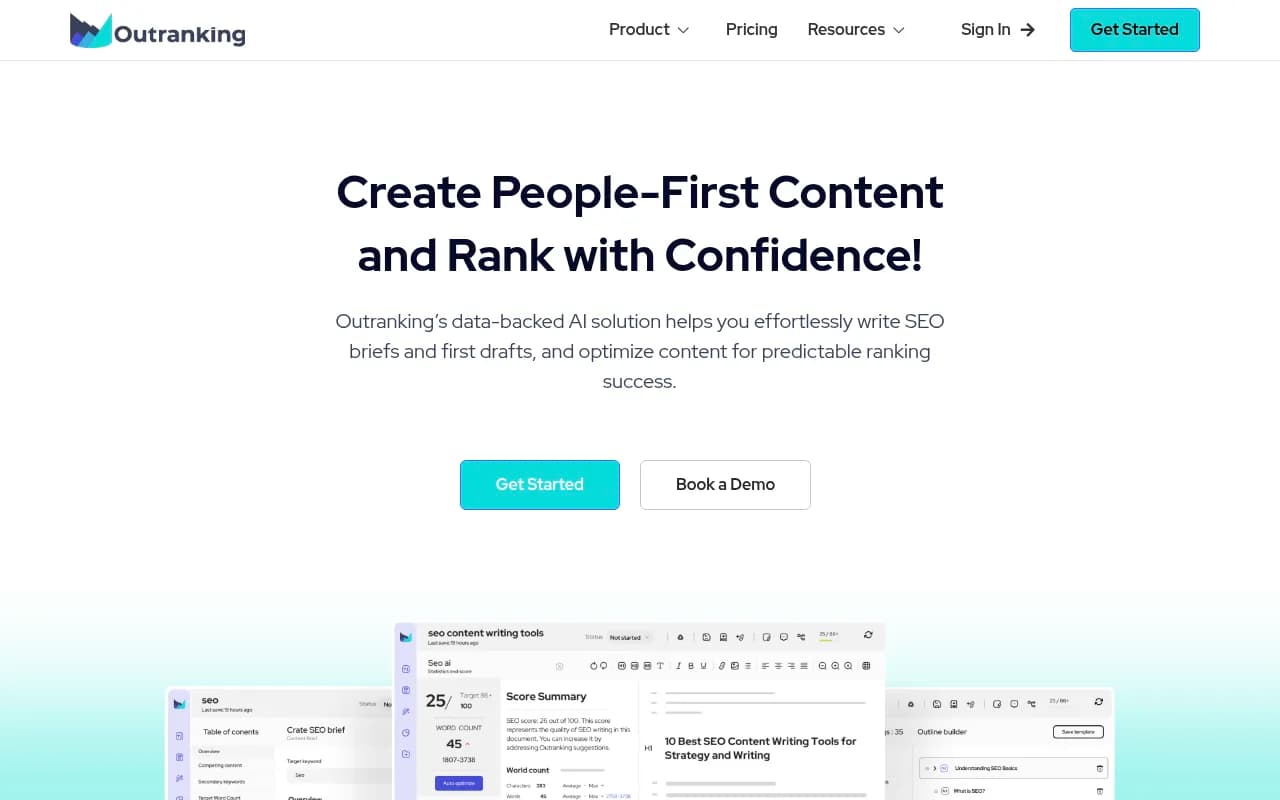
Outrank's pricing page (outrank.so/pricing) describes a single base plan at $99/month, or $999/year. The page shows $199 struck through. It includes:
- 30 articles a month, auto-generated and auto-published
- Automated keyword research
- Automated backlink building
- AI images, YouTube embeds, 150+ languages, unlimited users and unlimited AI rewrites
- Integrations with WordPress, Webflow, Shopify, Wix, Framer, Notion, Ghost and webhooks
Output add-ons are one site each: 60 articles a month for +$85 and 90 for +$160. Other add-ons include backlink plans at $199, $899 and $1,899 a month, directory submission at $500 one-time, a Free Tools Builder at $99 a month, and Premium Images at $49 a month. Multi-site discounts run from 10% for 2 to 4 sites up to 20% for 20 to 25 sites.
Vendor claims are 750,000+ articles, 25,000+ backlinks and 10,000+ "ChatGPT mentions secured". I would not rely on any of those without seeing methodology.
The human-curated tier
Outrank sells a Human Curated Service for $1,399 a month where human editors review and fact-check every article. That is about 14 times the base plan. I read it as a quiet admission: the base product is unreviewed output, and the company knows some customers need a person in the loop.
Why the risk is higher
Two things stack up here. Articles go live automatically, and links are built automatically. Google's spam policies (developers.google.com/search/docs/essentials/spam-policies) cover both scaled content abuse and link spam. I could not retrieve the exact wording of the scaled-content section in my research, so read it yourself before committing, but the combination is the pattern those policies exist to catch.
If you use Outrank, turn off auto-publishing for the first month, review every article, and look hard at what the backlink service actually places.
SurgeGraph: now an AEO platform
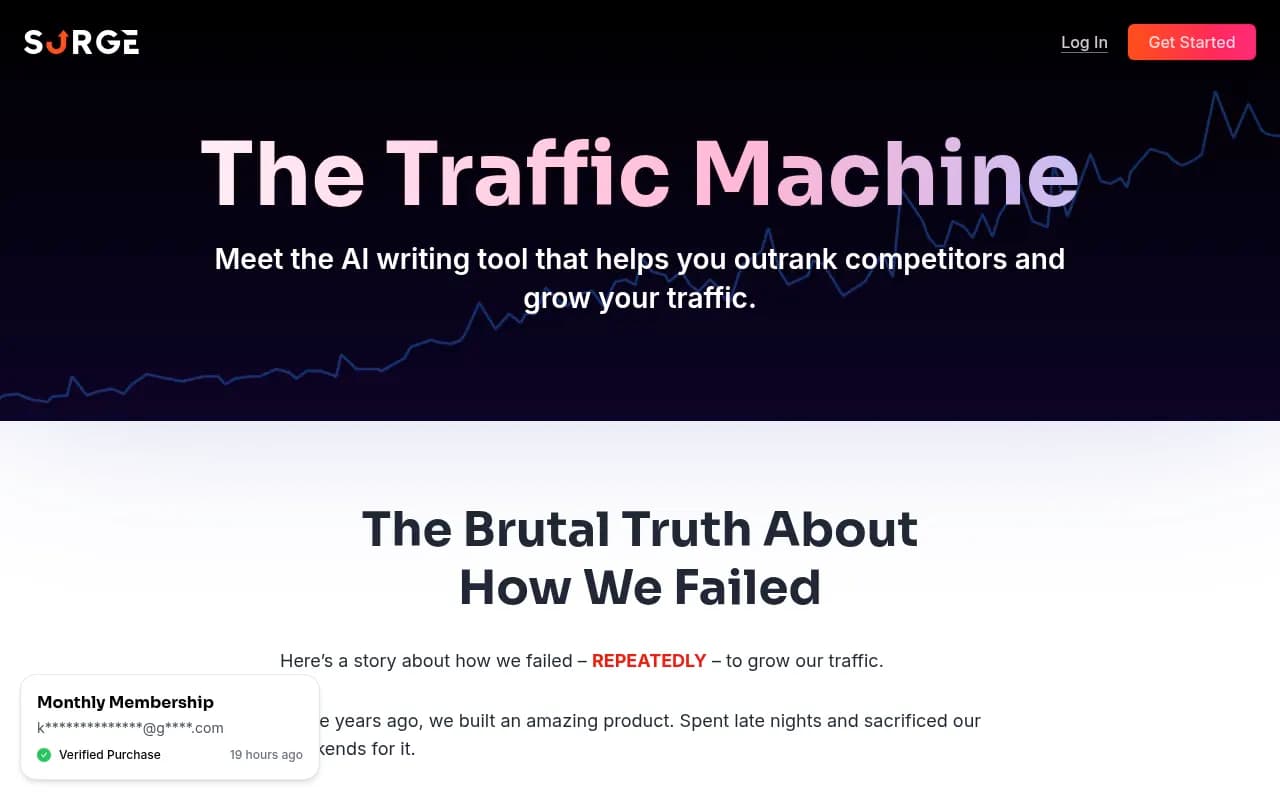
SurgeGraph has repositioned. Its pricing page now sells it as an AEO and AI-visibility platform for agencies, with tracking of visibility, share of voice and citations across ChatGPT, Perplexity, Google AI, Gemini and Claude, plus white-label reports. Content scoring shows separate AEO and SEO scores, checking word count, headings, direct answers and prompt coverage.
The scraped page showed no plan prices or article quotas, and I could not find them elsewhere. So I cannot tell you its cost per article. It displays a G2 rating of 4.9, Product Hunt 5.0 and Trustpilot 4.6, all vendor-displayed. It offers a 14-day money-back guarantee.
The page also quotes third-party statistics (94% of B2B buyers using LLMs, a 61% CTR decline on queries with AI Overviews, 40 to 60% of AI citations rotating monthly). These come from the vendor's marketing and I did not verify them.
Risk profile
SurgeGraph is the least dangerous of the three, mostly because its framing is about scoring and measuring content rather than flooding a site. The tradeoff is that it is no longer a pure bulk writer. If you want 300 cheap articles a month with no friction, it may not be the right shape of product anymore.
What actually gets cited
Bulk blog output often chases the wrong format. Promptwatch's report on which content types ChatGPT cites the most (Sep 28 to Oct 4, 2026) breaks down citation share by type:
| Content type | Share of ChatGPT citations |
|---|---|
| Product pages | 22.4% |
| Landing pages | 16.8% |
| Listicles | 13.6% |
| How-to guides | 8.7% |
| Documentation | 7.5% |
| General articles | 6.1% |
| Comparisons | 5.9% |
| News | 5.7% |
| FAQ pages | 3.3% |
| Reviews | 1.7% |
For commercial prompts, product pages (26.0%), landing pages (20.6%), listicles (15.0%) and comparisons (7.9%) make up almost 70% of citations. General articles are 6.1%. A pile of generic blog posts is not where citations land.
Shelf life is a second problem. In Promptwatch's content half-life report, news pages lost half their citations within about 36 days, while landing pages and docs lasted for months. Cheap, disposable articles decay fast.
Risk scorecard
| Risk factor | Byword | Outrank | SurgeGraph |
|---|---|---|---|
| Auto-publish by default | No | Yes | No |
| Automated backlinks | No | Yes | No |
| Template page generation | Yes (programmatic SEO) | Not a focus | Not a focus |
| Built-in human review | No | Paid tier ($1,399/mo) | Scoring only |
| Pricing transparency | Good | Good | Unclear |
| Overall | Moderate | High | Lower |
This is my judgment from the product design, not a measured penalty rate. Nobody has published one that I could find.
How to use a bulk writer without getting hurt
- Start with 5 to 10 articles, not 300. Byword's free trial covers this.
- Keep a human edit step. Check facts, add first-hand detail, and cut anything generic.
- Prioritize pages that earn citations: product, comparison and how-to content, not filler.
- Never auto-publish a brand-new batch to a site you care about.
- Be skeptical of automated backlinks. Link spam is a named policy violation.
- Watch results in Google Search Console for indexing drops or impression collapses after each batch.
If you want more editor-driven alternatives, tools like [tool:frase], [tool:surfer-seo] and [tool:koala-ai] sit nearer the human-in-the-loop end. For a wider view of the category, see the directory at surferstack.com.
Measuring whether the content works
Publishing is only half the job. You also want to know if AI engines crawl, cite and send traffic to what you ship. A platform like Promptwatch tracks citations across ChatGPT, Perplexity, Gemini and Google AI Overviews, and its crawler logs show whether AI bots even read new pages.

It is a measurement and optimization layer rather than a bulk writer, so it complements any of the three tools here. If you want agency help setting up an editorial and GEO process, that is the sort of work 1001 SEO Media does.
Which one should you pick?
- Choose Byword if you want cheap, transparent volume and will review output yourself.
- Choose Outrank only if you accept the risk, keep auto-publishing off at first, and scrutinize the backlinks. Consider the human-reviewed tier if you cannot edit in-house.
- Choose SurgeGraph if you care more about AI-search visibility and content scoring than raw article count, after confirming its current pricing.
None of these tools replaces an editor. At roughly $3 an article, the cost is not the real expense. The real expense is what happens to a domain when a few hundred thin pages go live at once.
FAQ
Will Google penalize AI-written content?
Google's spam policies target scaled content produced mainly to manipulate rankings, whether made by AI or people. I could not retrieve the exact scaled-content wording in my research, so read the policy page directly.
Which tool is cheapest per article?
Byword's Scale plan at about $2.78 per article on annual billing is the lowest I could verify. Outrank's base plan works out to about $3.30. SurgeGraph's pricing was not available.
Is there independent proof any of these rank well?
I did not find any. Vendor claims such as 3M+ articles generated or 750,000+ articles created describe volume, not quality or rankings.
Does bulk content get cited by AI search?
General articles are only 6.1% of ChatGPT citations in Promptwatch's data, while product pages, landing pages and listicles dominate. Format matters more than volume.