
Key takeaways
- Product descriptions and category pages are different jobs. Descriptions need facts and variation at scale. Category pages need search intent, structure, and internal linking.
- Tools built for e-commerce (Hypotenuse AI, ConvertMate) suit big catalogs. General writers (Claude, ChatGPT, Jasper, Copy.ai) suit smaller catalogs and teams that want control over prompts.
- Promptwatch Data found that product pages are the most cited content type in ChatGPT at 22.4%, and landing pages follow at 16.8% (Sep 28 to Oct 4, 2026). Your commerce pages are exactly what AI assistants quote.
- Accuracy beats fluency. Feed every tool structured product data and have a human check specs, materials, sizing, and claims.
- I have not verified current vendor pricing for this guide, so check each pricing page before you buy.
Why product copy matters more in 2026
For years, e-commerce copy was a chore. You wrote 40 words about a mug, pasted the manufacturer text on 300 other SKUs, and moved on. That still works badly, and now it fails in two places: Google and AI assistants.
Promptwatch Data's content type report looked at ChatGPT citations from Sep 28 to Oct 4, 2026. Product pages were the most cited type at 22.4%, landing pages came next at 16.8%, so about 39% of citations go to pages describing what a company sells. For commercial prompts (people comparing options before buying), product pages hit 26.0% and landing pages 20.6%. For branded prompts, reviews climb to 5.6%, more than three times their overall share.
The practical read: when someone asks an assistant "best waterproof hiking boots under 150", the assistant quotes specs, prices, and positioning from pages like yours. Thin or generic copy gives it nothing to quote. Complete, factual copy gives it plenty.
Also worth knowing: Promptwatch's content half-life data shows landing pages and docs stay cited far longer than news, which loses half its cited pages within about 36 days. Category pages are landing pages in practice, so they are worth writing well once and refreshing, not churning.
Product descriptions vs category pages
These need different things from a writer, and mixing them up is the most common mistake I see.
| Product descriptions | Category pages | |
|---|---|---|
| Goal | Convert one shopper, answer pre-purchase questions | Rank for a head term, guide browsing |
| Input | Structured attributes (size, material, specs) | Keyword, intent, subcategories, top products |
| Volume | Hundreds to hundreds of thousands | Dozens to hundreds |
| Biggest risk | Hallucinated specs, duplicate text | Fluffy SEO text nobody reads |
| Best tool type | Bulk, template and data driven | SEO-aware editor plus human review |
What to look for in an AI writer for e-commerce
- Structured input. CSV or feed import, attribute fields, and variables. If the tool only gives you a chat box, you will be copy-pasting forever.
- Brand voice controls. A saved style guide or example copy that applies to every generation.
- Bulk generation and export. Direct publishing or export to your platform (Shopify, WooCommerce, Magento, BigCommerce).
- Factual grounding. The tool should write from the data you give it, not invent details. Test this with a product that has unusual specs.
- SEO guidance for category pages. Keyword and competitor term suggestions, headings, and FAQ ideas.
- Multilingual output, if you sell across markets. Machine translation is not the same as localized copy, so review a sample with a native speaker.
- Review workflow. Approval steps matter when 5,000 descriptions go live at once.
The best AI writers for product descriptions
Hypotenuse AI
Hypotenuse is positioned as an AI content engine built for e-commerce at scale, which is the clearest fit on this list for large catalogs. The appeal is bulk workflows: upload product data, generate descriptions in one pass, and keep a consistent voice. Check the current feature set and limits on their site before committing.
ConvertMate
ConvertMate describes itself as an AI-powered SEO platform for e-commerce stores. It makes sense if you want product page optimization tied to conversion and search rather than just text generation. Look at how much editing control it gives you over each page.
Jasper
Jasper is a broad marketing platform with agents and content pipelines. It is a good choice if the same team also writes ads, emails, and landing pages and wants one brand voice everywhere. For pure product-data bulk work it is less specialized, so test with a real sample of your SKUs.
Copy.ai
Copy.ai is a fast, versatile copywriting tool that works well for short-form product blurbs, variant descriptions, and marketing snippets. Its workflow features are useful if you want repeatable processes for new product launches.

Claude and ChatGPT
For small and mid-sized catalogs, a general assistant with a good prompt is hard to beat. You paste attributes, a voice guide, and two example descriptions, and you get usable copy. Claude tends to do well on long-form category intros and following a detailed style guide. ChatGPT is versatile and convenient if your team already lives in it. Both need a disciplined prompt and human fact-checking, and neither gives you bulk publishing out of the box. If you want automation, connect them to your catalog with a workflow tool.

Writer
Writer is an enterprise platform aimed at teams that need governance: style guides, terminology rules, and approvals. If you are a brand with strict legal or compliance language on product claims (supplements, cosmetics, electronics), this kind of guardrail is worth more than raw speed.

Writesonic and Anyword
Writesonic covers blog and marketing content with a lot of templates. Anyword focuses on copy that predicts performance before you publish, which is handy for testing headline and short description variants on high-traffic products.

The best AI writers for category pages
Category pages live or die on search intent and structure, so SEO-aware tools are the better pick.
Surfer SEO, Frase, and Clearscope
These content optimization tools analyze top-ranking pages and tell you which terms, headings, and questions to cover. For a category page, use them to decide what belongs in the intro, buying guide, and FAQ, then write or edit with your own voice. Surfer and Frase add AI drafting on top of the briefs.

NeuronWriter and Semrush Writing Assistant
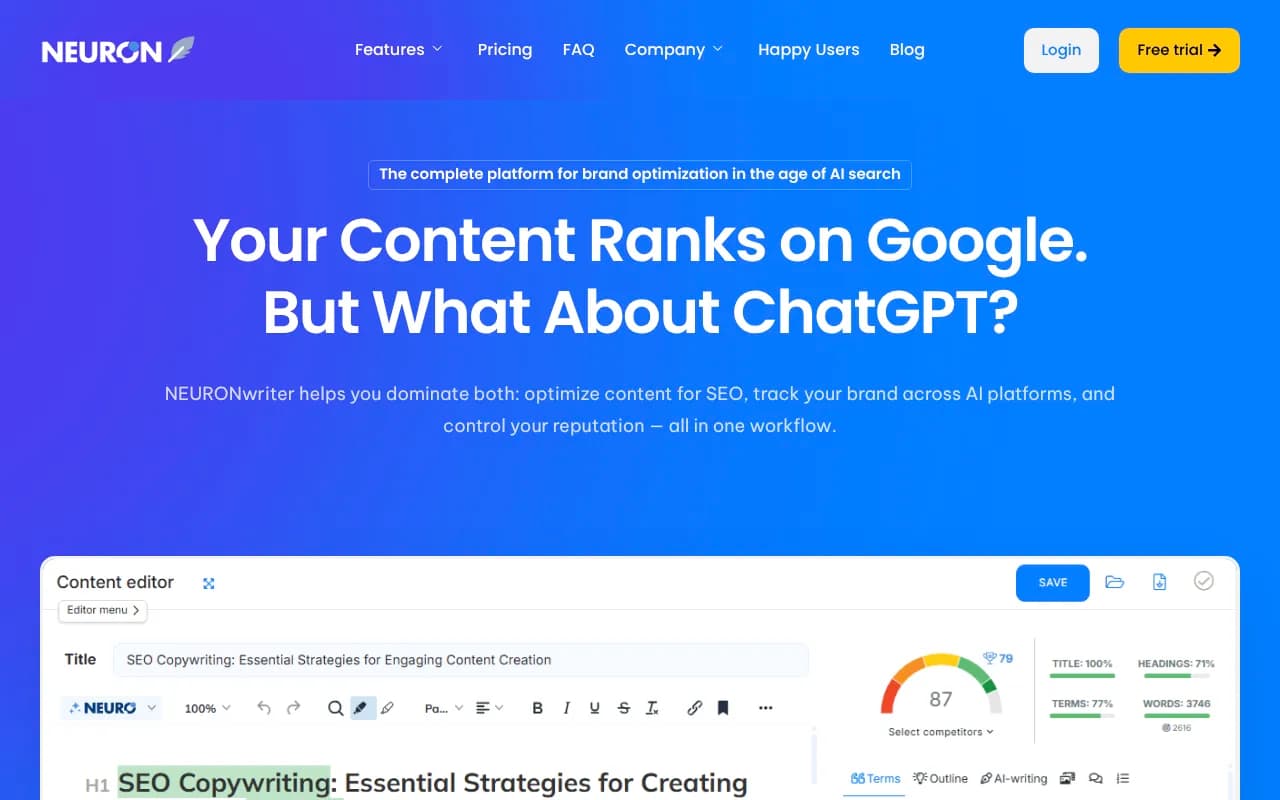
NeuronWriter and the Semrush Writing Assistant give real-time scoring against competitors. They are useful when someone other than an SEO specialist is writing the page and needs guardrails.
AirOps
AirOps is a content engineering platform that lets you build repeatable workflows, such as pulling live product data into a category page template and generating the text around it. It suits teams with someone technical enough to set up the pipeline.
Scale-first options: LPagery and Gushwork
If you manage hundreds of near-identical landing pages (brand plus category, category plus city), template tools like LPagery handle the page generation while an AI writer fills in the unique parts. Gushwork pitches itself as an engine that generates 100+ pages. Be careful here: generating pages in bulk without unique value is how sites end up with thin content problems.

Gushwork
Comparison table
| Tool | Best for | Handles bulk catalogs | SEO guidance | Notes |
|---|---|---|---|---|
| Hypotenuse AI | Large catalogs | Yes, built for it | Some | E-commerce focus |
| ConvertMate | Store SEO and conversion | Store-level | Yes | E-commerce focus |
| Jasper | Marketing teams, brand voice | Via workflows | Some | Broad platform |
| Copy.ai | Short copy, workflows | Via workflows | Limited | Fast and flexible |
| Claude / ChatGPT | Small catalogs, custom prompts | Manual or via automation | Manual | Most control, most effort |
| Writer | Regulated or governed brands | Yes | Limited | Style and terminology rules |
| Surfer / Frase / Clearscope | Category pages | No | Strong | Briefs and scoring |
| AirOps | Custom pipelines | Yes | Configurable | Needs setup |
I have deliberately left pricing out. Plans and credits change often, so open each vendor's pricing page and price it against your real SKU count.
A workflow that works
1. Clean your product data first
This is the part everyone skips. Good output needs good input: accurate titles, materials, dimensions, compatibility, care instructions, and what the product is not. Put it in a sheet with one row per SKU.
2. Write a voice guide and two gold-standard examples
One page: who you sell to, how formal you are, words you never use, how you handle claims. Add two descriptions a human wrote that you love. Feed these to every generation.
3. Pilot on 20 products
Pick a mix: simple items, complex items, and one with weird specs. Read every output. Look for invented features, wrong units, and the same sentence structure repeated. Fix the prompt, then scale.
4. Structure for humans and for AI assistants
Promptwatch's recommendations from the content type data are simple and worth following: keep specs, prices, and positioning complete and factual, make products easy to compare (clear pricing, specs, who it is for), add FAQ sections, and collect reviews on trusted sites. A good template for a product page:
One-sentence summary: what it is and who it is for
Key specs (list)
What is in the box / compatibility
How it differs from similar products
Care, sizing, or usage notes
FAQ (3-5 real customer questions)
5. Human review for risky categories
Anything touching health, safety, electrical, or legal claims needs a person to sign off. An AI writer will happily say a jacket is waterproof when the spec says water resistant.
6. Write category pages for the shopper, not the crawler
Put the products first. Keep the intro short, then add a buying guide, subcategory links, and an FAQ below the grid or in an expandable section. Use Google Search Console to see which queries a category page already gets impressions for, and write toward those.
Duplicate and thin content: the real risk
The danger with bulk AI copy is not that it is AI. It is that 2,000 descriptions that read the same add nothing. I would not state a firm rule about how search engines treat AI-written product copy without checking Google's current guidance, but the practical test is stable: does each page say something specific and useful that the shopper could not get from a competitor listing? If yes, you are fine. If your descriptions could be swapped between products, rewrite them.
Tips to keep copy distinct:
- Use real attributes in the opening sentence, not generic praise.
- Add use cases and comparisons that come from your own customer questions.
- Pull in review themes ("customers say it runs small") where you have the data.
- Vary structure by product type instead of using one template for everything.
Measuring whether it worked
Traditional metrics still matter: impressions, clicks, and conversion rate on the pages you rewrote. Run changes in batches so you can compare against untouched pages.
Then check the AI side. Product and landing pages are what assistants cite, so see whether your new copy gets picked up. A platform like Promptwatch tracks which of your pages ChatGPT, Perplexity, and Google AI Overviews cite, and its AI crawler logs show whether bots are even reading your product pages. If you sell on ChatGPT's shopping surfaces, its ChatGPT Shopping tracking shows which products get recommended and which competitors appear instead.

For more options in this category, the GEO software directory at bestgeosoftware.com lists other visibility tools.
Which should you pick?
- Under 200 products: Claude or ChatGPT with a strong prompt, plus your own editing. Cheapest and most flexible.
- Thousands of SKUs: Hypotenuse AI or an AirOps pipeline, with a human sampling reviews.
- Regulated products: Writer for guardrails, then human sign-off.
- Category pages that need to rank: Surfer, Frase, or Clearscope for the brief, a general AI writer for the draft, a human for the final edit.
- Marketing team that does everything: Jasper or Copy.ai to keep one voice across ads, email, and product pages.
Final checklist
- Is your product data accurate and structured?
- Do you have a voice guide and examples?
- Did you pilot on 20 products and read every one?
- Does each page carry specs, pricing context, and an FAQ?
- Is there human review on claims?
- Are you tracking both Google performance and AI citations?
The tool matters less than the data and the review. A mediocre writer with clean product data beats a great one fed a manufacturer spreadsheet full of mistakes.