Key takeaways
- Surfer SEO is the most feature-complete content optimization tool but its credit-based pricing punishes teams publishing at volume.
- Clearscope wins on writer adoption — it's the cleanest editorial layer for teams where writers, not SEOs, are the primary users.
- MarketMuse is the right call for topical authority strategy, not individual article optimization; it's priced accordingly.
- NeuronWriter is the closest budget alternative to Surfer, but its AI writer calibration has known issues.
- None of these four tools tell you whether your content is being cited in ChatGPT, Perplexity, or Gemini — that's a separate problem requiring a separate tool.
The conversation around content optimization tools has shifted in 2026. A year ago, the question was "which tool gives me the best content score?" Now it's more complicated: "which tool helps me rank in both Google and AI search?" Those are genuinely different problems, and most of the tools in this comparison were built for only one of them.
This guide compares Surfer SEO, NeuronWriter, MarketMuse, and Clearscope across the dimensions that actually matter for content teams today: scoring reliability, workflow fit, pricing model, and how well each tool prepares content for AI search visibility. We'll also flag what none of them do — and what you need if AI citation tracking is part of your strategy.
What these tools actually do (and don't do)
All four tools use NLP analysis to compare your draft against top-ranking pages for a given keyword. They identify terms you're missing, flag structural gaps, and give you a score or grade. That's the core loop.
Where they diverge is in scope, philosophy, and who they're built for.
- Surfer SEO is a full SEO workspace: content editor, SERP analyzer, keyword research, internal linking, and site audit in one platform.
- Clearscope is deliberately narrow: a content grading tool designed to be adopted by writers, not just SEOs.
- MarketMuse operates at the strategy layer — it's about building topical authority across a whole site, not just optimizing one article.
- NeuronWriter sits closest to Surfer in feature set but at a significantly lower price point.
None of them monitor whether your published content is actually being cited by AI engines. That's worth stating clearly upfront, because it's the gap that's become most relevant in 2026.
Surfer SEO
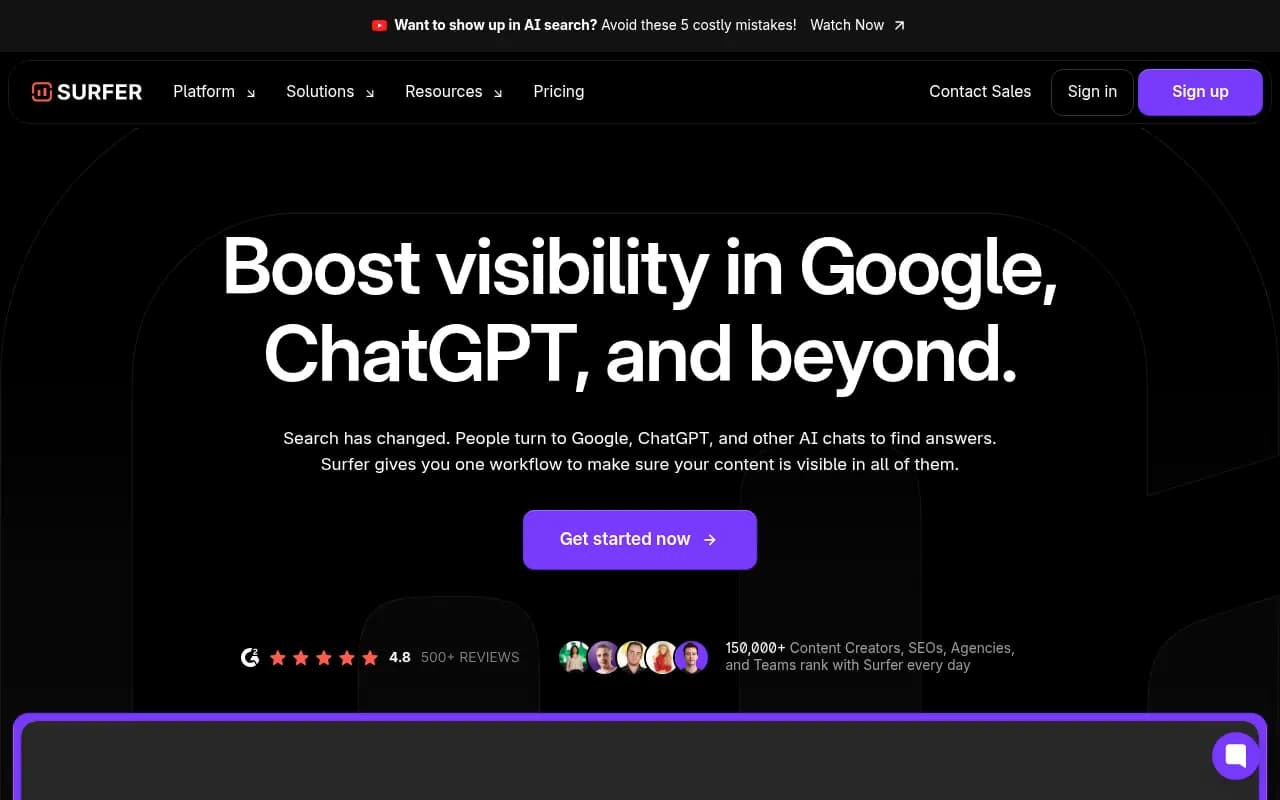
Surfer is the tool most content teams have tried. The Content Editor is genuinely good: real-time scoring, NLP term suggestions, heading structure analysis, and a built-in AI writer that generates outlines and drafts. The SERP Analyzer gives you a detailed breakdown of what's working for competitors on any keyword.
The problem most teams run into isn't quality — it's the credit model. On the Scale plan ($219/month), you get 100 article credits and 100 audit credits. A team publishing 15 articles and refreshing 10 per month can burn through that surprisingly fast, especially once you factor in ad-hoc briefs and SERP checks. The anxiety of "is this draft worth a credit?" is real, and it slows teams down.
There's also a scoring volatility issue. Surfer refreshes its SERP model periodically, which means a draft that scored 82 on Tuesday might score 67 on Thursday after a model update — without any change to the content. Writers find this demoralizing, and it erodes trust in the score as a meaningful signal.
Best for: Teams that want an all-in-one SEO workspace and publish fewer than 15-20 articles per month. Solo SEOs and small agencies get the most value here.
Watch out for: Credit anxiety at scale, scoring volatility, and the fact that the AI writer can produce generic output if you don't give it strong direction.
Clearscope

Clearscope takes the opposite approach to Surfer. It does less, on purpose. The content grading interface is clean, the term suggestions are reliable, and the grade system (A+ through F) is intuitive enough that writers adopt it without much training. There's no built-in AI writer, no SERP analyzer, no keyword research tool. It's a content grader, full stop.
That narrowness is actually its strength. When you're managing a team of writers who aren't SEOs, Clearscope's simplicity means they actually use it. Surfer's interface has enough moving parts that non-SEO writers often ignore half the features or get confused by conflicting signals.
Pricing is per-seat and per-report, which makes it expensive for high-volume teams but predictable for smaller ones. The $170/month Essentials plan includes 20 content reports per month. If you're doing more than that, costs climb fast.
One honest limitation: Clearscope's scoring is good for traditional Google optimization but doesn't account for how AI models evaluate content. It won't tell you whether your article answers questions the way Perplexity or ChatGPT would want it to.
Best for: Editorial teams where writers are the primary users, not SEOs. Companies that value writer adoption over feature depth.
Watch out for: Cost at volume, no research or strategy features, and no AI search visibility layer.
MarketMuse
MarketMuse is a different kind of tool. It's less about optimizing a single article and more about understanding your site's topical authority — which topics you own, which you're weak on, and where you should invest content resources next.
The Topic Model feature maps out the full semantic landscape of a subject. The Content Briefs are detailed and grounded in competitive analysis. The Personalized Difficulty score accounts for your site's existing authority on a topic, not just generic keyword difficulty — which is genuinely useful for prioritizing where to focus.
The tradeoff is price and complexity. MarketMuse starts at $149/month for the Standard plan (limited queries), with the Pro plan at $399/month for serious usage. Enterprise pricing goes higher. For a small team that just wants to optimize individual articles, that's a lot to spend on a strategy layer.
It's also worth noting that MarketMuse's strength is planning, not real-time editing. The content editor exists, but it's not as polished as Surfer's or as writer-friendly as Clearscope's. Teams that get the most value here are those using it to build content calendars and topical clusters, then using a different tool for the actual writing and optimization.
Best for: Content strategists and SEO leads at mid-to-large companies who need to make decisions about where to invest content resources across a whole site.
Watch out for: Price, complexity, and the fact that it's a strategy tool first — not a writing tool.
NeuronWriter
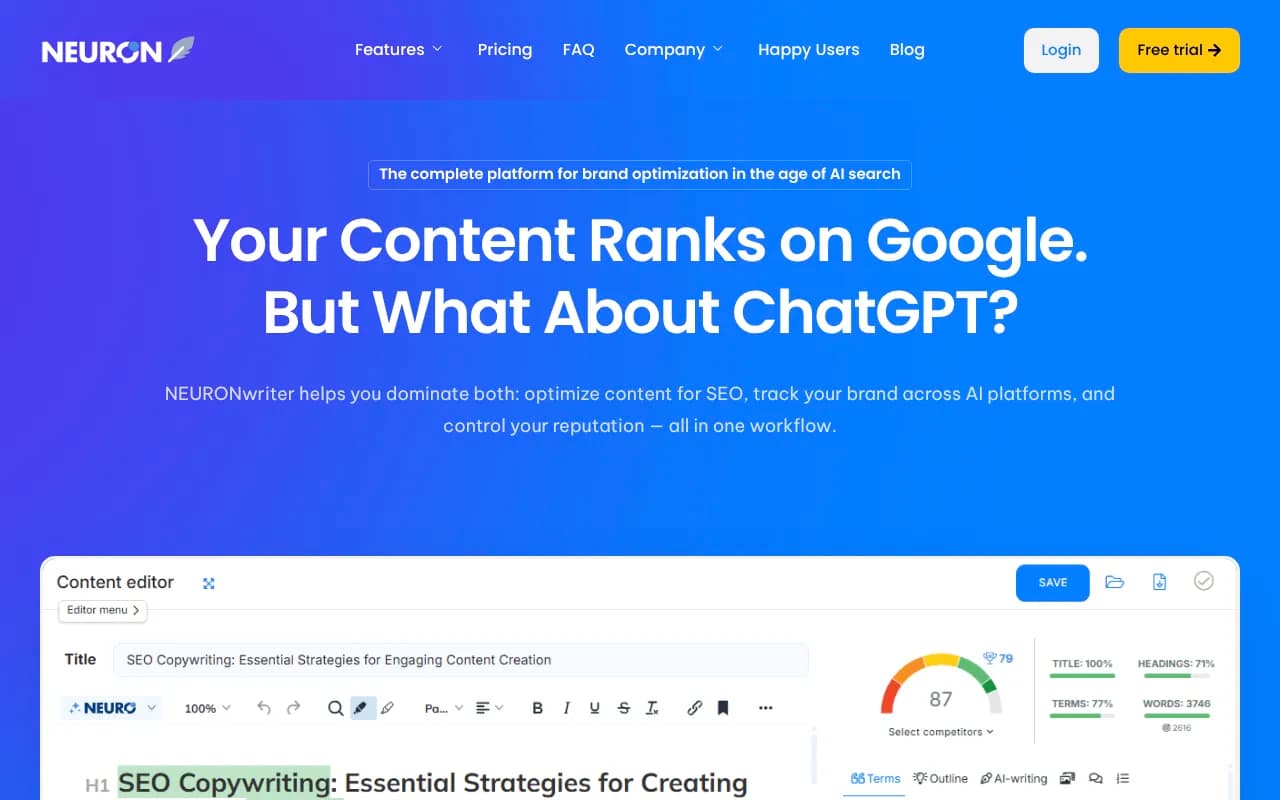
NeuronWriter is the most underrated tool in this comparison. It covers most of what Surfer does — content editor, NLP term suggestions, SERP analysis, content scoring, AI writing assistance — at a fraction of the price. Plans start around $23/month on a lifetime deal basis (available through AppSumo), with regular subscription plans starting lower than Surfer's entry tier.
The interface is less polished than Surfer's, and the AI writer has a known calibration issue: it tends to over-optimize for term density in ways that can make prose feel mechanical. If you use the AI writer as a starting point and edit heavily, it's fine. If you expect it to produce publish-ready drafts, you'll be disappointed.
For budget-conscious teams or solo content creators who want Surfer-style functionality without the credit anxiety, NeuronWriter is a legitimate option. It's not a step up from Surfer — it's a cost-effective alternative that covers 80% of the use cases at 30% of the price.
Best for: Freelancers, small teams, and budget-conscious agencies that need NLP-based content optimization without enterprise pricing.
Watch out for: AI writer calibration issues, less polished UX, and a smaller community/support ecosystem than Surfer.
Head-to-head comparison
| Surfer SEO | Clearscope | MarketMuse | NeuronWriter | |
|---|---|---|---|---|
| Starting price | $89/mo | $170/mo | $149/mo | ~$23/mo |
| Content editor | Yes, real-time | Yes, clean | Yes, basic | Yes, real-time |
| NLP term suggestions | Yes | Yes | Yes | Yes |
| AI writer | Yes | No | No | Yes (flawed) |
| SERP analysis | Yes | No | Yes | Yes |
| Topical authority planning | Limited | No | Yes (core feature) | No |
| Keyword research | Yes | No | Yes | Yes |
| Writer-friendly UX | Moderate | High | Low | Moderate |
| Credit/usage model | Credit-based | Per-report | Query-based | Generous limits |
| AI search visibility | No | No | No | No |
| Best for | SEO teams | Editorial teams | Content strategists | Budget teams |
The gap none of them fill: AI search visibility
Here's the honest reality of content optimization in 2026. All four tools above help you rank on Google. None of them tell you whether your content is being cited in ChatGPT, Perplexity, Gemini, or Google AI Overviews.
That matters because buyer behavior has changed. People ask AI engines for recommendations before they ever run a Google search. If your content isn't being cited in those answers, you're invisible to a growing segment of your audience — regardless of your Google rankings.
Optimizing for AI citations requires understanding which prompts your competitors are being cited for, which pages AI engines are actually reading on your site, and what content gaps exist between what AI models want to answer and what your site currently covers.
That's a different workflow from what Surfer, Clearscope, MarketMuse, or NeuronWriter were built for. Tools like Promptwatch address this directly — tracking which AI engines cite your content, identifying answer gaps, and helping you create content that fills them.

If your content strategy is purely Google-focused, the four tools in this comparison are sufficient. If you're thinking about AI search visibility as part of your strategy, you'll need something alongside them.
Also worth knowing: Frase and Scalenut
Two tools that come up frequently in this conversation are worth a brief mention.
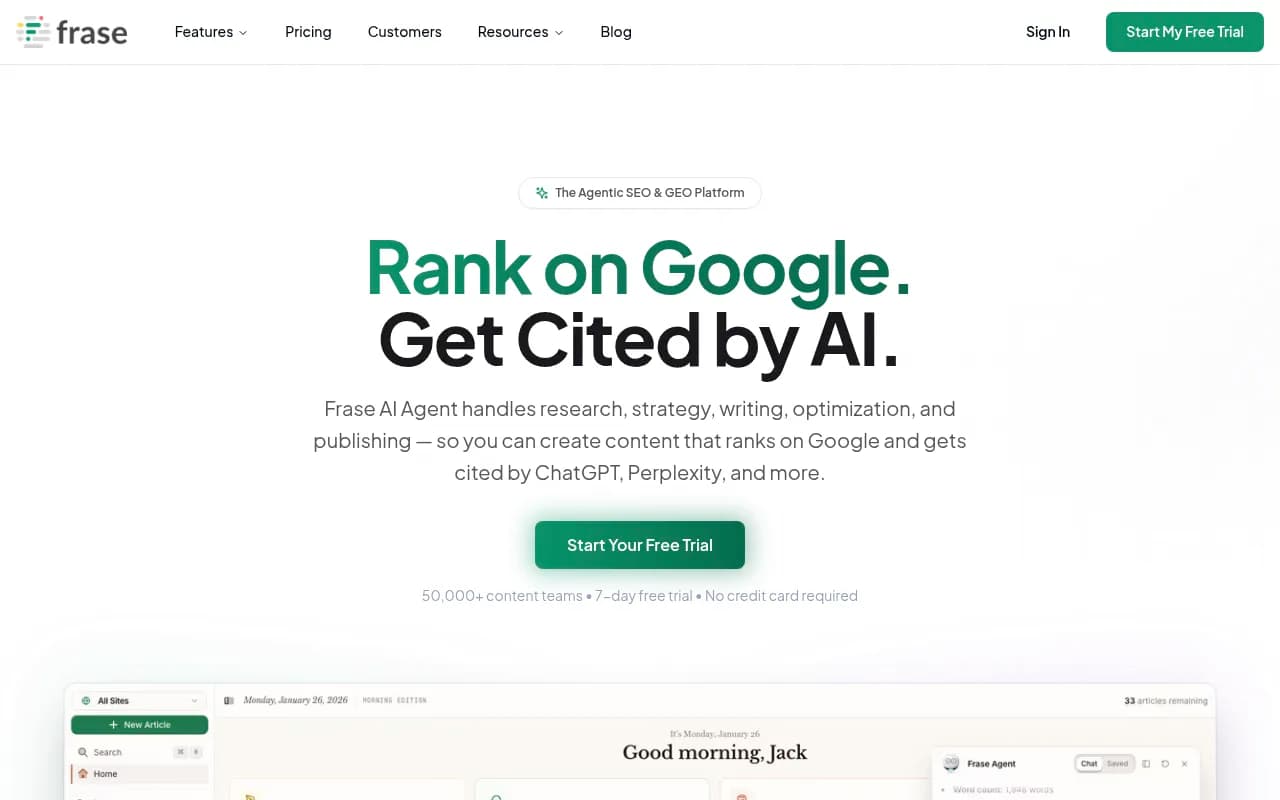
Frase sits between Surfer and Clearscope in scope. It's strong on the research-to-draft pipeline: you can go from keyword to brief to draft within the tool, and the SERP research is solid. It's less polished than Surfer for real-time scoring but more affordable and more integrated for teams that want a single research-and-write workflow.

Scalenut is an all-in-one content platform that combines keyword research, content planning, and optimization. It's priced competitively and has improved significantly in the past year. Worth evaluating if you want a single tool for the full content lifecycle.
How to choose
The right tool depends on your bottleneck, not feature count.
If your bottleneck is writer adoption — you have content writers who resist SEO tools — Clearscope is the answer. Its simplicity is the feature.
If your bottleneck is content strategy — you're not sure where to invest content resources across your site — MarketMuse is the right call. Use it for planning, then use a cheaper tool for execution.
If your bottleneck is cost at scale — you're publishing 20+ articles a month and Surfer's credits are causing friction — NeuronWriter covers the core use case at a fraction of the price.
If your bottleneck is all-in-one SEO workflow — you want keyword research, content optimization, and site auditing in one place — Surfer is still the most mature option.
And if your bottleneck is AI search visibility — you're not sure whether your content is being cited in ChatGPT or Perplexity — none of these four tools solve that. You need a GEO platform alongside your content optimizer.
The tools in this space were mostly built for a world where Google was the only search engine that mattered. That world is changing fast, and the smartest content teams in 2026 are running two parallel workflows: one for traditional SEO optimization, and one for AI search visibility. The good news is that they're complementary, not competing.