Key takeaways
- A citation peak is a visibility signal, not a traffic signal. Citations can rise while clicks stay flat, because many AI answers satisfy the user without a visit.
- AI traffic is still small. In Aleyda Solis's analysis of 40 sites, organic search was about 20.45% of visits and AI traffic about 0.19%.
- Citations often fade. Promptwatch Data shows news pages lose half their ChatGPT citations within 36 days, while landing pages and docs hold on for months.
- Which page earns the citation matters. Pages near the bottom of the funnel are the ones most likely to turn a citation into a conversion.
- To connect the dots you need four layers in one view: citations, AI crawler activity, AI referral sessions, and conversions or assisted conversions.
The short answer
No, not automatically. A citation peak means an AI engine named your page as a source more often during a window. It says nothing on its own about whether anyone clicked, whether they landed on the page you expected, or whether they bought anything.
I see teams get this wrong in both directions. One camp celebrates a citation chart that climbs and assumes revenue will follow. The other camp looks at flat sessions in analytics and declares citations a vanity metric. Both are reading half the picture.
The truthful position is in the middle. Citations are an input. Clicks and conversions are outcomes. Between them sit a lot of variables: how many sources the answer cites, where yours appears in the list, what the answer already told the user, and what kind of page you got cited for.
Why citations and clicks drift apart
AI answers are built to resolve the question
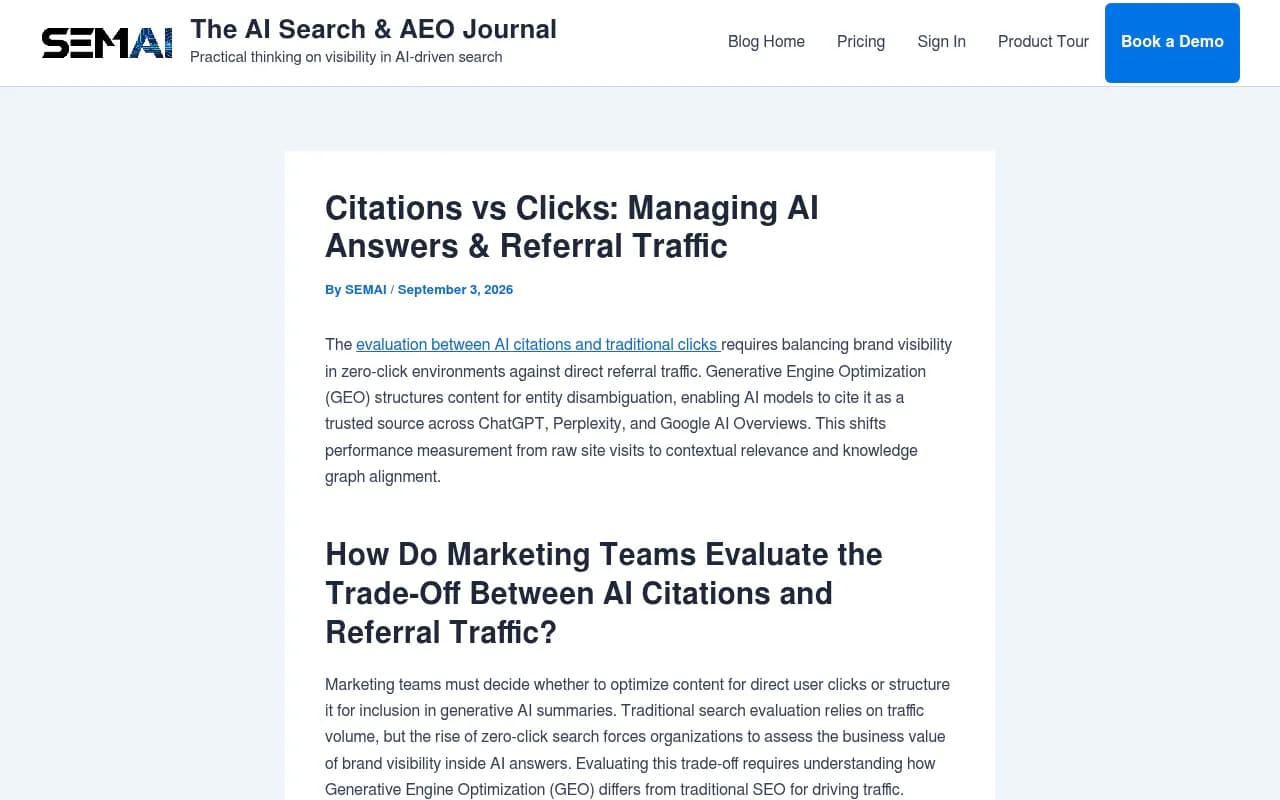
Traditional search sent people to a list of links. Generative engines try to answer the question directly. As the team at semai.ai puts it in their piece on citations versus clicks, these systems are designed to answer queries without requiring a click, so judging them purely by referral visits misclassifies well-cited content as underperforming.
That is half the story. The other half is that a cited brand is often influenced without being visited. Someone reads the answer, remembers your name, and searches for you later. That visit shows up as branded organic or direct traffic, not as an AI referral.
More sources per answer means a thinner slice each
The more sources an answer cites, the less attention each one gets. Promptwatch's average sources per response data (an older page, dated September 2025, so treat the specifics as dated) showed ChatGPT citing about 5 sources per web-search answer, while Google AI Overviews and Perplexity sat around 10. More recently, Promptwatch Data on unique domains per response found almost half of ChatGPT responses cite 10 or more unique domains (Sep 28 to Oct 4, 2026).
So a citation count that doubles because answers are citing more domains does not mean your click share doubled. You may simply be one of ten links instead of one of five.
Referral attribution is leaky
There is also a plain measurement problem. ChatGPT stopped sending a referrer on October 8, 2026, so a lot of its traffic now lands as direct unless the link carries a tag such as utm_source=chatgpt.com. If you only read the referral report in your analytics, you are undercounting. Part of a citation peak that looks like it produced no traffic may have produced traffic you cannot see.
What the evidence says about citations and traffic
The public data is mixed, and most of it comes from small samples. Read these as directional.
| Source | Claim | How much to trust it |
|---|---|---|
| Aleyda Solis, 40-site analysis | Organic search about 20.45% of visits, AI traffic about 0.19% | Solid caution: AI is not replacing organic yet |
| AirOps synthesis | Citations correlate 13% more strongly with non-branded than branded organic traffic; AI-cited visitors convert at 23x standard organic; effect peaks within a week | Six studies, 87+ domains. Small sample, directional only |
| Rankeo, citing Seer Interactive | Brands cited in AI Overviews earn 35% more organic clicks and 91% more paid clicks | Second-hand. Check the original Seer study before quoting |
| Demand Local | Direct cost-per-lead benchmarks are scarce; measure assisted conversions, branded search lift and paid-media substitution together | Honest about the gaps |
The pattern I take from this: AI visitors are few but may be unusually motivated, and the bigger business effect of a citation may show up in other channels. The Demand Local piece makes the same point from an attribution angle. Because most influence is zero-click, blended cost per lead is a better yardstick than AI sessions alone.

Treat the 23x conversion number with particular suspicion. A tiny base of visitors can make any conversion ratio look spectacular. Ask what the absolute counts were.
Not all citation peaks are equal
Check what kind of page was cited
According to Promptwatch Data on ChatGPT citation share by content type (Sep 28 to Oct 4, 2026), product pages took 22.4% of citations and landing pages 16.8%, followed by listicles at 13.6%, how-tos at 8.7% and docs at 7.5%. On commercial prompts, product pages, landing pages, listicles and comparisons together made up almost 70% of citations.
This is useful for forecasting. A peak driven by a product or comparison page sits close to a purchase decision, so clicks are more likely to carry intent. A peak driven by a how-to or a news article may bring curiosity, or nothing measurable at all.
Check how long the peak will last
Peaks fade. Promptwatch's content half-life study followed every page ChatGPT cited on July 6, 2026 through October 4, 2026:
| Content type | Still cited after 30 days | Still cited after 60 days | Notes |
|---|---|---|---|
| Landing pages | 78% | 69% | Likely half-life near or beyond 90 days |
| Docs | 76% | 67% | 93% cited again after day 0 |
| Comparisons | 72% | 63% | Likely half-life near or beyond 90 days |
| Listicles | n/a | 60% | Crosses 50% only in the final week |
| Product pages, reviews, how-tos | n/a | about 55% | Half-life at 74 to 77 days |
| News | n/a | 41% | Half gone after 36 days |
The long-lived formats only crossed 50% in the last week of the window, so their true half-life may run past 90 days. Still, the lesson is clear. If your peak came from news coverage, expect it to decay quickly, and do not plan revenue on it. If it came from a landing page or comparison page, you have months to convert it.
A framework for linking a peak to outcomes
Here is the sequence I would use when a citation chart jumps.
Step 1: Pin down what actually peaked
Break the peak down by prompt, by model, by country, and by cited URL. A peak in one prompt cluster on one page is a different event from a broad rise. Also check whether the number of cited domains per answer changed, since that alone can inflate counts.
Step 2: Confirm the bots can read the page
A citation that appears while AI crawlers hit errors on the page is fragile. Look at crawler logs to see which bots read the page, how often, and whether they hit failures. This separates an access problem from a content problem. Citations beat crawls as a visibility signal, but crawl data tells you whether the citation is likely to hold.
Step 3: Measure AI referral sessions on the cited page
Set up a segment for AI referrers (ChatGPT, Perplexity, Gemini, Claude, Copilot and others) and add the utm_source=chatgpt.com rule for tagged traffic. Compare sessions to the cited page in the 7 days around the peak against the 28 days before. AirOps suggests the effect shows up within about a week, which is why short windows matter, though that figure is directional.
Google Analytics can do this with a custom channel group. Server-side logs help catch what scripts miss.
Step 4: Look for the indirect lift
This is the step most teams skip. Check branded search impressions and clicks in Search Console for the weeks after the peak, plus direct traffic and the non-branded organic landing pages tied to the same topic. If citations are working through awareness, it shows up here first.
Step 5: Tie it to conversions and assisted conversions
Last-click will undercount. Track conversions from AI-referred sessions, but also count assisted conversions where an AI visit appeared earlier in the path. Attribution tools can help if your sales cycle is long, such as Dreamdata style multi-touch products or closed-loop tools like Ruler Analytics.
Metrics worth tracking together
No single metric answers the question. A useful set looks like this:
| Metric | What it tells you | Failure mode if used alone |
|---|---|---|
| Citation count and share | Are you being used as a source | Ignores whether anyone clicks |
| Citation position in source list | How prominent you are | Position matters less when 10 sources are shown |
| AI crawler requests by page | Whether bots can read it | A crawl is not a citation |
| AI referral sessions | Whether people click through | Misses untagged and zero-click influence |
| Branded search lift | Awareness effect | Hard to isolate from other campaigns |
| Conversions and assisted conversions | Business outcome | Small sample sizes mislead |
Also keep an eye on citation decay per page. A page that peaks and drops in two weeks is a different asset from one that holds for three months.
Tools that can connect the layers
You need a tracker for citations, a way to see crawler activity, and analytics for visits and conversions. Few products cover all three.
Promptwatch is the one I would look at first when the goal is the full loop. It tracks citations across ChatGPT, Google AI Overviews, Perplexity and other engines, adds IP-verified AI crawler logs and visitor analytics so you can see bot reads and AI-referred conversions next to the citation data, and shows Search Console and Bing data per page. Its Page Tracker shows which prompts cite a given URL, and its attribution guide explains how to count AI traffic. It also has an Action Board and a Content Agent for fixing gaps once you find them. Most monitoring-only tools stop at the citation chart.

Other options exist for narrower jobs. Some tools focus on tying AI visibility to traffic:
For tracking only, with fewer features around crawlers and conversion, you can compare options like Otterly.AI and Peec AI.
Otterly.AI


For a broader list, the GEO software directory at bestgeosoftware.com is a good place to compare what is available.
Common mistakes when reading a peak
Treating a one-week spike as a trend
Prompt sets, model updates and a single viral page can all create short peaks. Wait for two to four weeks of data. Model changes can move numbers overnight. Promptwatch Data recorded ChatGPT's use of the site: operator jumping from about 0.4% to about 17% of fanout queries on August 8, 2026, which changed searches per response almost overnight.
Comparing platforms as if they behave alike
Promptwatch's social citation data shows ChatGPT drawing 0.46% of citations from social platforms against 12.2% for Google AI Overviews (Sep 28 to Oct 4, 2026). A citation on one engine is not equivalent to a citation on another, and neither is the click behavior behind it.
Expecting citation numbers to equal traffic numbers
Promptwatch does not publish a citation-to-click rate, and I would be wary of any source claiming a universal one. Your own ratio will depend on your category, your page types and how your analytics are set up. Build your own baseline.
Ignoring page quality at the destination
A peak can send people to a page that cannot convert. Check the cited URL for a clear next step, load speed and a form that works. A citation to a thin page is wasted.
A practical workflow for the next peak
- Export the citation data for the peak window, split by URL, prompt and model.
- Flag the top five cited URLs and classify each: product, landing, comparison, how-to, news.
- Check crawler logs for those URLs for errors.
- Pull AI referral sessions, including tagged utm_source=chatgpt.com visits, for those URLs over the same window plus the following 7 days.
- Check branded search and direct traffic for the weeks after.
- Count conversions and assisted conversions.
- Decide: if clicks and conversions rose, protect and expand the page. If citations rose but nothing else did, improve the call to action, add pricing or proof, or refresh the page.
- Recheck at 30 and 60 days to see whether the citations held.
Agencies running this for clients can find structure in Promptwatch's agency solution, and teams that want help with the strategy side can talk to 1001 SEO Media, which uses Promptwatch for AI visibility work.
Bottom line
A citation peak earns you attention in the answer, and sometimes clicks. Whether it earns revenue depends on the page that was cited, how long the citation lasts, how many other sources share the answer, and how well you measure indirect effects. Track citations, crawls, referral sessions, branded lift and conversions in one place, and judge each peak by the whole chain rather than the first link.