Key takeaways
- Free AI brand monitoring tools exist, but most cap you at 5-10 prompts and one or two AI models -- enough to see the problem, not enough to solve it.
- Paid tools range from ~$15/month (basic tracking) to $579+/month (full optimization platforms), and the gap in capability is significant.
- The most important distinction isn't free vs. paid -- it's monitoring-only vs. optimization. Some paid tools still only show you data without helping you act on it.
- If you're serious about AI visibility, look for platforms that combine tracking, content gap analysis, and content generation in one workflow.
- Tools like Promptwatch sit at the top of this category because they close the loop: find gaps, create content, track results.
When someone asks ChatGPT "what's the best project management tool for remote teams" or "which CRM should a startup use," your brand either shows up or it doesn't. And right now, most companies have no idea which one is happening.
That's the problem AI brand monitoring tools are trying to solve. But the market has exploded -- there are now dozens of options, from free trackers to enterprise platforms charging thousands per month. The quality gap between them is enormous, and it's not always obvious what you're actually getting.
This guide breaks it down honestly.
What AI brand monitoring actually means
Before comparing tools, it's worth being clear about what this category does -- because "AI brand monitoring" gets used loosely.
At its most basic, these tools run queries against AI models (ChatGPT, Claude, Perplexity, Gemini, etc.) and check whether your brand appears in the responses. They might do this for a set of prompts you define, like "best accounting software for freelancers" or "alternatives to [competitor]."
More advanced platforms go further: they track sentiment, identify which sources AI models are citing, surface content gaps where competitors appear but you don't, and help you create content specifically designed to get cited.
The category sits at the intersection of traditional brand monitoring and a newer discipline called Generative Engine Optimization (GEO) -- the practice of optimizing your content to appear in AI-generated answers, not just Google search results.
What free tools actually give you
There are a handful of genuinely free options in this space, and a few more that offer free tiers. Here's what to expect.
The honest picture of free tiers
Most free plans in this category are designed as lead-gen tools. They give you enough to feel the problem -- you run a few prompts, see you're invisible in ChatGPT, feel a mild panic -- and then hit a wall.
Typical free tier constraints:
- 5-10 prompts maximum
- 1-2 AI models (usually just ChatGPT or Perplexity)
- No historical data or trend tracking
- No competitor comparison
- Manual refresh rather than scheduled monitoring
- No sentiment analysis
- No content recommendations
Tools like Mangools AI Search Watcher offer a free plan with 5 prompts. GenRank has a free tier with no credit card required. ProductRank offers basic free tracking.
These are useful for a quick sanity check. If you want to know whether ChatGPT mentions your brand at all when someone asks about your category, a free tool can answer that in five minutes.
What they can't tell you: why you're not appearing, what your competitors are doing differently, which specific content gaps are costing you visibility, or how your visibility is trending over time.
The DIY approach
Some teams skip dedicated tools entirely and just manually query ChatGPT or Claude themselves. This works at a very small scale -- maybe 10-20 prompts per week -- but it doesn't scale, doesn't give you historical data, and introduces significant inconsistency (AI responses vary between sessions, so manual checks aren't reliable for tracking trends).
What paid tools give you (and where they differ)
The paid tier is where things get interesting -- and where the differences between tools matter a lot.
Entry-level paid ($15-$99/month)
At this price range, you're getting proper scheduled monitoring across multiple AI models, more prompts, and some basic reporting.
Mangools AI Search Watcher at $15.60/month covers ChatGPT, Gemini, Claude, and Mistral with multi-run accuracy (running each prompt multiple times to account for AI response variability). That's genuinely useful for the price.
Otterly.AI's Lite plan starts at $29/month for 15 prompts across 6 AI platforms, plus competitive benchmarking and a GEO audit feature.
Otterly.AI

At $39-$99/month, you start seeing platforms like AIclicks and Profound's starter tier. Profound's entry plan covers 50 prompts but is limited to ChatGPT only at the base level.
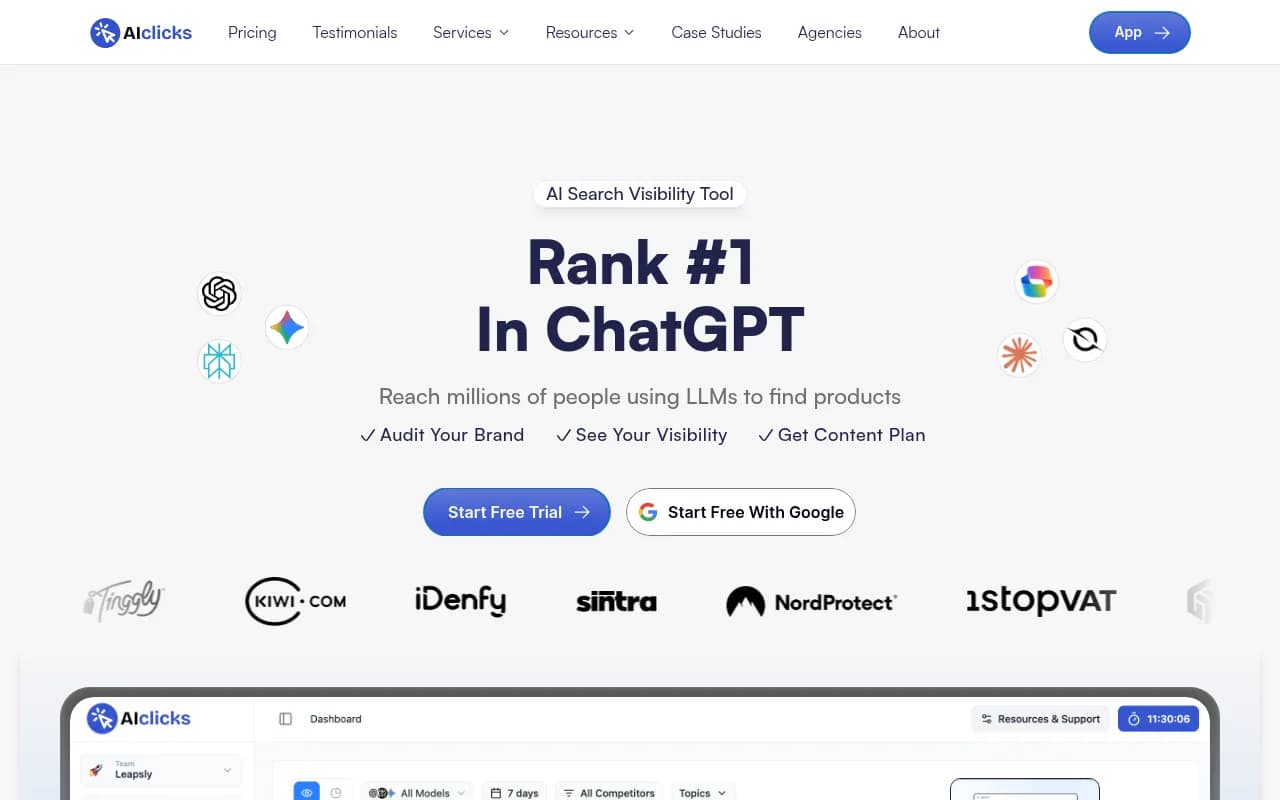
What you're still missing at this tier: deep content gap analysis, AI-powered content generation, crawler log access, and traffic attribution. You're getting monitoring, not optimization.
Mid-tier paid ($99-$249/month)
This is where the category starts to split into two distinct types of tools.
Type 1: Better monitoring. More prompts, more AI models, better reporting, maybe some competitor tracking. You get a clearer picture of where you stand.
Type 2: Optimization platforms. These don't just show you data -- they help you act on it. They identify which prompts you're losing to competitors, suggest or generate content to close those gaps, and track whether that content improves your visibility.
Semrush's AI Visibility Toolkit (a $99/month add-on to an existing Semrush subscription) falls into the first category. It's solid monitoring with a massive 100M+ prompt database, but it uses fixed prompts rather than letting you define your own, and it doesn't generate content for you.
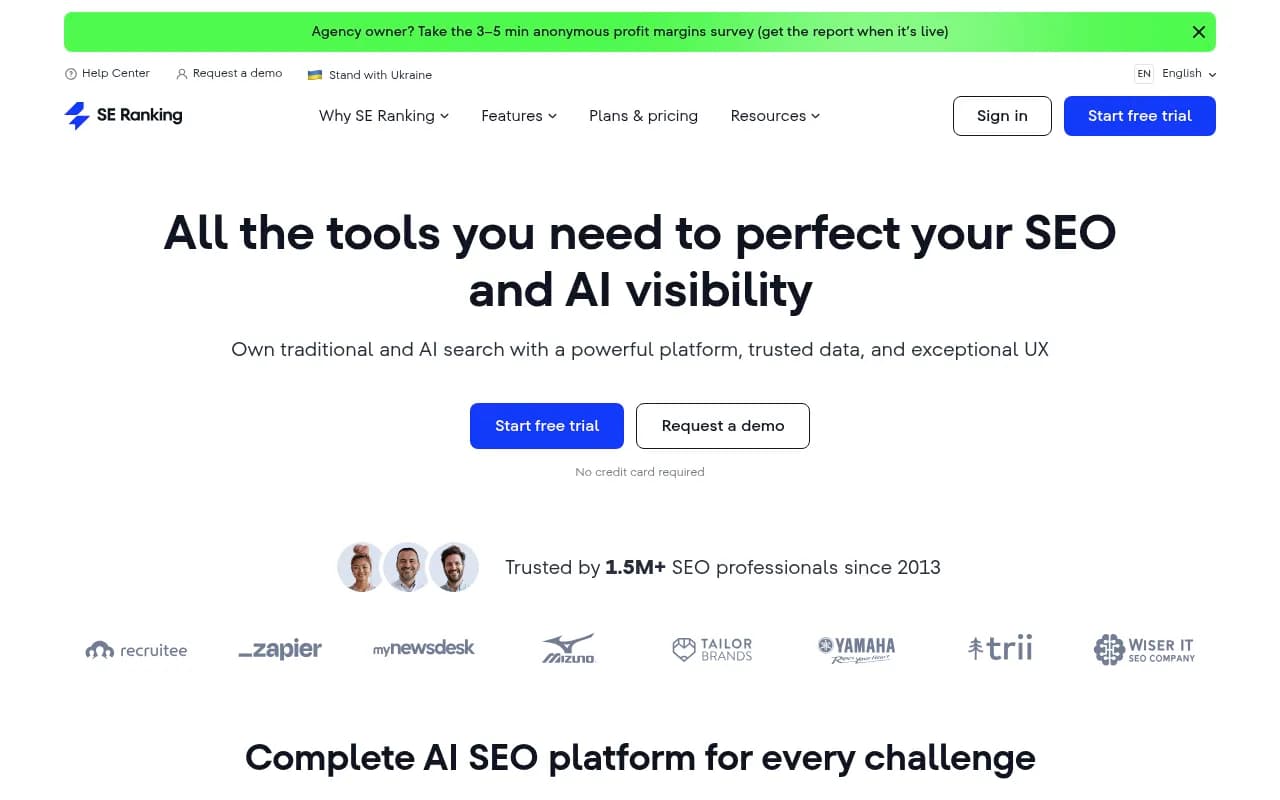
SE Ranking's AI visibility module is similar -- good tracking built into a broader SEO platform, but monitoring-focused.
Promptwatch sits firmly in the second category. At $249/month for the Professional plan, you get 150 prompts across 10 AI models, plus the content gap analysis and AI writing agent that most competitors lack entirely.

Enterprise tier ($500+/month)
At the top end, you're looking at platforms like Profound's higher tiers, Evertune (built for Fortune 500 brands), and Promptwatch's Business plan at $579/month.
Profound

The differentiators at this level: multi-site tracking, API access, custom reporting, agency white-labeling, and in some cases dedicated support. Promptwatch's Business plan covers 5 sites and 350 prompts, with Looker Studio integration and server log analysis for traffic attribution.
The feature comparison that actually matters
Here's a breakdown of what you get across the main tiers and tool types:
| Feature | Free tools | Entry paid ($15-$99) | Mid-tier paid ($99-$249) | Full optimization platform |
|---|---|---|---|---|
| AI models covered | 1-2 | 2-4 | 4-8 | 10+ |
| Prompt volume | 5-10 | 15-50 | 50-150 | 150-350+ |
| Scheduled monitoring | No | Basic | Yes | Yes |
| Competitor tracking | No | Limited | Yes | Yes |
| Sentiment analysis | No | Basic | Yes | Yes |
| Content gap analysis | No | No | Rarely | Yes |
| AI content generation | No | No | No | Yes |
| Crawler log access | No | No | No | Yes |
| Traffic attribution | No | No | No | Yes |
| Reddit/YouTube insights | No | No | No | Yes |
| API access | No | No | Some | Yes |
| Historical trend data | No | Limited | Yes | Yes |
The "full optimization platform" column describes what Promptwatch offers. Most competitors -- even at mid-tier pricing -- stop at monitoring.
The monitoring-only trap
This is worth dwelling on, because it's the most common mistake teams make when evaluating these tools.
A monitoring-only tool tells you that ChatGPT recommends your competitor when someone asks about your category. That's useful information. But it leaves you stuck: you know you have a problem, but the tool doesn't help you fix it.
The better question to ask any vendor is: "After I see that I'm invisible for a prompt, what does your platform help me do about it?"
If the answer is "we show you the response and you can export it," that's a monitoring tool. If the answer involves content gap analysis, content generation grounded in citation data, and tracking whether your new content improves visibility -- that's an optimization platform.
Tools like Otterly.AI and Peec.ai are solid monitoring tools. They're worth considering if you're just starting to understand your AI visibility landscape.

But if you're past the "understanding the problem" stage and want to actually improve your visibility, you need a platform that helps you create content AI models will cite.
Specific use cases and which tier fits
"I just want to know if ChatGPT mentions my brand"
Free tier is fine. Use GenRank, Mangools' free plan, or even just manually query ChatGPT a few times with your most important category prompts. You'll get your answer quickly.
"I'm managing brand visibility for a single product and want regular tracking"
Entry-level paid ($29-$99/month) makes sense. Otterly.AI or Peec.ai will give you scheduled monitoring across the main AI models without a huge commitment.
"I'm an SEO or marketing manager who needs to show AI visibility data to stakeholders"
Mid-tier paid with good reporting is what you need. SE Ranking's AI module works well if you're already using their platform. Promptwatch's Professional plan at $249/month is worth the step up if you want to move from reporting to actually improving the numbers.
"I'm an agency managing multiple client brands"
You need multi-site support, white-label reporting, and ideally an API. Promptwatch's Business or Agency plans are built for this. Rankscale is another agency-focused option worth evaluating.
"I'm at an enterprise brand and need to connect AI visibility to revenue"
This is where traffic attribution matters. You need a platform that can tell you not just that AI models cite your pages, but that those citations are driving actual traffic and conversions. Promptwatch's server log analysis and GSC integration does this. Evertune is another enterprise-focused option.
What to watch out for when evaluating tools
A few things that aren't always obvious from marketing pages:
Prompt variability: AI models give different answers to the same question in different sessions. A tool that runs each prompt once will give you noisy data. Look for platforms that run multiple iterations and aggregate results.
Model coverage: Some tools claim to track "10 AI models" but only have real-time data for 3-4 of them. Ask specifically which models are queried live vs. which are estimated or inferred.
Fixed vs. custom prompts: Some tools (including Semrush's AI toolkit) use a fixed prompt database. That's useful for benchmarking but limits your ability to track the specific queries your customers actually use. Custom prompt support matters.
Data freshness: How often are prompts re-run? Daily? Weekly? For fast-moving categories, weekly monitoring might miss important shifts.
What "citation" means: Some tools count any mention of your brand name as a citation. Others specifically track when AI models link to or reference your content as a source. The latter is more valuable for understanding your actual authority.
The bottom line
Free tools are fine for a quick check. Entry-level paid tools are fine if you just need to monitor. But if you want to actually improve how AI models talk about your brand -- and connect that improvement to business outcomes -- you need a platform that goes beyond monitoring.
The market in 2026 has plenty of options that will show you a dashboard of your AI visibility. Fewer will help you do something about it. That distinction is worth paying for.
For most marketing teams, the right starting point is a free trial of a mid-tier platform that includes content gap analysis. Run it for 30 days, identify your three biggest visibility gaps, create content to address them, and see if your scores improve. That cycle -- find gaps, create content, track results -- is what separates teams that are growing their AI visibility from teams that are just watching it.