Key takeaways
- AI assistants build restaurant answers from what the open web already says about you. They cannot be paid off, so the work is fixing your facts, your website, and your outside mentions.
- Put your menu, hours, prices, dietary options, and private dining details in crawlable HTML text. PDF menus and image-only pages are the most common reason a restaurant gets skipped.
- Keep your name, address, phone number, and hours identical across your site, Google Business Profile, Yelp, Tripadvisor, and reservation platforms.
- Most ChatGPT answers pull from many sources. Promptwatch Data shows 52.5% of organic prompts (the "best Italian in X" kind) cite 10 or more domains, so you need mentions beyond your own site.
- Test with real diner questions across several prompts and several weeks. A single query tells you almost nothing.
Why restaurants are a special case for GEO
Generative engine optimization (GEO) for a restaurant is local by nature. Someone types "where should I go for a nice dinner in Hoboken?" and gets a short list of named places. If you are not on it, that diner never sees you. No page two, no scrolling.
A caveat before the tactics. Vendor blogs from restaurant-tech companies quote numbers like "1 in 5 people use AI for restaurant information" (Owner.com cites a Reputation survey) and claim AI Overviews appear in 68% of local searches. I would treat those as directional marketing claims, not settled facts. The tactics below work whether the real number is 10% or 30%, because most of them also help classic local SEO.
Also worth saying: Promptwatch Data has no report specific to restaurants or dining. Where I cite numbers below, they come from adjacent reports and I will say what they do and do not cover.
How AI assistants actually pick restaurants
Large language models do not eat at your restaurant. They read about it. When ChatGPT gets a "best pizza near me" prompt, it runs live web searches and reads whatever comes back: websites, Google Business Profiles, ordering platforms, review sites, and local articles. The Forking Group describes the inputs as structured website data, consistent listings, and review volume and sentiment. Owner.com describes the same thing in plainer terms. It can only recommend you if that search turns you up.
Three things have to be true:
- Your core facts are the same everywhere they appear.
- Your website answers the question in text a machine can extract.
- Other credible sites mention you by name.
There is no paid placement in organic AI recommendations, which is oddly good news. Operators who do the boring work win.
Expect to share the answer
AI answers are crowded. According to Promptwatch's data for Sep 28 to Oct 4, 2026, 47.6% of ChatGPT responses with citations cite 10 or more unique domains, and for organic prompts that do not name a brand, the figure is 52.5%. You can read the full breakdown in the unique domains per response report. For restaurants, that means a "best Italian in Austin" answer is probably stitched together from a dozen pages: a city magazine list, a booking site, a couple of review platforms, maybe a food blog. Your own website is one voice among many.
Brand-specific prompts are different. When someone asks about your restaurant by name, only 21.3% of responses cite 10 or more domains, and the most common count is five. So your own site has a much better shot at shaping those answers. Both matter: discovery prompts bring new diners, brand prompts decide whether they book.
Step 1: Make your website readable by machines
Your site is the one source you fully control. Most restaurant sites fail here for boring reasons.
Publish the menu as HTML text
This is the number one fix. A PDF menu, or a menu rendered as an image or buried in a JavaScript widget, is hard for a crawler to read. Publish it as real text on a real page, with dish names, descriptions, prices, and dietary tags (vegan, gluten-free, nut-free). If the model cannot read "best gluten-free pasta," it will not repeat it.
Answer the questions diners actually ask
A good test: write down ten things a guest might ask an assistant, then check whether your site states each answer in a plain sentence.
- Do you take reservations, and how far ahead?
- Is there private dining for 20, and what does it cost?
- Is there outdoor seating? Is it dog friendly?
- What are your vegetarian and gluten-free options?
- Is there parking nearby?
- What is the price range?
Put these on dedicated pages or a clearly structured FAQ, not hidden inside a slideshow. Landing pages tend to stay cited longest in ChatGPT, according to the content half-life report, while news-type content loses half its cited pages within 36 days. That argues for durable pages (menu, private events, catering, neighborhood) over a blog of seasonal announcements.
Add structured data
Schema markup (Restaurant, LocalBusiness, Menu, and review types) gives machines your cuisine, address, hours, and price range in a format they read cleanly. On WordPress, plugins such as Yoast SEO or Rank Math handle the basics.
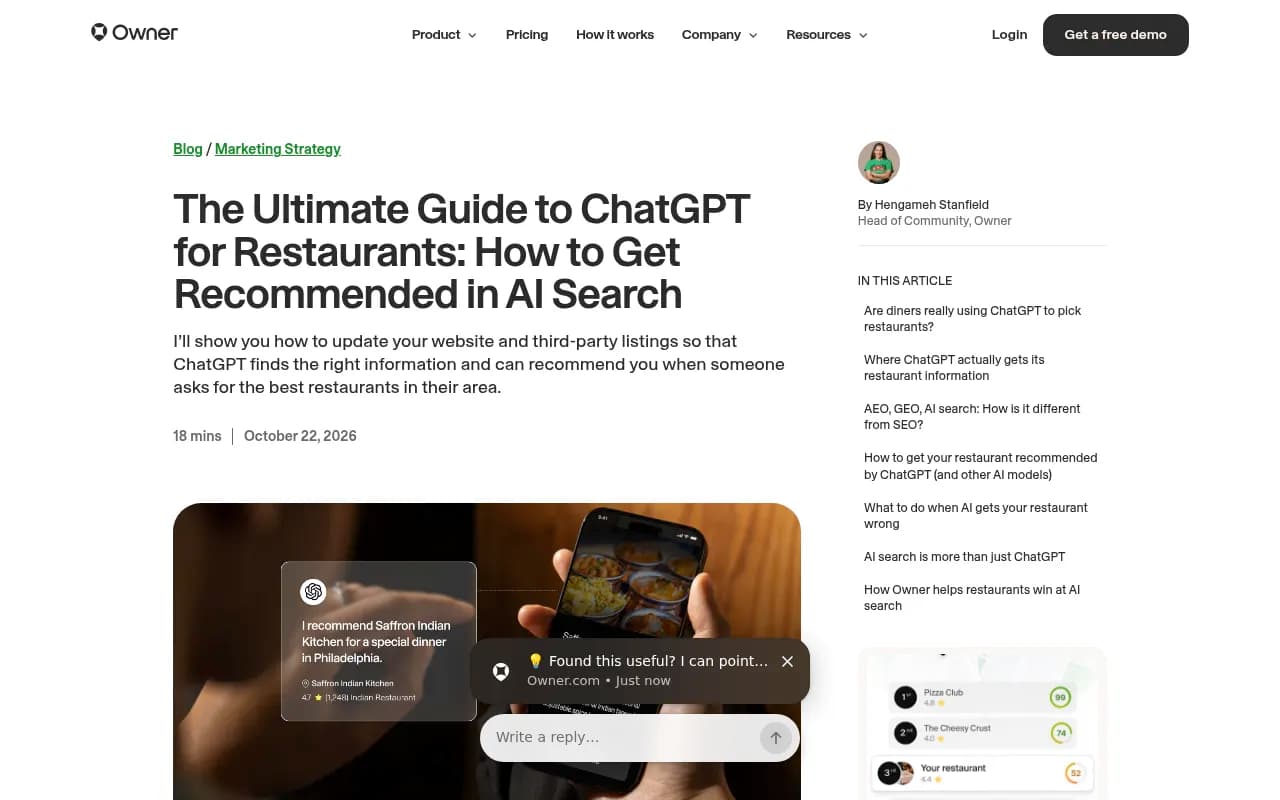
Site builders aimed at restaurants often do this automatically. Owner.com says its restaurant sites handle it, though as a vendor it has an interest in saying so. Whatever you use, view the page source or run a validator to confirm the markup actually shows up.
Do not block the crawlers
Check your robots.txt and any CDN or firewall rules. If AI crawlers get blocked or served errors, nothing else matters. A crawler like Screaming Frog will show you what a bot can actually reach, and it is worth running once on any restaurant site that was built years ago.
Step 2: Lock down your listings
Your name, address, and phone number (NAP) form your entity. When Google Business Profile, Yelp, Tripadvisor, OpenTable, delivery apps, and your site all agree, a model can trust that you are one real place. When they disagree (old hours, a previous phone number, "Joe's Kitchen" versus "Joes Kitchen & Bar"), models may repeat the wrong detail or skip you.
Practical checklist:
- Claim and complete your Google Business Profile: categories, hours, holiday hours, photos, menu link, attributes.
- Match the exact business name everywhere.
- Update hours the same day they change.
- Remove or merge duplicate listings.
- Link your reservation and ordering pages from your own site.
For one location, you can do this by hand in an afternoon. For a group with several venues, listing tools help. BrightLocal, Whitespark, Moz Local, Yext, and Uberall all manage listing consistency and audits.
Travel data gives a loose hint about which platforms matter. In ChatGPT travel citations for Sep 28 to Oct 4, 2026, booking and search sites earned 2.42% of the 4.18% total shown for the listed domains, more than half, and Tripadvisor was among the leaders (travel citation report). That is travel, not dining, so do not read it as a restaurant ranking. It does suggest that booking and review platforms carry real weight in local-intent answers, which is a reason to keep Tripadvisor, Yelp, and your reservation platform accurate.
Step 3: Reviews that describe you
Models read the language inside reviews to categorize you. A review saying "best gluten-free pasta in the neighborhood" or "great patio for groups" teaches an assistant something a star rating cannot. You cannot script reviews, and you should not try (fake reviews violate platform rules and can backfire). You can make leaving a useful one easier:
- Ask at the right moment, such as at the table or in the post-visit email.
- Prompt with specifics: "What did you order? Who did you come with?"
- Reply to reviews with substance. A reply that mentions the dish or the occasion adds more text about you.
Platforms like Birdeye, Reputation, and Podium handle review requests and monitoring at scale. They are more useful for groups than for a single neighborhood spot.
Step 4: Earn mentions off your own site
Since most answers draw on many domains, third-party mentions are how you get into the mix. Think of the pages an assistant would read when asked about your cuisine and neighborhood:
- City and regional "best of" lists and magazine guides
- Local food blogs and newsletters
- Local news and events coverage
- Guides like Time Out in larger cities
- Neighborhood and tourism sites
Pitching a local food writer, hosting a tasting, or giving a journalist a real story (a new chef, a sourcing change, an anniversary) is classic PR, and it feeds AI answers directly. Be named in the same sentence as your cuisine and neighborhood. "Best tacos in Silver Lake" in a respected list does more than a vague mention.
What about Reddit and social?
Older restaurant-GEO guides tell you to seed Reddit. That advice has aged badly for ChatGPT. Promptwatch Data shows reddit.com's share of ChatGPT citations fell from about 4% to 0.5% on August 14, 2026 (report). For Sep 28 to Oct 4, 2026, all seven tracked social platforms together made up only 0.46% of ChatGPT's citations, while Google AI Overviews drew 12.2% of its citations from social platforms (social media citations report).
The same report breaks down AI Overviews: YouTube 4.28%, Facebook 2.38%, Reddit 2.15%, Instagram 1.61%. For a restaurant, the sensible reading is to keep public Facebook and Instagram profiles complete and active, and to consider YouTube (a short kitchen or venue tour with a clear title and description) if you care about Google's AI answers. Do not build a ChatGPT plan around Reddit threads.
Step 5: Test where you stand
Start manually. Ask ChatGPT, Gemini, and Perplexity the questions a real guest would ask:
- "best [cuisine] restaurant in [neighborhood]"
- "where can I do private dining for 20 in [city]"
- "restaurants with good vegan options near [landmark]"
- "romantic dinner with outdoor seating in [city]"
If a competitor shows up, ask the assistant why it picked them. The answer often points at a specific listicle, review site, or menu page you can go after. Note which sources get cited, because those are your outreach targets.
And repeat it. Answers vary between runs and between days. One test is an anecdote; twenty prompts over a month is data. ChatGPT itself is the obvious place to start.
Tracking at scale
Manual checks get tedious fast. Dedicated AI visibility tools run your prompts on a schedule and log mentions, positions, and cited sources. Promptwatch is one option: it tracks the real interfaces of ChatGPT, Google AI Overviews, AI Mode, Gemini, and Perplexity by country, and its crawler logs show whether AI bots can read your pages at all. That last part matters for restaurants on older or JavaScript-heavy sites.

Other options in our catalog include Otterly.AI, Peec AI, and Profound, which are primarily monitoring tools. For a wider look, the GEO software directory at bestgeosoftware.com lists more. A single-location restaurant probably does not need an enterprise platform; a free manual routine plus a cheap tracker is plenty. Multi-venue groups and agencies get more out of automation.
Otterly.AI


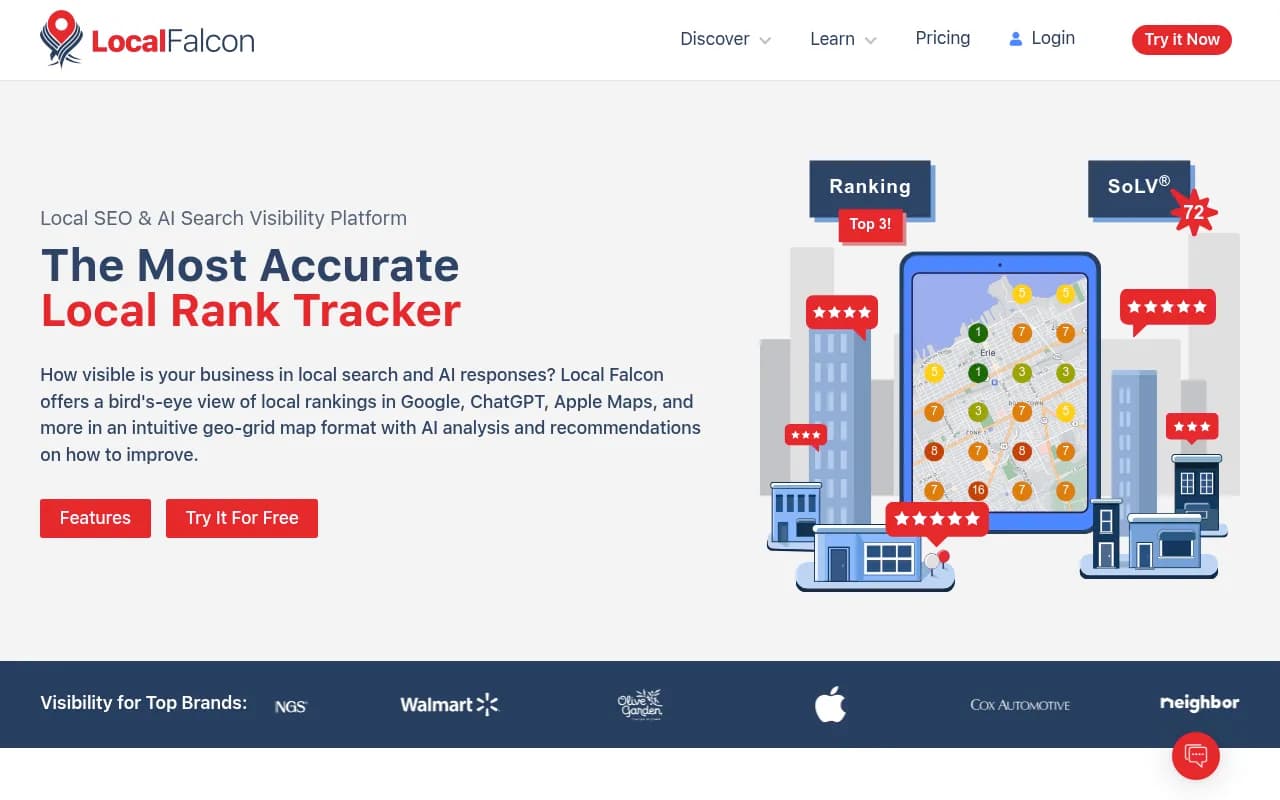
For local map rankings, which still feed everything else, Local Falcon shows geo-grid positions around your venue.
Tool comparison for restaurant GEO
| Job | Tools to consider | Best for |
|---|---|---|
| Listing consistency | BrightLocal, Whitespark, Moz Local, Yext, Uberall | Groups with multiple locations |
| Review requests and replies | Birdeye, Reputation, Podium | Operators with steady review volume |
| Structured data on WordPress | Yoast SEO, Rank Math | Single-site restaurants on WordPress |
| Crawl checks | Screaming Frog | Anyone with an older site |
| Local map rank | Local Falcon | Competitive city neighborhoods |
| AI visibility tracking | Promptwatch, Otterly.AI, Peec AI | Seeing mentions and cited sources |
A realistic 30-day plan
Week 1: Audit
Run your prompts across ChatGPT, Gemini, and Perplexity. Record who gets named and which sources are cited. Check Google Business Profile and every major listing for mismatches.
Week 2: Fix the site
Convert the PDF menu to HTML. Add FAQ content, private dining and catering pages, and structured data. Confirm crawlers are not blocked.
Week 3: Listings and reviews
Correct every listing, merge duplicates, and set up a simple review-request habit with specific prompts.
Week 4: Mentions
List the sources that kept appearing in competitor answers. Pitch two or three local writers or list publishers. Fill out Facebook and Instagram profiles if they are thin.
Then retest with the same prompts and compare. Expect slow movement. Newly updated pages need to be crawled, and third-party lists change on their own schedule.
Mistakes I see most often
- Treating the menu PDF as harmless. It is usually the main blocker.
- Letting hours drift on one platform. A model quoting the wrong closing time costs you a diner and trust.
- Chasing Reddit for ChatGPT visibility after the August 2026 drop.
- Judging success from one prompt on one day.
- Ignoring brand-name prompts. People who already know you still ask AI about your menu and hours, and your site should win those.
Do you need an agency?
Most single restaurants can do the fundamentals in-house. Multi-location groups, or operators short on time, may want outside help with listings, PR, and measurement. 1001 SEO Media works on local SEO and AI search visibility and is one place to start if you want a done-for-you option.
Bottom line
Getting recommended by ChatGPT is mostly the same work that has always helped local restaurants: accurate facts, a site that answers real questions, good reviews with real language, and coverage from people who write about food in your city. The difference is that the audience is now a model that reads everything and repeats what it can verify. Fix the PDF menu first, then the listings, then go earn mentions, and measure with many prompts rather than one.