Key takeaways
- Most platforms in this category are monitoring dashboards — they show you citation data but don't help you fix the gaps.
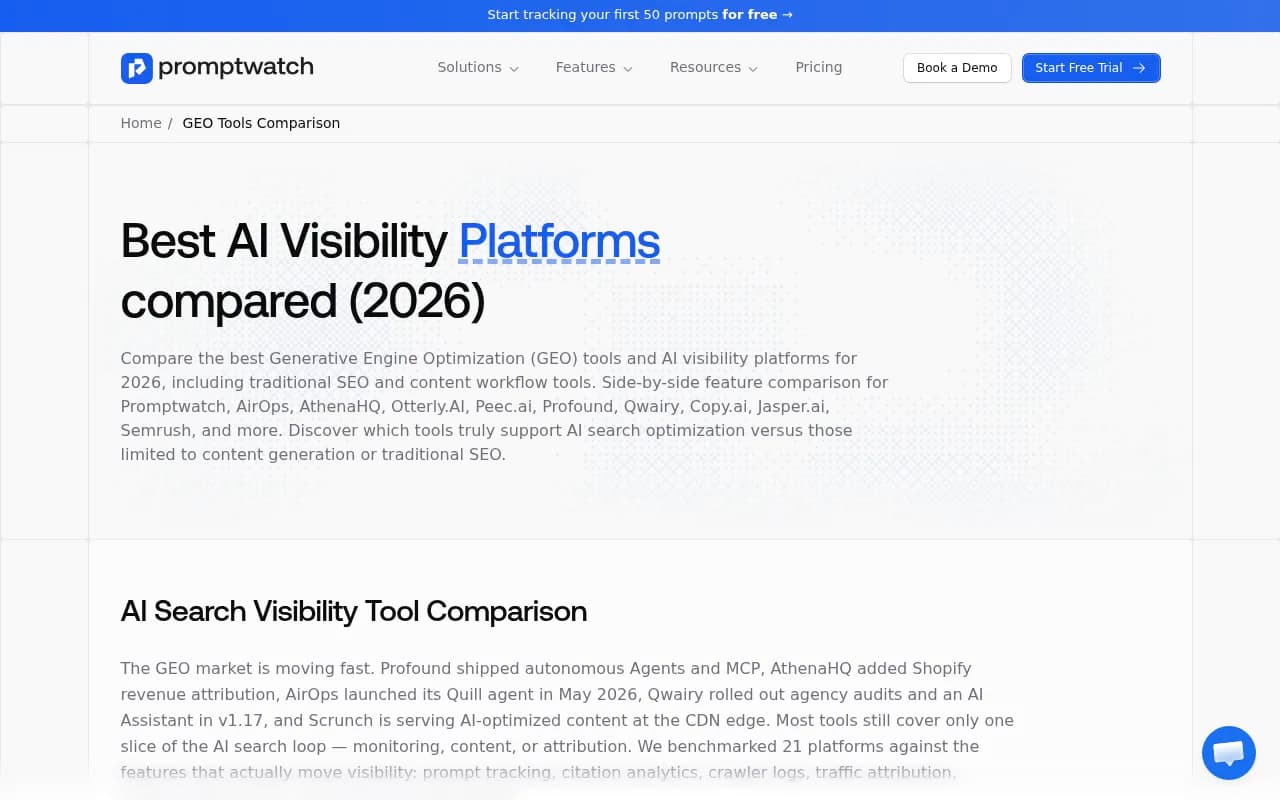
- Promptwatch is the only platform in this comparison that covers the full loop: tracking, content gap analysis, AI content generation, and crawler logs in one place.
- Profound is the best-funded player ($58.5M raised) and strong on enterprise monitoring, but content generation is not its core focus.
- AirOps is built for content operations at scale, but it's significantly more expensive and doesn't include native AI search monitoring.
- Searchable and Atomic AGI are newer entrants with narrower feature sets — useful in specific contexts but not full-stack solutions.
- If your goal is to actually appear in AI answers (not just track whether you do), the platform you choose needs to close the loop from gap to content to citation.
The AI search visibility category has a dirty secret: most platforms are built to show you a problem, not solve it. You get a dashboard full of citation scores, share-of-voice charts, and competitor heatmaps. Then you close the tab and wonder what to actually do next.
That gap between insight and action is where most enterprise teams get stuck. And it's the right lens for evaluating the five platforms in this comparison: Promptwatch, Profound, AirOps, Searchable, and Atomic AGI.
These are not the same kind of tool. Some track. Some generate. Some do a bit of both. Understanding what each one actually does — and where it stops — will save you from buying a monitoring dashboard when what you need is a content engine, or vice versa.
What "getting cited" actually requires
Before comparing platforms, it's worth being precise about what we mean. Getting cited by ChatGPT, Perplexity, or Google AI Overviews isn't random. These models pull from sources that:
- Directly answer the specific prompt being asked
- Are crawled and indexed by AI crawlers (GPTBot, ClaudeBot, PerplexityBot, etc.)
- Are considered authoritative for the topic based on the model's training and retrieval logic
That means the path from "invisible in AI search" to "cited regularly" involves three distinct steps:
- Knowing which prompts you're missing (gap analysis)
- Creating content that answers those prompts better than what currently exists
- Verifying that AI crawlers found your new content and started citing it
A platform that only does step one is a monitoring tool. A platform that does all three is an optimization platform. That distinction matters a lot when you're evaluating enterprise spend.
The five platforms compared
Promptwatch
Promptwatch is the platform most explicitly built around the full optimization loop described above. It tracks brand visibility across 10 AI models (ChatGPT, Perplexity, Claude, Gemini, Google AI Overviews, DeepSeek, Grok, Copilot, Meta AI, Mistral), but the monitoring layer is just the entry point.
The real differentiator is what happens after you see a gap. Promptwatch's Answer Gap Analysis identifies specific prompts where competitors are being cited and you aren't — not just categories, but the actual questions AI models are answering without mentioning you. From there, Content Agents generate articles, comparisons, and listicles grounded in that prompt data, with brand guidance, competitor context, and real citation patterns baked in.
The third piece is AI Crawler Logs (available on Professional and Business plans). These are real-time logs of when GPTBot, ClaudeBot, PerplexityBot, and others crawl your pages — which pages they read, how often they return, and when a crawled page moves to an actual citation. That's the feedback loop most platforms don't have.
Other capabilities worth noting: page-level citation tracking, Reddit and YouTube insights, ChatGPT Shopping monitoring, offsite citation analysis, prompt volume and difficulty scoring, and multi-language/multi-region support. Pricing starts at $99/month (Essential), $249/month (Professional), and $579/month (Business).

Profound
Profound is the most-funded platform in this category at $58.5M raised, and it shows in the product's depth on the monitoring side. It covers 10+ AI models, includes prompt demand estimation, sentiment analysis, and dedicated AI shopping insights. In mid-2026, Profound shipped autonomous Agents and MCP (Model Context Protocol) integration, which lets it connect more directly with AI workflows.
For pure enterprise-scale monitoring, Profound sets a high bar. It's particularly strong on share-of-voice tracking across models and on understanding how AI models perceive your brand's sentiment and positioning.
Where Profound falls short for teams trying to close the loop: content generation is not a core feature. You get excellent data about where you're invisible, but the path from that data to published content that fixes the problem requires other tools. Profound also doesn't include Reddit or YouTube tracking, and there's no native AI crawler log functionality.
Pricing is not publicly listed — Profound operates on enterprise contracts, which typically means it's priced above most mid-market budgets.
Profound

AirOps
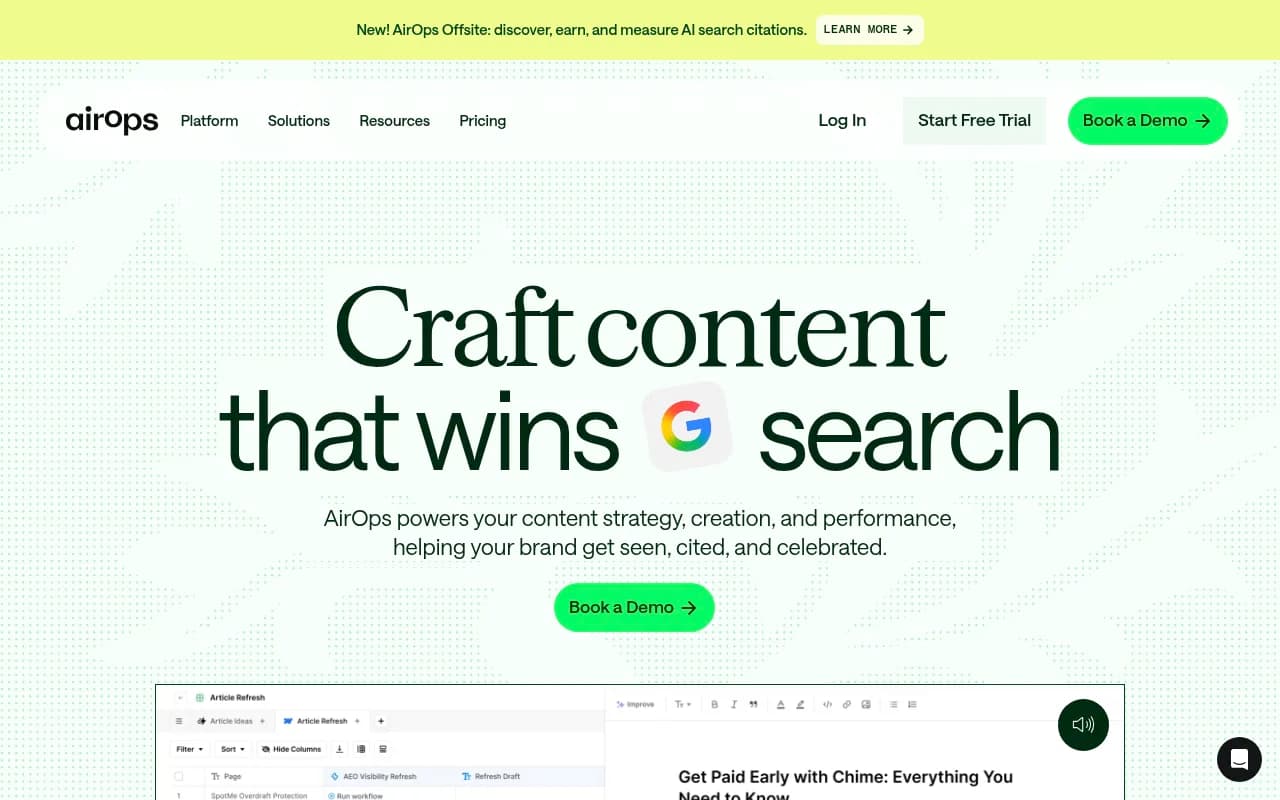
AirOps is a different kind of tool. It's primarily a content operations platform that uses AI to help teams produce content at scale — think structured workflows, content briefs, and publishing pipelines. In May 2026, AirOps launched its Quill agent, which adds more autonomous content generation capability.
The connection to AI search visibility is real but indirect. AirOps can help you produce content faster, and if that content is well-structured and answers the right questions, it may improve your AI citations. But AirOps doesn't natively track which prompts you're missing, doesn't monitor your citation share across AI models, and doesn't include crawler logs or traffic attribution from AI search.
One honest watch-out from research: AirOps is significantly more expensive than other tools in this category. If you're evaluating it specifically for GEO/AEO purposes, you're paying for a broader content operations platform and using a fraction of it for AI visibility work.
Searchable
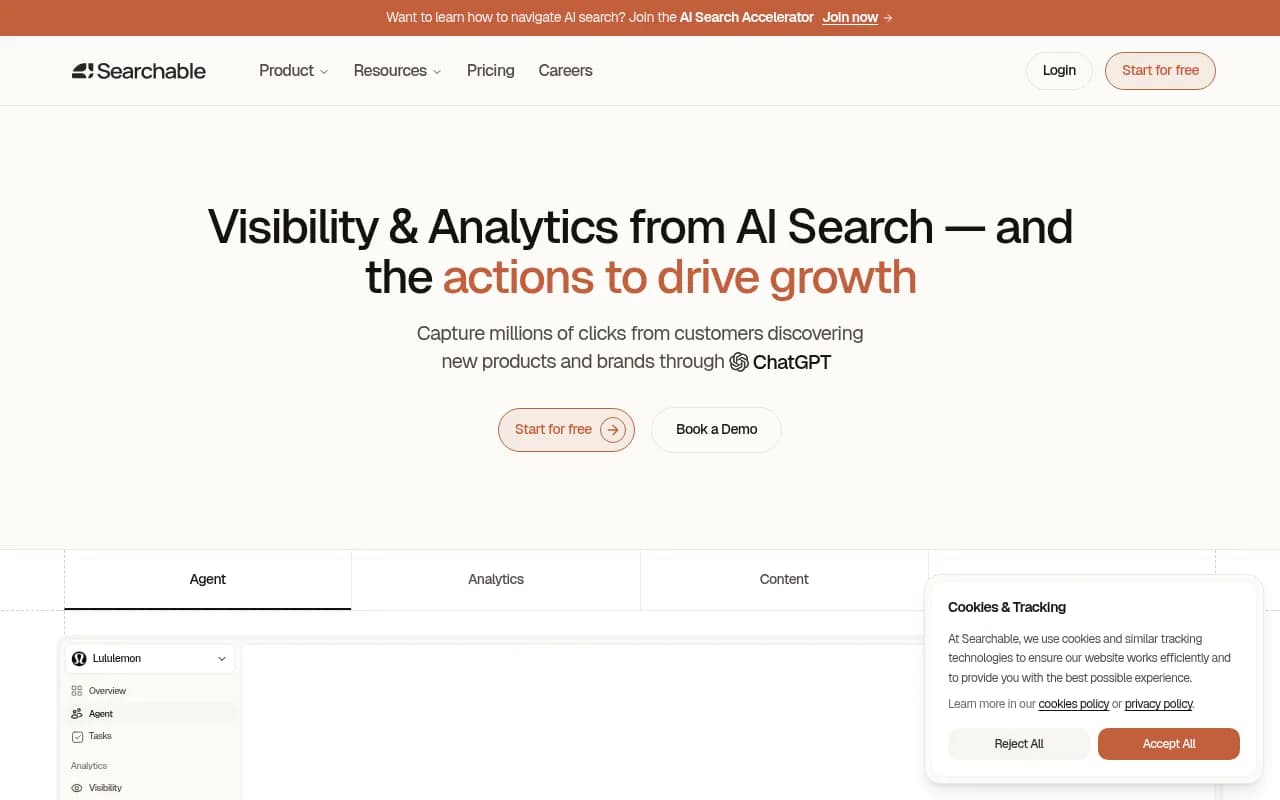
Searchable is a newer entrant that combines AI search visibility monitoring with built-in content generation. The pitch is similar to Promptwatch's — track where you're invisible, then generate content to fix it — but the platform is earlier in its development.
Searchable covers the core monitoring use case reasonably well for teams getting started with AI visibility. The content generation features exist but are less mature than Promptwatch's Content Agents, which are grounded in real prompt data, citation patterns, and competitor analysis.
Where Searchable has a gap: no crawler log functionality, no Reddit or YouTube insights, no ChatGPT Shopping tracking, and no traffic attribution connecting AI visibility to revenue. For teams that need a lightweight starting point, it's worth evaluating. For enterprise teams that need the full loop, it's not there yet.
Atomic AGI
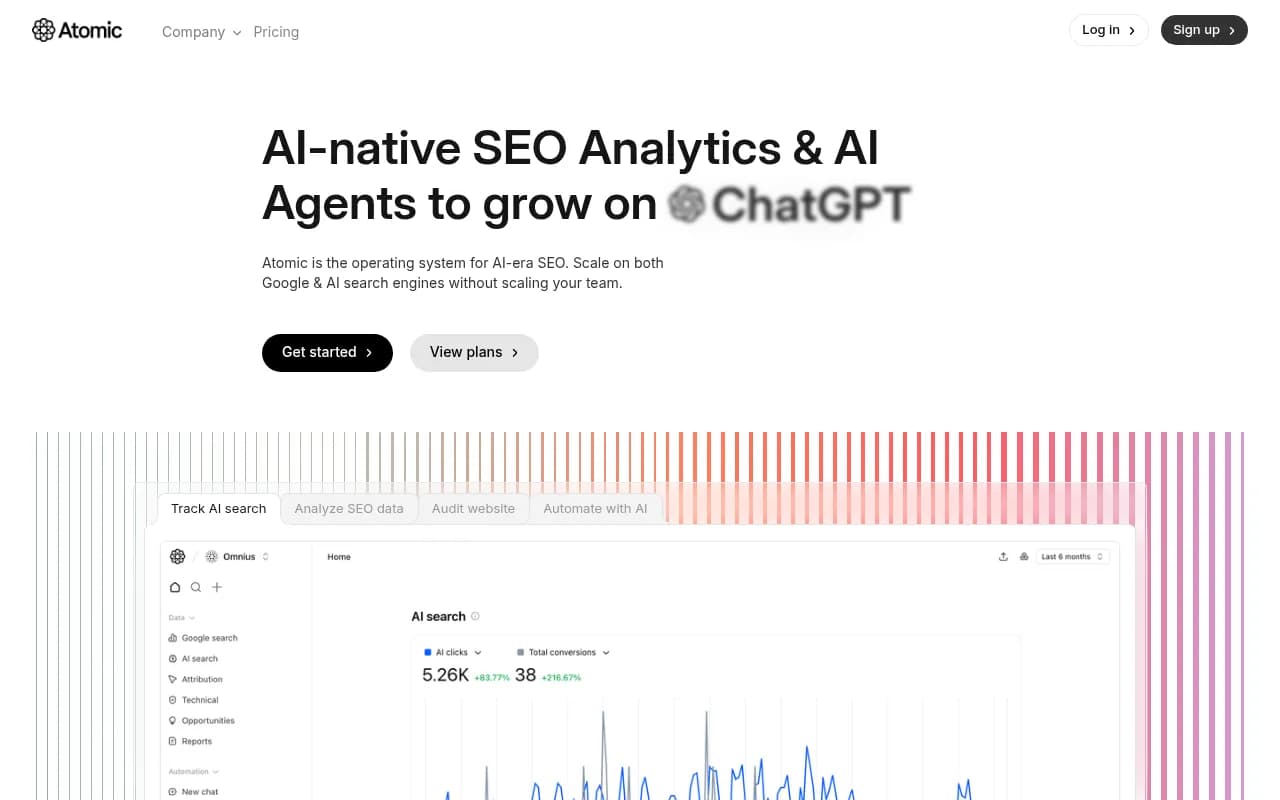
Atomic AGI positions itself as an AI-native SEO platform that combines multi-engine tracking with workflow automation. It covers prompt monitoring across major AI models and has workflow features that let teams act on visibility data.
The platform is thoughtful about the "why" of AI search monitoring — their own content on the topic is genuinely useful for understanding the category. But as a product, Atomic AGI is more monitoring-plus-workflow than a true end-to-end optimization platform. Content generation capabilities are present but not the core of the product.
Atomic AGI is a reasonable choice for teams that want more than a basic tracker but aren't ready for the full enterprise stack. It's worth comparing directly against Promptwatch's Professional tier to see where the feature gaps land for your specific use case.
Feature comparison
| Feature | Promptwatch | Profound | AirOps | Searchable | Atomic AGI |
|---|---|---|---|---|---|
| AI model coverage | 10 models | 10+ models | None (content ops) | Limited | Multiple |
| Prompt tracking | Yes | Yes | No | Yes | Yes |
| Citation analytics | Yes | Yes | No | Basic | Basic |
| Answer gap analysis | Yes | Limited | No | Limited | No |
| AI content generation | Yes (Content Agents) | No | Yes (core feature) | Yes (basic) | Limited |
| AI crawler logs | Yes | No | No | No | No |
| Traffic attribution | Yes | No | No | No | No |
| Reddit/YouTube insights | Yes | No | No | No | No |
| ChatGPT Shopping tracking | Yes | Yes | No | No | No |
| Prompt volume/difficulty | Yes | Yes | No | No | Limited |
| Offsite citation analysis | Yes | Limited | No | No | No |
| Multi-language/region | Yes | Yes | No | Limited | Limited |
| Public pricing | Yes ($99-$579/mo) | No (enterprise) | No (enterprise) | Limited | Limited |
Which platform is right for which team
The honest answer depends on what problem you're actually trying to solve.
If you need to monitor AI citations and understand your share of voice across models, all five platforms do some version of this. Profound does it at the highest level of sophistication for pure monitoring. Promptwatch does it with the same depth and adds the action layer on top.
If you need to generate content that gets cited, not just track whether you're being cited, the field narrows quickly. AirOps is the strongest pure content operations platform, but it doesn't know which prompts to target. Promptwatch's Content Agents are grounded in real prompt data and citation patterns, which means the content is engineered for the specific gaps AI models are exposing.
If you need to prove that your new content is being crawled and cited, only Promptwatch has AI crawler logs that show the timeline from publish to crawl to citation. This is the feedback loop that makes optimization possible rather than just hopeful.
If you're a smaller team or just getting started, Searchable or Atomic AGI might be the right entry point before committing to a more comprehensive platform.
The monitoring-only trap
One pattern worth naming directly: a lot of enterprise teams buy a monitoring platform, generate impressive-looking dashboards, and then struggle to show actual improvement in AI citations six months later. The data was there. The action wasn't.
This isn't a knock on monitoring — you need to know where you stand before you can improve. But monitoring without a clear path to content creation and verification is an expensive way to watch a problem you're not fixing.
The platforms that close this loop — where gap analysis feeds content generation, and crawler logs confirm the content is being found — are the ones that actually move the needle. Right now, Promptwatch is the most complete version of that loop in a single platform.
A note on pricing and enterprise fit
Profound's enterprise pricing model means it's typically out of reach for teams without a dedicated budget and procurement process. AirOps is similarly priced for enterprise content operations teams. If you're a marketing team of 5-15 people trying to move fast, those price points create friction.
Promptwatch's public pricing ($99-$579/month) makes it accessible for teams at different stages. The Essential plan at $99/month covers 50 prompts and 5 articles per month — enough to run a meaningful test before scaling. The Business plan at $579/month covers 5 sites, 350 prompts, and 30 articles, which is where most mid-market enterprise teams land.
For agencies managing multiple client brands, Promptwatch's agency/enterprise tier includes custom pricing and the multi-site infrastructure to manage visibility across a portfolio.
Bottom line
The question in the title — which platform actually generates content that gets cited — has a fairly clear answer in 2026.
Profound is the best pure monitoring platform if budget isn't a constraint and you have a separate content team to act on the data. AirOps is the best content operations platform if you already know what to write and need to produce it at scale. Searchable and Atomic AGI are reasonable starting points for teams earlier in their AI visibility journey.
But if you need one platform that finds the gaps, generates the content, and confirms the content is being crawled and cited, Promptwatch is the only option in this comparison that does all three. The action loop — gap analysis to content generation to crawler verification to citation tracking — is what separates an optimization platform from a monitoring dashboard.
For most enterprise marketing teams, that distinction is the whole game.