Key takeaways
- Promptwatch is the only platform in this comparison that covers the full optimization loop: tracking, gap analysis, content generation, and crawler intelligence in one place.
- Profound is a strong enterprise monitoring tool but stops short of helping you act on what it finds.
- Atomic AGI and Relixir are both building toward end-to-end GEO, but each has meaningful gaps depending on your use case.
- Geostar is the lightest option here -- useful for basic visibility checks, not for teams serious about improving their AI search presence.
- If your goal is to actually improve AI visibility (not just measure it), the platform you pick matters enormously.
The GEO platform market in 2026 is crowded in a specific, frustrating way. There are now dozens of tools that will tell you how visible your brand is in ChatGPT or Perplexity. Far fewer will tell you why you're invisible -- and fewer still will help you fix it.
This comparison focuses on five platforms that have been getting real attention this year: Profound, Promptwatch, Atomic AGI, Relixir, and Geostar. They're not all playing the same game. Some are monitoring dashboards with a nice UI. Others are trying to be full optimization engines. The difference matters a lot when you're trying to justify the spend to a marketing director.
Let's get into it.
What we're actually comparing
Before the breakdown, it's worth being clear about what separates a tracking tool from an optimization platform. The distinction isn't marketing fluff -- it changes what you can actually do with the product.
A tracking tool shows you citation rates, share of voice, and which prompts your brand appears in. That's useful baseline data. An optimization platform does all of that, then shows you the specific gaps (prompts where competitors appear but you don't), helps you understand why, and gives you tools to create content that closes those gaps. Then it tracks whether the new content actually gets cited.
Most tools in 2026 are still in the first category. A few are genuinely in the second.
The five platforms
Profound
Profound

Profound has been around long enough to build a serious enterprise reputation. It tracks brand mentions across ChatGPT, Perplexity, Claude, Gemini, Copilot, and several others -- nine or more AI engines depending on the plan. The interface is clean, the data is reliable, and the share-of-voice reporting is genuinely useful for enterprise teams that need to show AI visibility trends to leadership.
Where Profound runs into limits is on the "now what?" side of things. The platform is strong at telling you where you stand. It's less strong at telling you what to do about it. There's no content generation, no crawler log analysis, and no prompt-level gap analysis that shows you the specific questions your competitors are answering that you're not. For a tool at Profound's price point, that's a real gap.
It's also worth noting that Profound's pricing is on the higher end of the market -- it targets enterprise teams, and the feature set reflects that focus. If you're a mid-market marketing team or a growing agency, you may find you're paying for enterprise reporting infrastructure when what you actually need is actionable optimization.
Best for: Enterprise brands that need reliable AI share-of-voice data and executive-level reporting, and have a separate content team to act on the insights.
Promptwatch

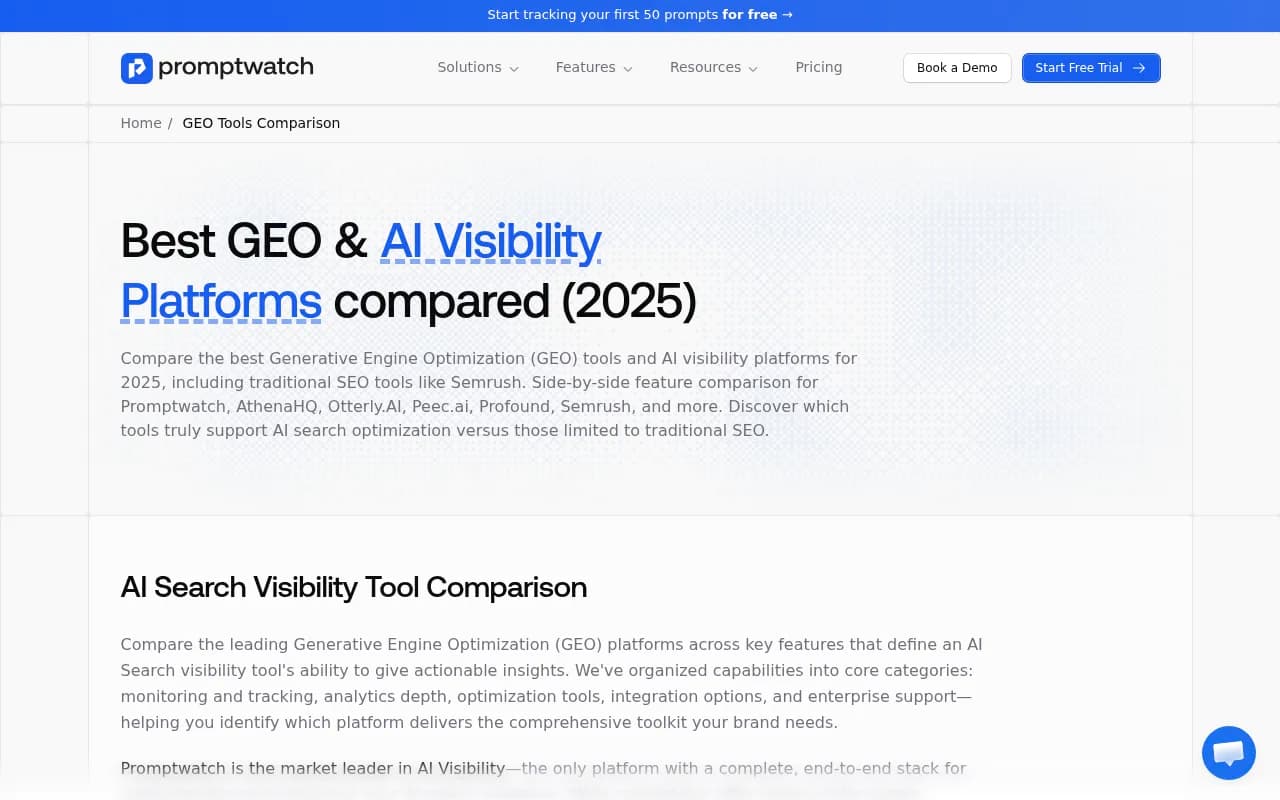
Promptwatch is the platform I'd point most teams toward in 2026, and the reason is straightforward: it's the only one in this comparison that actually closes the loop between finding gaps and fixing them.
The tracking layer is solid -- it monitors 10 AI models including ChatGPT, Perplexity, Claude, Gemini, Grok, DeepSeek, Mistral, Google AI Overviews, Google AI Mode, and Copilot. But what separates it is what happens after the tracking. The Answer Gap Analysis shows you exactly which prompts competitors rank for that you don't. The Content Agents then generate articles, listicles, and briefs grounded in that prompt data -- not generic SEO content, but pieces engineered to answer the specific questions AI models are already surfacing.
The AI Crawler Logs feature is something most competitors don't have at all. It shows you in real time which AI crawlers (GPTBot, ClaudeBot, PerplexityBot) are hitting your pages, which pages they're reading, and when a crawled page moves to an actual citation. That's the kind of technical visibility that lets you diagnose indexing problems before they become ranking problems.
Prompt Intelligence is another differentiator -- volume estimates and difficulty scores for each prompt, plus query fan-outs that show how one question branches into sub-queries. This lets you prioritize the prompts worth going after instead of guessing.
Pricing starts at $99/month for the Essential plan (1 site, 50 prompts, 5 articles), $249/month for Professional (2 sites, 150 prompts, 15 articles, crawler logs), and $579/month for Business (5 sites, 350 prompts, 30 articles). There's a free trial, and annual billing brings the cost down further.
Best for: Marketing and SEO teams that want to improve AI visibility, not just measure it. Also strong for agencies managing multiple client sites.
Atomic AGI
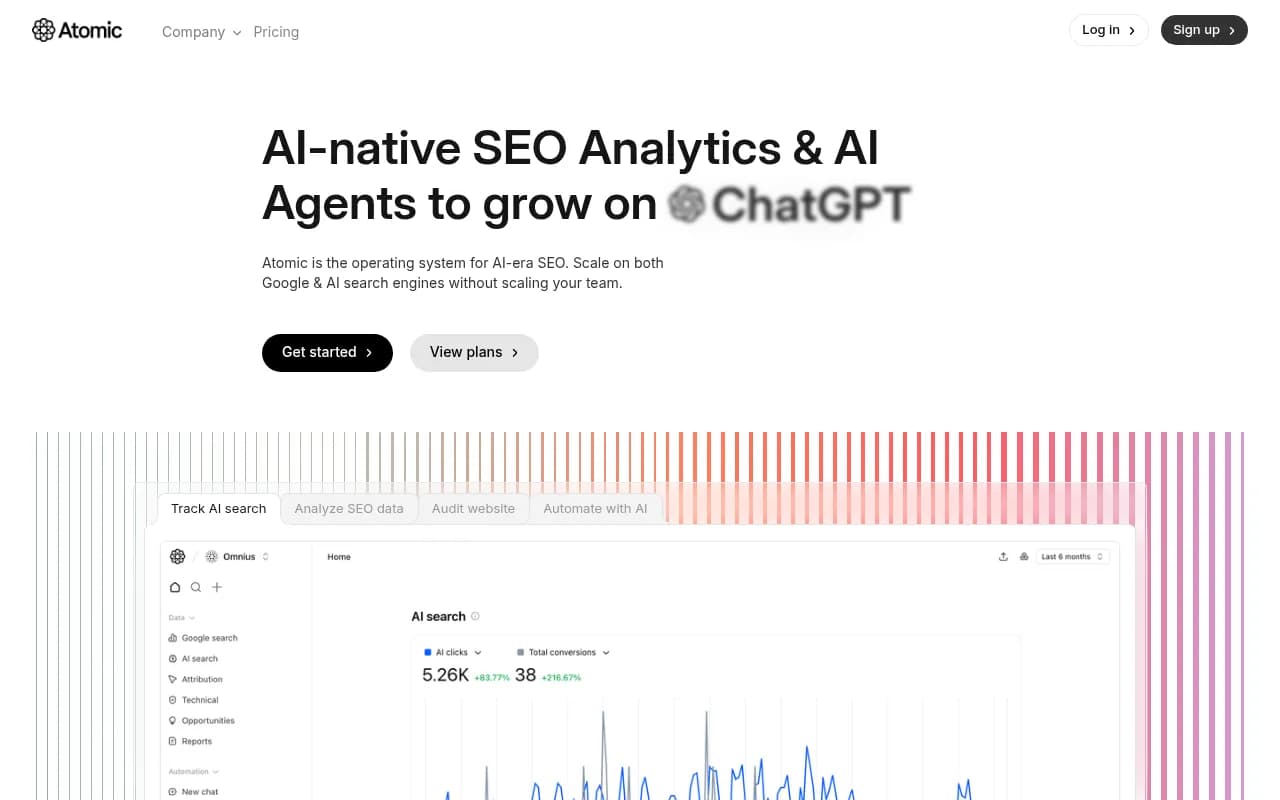
Atomic AGI positions itself as an AI-native SEO platform that combines multi-engine tracking with workflow automation. It's been building out its feature set quickly, and the platform has some genuinely interesting capabilities -- particularly around workflow automation for content teams that want to systematize their GEO process.
The tracking covers the major AI engines, and the interface is designed for teams that want to move fast. Atomic AGI also publishes useful content (their blog on Profound alternatives, for instance, is one of the more honest comparisons in the space), which suggests the team understands the GEO landscape well.
The gaps are in depth. Crawler log analysis isn't a feature. The prompt intelligence layer -- volume estimates, difficulty scoring, query fan-outs -- is less developed than Promptwatch's. And the content generation, while present, is more template-driven than data-grounded. You get content tools, but they're not as tightly connected to real prompt and citation data as you'd want for serious GEO work.
For teams that are just getting started with GEO and want a workflow-friendly tool that doesn't overwhelm, Atomic AGI is worth a look. For teams that need deep optimization, it's a stepping stone.
Best for: Teams new to GEO who want workflow automation alongside basic tracking, without the complexity of a full enterprise platform.
Relixir
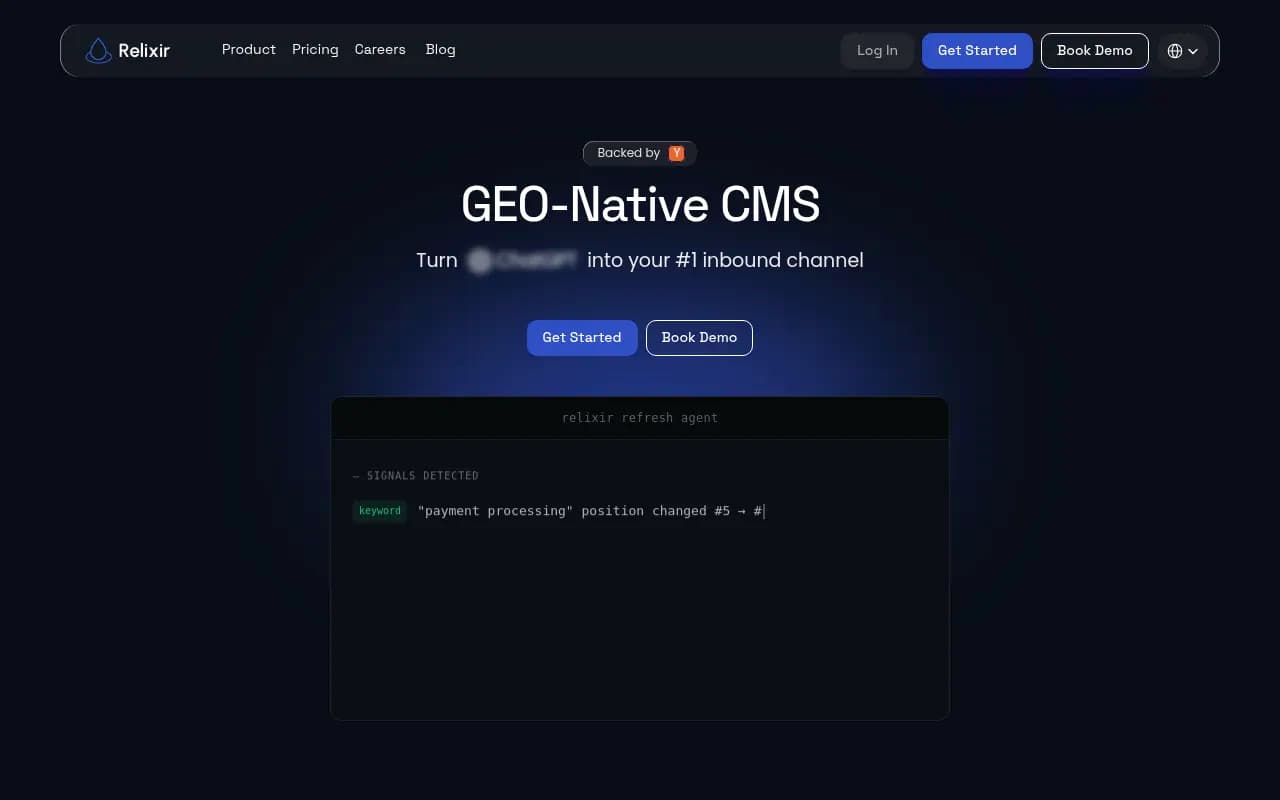
Relixir markets itself as an end-to-end GEO engine built for enterprise brands. The ambition is clear, and the platform has some real strengths -- particularly in competitive analysis and the breadth of AI engines it covers.
What Relixir does well is give you a comprehensive view of your competitive position in AI search. The share-of-voice comparisons are detailed, and the platform is designed for teams that need to present AI visibility data to stakeholders. There's also content optimization guidance, which puts it ahead of pure monitoring tools.
The challenge is that "end-to-end" is doing a lot of work in Relixir's positioning. The content generation capabilities are less mature than the tracking side, and the crawler intelligence layer -- which is increasingly important as AI crawlers become more sophisticated -- isn't a core part of the product. The platform is also relatively new, which means the data set (citations analyzed, prompts tracked) is smaller than more established players.
If Relixir continues building at its current pace, it could become a serious contender. Right now, it's a strong monitoring and competitive analysis tool that's still filling in the optimization side.
Best for: Enterprise teams focused on competitive benchmarking and AI share-of-voice reporting, with tolerance for a platform that's still maturing.
Geostar
Geostar is the lightest option in this comparison. It tracks brand visibility across AI search engines and provides basic reporting on where your brand appears and how often. The interface is clean and the setup is fast.
The honest assessment: Geostar is a monitoring tool, not an optimization platform. There's no content generation, no gap analysis, no crawler logs, and no prompt intelligence. It tells you what's happening but not why, and it doesn't help you change it.
For a small business or solo marketer who just wants a simple dashboard to check whether they're appearing in AI answers, Geostar is fine. For any team that's serious about GEO as a growth channel, you'll hit the ceiling quickly.
Best for: Small businesses or individuals who want basic AI visibility monitoring without complexity or high cost.
Feature comparison
| Feature | Promptwatch | Profound | Atomic AGI | Relixir | Geostar |
|---|---|---|---|---|---|
| AI engines tracked | 10+ | 9+ | 6+ | 8+ | 4+ |
| Answer gap analysis | Yes | No | Partial | Partial | No |
| Content generation | Yes | No | Yes | Partial | No |
| AI crawler logs | Yes | No | No | No | No |
| Prompt volume/difficulty | Yes | No | No | No | No |
| Query fan-outs | Yes | No | No | No | No |
| Reddit/YouTube insights | Yes | No | No | No | No |
| ChatGPT Shopping tracking | Yes | No | No | No | No |
| Competitor heatmaps | Yes | Yes | Partial | Yes | No |
| Offsite citation analysis | Yes | Partial | No | No | No |
| Multi-language/region | Yes | Yes | Partial | Partial | No |
| Traffic attribution | Yes | No | No | No | No |
| Free trial | Yes | Limited | Yes | Limited | Yes |
| Starting price | $99/mo | Enterprise | Mid-market | Enterprise | Low |
Tracking depth: who actually goes deep?
Tracking depth isn't just about how many AI engines a platform covers -- it's about what it measures within each engine. Citation rate is the baseline. But the more useful questions are: which specific pages are being cited? How often does a crawler visit before a citation appears? Which prompts trigger citations and which don't? What's the sentiment of the response when your brand is mentioned?
On this dimension, Promptwatch is meaningfully ahead. The page-level tracking (which specific URLs are cited, by which models, how often) combined with the crawler log data gives you a level of technical visibility that the other platforms here don't match. Profound comes second on tracking depth, particularly for enterprise-scale monitoring. Relixir and Atomic AGI are in the middle tier. Geostar is surface-level.
Optimization capability: where most tools fall short
This is the category that separates the platforms most clearly. Tracking tells you where you are. Optimization tools help you get somewhere better.
The honest reality in 2026 is that most GEO platforms are still primarily monitoring dashboards. They show you data, then leave you to figure out what to do with it. That's not a criticism of the teams building these tools -- it's genuinely hard to build reliable content generation that's grounded in real prompt and citation data rather than generic SEO patterns.
Promptwatch's Content Agents are the most developed implementation of this in the market right now. The articles and briefs they generate are tied to actual prompt data, citation patterns, and competitor analysis -- not just keyword stuffing for AI. The Answer Gap Analysis that feeds into content generation is also more granular than what competitors offer.
Atomic AGI has content tools, but they're more workflow-oriented than data-grounded. Relixir has optimization guidance but not generation. Profound and Geostar don't have optimization tools in any meaningful sense.
Who should use what
If you're an enterprise brand that needs executive-level AI share-of-voice reporting and already has a content team to act on insights, Profound is a reasonable choice. The data is reliable and the reporting is polished.
If you're a marketing or SEO team that wants to actually improve your AI visibility -- find the gaps, create content that closes them, track whether it works -- Promptwatch is the clearest choice in this comparison. The action loop (find gaps, generate content, track results) is what makes it an optimization platform rather than a tracker.
If you're early in your GEO journey and want something workflow-friendly without a steep learning curve, Atomic AGI is worth exploring. Just know you'll likely outgrow it.
If competitive benchmarking is your primary need and you're comfortable with a newer platform, Relixir has some interesting capabilities in that area.
If you just want a basic dashboard to check AI visibility without much depth, Geostar works for that specific use case.
The broader picture
The GEO platform category is still sorting itself out. In 2026, we're past the point where "we track ChatGPT mentions" is a differentiator -- that's table stakes now. The real question is what a platform does with that data.
The tools that will matter in 12 months are the ones that can show a clear line from "here's where you're invisible" to "here's what we did about it" to "here's the traffic and revenue that resulted." That's a hard product to build, and most platforms aren't there yet.
Promptwatch is the closest to that full loop right now. The others are useful tools with specific strengths, but they're not yet optimization platforms in the full sense of the word.
If you're evaluating GEO tools for your team, the most important question to ask any vendor is: "Show me what happens after I see my visibility data." The answer will tell you everything.