Key takeaways
- Morningscore is the cheapest full suite at $69/mo and the easiest to use, but its Lite plan tracks only 100 keywords and its databases are smaller than the big names.
- SE Ranking Core costs $129/mo ($103.20 billed annually) and gives you 2,000 daily keywords, 10 projects and 100 daily AI prompts. It is the strongest on raw capacity.
- Ubersuggest is the cheapest to get into and has a lifetime option, but tracking is weekly, there is no API below Enterprise, and its prices differ depending on which page you read.
- Most comparison articles are vendor-written. Several numbers in them are stale, including the old claim that SE Ranking charges extra for any AI tracking at all.
- Normalise by keyword count and tracking frequency before comparing sticker prices.
How I approached this comparison
Budget SEO tool comparisons are a mess. Almost every one I found is published by a vendor or an affiliate, and the prices drift. Morningscore's own roundup, for example, still treats SE Ranking's AI tracking as a pure $89 add-on. SE Ranking's current pricing page shows its Core and Growth plans already include GEO tracking (100 and 250 daily prompts). The add-on buys more capacity, not the first prompt.
So I leaned on the official pricing pages where possible and flagged anything that came only from a vendor. I did not find an independent accuracy test of data quality for any of the three tools. Treat the data-depth comments below as vendor statements plus general reputation, not lab results.
The short version
| SE Ranking | Ubersuggest | Morningscore | |
|---|---|---|---|
| Entry price (monthly) | $129 (Core) | $29 list, $12 promo reported | $69 (Lite) |
| Cheaper options | $103.20/mo annual | Lifetime from $120 official page | Annual pricing not confirmed |
| Rank tracking | Daily, 2,000 keywords | Weekly, 125 keywords | Daily, 100 keywords |
| AI visibility | 100 prompts/day included | Add-on from +$9/mo | GEO Score, AIO and prompt tracker included |
| API | Included from Core | Enterprise only | Included on all plans |
| Free trial | 14 days, no card | 7 days | 14 days, no card |
| Best for | Capacity and agencies | Occasional light use | Beginners and small teams |
SE Ranking: the capacity pick
SE Ranking is the most conventional of the three: a full suite with rank tracking, site audits, backlink and keyword research, and reporting. The current structure has two public tiers plus Enterprise.
- Core: $129/mo monthly, or $103.20/mo billed annually. 10 projects, 1 manager seat, 2,000 daily keywords, 250,000 audit pages a month, 25K API credits, and MCP access.
- Growth: $279/mo monthly, or $223.20/mo annually. 30 projects, 3 seats, 5,000 keywords, 2M audit pages, all-time history, guest links, page-change monitoring and dedicated support.
Unlimited keyword, competitor and backlink research is included. Integrations with Data Studio, Matomo, GA and GSC are there too. The 14-day trial needs no card, and annual plans include free migration.
Where the costs creep in
The base price is not the whole story if you are an agency or want more AI coverage:
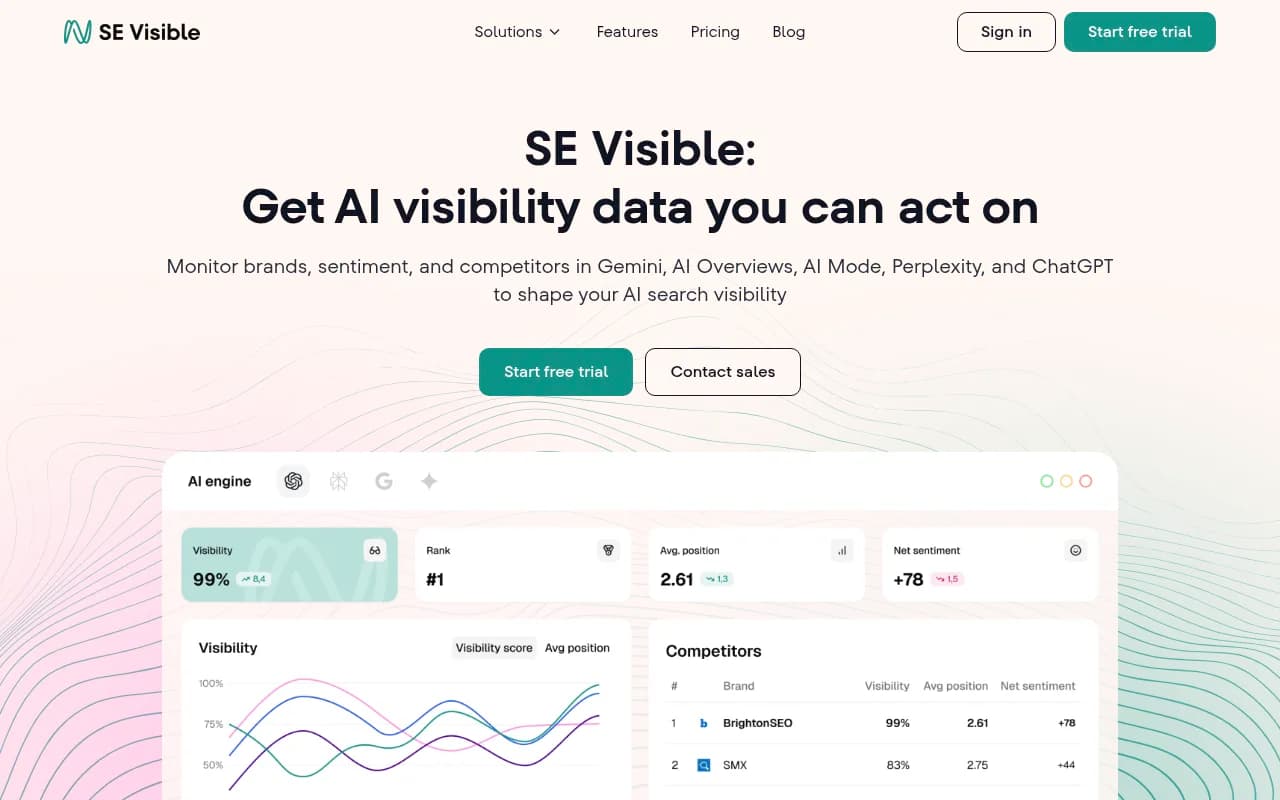
- AI Search add-on: $89/mo ($71.20 annually) for 200 prompts, an AI Results Tracker covering AI Overviews, AI Mode and ChatGPT, and access to SE Visible.
- Agency Pack: +$69/mo, annual billing only, for 30 client seats and white-label reports. White-label is not in the base plan.
- API add-on: +$45/mo, annual only, for 3M credits.
- Extra keywords start at $22.40 on Core.
So the claim that SE Ranking turns into a $218/mo tool is only true if you actually need the larger AI capacity. A solo marketer on Core already gets 100 daily prompts across 5 LLMs. An agency that needs white-label reporting and 200+ prompts really can land north of $200.
In my view, SE Ranking is the safest choice if you outgrow starter tools. The capacity per dollar is much better than the other two, even though the entry price is highest.
Ubersuggest: the cheapest door in, with caveats
Neil Patel's tool is the one most people have heard of, and also the one with the most confusing pricing. Here is what I found:
- The official page (app.neilpatel.com/en/pricing) currently shows only lifetime pricing at "Save 90%": Individual $120, Business $200, Enterprise $400, as final, non-refundable one-time payments.
- Third-party sources dated June 2026 list monthly pricing of $29, $49 and $99, with lifetime at $290, $490 and $990.
- Other sources list $12, $20 and $40 monthly and call those promotional.
- The old neilpatel.com pricing URL returns a 404.
My reading: $29/mo is the list price, $12 is a promo, and the official page may be mid-promotion. I could not confirm the monthly numbers on the official page, so check it yourself before paying anything. If you read a comparison still quoting $12 as the standard price, it is probably out of date.
What the limits look like
| Plan | Projects | Tracked keywords (per project) | Audit pages per report | Keyword suggestions per month |
|---|---|---|---|---|
| Individual | 1 | 125 | 1,000 | 20,000 |
| Business | 7 | 150 | 5,000 | 50,000 |
| Enterprise | 15 | 300 | 10,000 | 100,000 |
Credits run 200, 500 and 700 a month. Rank tracking and site audits are weekly, not daily. Backlinks cap at 2,000, 5,000 and 10,000 rows with a 3-year link history. There is no API on Individual or Business, and no documented compliance certifications, which matters if you work with larger clients.
AI visibility is a paid add-on: +$9/mo on Individual (10 prompts per brand, monthly updates), +$29 on Business (15 prompts, biweekly), +$69 on Enterprise (20 prompts, weekly). It covers ChatGPT, Gemini and Google AI Overview. Other add-ons for users, projects, keywords and competitors are about +$5/mo each. The G2 rating is 4.2 out of 5 from 160+ reviews, lower than SE Ranking's 4.8 from 1,400+.
Ubersuggest makes sense for a solo blogger or a local business that checks rankings occasionally and wants keyword and content ideas. The lifetime deal is the real draw, since the lifetime purchase pays back in about ten months against the monthly plan. For anything where daily rank movement matters, weekly tracking gets old quickly.
Morningscore: the beginner-friendly one
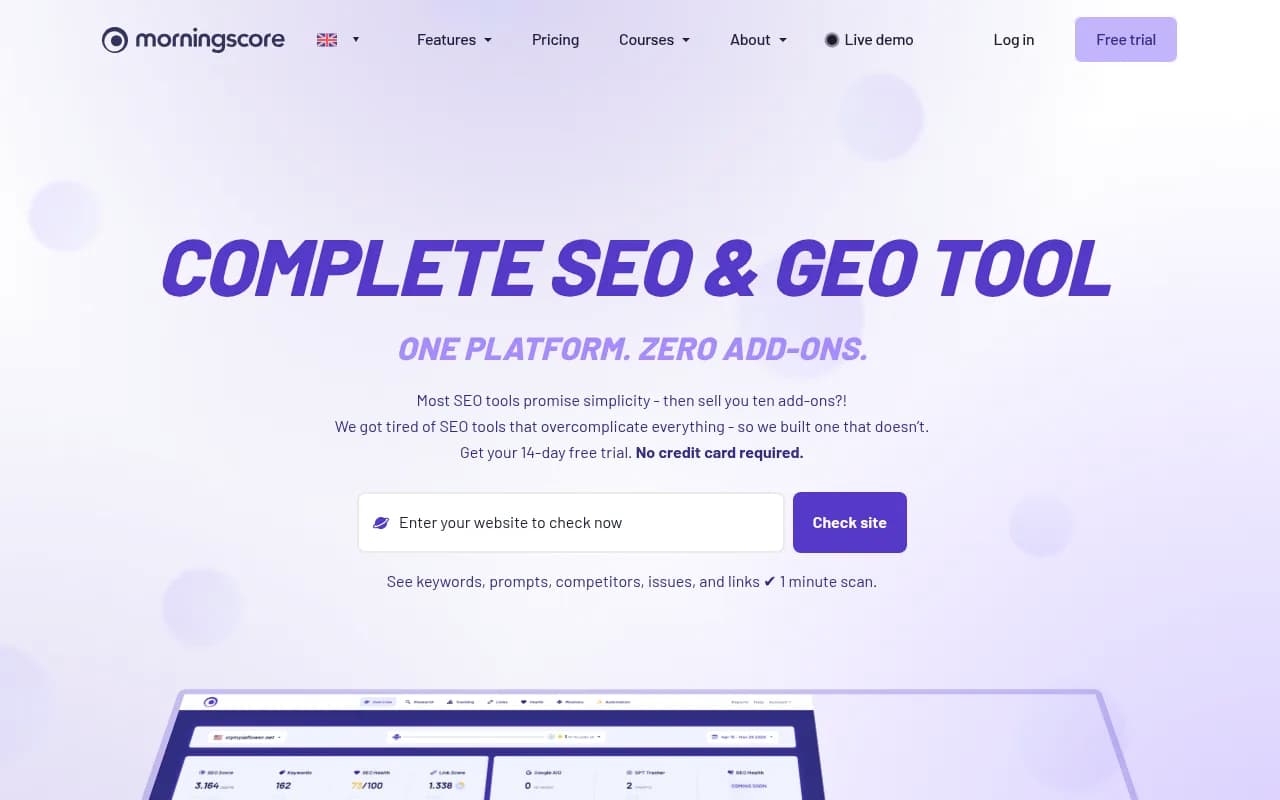
Morningscore is a Danish tool built around gamification: scores, missions and a task list that tell you what to fix next. For a business owner without an SEO background, that is genuinely useful, because most suites hand you data and leave you to work out priorities.
| Plan | Price | Users | Websites | Keywords | AI credits |
|---|---|---|---|---|---|
| Lite | $69/mo | 2 | 3 | 100 | 100 |
| Business | $99/mo | 4 | 10 | 500 | 1,000 |
| Pro | $159/mo | 10 | 30 | 2,000 | 5,000 |
| Premium | $299/mo | 20 | 100 | 5,000 | 20,000 |
Every plan includes daily rank tracking, a GEO Score, a Google AI Overviews tracker, an AI prompt tracker, WordPress and Shopify plugins, API access, and human chat support Monday to Friday, 9 to 16 CET. It supports 167 countries.
The limits you will hit on Lite
This is the part the marketing skips:
- 25 keyword researches a month.
- 5 full page scans a month, 250 pages maximum.
- 10 link scans a month.
- No automatic scheduling, no CSV export, and no report tool. Reports start on Business, with 3 a month.
- Backlink CSV export and ongoing reports need Pro.
It also only tracks Google and ChatGPT, which Morningscore says is deliberate. Data comes from 7 partners and is fetched on demand, so first loads are slower. The company itself says its databases are much smaller than Semrush, Ahrefs or Moz. I appreciate that honesty, but it does mean you should not buy it for deep backlink or competitor research.
A caveat: the pricing, the "no add-ons" claim, and the case studies (a Danish food brand reportedly nearly tripling organic traffic, another customer citing a 30% lead increase) all come from Morningscore's own material. They are plausible, not independently verified.
Comparing them fairly: price per capacity
Sticker price is misleading here because the entry plans buy very different amounts of tracking.
| Plan | Monthly price | Keywords tracked | Tracking frequency | Rough cost per tracked keyword |
|---|---|---|---|---|
| Morningscore Lite | $69 | 100 | Daily | $0.69 |
| Ubersuggest Individual | $29 (list) | 125 | Weekly | about $0.23 |
| SE Ranking Core | $129 | 2,000 | Daily | about $0.06 |
SE Ranking costs the most up front and the least per keyword by a wide margin. Ubersuggest looks cheap, but you get weekly updates. Morningscore is the priciest per keyword, which is the trade you make for the guidance and simplicity.
Those are rough figures. They ignore audits, backlinks and everything else, but they show why picking by headline price alone goes wrong.
AI visibility tracking: what each tool really gives you
All three now sell some form of AI search tracking, and the differences matter if you care about being cited in ChatGPT or AI Overviews.
| SE Ranking | Ubersuggest | Morningscore | |
|---|---|---|---|
| Included in base plan | 100 daily prompts (Core) | 10 free ChatGPT prompts/month, 1 project | GEO Score, AIO tracker, prompt tracker |
| Paid extra | $89/mo for 200 prompts and AI Results Tracker | +$9 to +$69/mo | None claimed |
| Engines | 5 LLMs tracked | ChatGPT, Gemini, AI Overview | Google and ChatGPT |
One thing to keep in mind is how much these prompt counts actually measure. According to Promptwatch's average sources per response data, ChatGPT cites about 5 sources per web-search answer, while Google AI Overviews and Perplexity cite about 10 each, and Copilot swung from under 2 to nearly 17. That is the number of slots a tracker is trying to see you in, and it varies by engine, so a tool that only covers two engines gives you a partial picture.
If AI visibility is your main goal rather than a bonus feature, a dedicated platform is worth a look. Promptwatch tracks the actual interfaces of ChatGPT, AI Overviews, Gemini, Perplexity and others, and goes beyond monitoring into content and crawler data. You can also browse the GEO software directory at bestgeosoftware.com for more options.

For a general SEO suite buyer, though, the built-in trackers are fine as a starting point.
Which one should you choose?
Pick SE Ranking if
- You track more than a few hundred keywords or manage several sites.
- You want daily tracking, large audits and historical data without add-ons.
- You are an agency and can live with the Agency Pack cost for white-labelling.
Pick Ubersuggest if
- You are a solo creator or tiny local business.
- You mostly want keyword ideas and content suggestions.
- You like a one-time lifetime payment and weekly updates are fine.
Pick Morningscore if
- Nobody on your team has an SEO background and you want a task list.
- 100 to 500 keywords is enough.
- You value human support and simple UX over raw data depth.
Other budget options worth a look
If none of these fit, a few alternatives in the same range are worth checking against your needs:
- Mangools for simple keyword research aimed at solo users.
- Moz Pro for basic rank tracking, with plans starting around $49 on the Starter tier per vendor sources.
- Semrush when you need the biggest databases and can afford $139.95 and up.
- Ahrefs for deeper backlink data, with Lite at $129.
For a wider look at tools in this category, the software directory at surferstack.com has reviews and comparisons.
Before you pay
- Confirm the live price on the official page. Ubersuggest in particular shows different numbers depending on where you look.
- Use the free trials. SE Ranking and Morningscore give 14 days with no card; Ubersuggest gives 7.
- Count your real keywords. If it is over 150, Morningscore Lite and Ubersuggest Individual will not fit.
- Price in the add-ons you need: SE Ranking's Agency Pack and API, Ubersuggest's AI and keyword add-ons.
- Ask whether you need daily or weekly updates. That one question rules out a lot.
Verdict
For most people who track more than a handful of keywords, SE Ranking Core is the best value, because the cost per tracked keyword is far lower. Morningscore wins for beginners who want guidance and are happy with a small keyword set. Ubersuggest only wins when budget is the main constraint and weekly data is acceptable. If you cannot decide, run the free trials side by side on the same site for a week and see which dashboard you actually open.