Key takeaways
- All four platforms track brand visibility across AI search engines, but they differ significantly in what they do with that data after the fact.
- Evertune and Relixir are built for large enterprise teams with deep workflow integrations, while Searchable and Promptwatch serve a broader range of company sizes.
- Promptwatch is the only platform in this comparison that closes the full loop: gap analysis, AI content generation, crawler logs, and traffic attribution in one workflow.
- If your team needs monitoring plus a clear path to actually improving visibility, the platform you choose matters more than most people realize -- most tools stop at the dashboard.
- Pricing varies widely, from mid-market to enterprise-only, so team size and budget will shape which option makes sense.
The GEO platform market has gotten crowded fast. Two years ago, most marketing teams had never heard of "AI search visibility." Now there are dozens of tools claiming to track it, and enterprise buyers are being pitched four or five platforms at once.
This guide focuses on four that come up most often in enterprise conversations: Searchable, Relixir, Evertune, and Promptwatch. They're not identical -- they have genuinely different philosophies about what a GEO platform should do. Some are built to show you data. Others are built to help you act on it. That difference is worth understanding before you sign anything.
What enterprise GEO platforms actually need to do
Before comparing features, it's worth being clear about what the job is. AI search engines like ChatGPT, Perplexity, Google AI Overviews, and Claude don't rank pages the way Google does. They synthesize answers from sources they've already crawled and indexed into their training or retrieval systems. If your content isn't being cited, it's not because you're on page two -- it's because the model doesn't consider your site a reliable, extractable source for the question being asked.
That means a GEO platform needs to do more than tell you your "visibility score." It needs to show you:
- Which prompts your competitors are being cited for that you're not
- Why AI crawlers are or aren't engaging with your pages
- What content you need to create or fix to close those gaps
- Whether the changes you make are actually working
Most platforms handle the first bullet reasonably well. The rest is where they diverge.
The four platforms at a glance
Searchable
Searchable positions itself as an AI Search Visibility Platform with built-in content generation. It tracks brand mentions across major AI engines and includes tools for creating content designed to improve those mentions. The pitch is a combined monitoring-plus-creation workflow, which puts it in a similar category to Promptwatch on paper.
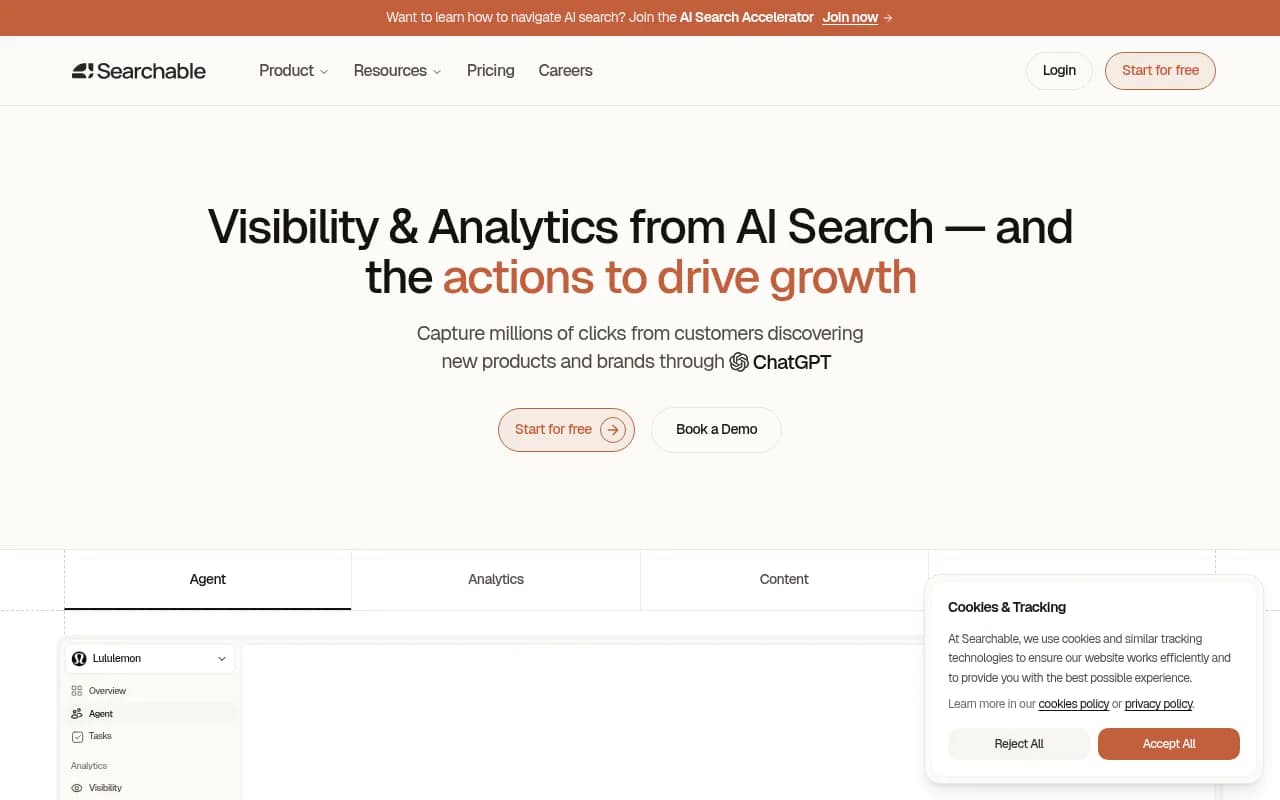
In practice, Searchable is strongest for teams that want a relatively straightforward interface and don't need deep technical data like crawler logs or prompt-level difficulty scoring. It covers the basics well -- visibility tracking, competitor comparisons, content suggestions -- but the depth of its analytics layer is more limited than what you'd find in platforms built specifically for enterprise scale.
Relixir
Relixir describes itself as an end-to-end GEO engine built for enterprise brands. It's one of the more ambitious platforms in the space, with a focus on connecting AI visibility data to actual content workflows at scale. Relixir is designed for teams managing large content libraries who need to audit existing pages against AI retrieval patterns, not just track new mentions.
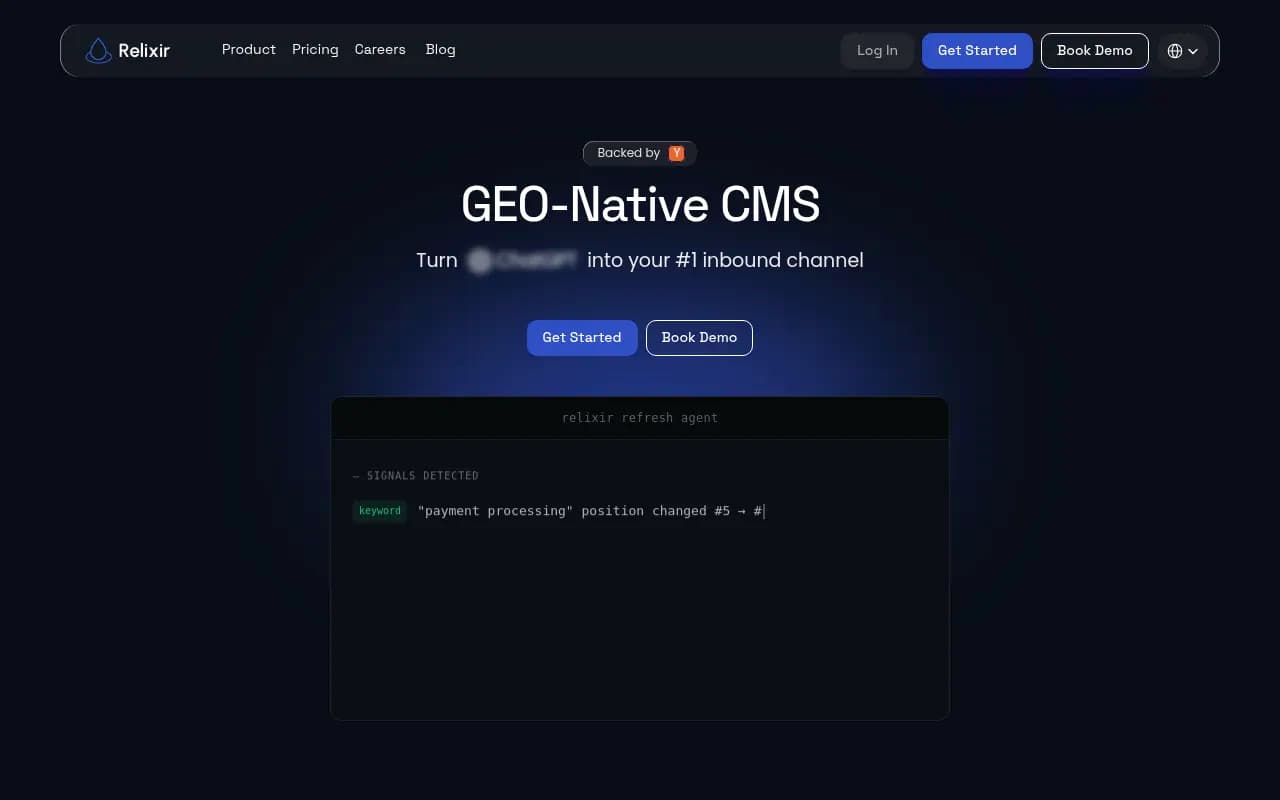
The platform's strength is in content remediation -- taking existing pages and tuning them to match how AI engines extract information. This is genuinely useful for enterprises with thousands of pages that were written for traditional SEO and now need to be restructured for AI retrieval. The tradeoff is complexity: Relixir has a steeper learning curve and is priced for enterprise budgets.
Evertune
Evertune is squarely aimed at Fortune 500 brands. It tracks AI visibility across major models and provides share-of-voice analysis, competitive benchmarking, and reporting features that work well in large organizational structures where multiple stakeholders need visibility into the data.

What Evertune does particularly well is executive-level reporting. If you're a VP of Marketing who needs to show the board how your brand is performing in AI search versus competitors, Evertune's dashboards are built for that conversation. What it's less focused on is the optimization side -- it's primarily a tracking and reporting tool, not a content creation or technical optimization platform.
Promptwatch
Promptwatch is the platform in this comparison with the most complete end-to-end workflow. It tracks visibility across 10 AI models (ChatGPT, Perplexity, Claude, Gemini, Google AI Overviews, Grok, DeepSeek, Copilot, Meta AI, and Mistral), but the tracking is just the starting point.

Where Promptwatch is different is what happens after you see the data. Answer Gap Analysis shows you the specific prompts your competitors are being cited for that you're not. Content Agents then generate articles, comparisons, and briefs grounded in that prompt data -- not generic AI content, but content engineered around the actual gaps AI models are exposing. AI Crawler Logs show you which pages AI crawlers are hitting, how often, and when those pages move from crawl to citation. And traffic attribution connects visibility improvements to actual revenue.
That full loop -- find gaps, create content, track results -- is what separates Promptwatch from the other three in this comparison. The others do pieces of it. Promptwatch does all of it.
Feature comparison
| Feature | Searchable | Relixir | Evertune | Promptwatch |
|---|---|---|---|---|
| AI model coverage | 5+ | 6+ | 8+ | 10 |
| Brand mention tracking | Yes | Yes | Yes | Yes |
| Competitor visibility benchmarking | Yes | Yes | Yes | Yes |
| Answer gap analysis | Partial | Yes | No | Yes |
| AI content generation | Yes | Yes | No | Yes |
| Content briefs with prompt data | No | Partial | No | Yes |
| AI crawler logs / agent analytics | No | No | No | Yes |
| Prompt volume & difficulty scoring | No | No | No | Yes |
| Query fan-out analysis | No | No | No | Yes |
| Reddit & YouTube citation tracking | No | No | No | Yes |
| ChatGPT Shopping tracking | No | No | No | Yes |
| Traffic attribution | No | Partial | No | Yes |
| Offsite citation analysis | No | Partial | No | Yes |
| Multi-language / multi-region | Partial | Yes | Yes | Yes |
| Executive reporting / share-of-voice | Basic | Yes | Yes | Yes |
| Looker Studio integration | No | No | No | Yes |
| Free trial | Yes | No | No | Yes |
| Starting price | ~$99/mo | Enterprise | Enterprise | $99/mo |
A few things stand out from this table. First, all four platforms do the basics -- brand tracking and competitor benchmarking are table stakes at this point. Second, the gap between monitoring-focused tools and optimization-focused tools is real. Evertune is a strong reporting platform but doesn't help you fix what it finds. Relixir and Searchable both attempt optimization but with different levels of depth. Promptwatch is the only one with crawler logs, prompt intelligence, and traffic attribution all in the same platform.
Tracking depth: where each platform actually goes
"Tracking depth" sounds like a spec-sheet metric, but it has real consequences. If your platform only tells you that your brand was mentioned in 34% of responses for a given topic, that's interesting but not actionable. You need to know which specific prompts, which models, which competitor pages are being cited instead, and why.
Promptwatch's approach to tracking
Promptwatch tracks real user-interface behavior, not just API outputs. This matters because what ChatGPT shows a user in its interface can differ from what the API returns. The platform processes prompt data at scale -- over 4.5 billion citations, clicks, and prompts analyzed -- which means the volume estimates and difficulty scores it surfaces are grounded in real behavior, not synthetic queries.
The AI Crawler Logs feature is something none of the other three platforms offer. You can see exactly when GPTBot, ClaudeBot, PerplexityBot, and others crawl your pages, which pages they return to most, and where they encounter errors. This is the kind of technical data that explains why a page isn't being cited even when the content seems right.
Evertune's approach to tracking
Evertune's tracking is broad and well-structured for enterprise reporting. It covers major AI models and provides share-of-voice metrics that are easy to present to leadership. The platform is good at telling you where you stand relative to competitors across a portfolio of topics. What it doesn't do is drill into the "why" -- there's no crawler data, no prompt-level analysis, and no mechanism for understanding what's driving the numbers you see.
Relixir's approach to tracking
Relixir takes a more technical approach than Evertune, with tools for auditing content against AI retrieval patterns. It can analyze large page sets and flag structural issues that might prevent AI engines from extracting information cleanly. This is valuable for enterprises with legacy content libraries. The tracking layer is solid, though it's less focused on real-time prompt monitoring and more on periodic audits.
Searchable's approach to tracking
Searchable's tracking covers the core use cases -- brand mentions, topic visibility, competitor comparisons -- in a cleaner interface than some of the more complex enterprise tools. It's a good fit for teams that are newer to GEO and want to get up and running quickly. The depth isn't there for teams that need prompt-level granularity or technical crawler data.
Optimization capabilities: the real differentiator
This is where the four platforms diverge most sharply, and it's the question that should drive your decision.
The monitoring-only trap
Evertune is a strong monitoring platform. But monitoring without optimization is like a fitness tracker that tells you you're out of shape without suggesting what to do about it. If your team's workflow is: see the data, then figure out what to do separately, then Evertune works. But most enterprise teams don't have unlimited time to translate dashboards into action plans.
Content generation quality
Both Searchable and Promptwatch include AI content generation, but the inputs differ. Searchable generates content based on topic and brand context. Promptwatch's Content Agents generate content grounded in real prompt data, citation analysis, competitor page analysis, search results, screenshots, and brand guidance. The output is content engineered to answer specific gaps AI models are already exposing -- which is a meaningfully different thing from general AI writing.
Relixir's content capabilities are focused on remediation -- taking existing pages and restructuring them -- rather than net-new content creation. For enterprises with large existing content libraries, this is genuinely useful. For teams that need to build out new topic coverage, it's less complete.
Closing the loop with attribution
The hardest question in GEO right now is: "Is this working?" Traffic attribution is what answers it. Promptwatch connects AI visibility improvements to actual site traffic and revenue, using integrations with Cloudflare, Fastly, Vercel, server logs, and Google Search Console. None of the other three platforms in this comparison offer this level of attribution depth.
Without attribution, you're left guessing whether your GEO efforts are moving the needle. That's a hard position to be in when you're justifying budget to leadership.
Pricing and who each platform is for
| Platform | Pricing model | Best for |
|---|---|---|
| Searchable | Mid-market, starts ~$99/mo | Teams new to GEO, straightforward monitoring + content |
| Relixir | Enterprise (custom pricing) | Large brands with legacy content libraries needing remediation |
| Evertune | Enterprise (custom pricing) | Fortune 500 brands needing executive reporting and share-of-voice |
| Promptwatch | $99/mo to $579/mo, custom for agencies | Marketing and SEO teams that need the full optimization workflow |
Promptwatch's pricing structure is worth noting because it's the only one in this group with transparent, accessible tiers. The Essential plan at $99/month covers one site, 50 prompts, and 5 articles per month -- enough for a focused team to get started and see real results. The Professional plan at $249/month adds crawler logs, city/state tracking, and 15 articles. Business at $579/month scales to 5 sites and 30 articles. Agency and enterprise pricing is available for larger deployments.
Relixir and Evertune are enterprise-only, which means custom pricing conversations and longer sales cycles. That's fine if you're a large brand with a dedicated procurement process, but it's a barrier for mid-market teams that want to move quickly.
Which platform should you choose?
The honest answer depends on what your team actually needs to do.
If you need executive-level reporting and share-of-voice analysis for a Fortune 500 brand, and your primary audience is leadership rather than the content team, Evertune is purpose-built for that use case.
If you have thousands of existing pages that were written for traditional SEO and need to be restructured for AI retrieval, Relixir's content remediation focus is worth a serious look.
If you're newer to GEO and want a clean interface that covers monitoring and basic content creation without a steep learning curve, Searchable is a reasonable starting point.
If you need the full workflow -- gap analysis, content generation grounded in real prompt data, crawler logs, traffic attribution, and prompt intelligence -- Promptwatch is the only platform in this comparison that delivers all of it. The fact that it also has transparent pricing and a free trial makes it easier to evaluate without a lengthy sales process.
The broader point is this: the GEO platforms that will matter in 2026 and beyond are the ones that help you act, not just observe. Being able to see that your competitor is cited 60% more often than you for a given topic is useful. Knowing exactly which content to create, having tools to create it, seeing AI crawlers pick it up, and watching your citation rate improve -- that's what actually moves the business.
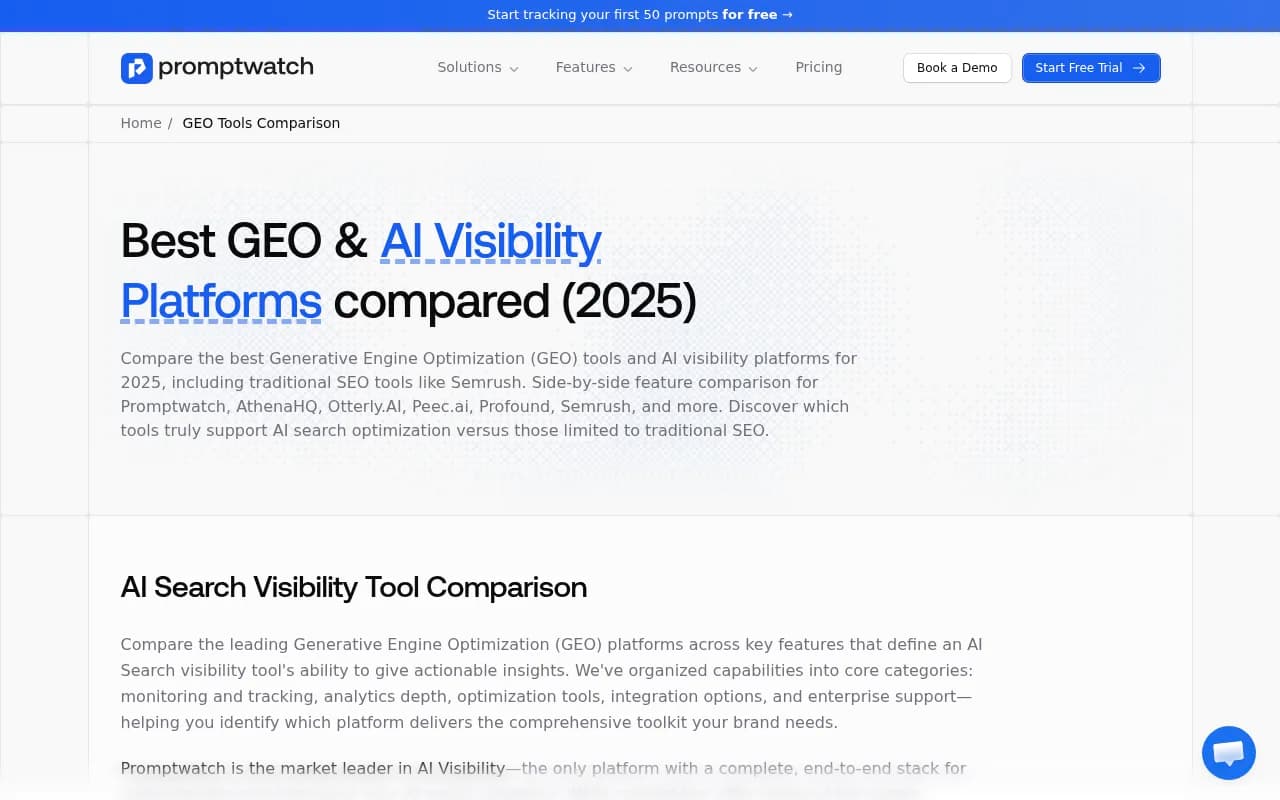
Most monitoring-only platforms leave you with a gap between insight and action. The platforms that close that gap are the ones worth investing in.