Key takeaways
- Semrush has the most complete AI feature set of the three, including AI Copilot and AI Overviews tracking, but its AI search monitoring is still limited compared to dedicated GEO platforms.
- Ahrefs has the deepest backlink index and the cleanest interface, but its AI visibility features are thin -- Brand Radar uses fixed prompts and there's no AI traffic attribution.
- SE Ranking offers the best price-to-feature ratio for most teams, with solid AI content tools and rank tracking, though it lacks some enterprise-grade capabilities.
- For tracking how your brand actually appears in ChatGPT, Perplexity, Claude, and other AI engines, all three platforms have meaningful gaps -- purpose-built tools fill those gaps better.
- The right choice depends heavily on your primary use case: link building and technical SEO (Ahrefs), full marketing suite (Semrush), or cost-conscious all-in-one (SE Ranking).
The SEO tool market hasn't changed this dramatically since Google rolled out Panda. AI search is genuinely reshaping how people find information, and the three platforms that have dominated the space for years -- Semrush, Ahrefs, and SE Ranking -- are all scrambling to adapt.
The question isn't just "which is the best SEO tool" anymore. It's "which one actually helps you stay visible as AI search engines eat into traditional click-through rates?"
I've spent time digging into all three platforms, reading through real user feedback on communities like r/bigseo, and comparing their actual AI feature sets. Here's what I found.
What's actually changed in 2026
Before comparing the tools, it's worth being clear about what's driving the urgency. AI Overviews from Google, plus the rise of ChatGPT, Perplexity, and Claude as genuine search destinations, have created a new visibility problem. Traditional rank tracking tells you where you appear in the blue links. It doesn't tell you whether ChatGPT recommends your brand, or whether Perplexity cites your content when someone asks a question you should own.
Research cited by Victoria Olsina found that click-through rates drop 34-46% when AI summaries appear above organic results. That's not a rounding error -- that's a structural shift in how traffic flows. And none of the three platforms in this comparison were built from the ground up to address it.
That context matters when evaluating their AI features. Some of what these platforms call "AI features" is AI-assisted content writing. That's useful, but it's not the same as AI search visibility.
Semrush: the most complete platform, but complex
Semrush is the Swiss Army knife of digital marketing. It covers SEO, PPC, content marketing, social media, PR, and competitive research -- all in one place. For teams that need a single platform to manage multiple marketing channels, it's hard to beat on breadth.
AI features in Semrush
Semrush's AI Copilot is the headline feature for 2026. It analyzes your site's data and surfaces prioritized recommendations -- essentially a smart assistant that tells you what to fix first. For teams drowning in audit data, this is genuinely useful.
On the AI search side, Semrush has added Google AI Overviews tracking. You can see when your pages appear in AI-generated summaries at the top of Google results. That's meaningful, but it's limited to Google's ecosystem.
The ContentShake AI tool generates SEO-optimized articles and can suggest content ideas based on trending topics. It's decent for content teams that want to move faster.
The limitation is that Semrush's AI monitoring uses fixed prompts rather than dynamic, real-user prompt data. You're tracking a curated set of queries, not the actual questions people are asking AI engines right now. For competitive intelligence purposes, that's a real constraint.
What Semrush does well
- Keyword research database is enormous -- one of the largest in the industry
- PPC competitive intelligence is genuinely excellent
- The breadth of tools means you can cancel several other subscriptions
- AI Copilot reduces the cognitive load of interpreting audit results
- Good for agencies managing multiple client campaigns
Where it falls short
- Can feel overwhelming -- there are tools in Semrush that most users never open
- AI search tracking is Google-centric and uses fixed prompts
- No meaningful tracking of ChatGPT, Perplexity, or Claude brand mentions
- Higher pricing tiers are expensive for smaller teams
- The interface has improved but still has a learning curve
Ahrefs: the technical SEO standard, slower on AI
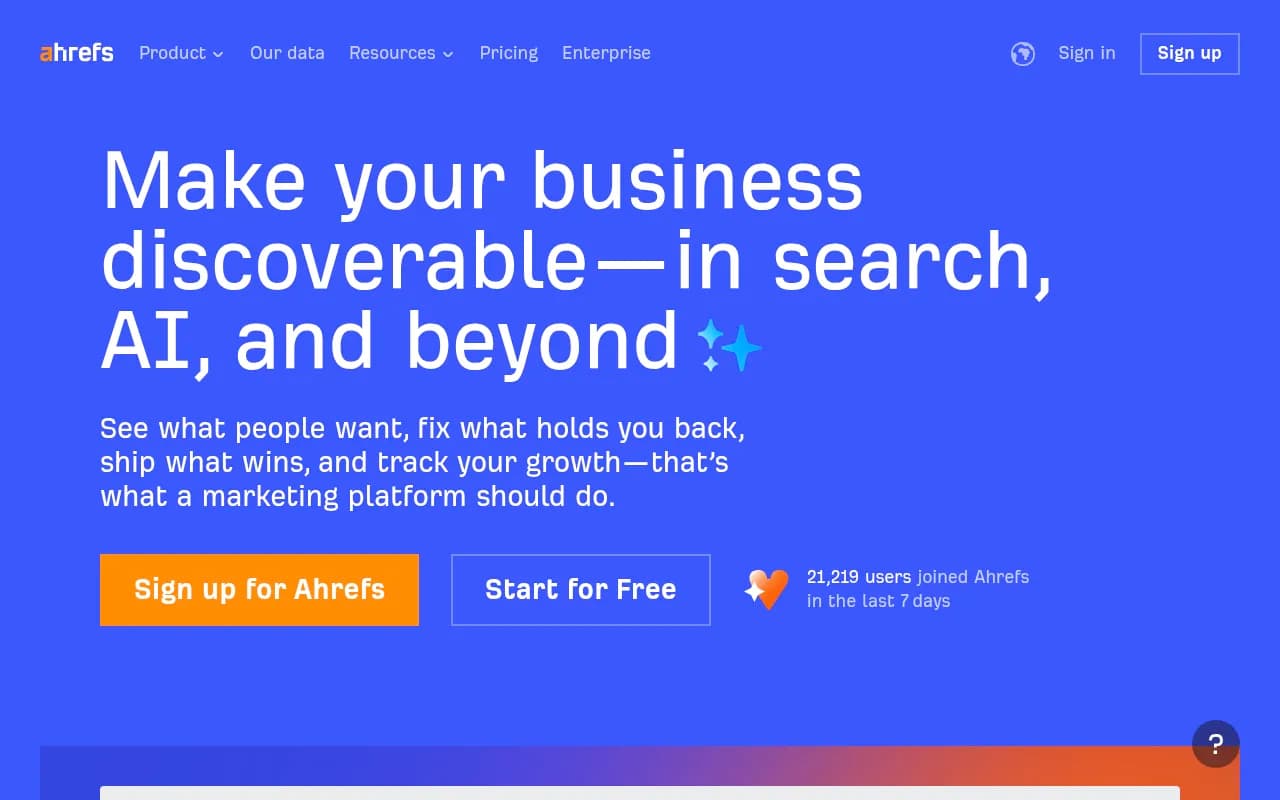
Ahrefs built its reputation on backlink data, and that reputation is still deserved. Its link index is widely considered the most comprehensive available, and the site audit tool is clean and actionable. Among SEO practitioners on forums like r/bigseo, Ahrefs consistently gets described as "the most solid" for link work.
AI features in Ahrefs
Ahrefs introduced Brand Radar as its answer to the AI search question. It lets you monitor when your brand appears in AI-generated responses. The problem is that it uses fixed prompts -- meaning you're not discovering new prompts where you should be visible, you're just checking a predetermined list.
Ahrefs also has AI-assisted content writing tools and some content gap analysis features. These are useful for traditional SEO content planning, but they're not specifically engineered for AI search optimization.
There's no AI traffic attribution in Ahrefs. You can't connect your AI visibility data to actual revenue or traffic outcomes. That's a significant gap as teams try to justify GEO investments to leadership.
What Ahrefs does well
- Backlink index depth and freshness is best-in-class
- Site audit is clean, fast, and genuinely actionable
- Keyword Explorer is excellent for research
- Content Explorer helps find link-building opportunities
- Interface is cleaner and less overwhelming than Semrush
Where it falls short
- AI search features are thin compared to what the market now expects
- Brand Radar's fixed prompts limit discovery
- No AI traffic attribution
- Primarily focused on SEO -- less useful for PPC or social
- Some users find the credit system limiting at lower tiers
SE Ranking: the value play with solid AI content tools
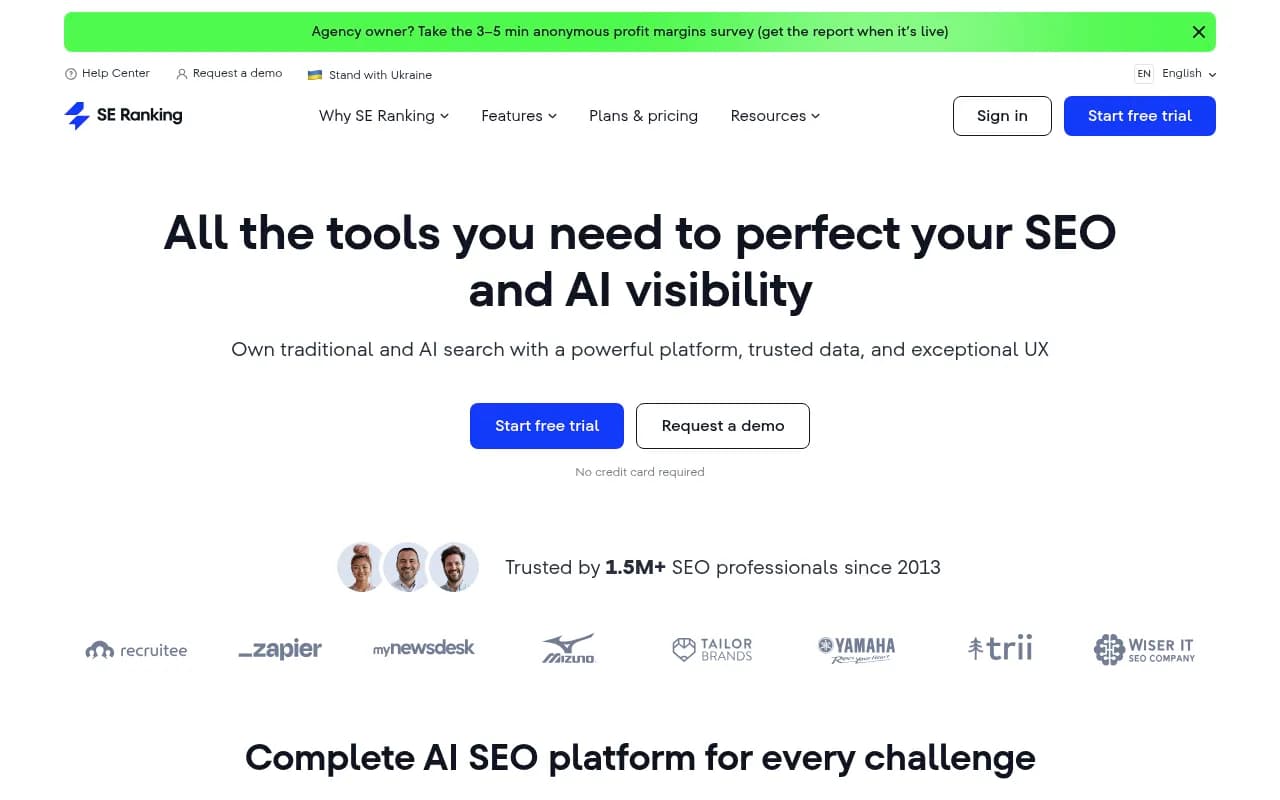
SE Ranking has quietly become a serious contender. It's not trying to out-feature Semrush or out-backlink Ahrefs. Instead, it's built a genuinely capable all-in-one SEO platform at a price point that makes agencies and smaller teams take notice.
At $129/month, you get rank tracking, site audits, keyword research, backlink analysis, and a suite of AI content tools. That's a meaningful value proposition.
AI features in SE Ranking
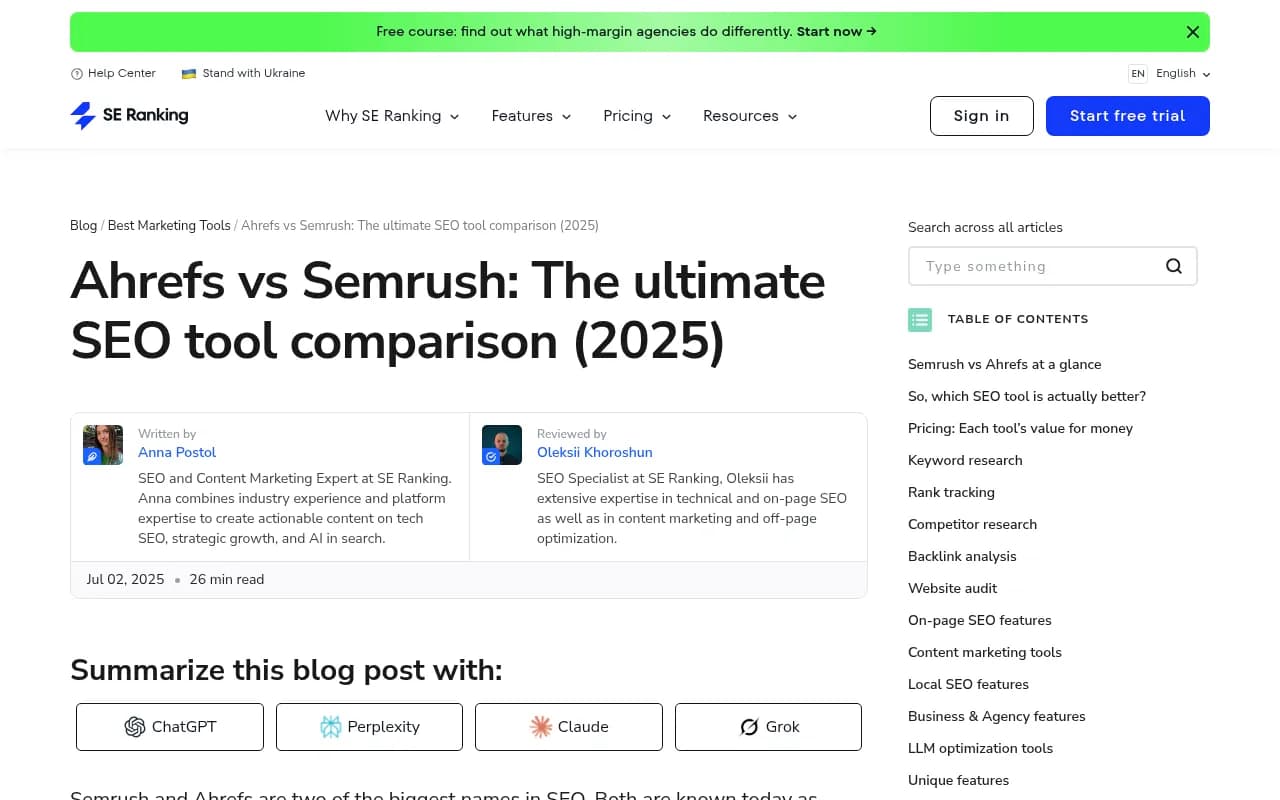
SE Ranking has invested in AI content generation and optimization tools. Its AI writer can produce SEO-optimized drafts, and the content editor helps optimize existing pages against top-ranking competitors.
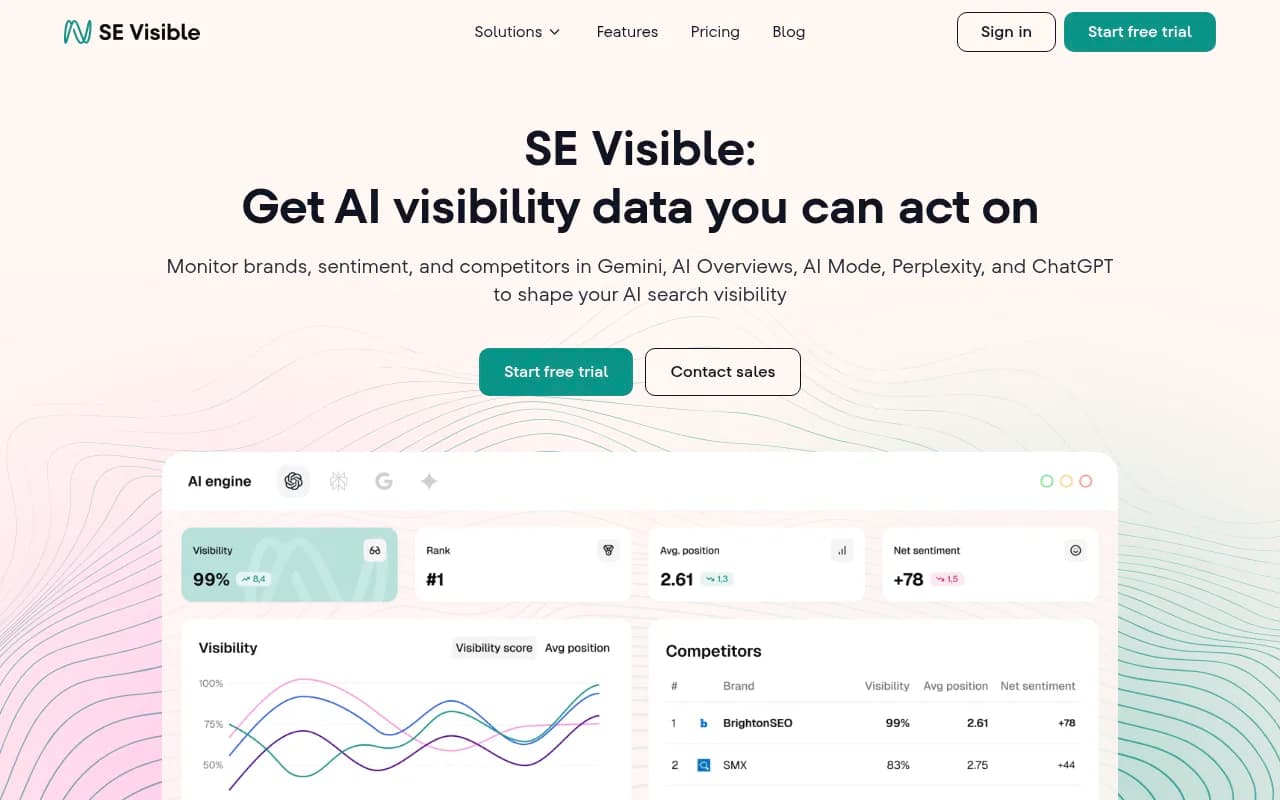
SE Ranking also launched SE Visible, a separate product for tracking brand mentions in AI search engines. It's worth noting this exists as a distinct offering rather than being deeply integrated into the main platform.
For local SEO, SE Ranking has strong capabilities -- one analysis from Predicta Digital found it winning on three of four criteria when compared to Semrush and Ahrefs specifically for AI visibility use cases, with Ahrefs winning only on backlink depth.
What SE Ranking does well
- Best price-to-feature ratio of the three
- AI content tools are practical and well-integrated
- Strong local SEO capabilities
- Agency tools and white-labeling are solid
- Rank tracking is accurate and flexible
Where it falls short
- Backlink index is smaller than Ahrefs
- AI search monitoring is less mature than Semrush's
- Less brand recognition means some clients expect the "big names"
- Feature depth in some areas doesn't match Semrush
Head-to-head comparison
| Feature | Semrush | Ahrefs | SE Ranking |
|---|---|---|---|
| Backlink index | Large | Best-in-class | Good |
| Keyword research | Excellent | Excellent | Good |
| Site audit | Good | Excellent | Good |
| AI content writing | Yes (ContentShake) | Basic | Yes |
| AI Copilot / assistant | Yes | No | No |
| Google AI Overviews tracking | Yes | No | Limited |
| ChatGPT / Perplexity tracking | No | Limited (Brand Radar) | Via SE Visible |
| AI traffic attribution | No | No | No |
| Local SEO | Good | Basic | Strong |
| PPC tools | Excellent | None | Basic |
| Social media tools | Yes | No | Basic |
| Starting price | ~$139/mo | ~$129/mo | ~$65/mo |
| Best for | Full marketing suite | Technical SEO / links | Budget-conscious all-in-one |
The AI search gap all three share
Here's the honest assessment: none of these platforms were built for the AI search era. They're traditional SEO tools adding AI features at the edges, not platforms designed from scratch to answer the question "how visible is my brand in AI search engines?"
The specific gaps are consistent across all three:
- They don't track real user prompts -- they use fixed query sets
- They can't tell you which Reddit threads, YouTube videos, or third-party pages are driving AI citations for your competitors
- They don't show you AI crawler logs -- which pages AI bots are reading, how often, and whether those reads are converting to citations
- They can't connect AI visibility to actual traffic or revenue
If you're primarily concerned with traditional SEO -- ranking in Google's blue links, building backlinks, auditing technical issues -- these platforms are still excellent. But if AI search visibility is becoming a priority (and for most brands, it should be), you'll hit the ceiling of what they offer fairly quickly.
For dedicated AI search visibility tracking and optimization, platforms like Promptwatch are built specifically for this use case -- tracking how brands appear across ChatGPT, Perplexity, Claude, Gemini, and other AI engines, with actual prompt data, crawler logs, and content gap analysis that connects to real optimization actions.

Which platform should you choose?
The answer depends on what you're actually trying to do.
Choose Semrush if you need a single platform that covers SEO, PPC, content, and social media. It's the most complete marketing suite, and the AI Copilot genuinely reduces the time spent interpreting data. If your team is managing multiple channels and wants one login, Semrush makes sense despite the cost.
Choose Ahrefs if your primary focus is link building, technical SEO, and backlink analysis. The interface is cleaner, the link data is deeper, and for pure SEO work it's the tool most practitioners trust. Just don't expect it to solve your AI search visibility problem.
Choose SE Ranking if you need a solid all-in-one SEO platform and budget is a real constraint. At its price point, it's remarkable how much it covers. Agencies managing multiple clients at a lower price tier will find it particularly compelling.
Add a dedicated AI visibility tool if tracking your brand in ChatGPT, Perplexity, and Google AI Mode is becoming a business priority. None of the three platforms above will give you the depth of data you need for that specific problem.
A note on the broader tool landscape
It's worth knowing that several tools have emerged specifically to fill the AI search visibility gap that Semrush, Ahrefs, and SE Ranking leave open. Some are monitoring-only dashboards that show you data without helping you act on it. Others, like Promptwatch, are built around an optimization loop -- find where you're invisible, generate content that addresses those gaps, then track whether AI engines start citing you.
If you're evaluating tools in this space, the key question to ask is: does this tool just show me data, or does it help me do something with it?
For traditional SEO, Semrush, Ahrefs, and SE Ranking all help you act on data. For AI search visibility, most monitoring tools stop at the data. That distinction matters more as AI search continues to grow.
Bottom line
Semrush wins on breadth and AI feature count. Ahrefs wins on backlink depth and interface quality. SE Ranking wins on value. None of them fully solve the AI search visibility problem -- that's a separate category now, and it's growing fast.
Pick the traditional SEO platform that fits your workflow and budget, then honestly assess whether you need a dedicated AI visibility layer on top of it. For most brands with serious AI search ambitions in 2026, the answer is yes.