Key takeaways
- A single prompt sent to ChatGPT, Perplexity, or Google AI Mode typically generates 8–12 parallel sub-queries before an answer is returned -- and that number grows as a topic gains complexity.
- When a prompt's sub-query count increases over time, it signals rising topic authority and competitive opportunity -- the window before competitors notice is usually short.
- 95% of fan-out sub-queries show zero monthly search volume in traditional keyword tools, so standard SEO monitoring misses them entirely.
- Detecting fan-out velocity requires tracking sub-query counts per prompt over time, not just citation rates or keyword rankings.
- The brands that win in AI search are the ones covering the full sub-query spectrum -- not just the obvious head term.
Why sub-query count is the metric nobody's watching
Most teams tracking AI search visibility are focused on the wrong signal. They watch whether their brand gets cited. They monitor sentiment. They check if they appear in a response at all.
That's fine, but it's backward-looking. You're measuring what already happened.
The more interesting question is: which prompts are getting more complex over time? Because when a prompt's sub-query count grows -- when AI models start decomposing it into more parallel searches than they used to -- that's a leading indicator. The topic is maturing. More angles are being explored. And whoever covers those angles first gets cited first.
That's what I'm calling fan-out velocity: the rate at which a prompt's sub-query count expands. It's not a widely tracked metric yet, which is exactly why it's worth paying attention to.
What query fan-out actually is (and why it changed everything)
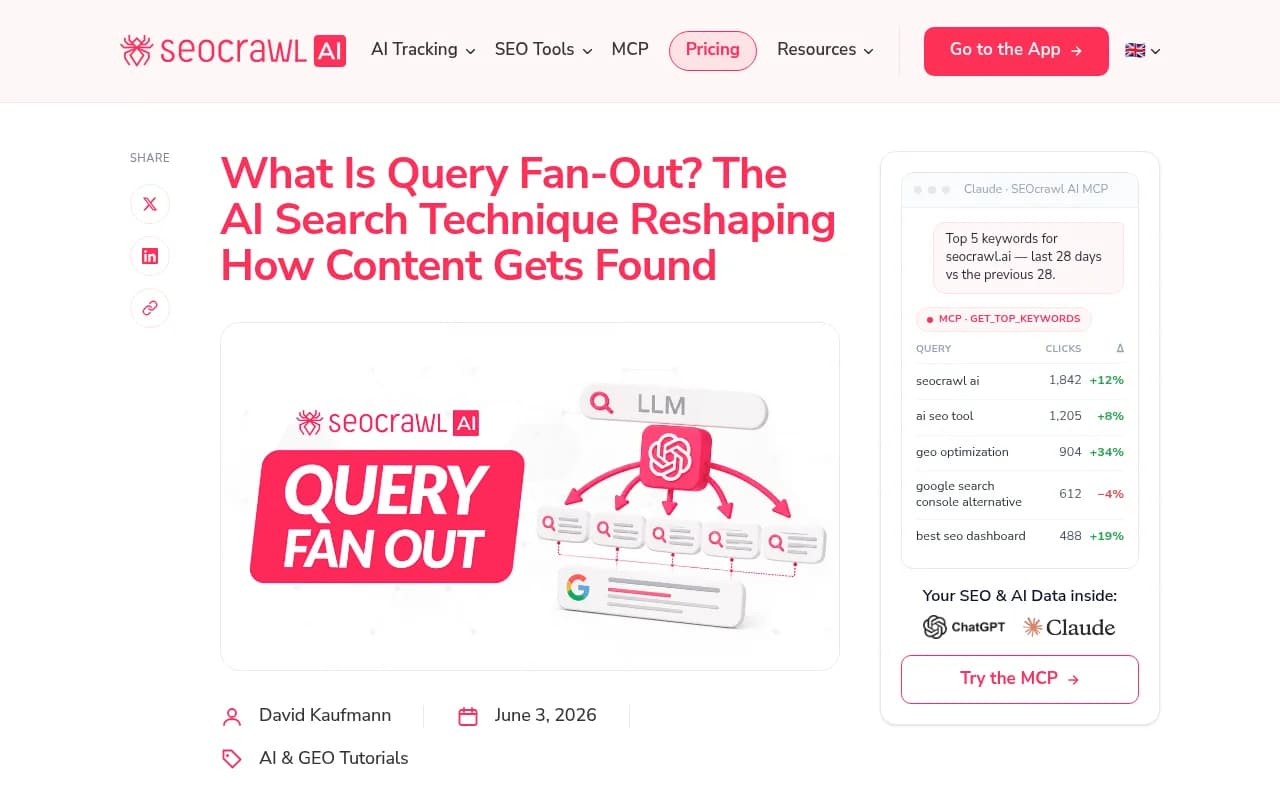
When you type a question into Google AI Mode, ChatGPT, or Perplexity, you see one answer. Behind that answer, the model ran somewhere between 8 and 12 separate searches -- sometimes more.
Google named this publicly when it launched AI Mode, describing a "query fan-out technique, issuing multiple related searches concurrently across subtopics and multiple data sources." ChatGPT and Perplexity do the same thing under different names. It's now the default retrieval pattern across every major AI engine.
Here's a concrete example. Someone asks: "best project management tool for remote teams."
The AI doesn't just search for that phrase. It decomposes it:
- What are the top-rated project management tools in 2026?
- Which project management tools have the best async collaboration features?
- How does Notion compare to Asana for remote teams?
- What do Reddit users say about remote work tools?
- Which project management tools have the best free tier?
- What are the limitations of Monday.com for distributed teams?
- What integrations does ClickUp offer for remote workflows?
Each of those runs in parallel. Each pulls from different sources. The final answer is a synthesis of whatever came back.
This matters for content strategy because you're no longer optimizing for one phrase. You're optimizing for a cluster of implied questions -- and that cluster changes size over time.
The four-stage fan-out pipeline
Understanding the mechanics helps you see where fan-out velocity fits in.
Stage 1: Deconstruction. The model parses the prompt and identifies every explicit and implicit need. A question about "best CRM for startups" implicitly asks about pricing, integrations, onboarding complexity, reviews, and comparisons with alternatives.
Stage 2: Parallel retrieval. Each sub-query runs simultaneously. This is why coverage breadth matters more than depth on a single page -- the model is pulling from multiple sources at once.
Stage 3: Aggregation. Results are pooled and ranked. Sources that appear across multiple sub-queries get weighted more heavily. Consensus signals (reviews, forums, professional sources) carry particular weight here.
Stage 4: Synthesis. The model writes the final answer, citing sources it found credible across the sub-queries.
Fan-out velocity affects stages 1 and 2 most directly. As a topic grows in complexity, the deconstruction phase generates more sub-queries. If your content doesn't cover those new angles, you're invisible to the retrieval phase -- and therefore absent from the final answer.
Why traditional keyword tools miss this entirely
Here's the uncomfortable truth: 95% of fan-out sub-queries show zero monthly search volume in tools like Google Keyword Planner, Ahrefs, or Semrush. They're too specific, too conversational, or too recently emerged to have accumulated volume data.
Traditional keyword research finds the questions people have already asked enough times to register in a database. Fan-out sub-queries are often questions the AI itself is generating -- derived from the prompt's implicit needs, not from historical search behavior.
This creates a blind spot. A brand can have excellent traditional SEO coverage and still be completely invisible in AI search, because the sub-queries the model generates don't match any of the keywords the brand optimized for.
Fan-out velocity tracking requires a different approach: you need to observe what sub-queries AI models are actually generating for your target prompts, then track whether that set is growing or shrinking over time.
How to detect fan-out velocity: a practical framework
Step 1: Identify your target prompts
Start with the 20-30 prompts most relevant to your business. These should be the questions your customers are most likely to ask AI engines when they're in the research or consideration phase. Not brand queries -- intent queries.
For a B2B SaaS company, that might be:
- "best [category] software for [use case]"
- "how to solve [specific problem]"
- "[your category] vs [competitor category]"
- "what to look for in [your product type]"
Step 2: Run each prompt through multiple AI engines and capture the sub-queries
This is where most teams stop -- they look at the final answer and check if they're cited. Don't stop there. You want to capture the sub-queries the model generated, not just the output.
Some AI engines expose this directly. Perplexity shows its searches in the interface. Google AI Mode sometimes surfaces related queries. ChatGPT with browsing enabled shows what it searched. For others, you can infer sub-queries by analyzing the sources cited and working backward.
Document the sub-query set for each target prompt. How many sub-queries? What categories do they fall into (comparison, recency, pricing, reviews, risk, feature-specific)?
Step 3: Repeat at regular intervals and track the delta
This is the velocity part. Run the same prompts every two to four weeks. Record:
- Total sub-query count per prompt
- New sub-query categories that appeared
- Sub-queries that disappeared
- Which sub-queries your content currently covers
When the total count for a prompt increases, that's a signal. The topic is becoming more complex in the model's view -- more angles are being explored, more sources are being consulted. That's your window.
Step 4: Map your content coverage against the sub-query set
For each sub-query, ask: does your site have a page that directly answers this? Not a page that vaguely touches on it -- a page that answers it specifically.
Build a simple coverage matrix:
| Sub-query | Content exists? | Cited in AI response? | Gap priority |
|---|---|---|---|
| "best [tool] for [use case]" | Yes | Yes | -- |
| "[tool] pricing vs [competitor]" | No | No | High |
| "[tool] limitations for [segment]" | No | No | High |
| "[tool] integrations with [platform]" | Partial | No | Medium |
| "Reddit reviews of [tool]" | N/A | Sometimes | Monitor |
The gaps with high priority are your content targets. The ones that appeared in the most recent fan-out run but weren't there two months ago are your highest-priority targets -- those are the emerging angles.
What growing fan-out velocity actually signals
Not all fan-out growth is equal. Here's how to interpret what you're seeing:
More comparison sub-queries means the market is maturing and buyers are evaluating options more carefully. This is common in mid-to-late growth stage categories. Your response: publish direct comparison content, not just feature pages.
More recency sub-queries (queries with "2026", "latest", "new") means the model is trying to time-stamp its knowledge. Your response: keep content dated and updated, and publish regular "what's changed" pieces.
More risk/limitation sub-queries ("pros and cons", "complaints", "limitations") means buyers are getting more sophisticated. Your response: publish honest limitation content. Brands that acknowledge their own limitations get cited more often because the model treats them as credible.
More pricing sub-queries means the category is commoditizing or buyers are becoming more price-sensitive. Your response: make pricing information explicit and easy to find.
More use-case-specific sub-queries means the topic is fragmenting into niches. Your response: build out use-case-specific landing pages rather than relying on one generic page.
The competitive timing advantage
Here's why velocity matters more than coverage alone.
When a new sub-query type emerges in a prompt's fan-out, there's a brief window -- typically a few weeks -- where almost nobody has content specifically targeting that angle. The AI model is generating the sub-query because it senses the need, but the web hasn't caught up yet.
If you publish content targeting that sub-query before competitors do, you get cited first. And once a model starts citing a source for a particular sub-query type, it tends to keep citing it -- because citation patterns reinforce themselves through training data and retrieval weighting.
This is the actual competitive advantage in AI search: not just having good content, but having the right content earlier than competitors.
The brands losing in AI search right now aren't losing because their content is bad. They're losing because they're publishing content in response to what competitors already rank for -- which means they're always one cycle behind.
Tools that help you track this
Doing this manually is possible but painful. A few tools make it more tractable:
For tracking which sub-queries AI models are generating and how your content maps against them, Promptwatch is the most complete option. Its query fan-out feature shows how prompts branch into sub-queries, with prompt volume estimates and difficulty scores that help you prioritize which gaps to close first. The Answer Gap Analysis specifically surfaces which prompts competitors are visible for that you're not -- which maps directly to the fan-out coverage problem.

For understanding what questions people are already asking (which often predicts what sub-queries will emerge), tools like AlsoAsked and AnswerThePublic give you a starting point.

For monitoring your brand's citation patterns across AI engines over time -- which is the downstream measure of whether your fan-out coverage is working -- several platforms offer this:
Otterly.AI

Profound


AirOps is worth mentioning specifically here because their research (72,000+ AI-generated queries, 8,700+ prompts) is one of the most detailed public datasets on fan-out behavior by industry. Their data shows that fan-out frequency varies significantly by vertical -- some industries trigger search on nearly every prompt, others much less frequently.
For content creation once you've identified the gaps, you need something that can produce content grounded in the specific sub-query angle, not generic SEO filler. Promptwatch's Content Agents generate articles and briefs based on real prompt data and citation patterns. For standalone content tools:
A comparison of approaches to fan-out tracking
| Approach | What you learn | Effort | Best for |
|---|---|---|---|
| Manual AI engine sampling | Raw sub-queries per prompt | High | Initial research, small prompt sets |
| Dedicated GEO platform (e.g. Promptwatch) | Sub-query trends, coverage gaps, competitor visibility | Low-medium | Ongoing tracking at scale |
| Traditional keyword tools (Ahrefs, Semrush) | Historical search volume for related terms | Low | Background research only |
| AI crawler log analysis | Which pages AI bots are reading and how often | Medium | Technical gap identification |
| Citation monitoring tools | Whether you're cited in final answers | Low | Downstream validation |
The honest answer is that no single tool gives you a complete fan-out velocity picture out of the box. The closest thing is a GEO platform with query fan-out data combined with regular manual sampling to catch what automated tools might miss.
Building a fan-out velocity workflow
Here's a practical cadence that works for most teams:
Weekly: Run your top 10 prompts through Perplexity (which shows its searches) and one other engine. Log the sub-queries. Flag anything new.
Bi-weekly: Update your coverage matrix. Identify gaps that appeared in the last two runs. Assign content briefs for high-priority gaps.
Monthly: Pull your citation data from your GEO platform. Cross-reference with your coverage matrix -- are the pages you published for new sub-queries getting cited? If not, why not?
Quarterly: Review the full sub-query set for each target prompt. Have any prompts grown significantly in complexity? That's a signal to invest more content resources in that topic cluster.
The workflow doesn't need to be elaborate. A shared spreadsheet tracking sub-query counts per prompt over time, combined with a content brief queue, is enough to start. The discipline is in the consistency -- you need at least three or four data points before velocity becomes visible.
The one mistake to avoid
The most common mistake teams make when they start tracking fan-out is treating it as a one-time audit rather than a continuous process.
They run their prompts, identify the gaps, publish content to fill them, and then move on. Six weeks later, the prompt's sub-query set has evolved, new angles have emerged, and competitors have started publishing content for the gaps they identified from the same audit.
Fan-out velocity is a continuous signal, not a one-time finding. The teams that build a systematic cadence for tracking it -- even a lightweight one -- consistently outperform the teams that do periodic deep dives.
The sub-query landscape for any given prompt is not static. It shifts as topics evolve, as new products launch, as industry events happen, as Reddit discussions surface new concerns. Treating it as static is how you end up perpetually reactive.
The goal is to be the brand that shows up in the sub-queries before competitors realize those sub-queries exist. That's not luck -- it's a process.