Key takeaways
- Most GEO platforms in 2026 are monitoring dashboards — they show you where you're invisible but don't help you fix it.
- The GEO action loop has three stages: finding content gaps, creating content that fills them, and tracking whether AI models start citing you.
- Very few platforms support all three stages natively. Most require you to stitch together separate tools.
- Platforms that cover the full loop deliver compounding returns — each new piece of content feeds better tracking data, which surfaces better gaps.
- When evaluating GEO tools, ask specifically: does this tool tell me what to write, help me write it, and show me if it worked?
Gartner projected a 25% drop in traditional search engine volume by 2026. Whether that number lands exactly right or not, the directional shift is real and visible: users are asking AI systems questions and acting on the answers those systems generate. They're not clicking through ten blue links anymore.
For brands, this creates a new kind of visibility problem. You can rank well in Google and still be completely absent from ChatGPT, Perplexity, or Google AI Overviews. And unlike traditional SEO, where you can check a rank tracker and see where you stand, AI visibility is harder to measure, harder to influence, and changes as models retrain.
The response from the tools market has been fast but uneven. Dozens of GEO platforms launched in 2024 and 2025. Most of them do one thing: they query AI models with prompts relevant to your brand and show you whether you appear. That's useful. But it's only the first step.
What actually moves the needle is a complete action loop: find the gaps, create content to fill them, and track whether it worked. This guide breaks down each stage, explains why most platforms stall at stage one, and identifies which tools support the full cycle.
Stage 1: Finding the gaps
The gap-finding stage is where most GEO tools live. The core mechanic is straightforward: you define a set of prompts that represent how your target customers ask AI systems about your category. The platform runs those prompts across multiple AI engines and shows you the results — who's cited, who's not, and how often your brand appears.
That's genuinely useful data. But the difference between a basic monitoring tool and a real gap analysis tool is specificity.
Basic monitoring tells you: "You appeared in 12% of responses for this prompt set."
Real gap analysis tells you: "Your competitors are cited for these 47 specific prompts, and you're not. Here's what content they have that you don't. Here's the angle AI models seem to prefer when answering this type of question."
The second version gives you something to act on. The first just tells you you're losing.
What good gap analysis looks like
A proper gap analysis should surface:
- Specific prompts where competitors appear and you don't
- The content or pages that are driving those competitor citations
- Topic clusters and angles that AI models favor for your category
- Prompt volume estimates so you can prioritize by potential impact
- Query fan-outs — how a single prompt branches into related sub-queries that all need coverage
Without prompt volume data, you're flying blind on prioritization. Without competitor citation analysis, you don't know what's actually working in your space. Without fan-out mapping, you'll write one piece of content when you actually need five.
Stage 2: Creating content that fills the gaps
This is where the market really fractures. Almost every GEO monitoring tool stops at stage one. They show you the gaps and then... leave you to figure out what to do about it.
Creating content for AI visibility is different from creating content for traditional SEO. You're not optimizing for keyword density or backlink profiles. You're writing content that AI models will trust enough to cite. That means:
- Directly answering the specific questions AI models are being asked
- Covering the topic with enough depth and specificity that the model treats you as an authoritative source
- Structuring content so AI crawlers can extract clean, quotable answers
- Aligning with the citation patterns you've observed — if AI models in your space consistently cite comparison articles, you need comparison articles
Content generation that's grounded in real prompt data is fundamentally different from generic AI writing. A tool that knows "Perplexity is citing three competitors for the prompt 'best project management software for remote teams' and your site has no page addressing that exact angle" can generate a brief — or even a full draft — that's specifically engineered to fill that gap.
Generic AI writing tools don't have that context. They produce content that might be fine for a blog but isn't targeted at the specific gaps AI models are exposing.
The brief vs. the draft
There's a spectrum here. Some teams want a detailed content brief — the angle, the structure, the key points to cover, the competitor content to differentiate from — and then write the piece themselves or hand it to a writer. Others want a full draft they can edit and publish. The best platforms support both workflows.
What matters most is that the content generation is grounded in the gap data. The brief should tell you why this piece needs to exist, not just what to write.
Stage 3: Tracking citations
Publishing content is not the end of the loop. It's the beginning of the measurement phase.
Once new content is live, you need to know:
- Have AI crawlers found and indexed the page?
- Which AI models are citing it, and for which prompts?
- How has your overall visibility score changed since publishing?
- Is there a measurable traffic signal from AI referrals?
Most monitoring tools can answer the third question eventually — your visibility score goes up or it doesn't. But the first two questions require something most platforms don't have: real-time AI crawler logs.
AI crawler logs tell you when GPTBot, ClaudeBot, PerplexityBot, and others hit your pages, which pages they read, how often they return, and whether they're encountering errors. This is the difference between knowing "my visibility improved" and knowing "Perplexity crawled my new comparison page 11 times in the first week and started citing it on day 9."
That level of detail lets you close the loop properly. You can see the timeline from publish to crawl to citation, identify pages that are being crawled but not cited (and figure out why), and prioritize technical fixes that might be blocking AI indexing.
Traffic attribution is the final piece. If AI visibility is driving real sessions and conversions, you need to be able to connect the dots — which AI model sent traffic, to which pages, and what those visitors did.
Which platforms support all three stages?
This is the honest answer: not many. The GEO tools market in 2026 is dominated by monitoring-first products. Here's how the landscape breaks down.
Full action loop platforms
Promptwatch is the clearest example of a platform built around the complete loop. The gap analysis surfaces specific prompts where competitors are visible and you're not, with prompt volume estimates and query fan-outs for prioritization. Content Agents generate articles, listicles, and comparisons grounded in that real prompt data. And the tracking layer includes page-level citation tracking, AI crawler logs, and traffic attribution that connects visibility to actual revenue.

The crawler log capability is particularly rare. Most competitors don't have it at all. Knowing that GPTBot crawled your page but hasn't cited it yet — and being able to see any errors it encountered — gives you a feedback loop that pure monitoring tools can't provide.
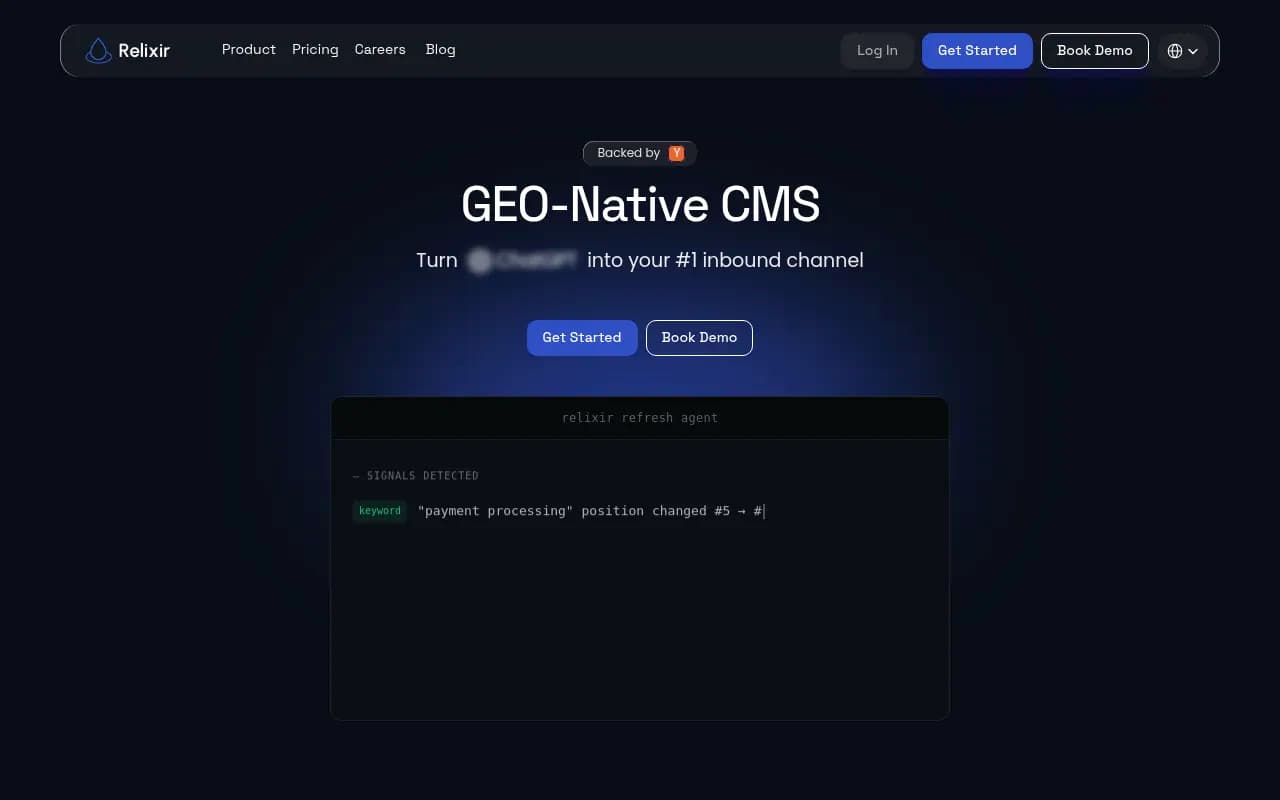
Relixir positions itself as an end-to-end GEO engine for enterprise brands and covers gap analysis through content generation. It's worth evaluating if you're at the enterprise tier.
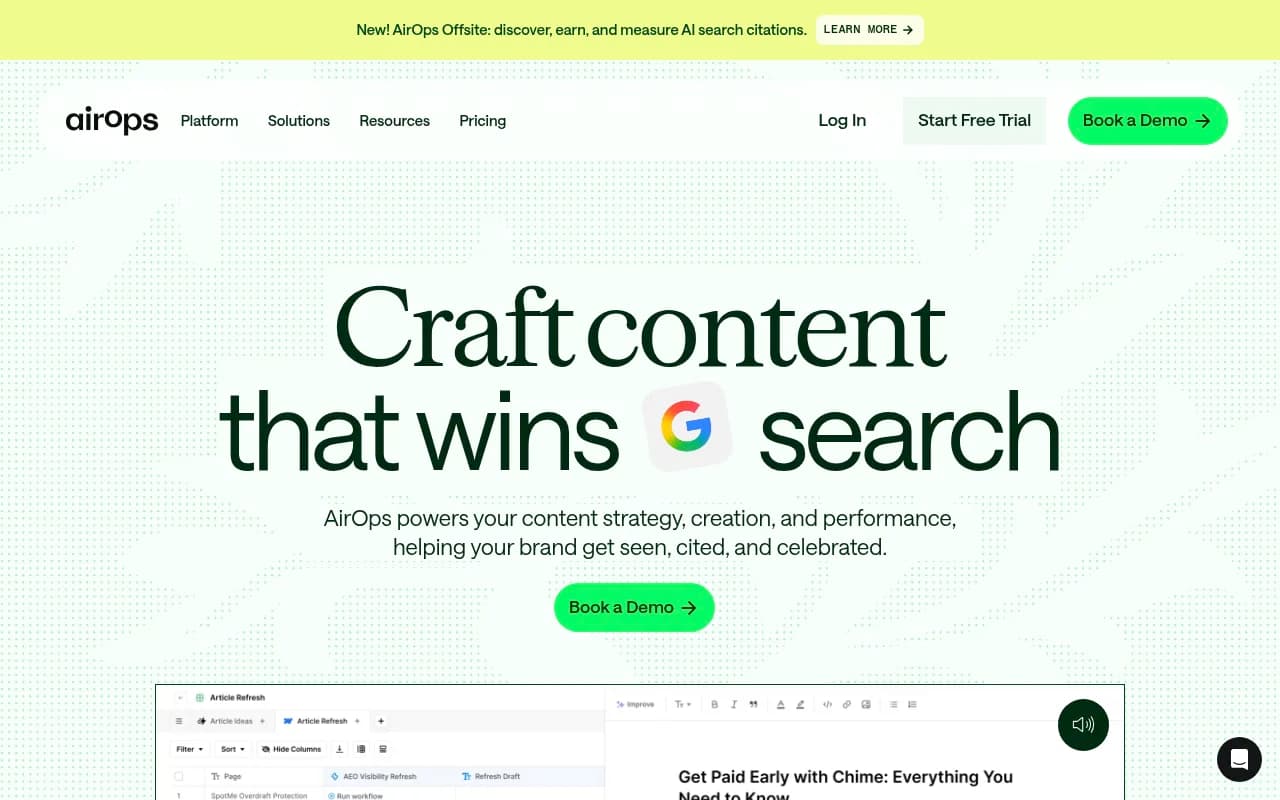
AirOps takes a content engineering angle — it's built around creating content for AI search visibility and has strong workflow tooling, though its gap analysis is less deep than dedicated GEO platforms.
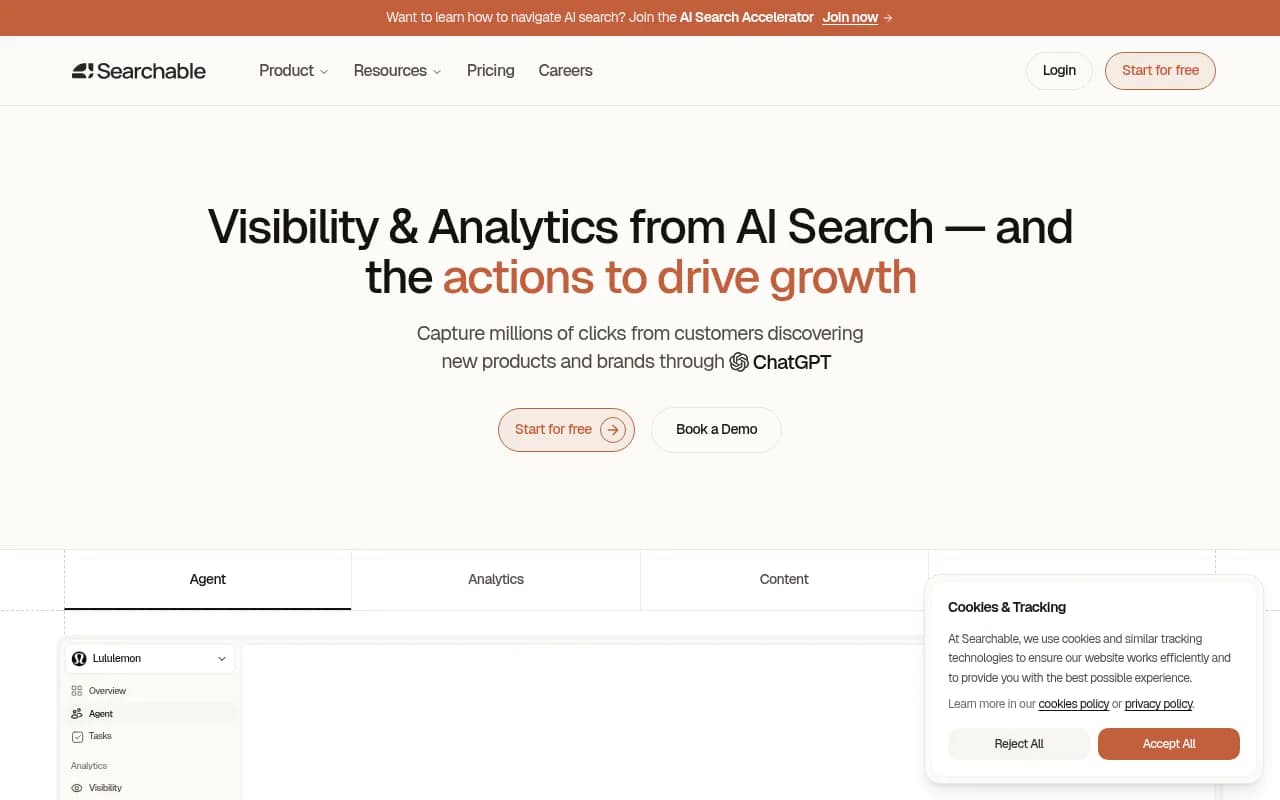
Searchable includes built-in content generation alongside its visibility tracking, making it one of the few mid-market options that attempts the full loop.
Strong monitoring, limited action
Most of the market lives here. These tools do stage one well and sometimes stage three partially, but leave stage two entirely to you.
Profound has strong enterprise monitoring across 9+ AI engines and good competitive intelligence. No content generation.
Profound

AthenaHQ has an "Action Center" that uses autonomous agents to flag content gaps, which is closer to stage two than most. But it's still primarily a monitoring platform.

Otterly.AI covers prompt monitoring across ChatGPT, Perplexity, and Google AI Overviews. Clean interface, solid for teams that just need visibility data.
Otterly.AI

Peec AI is a monitoring-focused tool with decent multi-model coverage. No content generation, no crawler logs.

Scrunch AI tracks brand mentions across LLMs with reasonable depth. Monitoring only.
Traditional SEO tools with GEO features
Semrush has added AI search monitoring, but it uses fixed prompts rather than custom prompt sets, and there's no AI traffic attribution. Useful if you're already in the Semrush ecosystem.
Ahrefs has Brand Radar for AI visibility tracking. Fixed prompts, no content generation, no AI traffic attribution.
Platform comparison
| Platform | Gap analysis | Content generation | Citation tracking | Crawler logs | Traffic attribution |
|---|---|---|---|---|---|
| Promptwatch | Full (with prompt volumes + fan-outs) | Yes (Content Agents) | Page-level | Yes | Yes |
| Relixir | Yes | Yes | Yes | Limited | Limited |
| AirOps | Partial | Yes (strong) | Partial | No | No |
| Searchable | Yes | Yes | Yes | No | No |
| AthenaHQ | Yes (Action Center) | Partial | Yes | No | No |
| Profound | Yes | No | Yes | No | No |
| Otterly.AI | Basic | No | Basic | No | No |
| Peec AI | Basic | No | Basic | No | No |
| Semrush | Limited (fixed prompts) | No | Basic | No | No |
| Ahrefs Brand Radar | Limited (fixed prompts) | No | Basic | No | No |
Why the loop matters more than any single stage
Here's the thing about treating GEO as a monitoring exercise: you end up with a dashboard full of data and no clear path to improving it.
The action loop creates compounding returns. When you find a gap and create content to fill it, you get new citation data. That citation data tells you which angles AI models responded to, which prompts your new content is showing up for, and what related gaps have opened up. Each cycle makes the next cycle more targeted.
A team that runs this loop monthly will outpace a team that monitors weekly but never acts. The monitoring-only approach is like checking your weight every day without changing what you eat.
The other thing worth saying: the loop only works if the content generation is actually grounded in the gap data. If you're using a separate AI writing tool that has no connection to your GEO monitoring, you're essentially guessing at what to write. You might get lucky. But you're not systematically filling the gaps that AI models are exposing.
Practical advice for building your GEO workflow in 2026
If you're starting from scratch or evaluating your current stack, here's how to think about it:
Start with the gap analysis. Before you create anything, understand what AI models are saying about your category and where your competitors are appearing that you're not. This shapes everything downstream.
Prioritize by prompt volume. Not all gaps are equal. A prompt that gets asked 10,000 times a month is worth more than one asked 50 times. Platforms that give you volume estimates let you sequence your content roadmap by impact.
Track at the page level, not just the brand level. Knowing your overall visibility score is fine. Knowing which specific pages are being cited — and which are being crawled but not cited — is what lets you iterate.
Close the loop with traffic data. AI referral traffic is still small for most brands, but it's growing fast. Connecting visibility to sessions and conversions is how you justify the investment and prioritize future content.
Don't skip the technical layer. If AI crawlers are hitting your pages and encountering JavaScript rendering issues, slow load times, or broken schema, your content won't get cited regardless of how good it is. Crawler logs surface these issues directly.
The brands that will win in AI search over the next 18 months aren't the ones with the biggest monitoring dashboards. They're the ones running a tight, repeatable loop: find the gaps, fill them with targeted content, track what sticks, and repeat.
That loop is the whole game.