Key takeaways
- Only 38% of pages cited in Google AI Overviews also rank in the top 10 for the same query — down from 76% just seven months ago, per Ahrefs' study of 863K keywords.
- Google's query fan-out process is a primary driver: one search triggers multiple sub-queries, and citations are drawn from across all of them.
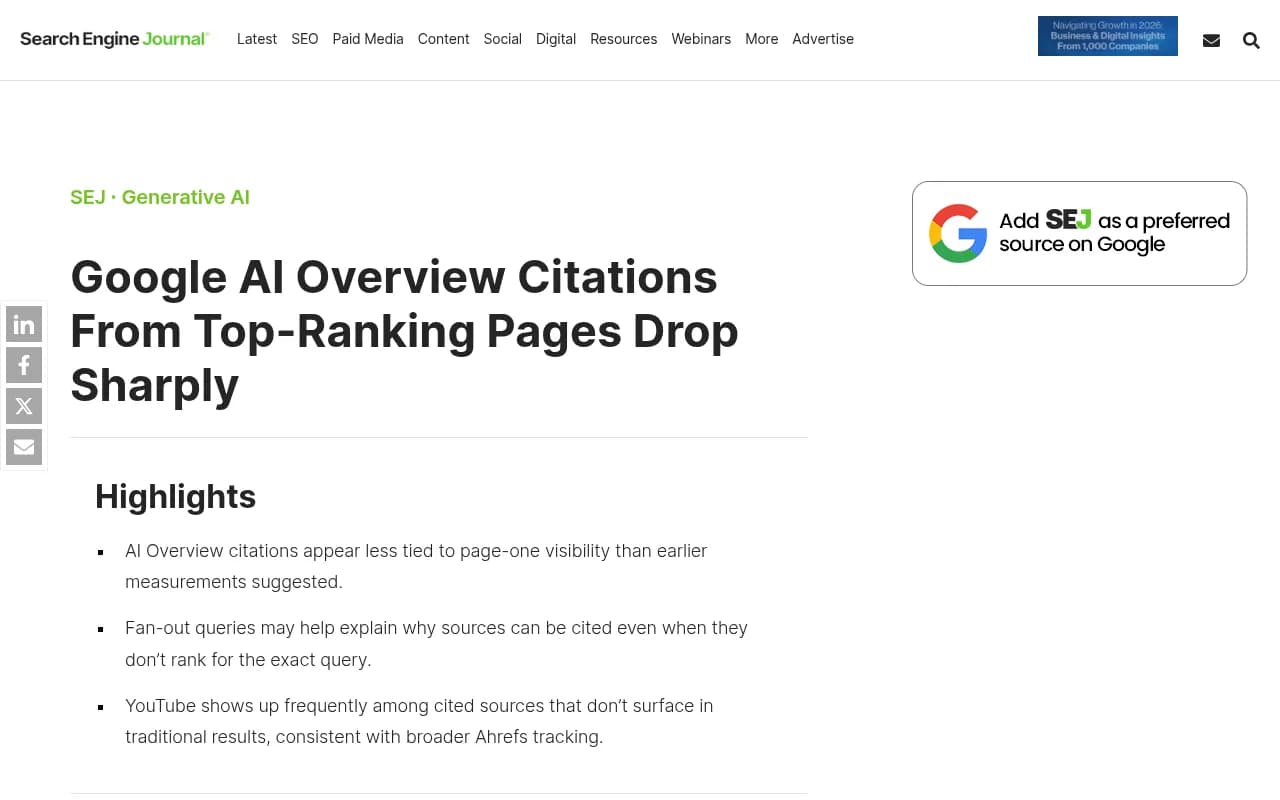
- YouTube is now the single most-cited domain in AI Overviews, accounting for 18.2% of citations from outside the top 100.
- The pages that consistently earn citations share four traits: clear entity authority, extractable content structure, topical depth across related sub-queries, and strong E-E-A-T signals.
- Brands cited in AI Overviews see 35% more organic clicks from branded searches, making citation visibility a direct revenue lever.
The rule that no longer applies
For most of the past two years, SEOs operated on a reasonable assumption: if your page ranked in the top 10 for a query, it had a solid shot at appearing in the AI Overview for that same query. The correlation was tight enough to treat organic rankings as a reasonable proxy for AI citation likelihood.
That assumption is now broken.
Ahrefs published an updated study in early 2026 covering 863,000 keywords and 4 million AI Overview URLs. The finding: only 38% of pages cited in AI Overviews also appear in the top 10 organic results for the same query. In Ahrefs' previous version of the same study from July 2025, that number was 76%.
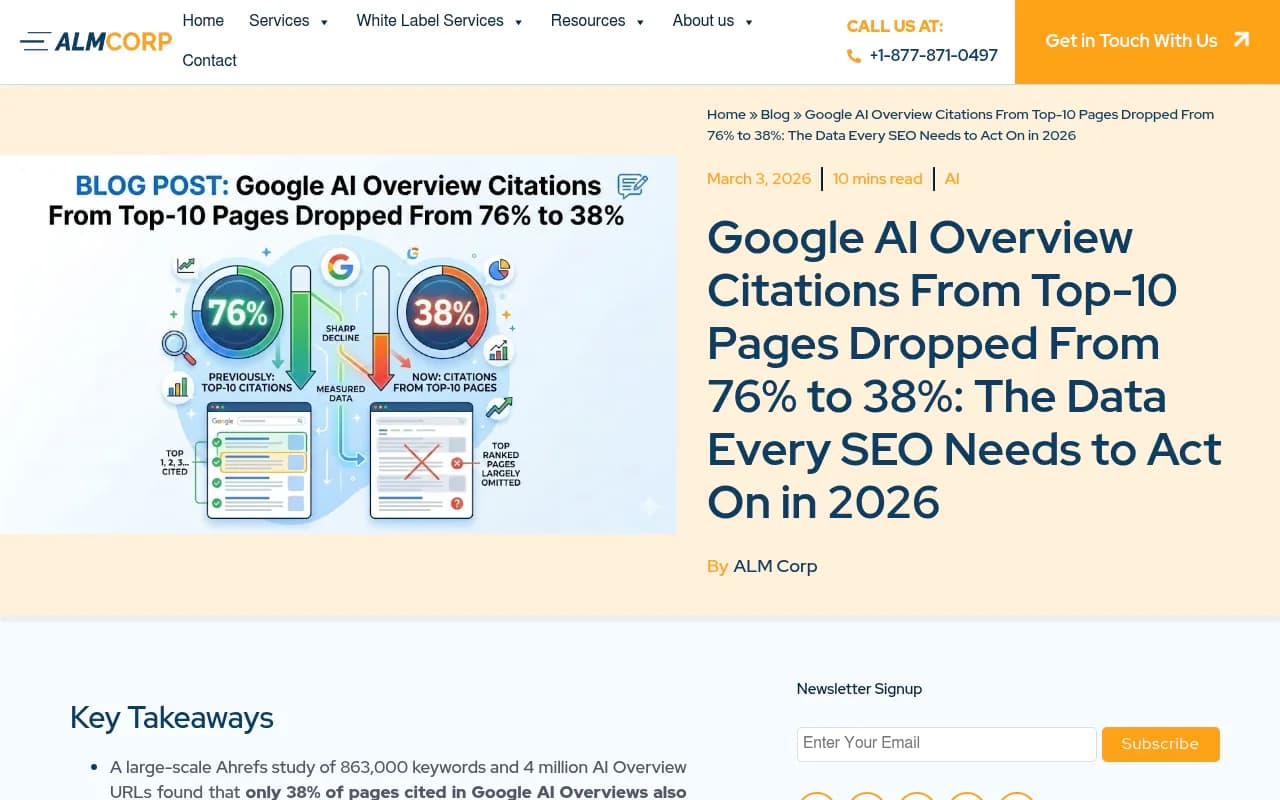
That's not a small drift. It's a structural change. And a separate BrightEdge analysis puts the top-10 overlap even lower, at around 17%, depending on methodology.
BrightEdge has been tracking this shift closely.
The remaining citations split almost evenly: 31.2% come from pages ranking positions 11–100, and 31% come from pages that don't appear in the top 100 at all. So roughly two-thirds of AI Overview citations now go to pages that wouldn't even show up on the first page of traditional search results.
This changes the optimization game considerably.
Why this happened: the fan-out effect
Google hasn't published a detailed changelog explaining the shift, but Ahrefs and others point to two contributing factors.
The first is methodological: Ahrefs improved its citation detection between the July 2025 and early 2026 studies, meaning some of the apparent drop reflects better measurement of citations that were previously missed. The two datasets aren't directly comparable.
The second factor is more interesting, and probably more significant: Google's query fan-out process.
When a user types a query and an AI Overview is triggered, Google doesn't just look at results for that exact query. It splits the original query into multiple related sub-queries, retrieves results for each of them, and then synthesizes a response by drawing from the most relevant sources across all of those sub-query result sets.
So if someone searches "best project management tools for remote teams," Google might fan that out into sub-queries like "project management software comparison," "tools for async remote work," "project management for distributed teams," and several others. The pages that get cited in the AI Overview are the ones that appear most consistently and authoritatively across that broader set of results — not necessarily the ones that rank #1 for the original query.
Google also upgraded AI Overviews to Gemini 3 as the global default in January 2026, which Ahrefs notes as additional context for the timing of the shift. The new model appears to cast a wider net when selecting sources.
What cited pages actually have in common
After analyzing patterns across hundreds of cited pages, researchers and practitioners have identified a consistent set of traits. These aren't ranking factors in the traditional sense — they're more like citation readiness signals.
Clear entity authority
Google's AI Overview citation selection is heavily influenced by what researchers call "entity authority" — how clearly and consistently a page (and the site it lives on) is associated with a specific topic or brand.
Pages that earn citations tend to belong to sites with a well-defined topical focus. A page about CRM software on a site that covers CRM, sales operations, and customer success is more likely to be cited than the same content on a general-purpose blog that covers everything from recipes to finance.
This is related to E-E-A-T (Experience, Expertise, Authoritativeness, Trustworthiness), but entity authority is more specific. It's about whether Google's knowledge graph can confidently associate your site with a particular domain of knowledge.
Practical implication: if your site covers too many unrelated topics, consider whether a more focused content architecture would improve your citation rate for the topics that matter most to your business.
Extractable content structure
AI Overviews need to pull specific facts, definitions, comparisons, and answers from source pages. Pages that make this easy — through clear headings, concise definitions, structured lists, comparison tables, and direct answers to specific questions — get cited more often than pages that bury their answers in long paragraphs.
According to data from Heroic Rankings, 88% of Google AI Overviews cite three or more sources, and AI Overviews with fewer than 600 characters typically cite fewer sources. This suggests Google is actively pulling from multiple pages to build a comprehensive answer, and it needs each source to contribute something specific and extractable.
What this looks like in practice:
- Define terms explicitly in the first paragraph, not buried in the middle
- Use H2 and H3 headings that match the exact phrasing of sub-questions users ask
- Include comparison tables, numbered steps, and bullet lists for scannable facts
- Answer the question directly before elaborating — don't make Google hunt for the core claim
Topical depth across related sub-queries
This is probably the biggest shift in 2026. Because of fan-out, a single page that ranks well for one query isn't enough. You need content that covers the topic deeply enough to appear relevant across the range of sub-queries Google generates from the original search.
The Digital Bloom's 2026 AI Citation Position & Revenue Report found that citation probability by SERP position drops sharply: position #1 earns a 33.07% AI Overview citation probability, while position #10 drops to 13.04% — a 60% decline across just 10 positions. But the more interesting finding is that pages outside the top 100 still earn citations at meaningful rates, which can only be explained by fan-out pulling from sub-query results where those pages do rank well.
The implication: a page that ranks #15 for "project management software" but #3 for "project management tools for remote teams" might still get cited in AI Overviews for the broader query, because that sub-query is part of the fan-out.
This makes comprehensive topic coverage — not just keyword targeting — the primary lever for AI citation optimization.
Backlinks and E-E-A-T signals
Traditional authority signals still matter, but they work differently in the AI Overview context. Backlinks from authoritative sources signal to Google that a page is trusted within its topic area. This feeds into the entity authority calculation and increases citation confidence.
Pages with strong backlink profiles from relevant domains are more likely to appear in fan-out sub-query results across a wider range of related searches, which in turn increases their citation frequency in AI Overviews.
First-hand experience signals — author bios, original research, case studies, specific data points — also increase citation likelihood. AI Overviews tend to cite pages that contain information Google can't easily synthesize from generic sources.
The YouTube factor
One finding that deserves its own section: YouTube is now the single most-cited domain in Google AI Overviews, accounting for 18.2% of all citations that come from outside the top 100 organic results.
This is a significant channel that most SEO strategies completely ignore. If your brand has a YouTube presence with well-structured video content, those videos can earn AI Overview citations even when your written content doesn't rank in the top 10.
The practical takeaway: treat YouTube as a citation channel, not just a traffic channel. Video titles, descriptions, and transcripts that directly answer specific questions increase the likelihood of citation. A well-structured "how to" video with a clear transcript is more citeable than a polished brand video with vague messaging.
The revenue connection
This isn't just an academic SEO question. The Digital Bloom's 2026 report found that brands cited as AI Overview sources gain 35% more organic clicks from branded searches. When Google's AI names your brand as a source, it creates a trust signal that drives downstream search behavior.
At the same time, organic CTR for queries with AI Overviews has fallen by as much as 61% for non-cited results. So the gap between being cited and not being cited is widening in both directions: cited brands get more clicks, non-cited brands get fewer.
This makes AI Overview citation optimization a direct revenue lever, not just a visibility metric.
A practical framework for citation optimization
Here's how to apply this research to your own content strategy.
Step 1: Map your fan-out exposure
For each target query, identify the sub-queries Google is likely generating. Tools like AlsoAsked and AnswerThePublic surface related questions that often correspond to fan-out sub-queries.
For each sub-query, check where your content currently ranks. The goal is to have strong coverage across the full fan-out cluster, not just the head term.
Step 2: Audit your content for extractability
Go through your top pages and ask: if Google's AI needed to pull a specific fact or answer from this page, how easy would it be? Look for:
- Pages where the main answer is buried after 300+ words of preamble
- Pages without clear H2/H3 structure that maps to specific sub-questions
- Pages that use vague, hedged language instead of direct claims
- Missing comparison tables, numbered lists, or definition blocks
Rewriting for extractability often means restructuring existing content rather than creating new content. A page that already ranks well but isn't being cited may just need its structure improved.
Step 3: Build topical clusters, not individual pages
A single comprehensive page is less effective than a cluster of pages that cover a topic from multiple angles. Each page in the cluster can rank for different sub-queries, increasing your overall fan-out coverage.
For example, instead of one page about "project management software," build:
- A comparison page (best project management software for X use case)
- A how-to page (how to set up project management for remote teams)
- A definition/explainer page (what is project management software)
- A specific feature deep-dive (how to use Gantt charts for project planning)
Each of these can rank for different sub-queries in the fan-out, and together they dramatically increase your citation probability for the head term.
Step 4: Track which pages are actually getting cited
This is where most teams fall short. They optimize content but don't close the loop by measuring whether AI Overviews are actually citing their pages. Without that feedback, you're optimizing blind.
Promptwatch tracks page-level AI citations across Google AI Overviews and other AI search engines, showing exactly which pages are being cited, how often, and for which queries. It also surfaces Answer Gap Analysis — the specific prompts where competitors are getting cited but you're not — which maps directly to the fan-out coverage gaps described above.

For tracking traditional rankings alongside AI citation data, Ahrefs remains the most comprehensive tool for understanding where your pages rank across the full range of sub-queries.
Semrush also has AI Overview tracking capabilities within its broader SEO platform, though its approach uses fixed prompts rather than dynamic query analysis.
Comparison: citation optimization vs. traditional SEO
The table below summarizes how the optimization approach differs between traditional organic SEO and AI Overview citation optimization.
| Factor | Traditional SEO | AI Overview citation optimization |
|---|---|---|
| Primary goal | Rank #1 for target keyword | Appear in fan-out sub-query results |
| Content structure | Keyword density, meta tags | Extractable answers, clear headings |
| Coverage strategy | Target individual keywords | Cover full topic clusters |
| Authority signals | Domain authority, backlinks | Entity authority, E-E-A-T, topical focus |
| Video content | Optional | High priority (YouTube is top cited domain) |
| Success metric | Organic ranking position | Citation frequency in AI Overviews |
| CTR impact | Direct | Indirect via branded search lift |
| Measurement tools | Rank trackers, GSC | AI visibility platforms + rank trackers |
The two approaches aren't mutually exclusive — strong organic rankings still correlate with higher citation probability (position #1 has a 33% citation rate vs. 13% at position #10). But citation optimization requires additional work beyond traditional SEO, particularly around content structure, topical cluster depth, and multi-format coverage.
What this means for your 2026 content strategy
The shift from 76% to 38% top-10 citation overlap isn't a temporary fluctuation. It reflects a more fundamental change in how Google's AI selects sources: it's optimizing for answer quality across a broad query space, not just rewarding the page that ranks highest for a single keyword.
The pages that earn citations consistently in 2026 share a common profile: they belong to sites with clear topical authority, they're structured for easy extraction, they cover topics deeply enough to appear across multiple fan-out sub-queries, and they have strong trust signals from backlinks and first-hand expertise.
The good news is that this creates real opportunity. If you're currently outside the top 10 for a competitive query, you can still earn AI Overview citations by ranking well for the sub-queries in that topic's fan-out cluster. That's a more achievable goal for most sites than displacing a well-established #1 result.
The teams that figure this out first — and build the measurement infrastructure to track what's actually working — will have a meaningful advantage as AI Overviews continue to absorb a larger share of search clicks.