Key takeaways
- Several classic SEO features — keyword density checkers, exact-match rank trackers, meta keyword tags, and others — are now largely irrelevant in an AI search world
- AI engines like ChatGPT, Perplexity, and Google AI Overviews don't rank pages the way traditional search does; they synthesize answers and cite sources
- The shift isn't that SEO is dead — it's that the signals that matter have changed dramatically
- Brands winning in 2026 focus on topical authority, E-E-A-T, original data, and AI citation tracking rather than chasing keyword positions
- New tools built specifically for AI search visibility have emerged to replace (or supplement) the old stack
There's a particular kind of pain that comes from realizing you've been optimizing for the wrong thing. You've spent months tracking keyword positions, obsessing over meta descriptions, and running keyword density reports — and then you look at your traffic data and notice that a growing chunk of your audience never even reached your site. They got their answer from ChatGPT.
That's the reality of search in 2026. AI Overviews now appear on a significant portion of Google queries. Perplexity is handling millions of research queries daily. ChatGPT has become a default starting point for product research, comparisons, and how-to questions. The way people find information has shifted, and a lot of the tools and tactics that defined SEO for the past 15 years are struggling to keep up.
This isn't a "SEO is dead" piece. It isn't. Brands like Serious Eats, NerdWallet, and Recurly are still getting enormous value from search-optimized content — but they're doing it differently. What is dead, or at least on life support, are specific features and tactics that made sense when Google's ten blue links were the only game in town.
Here are 10 of them.
1. Keyword density checkers
Keyword density — the idea that you should hit a specific percentage of your target keyword in a piece of content — was always a somewhat crude proxy for relevance. Google moved past it years ago. In 2026, it's completely irrelevant.
AI models don't count keyword repetitions. They evaluate whether content actually answers a question, whether it demonstrates expertise, and whether it's cited by other credible sources. A page that says "best project management software" fourteen times is not going to get cited by Perplexity. A page that provides a genuinely useful, well-structured comparison with real data might.
Tools that still lead with keyword density as a core metric are solving a problem that no longer exists.
2. Exact-match keyword rank tracking (for AI queries)
Traditional rank tracking — checking where your page sits for "best CRM software" on Google.com — still has some value for traditional organic search. But it tells you nothing about what's happening in AI search.
When someone asks ChatGPT "what's the best CRM for a small sales team?", there's no rank 1 through 10. There's a synthesized answer that may or may not mention your brand. Your page might be sitting at position 2 on Google and completely absent from every AI response. Or the reverse: you might be getting cited constantly by Perplexity despite ranking on page 3.
Rank tracking tools that only track Google positions are giving you an increasingly incomplete picture. The metric you actually need is AI citation frequency — how often your brand or content appears in AI-generated answers.
Promptwatch tracks exactly this, across ChatGPT, Perplexity, Google AI Overviews, Claude, Gemini, and several other models.

3. Meta keywords tags
This one has been dead since roughly 2009 when Google officially confirmed it ignores the meta keywords tag. Yet SEO plugins and audit tools still flag "missing meta keywords" as an issue in 2026. It's noise.
No major search engine uses meta keywords as a ranking signal. AI models certainly don't. If your SEO checklist still includes "add meta keywords," you can safely delete that line.
4. Thin content spinners and AI mass-publishing tools (the old kind)
This is a nuanced one. AI content tools aren't inherently bad — but the specific use case of spinning out hundreds of near-identical pages to capture long-tail keyword variations is now actively counterproductive.
Google's Helpful Content system has gotten much better at identifying content that exists to rank rather than to help. More importantly, AI models are trained to cite authoritative, specific, well-sourced content. A page that's a thin variation of ten other pages on your site is not getting cited by anyone.
The brands winning in AI search are publishing less content, not more — but making each piece genuinely useful, original, and defensible. Recurly's strategy of publishing proprietary subscription data is a good example: content competitors literally cannot replicate.
Tools built around volume-first content generation without quality controls are pushing you in the wrong direction.
5. Exact-match anchor text optimization
The old playbook said: get backlinks with exact-match anchor text ("best accounting software") to rank for that phrase. This worked, then it got abused, then Google's Penguin update in 2012 started penalizing it. By 2026, obsessing over anchor text ratios is mostly a distraction.
What matters for AI visibility isn't anchor text at all — it's whether authoritative sources mention your brand in context. A Reddit thread where real users recommend your product, a YouTube review that gets cited in AI responses, a listicle on a trusted industry site that includes you — these carry far more weight in AI search than a carefully engineered backlink profile.
The citation graph that AI models use to decide what to recommend looks very different from Google's PageRank-style link graph.
6. Keyword stuffing in title tags
Title tags still matter for traditional search click-through rates. But the practice of cramming as many keyword variations as possible into a title — "Best CRM Software | CRM Tools | Top CRM Systems 2026" — is counterproductive in multiple ways now.
First, Google rewrites titles it considers unhelpful. Second, AI models don't use title tags to decide what to cite. They read the actual content. A title that's a keyword list signals low quality to both human readers and AI systems.
Write titles for humans. Make them clear and specific. The keyword optimization happens in the content itself.
7. Automated schema markup generators (the generic kind)
Structured data still matters — but generic, auto-generated schema that doesn't reflect the actual content of a page is increasingly useless. Tools that slap Organization, WebPage, and BreadcrumbList schema on every page without any customization aren't moving the needle.
What actually helps in 2026 is specific, accurate schema: FAQPage markup on pages that genuinely answer questions, HowTo markup on tutorial content, Review schema with real review data. AI models can read structured data, but they're also reading the content itself. If the schema says you have 4.8 stars and the content doesn't support that claim, it doesn't help.
WordLift is one of the tools that takes a more intelligent approach to structured data and entity optimization.
8. Bounce rate as a quality signal
Bounce rate was never a confirmed Google ranking factor, but it became a proxy metric that SEO teams obsessed over. In AI search, it's even less relevant.
AI models don't have access to your Google Analytics data. They don't know your bounce rate. They evaluate content quality based on what's actually on the page, how it's structured, whether it's cited by other sources, and whether it aligns with what their training data suggests is authoritative.
Optimizing for bounce rate — adding fake "engagement" elements, forcing users to click through multiple pages, using pop-ups to keep people on-site — doesn't make your content more likely to be cited by an AI model. It might actually make it worse by degrading the user experience.
9. Competitor keyword gap analysis (as the primary strategy)
Keyword gap analysis — finding keywords your competitors rank for that you don't — was a core SEO tactic for years. It's not worthless, but using it as your primary content strategy in 2026 is a mistake.
The problem: if you're just targeting the same keywords as your competitors, you're producing commodity content. And commodity content is exactly what AI models are least likely to cite. They prefer original perspectives, proprietary data, and content that says something the other ten results don't.
The more useful version of this analysis in 2026 is AI answer gap analysis — finding the specific prompts and questions where competitors are being cited by AI models but you aren't. That tells you what content to create to capture AI citations, not just traditional rankings.
This is one of the core features in Promptwatch's Answer Gap Analysis — it shows you the exact prompts where competitors appear in AI responses and you don't.
10. PageSpeed as a standalone ranking obsession
Page speed matters. Core Web Vitals matter. A slow site is a bad site. But the SEO industry developed a somewhat unhealthy fixation on PageSpeed scores as a primary ranking lever, and that fixation is even less justified in the AI search era.
AI models don't visit your site in real time when generating answers. They work from training data and, in some cases, retrieval-augmented systems that fetch content — but the speed at which your page loads for a human visitor has no bearing on whether an AI model cites your content.
Fixing a genuinely slow site is worth doing for user experience and traditional search. But chasing a perfect PageSpeed score while your content is thin and your brand has zero AI visibility is misallocating effort.
What actually works in 2026
The pattern across all ten of these dead features is the same: they were optimizations for a system (Google's traditional ranking algorithm) that is no longer the only system that matters, and in some cases is no longer the primary system for a growing share of search queries.
Here's what the brands winning in AI search are doing instead:
- Publishing content with genuine E-E-A-T signals: real author credentials, original research, specific data
- Building topical authority in a defined subject area rather than chasing individual keywords
- Tracking AI citation frequency across multiple models, not just Google positions
- Analyzing which external sources (Reddit, YouTube, third-party listicles) are driving AI citations and optimizing for those
- Creating content that answers the specific questions AI models are already being asked
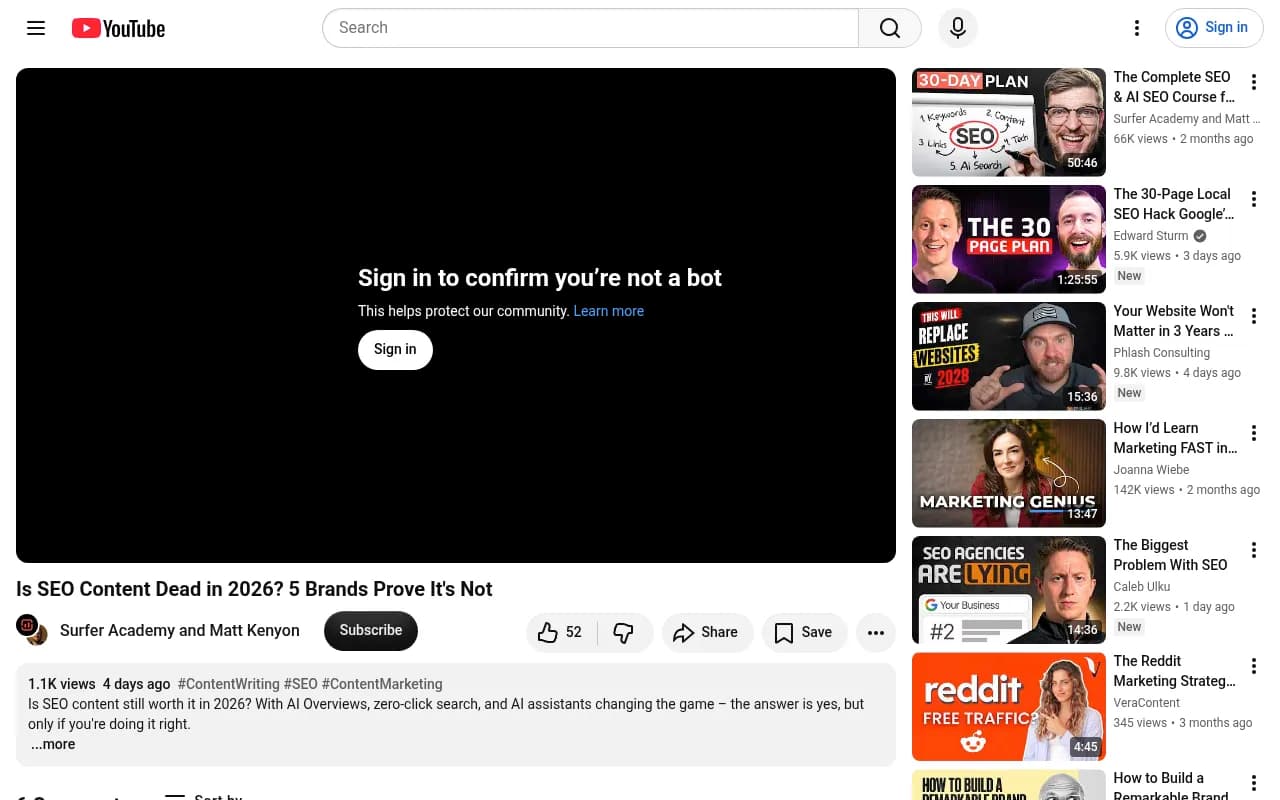
The Surfer Academy breakdown of five brands doing this well is worth watching if you want concrete examples. The common thread: none of them are winning because of keyword density or meta keywords. They're winning because their content is genuinely better and more specific than the alternatives.
The new tool stack for AI search
The tools that matter in 2026 look different from the classic SEO stack. Here's a quick comparison:
| Old feature | Why it's fading | What replaces it |
|---|---|---|
| Keyword rank tracker | Only shows Google positions | AI citation tracking across ChatGPT, Perplexity, etc. |
| Keyword density checker | Irrelevant to AI models | Topical coverage and E-E-A-T analysis |
| Meta keywords field | Ignored since 2009 | Structured data (specific, accurate schema) |
| Anchor text ratio tools | Not how AI evaluates authority | Brand mention tracking across the web |
| Bounce rate dashboards | AI models don't see this | Content quality signals, citation frequency |
| Generic schema generators | Too shallow to help | Entity-level structured data optimization |
| Keyword gap analysis | Produces commodity content | AI answer gap analysis |
| PageSpeed obsession | Doesn't affect AI citations | Content depth, originality, and authority |
| Thin content spinners | Actively counterproductive | Original research, proprietary data |
| Exact-match title stuffing | Penalized or rewritten | Clear, human-readable titles |
For tracking AI visibility specifically, a few tools are worth knowing about:
Semrush has added some AI search features, though its core strength remains traditional SEO. It uses fixed prompt sets rather than custom prompt tracking, which limits how useful it is for brand-specific AI visibility work.
Ahrefs has similarly added AI search tracking through its Brand Radar feature, but like Semrush, it doesn't offer AI traffic attribution or content generation tied to AI gaps.
For teams that want to go deeper on AI visibility — tracking which pages are being cited, why competitors are appearing in AI responses, and what content to create to close those gaps — Promptwatch covers the full cycle from gap identification to content creation to citation tracking.
Tim Soulo's breakdown on Medium makes a useful distinction: there are tools that use AI to make traditional SEO faster, and there are tools that track whether AI search engines actually mention your brand. Both categories exist, but the second one is where the real shift is happening in 2026.
The honest summary
Most of the features in this list didn't die overnight. They faded gradually as Google got smarter, then faded faster as AI search became mainstream. The problem is that many SEO tools — and many SEO teams — are still organized around them.
The brands that are adapting aren't abandoning SEO. They're expanding what SEO means: from "rank on Google" to "appear in every place where someone might ask a question about our category." That includes Google, but it also includes ChatGPT, Perplexity, Claude, Gemini, and whatever comes next.
The tools that help you do that are the ones worth investing in. The ones that help you check keyword density and meta keywords are, at this point, museum pieces.