Key takeaways
- AI answers are probabilistic. The same prompt run twice can return different brands, so any tool that runs a prompt once and reports a score is mostly reporting noise.
- Tools disagree because of method: real user interface scraping versus API calls, sample size, location, prompt sets, how a "mention" is counted, and when the check ran.
- Models change underneath you. ChatGPT cut its average citations per response by roughly 27% around the GPT-5.3 rollout, which can look like a visibility drop when nothing about your brand changed.
- Trust the tool that shows evidence (snapshots, cited URLs, variance across reruns), not the one with the cleanest score.
- Run the same 20-30 prompts through two or three shortlisted tools before you buy. It takes an afternoon and beats any vendor demo.
The problem: you run the same prompts in two tools and get two answers
It happens to nearly everyone who evaluates AI visibility software. You load a set of prompts into Tool A and your brand has a 34% visibility score. Tool B says 12%. A manual check in ChatGPT shows you in the answer. Then you check again ten minutes later and you're gone.
Nobody is necessarily lying. Classic rank tracking trained us to expect one number per keyword. AI search doesn't work like that, and most of the disagreement between tools comes from that mismatch.
One caveat before we go further. A lot of the public writing on this topic comes from vendors who rank themselves first. The Omnia list of AI Overviews trackers, for example, puts Omnia at number one. That doesn't make the underlying points wrong (the point about timestamped snapshots is a good one), but treat any "best of" list from a tool maker as a pitch with useful parts.
Why AI results are not deterministic
Traditional Google rankings vary by location, device and time, but there is still a ranked list of links underneath. AI answers are generated. The model composes a response, picks sources, and decides which brands to name. Run it again and the composition can change.
Sterling Sky's video on AI and local rank tracking makes the same point: AI local results are probabilistic, so rankings, businesses and snippets can change from search to search. Chosenly puts it bluntly: run the same prompt three times and you may get three different answers. Most tools, they argue, run prompts once.
The Omnia write-up adds that Google Search Console doesn't give you AI Overview mention data or the specific URLs referenced in the answers, which is why purpose-built trackers exist at all. You can't just cross-check against a free first-party source.
So "what is my rank" is the wrong question. The right one is "how often do I appear, in what role, and how stable is that?"
Seven reasons two tools report different numbers
1. Real interface versus API
This is the biggest one and the least discussed. Some platforms query the model through its API. Others capture what the actual consumer interface shows. They are not the same product. The user-facing ChatGPT with search switched on, Google AI Overviews, and a raw API call to a model can give different answers and different citations, because the interface adds retrieval, ranking and formatting layers the API doesn't.
If your customers use the app, you want data from the app. Ask every vendor directly which surface they measure for each engine. Promptwatch, for instance, says its data comes from the actual user interfaces of ChatGPT, Gemini, Perplexity, Claude and AI Overviews, and tracks API models alongside to show what models believe from training data. That distinction is worth asking any vendor about.
2. Sample size and reruns
A tool that runs each prompt once per day gives you one draw from a distribution. A tool that runs it several times and averages is closer to the truth. Neither is wrong, but they will disagree, and the single-run tool will bounce around more.
3. Different prompt sets
This sounds obvious, but it explains many disputes. One tool auto-generates prompts from your site, another uses your own list, a third mixes brand-specific and organic prompts. Brand-specific prompts ("is Acme any good?") make you look far better than organic ones ("best project tools for agencies"). Compare tools on identical prompts or you're comparing prompt lists, not tools.
4. What counts as a mention
Some tools count any occurrence of your brand string. Others weight by position, tag sentiment, or require a citation link. Mighty and True's write-up of the ClickUp study (21 prompts, run twice, across ChatGPT, Claude, Gemini, Perplexity, AI Overviews and AI Mode) found that being named as the answer and being listed among options are very different outcomes, and most dashboards collapse them into one number. ClickUp was the lead recommendation in one run and a mid-list mention in the next.
5. Location, language and persona
The same prompt asked from Amsterdam and from Austin can produce different brands, especially for anything local or regulated. A tool checking from one data center and another checking from a different country will disagree. This is the same reason rank trackers have always disagreed with each other and with Search Console.
6. Timing
Retrieval behavior changes in steps. Promptwatch Data on ChatGPT query fanouts shows average fanouts per response at 2.15 in early December 2025 and about 1.84 by early March 2026, with average fanout query length dropping from about 117 characters to the high 80s. If two tools collected their data on either side of a change like that, they'll show different pictures.
The bigger example is the ChatGPT citation drop. GPT-5.3 rolled out on March 4, 2026. The week before, ChatGPT cited about 6.4 sources per search-enabled response. By late March it was 4.7 to 4.9, roughly 27% fewer, with no recovery a month later. If your visibility score fell that month, it may have fallen because every brand lost citation slots, not because you did something wrong. A tool that logs citations per response next to your own visibility can tell those two situations apart. One that doesn't will send you chasing a problem that doesn't exist.
7. Crowded answers
How many sources an answer cites changes how "visible" any one brand can be. Promptwatch's unique domains per response report (Sep 28 to Oct 4, 2026) found that 47.6% of ChatGPT responses with a citation cite 10 or more unique domains, and 66.1% cite at least 8. For organic prompts the figure for 10 or more is 52.5%. For brand-specific prompts the most common count is 5 domains. So the same brand looks different depending on which prompt types a tool favors. A single prompt tells you very little when answers are this crowded. You need many prompts.
Why a single visibility score is a weak instrument
Most dashboards lead with one number. It's clean and comparable, and it hides the thing you most need to know: variance. If you only see the mean, you can't tell a real change from model drift. You will brief a team to fix something that was never broken, or celebrate a jump that reverses on the next run.
A more useful setup separates three things, per prompt and per model:
- Presence: did the brand appear at all?
- Position: recommendation, shortlist item, or footnote citation?
- Persistence: does the result hold when you rerun it an hour, a day or a week later?
Presence is the easy one every tool does. Position and persistence are where tools actually differ, and where trust is earned.
Evidence to demand from any tracker
Borrowing from the Omnia and Brainlabs write-ups, plus common sense, here is what separates an auditable tool from a score generator:
- Stored responses or snapshots with timestamps, so you can open the answer that produced a number.
- Extracted citations at the URL level, exportable. Without them, optimization is guesswork.
- Rerun and variance reporting, or at least a stated sampling method.
- Country, language and (for local businesses) location controls.
- A clear statement of which surface is tracked: consumer interface or API.
- Engine coverage that matches where your buyers actually look, not every model available.
Brainlabs also makes a fair point about cadence: weekly tracking is enough for most brands, and daily only makes sense in fast-moving or high-risk categories. More data doesn't automatically mean better insight. I'd add that if the tool samples once a day and the underlying answer is noisy, daily numbers mostly show you noise faster.
How the main tool types compare
| Tool type | What it measures well | Typical weakness | Examples |
|---|---|---|---|
| Prompt trackers | Presence and share of voice across engines | Few reruns, little evidence behind the score, no action layer | Otterly.AI, Peec AI, Rankshift |
| SEO suites with AI add-ons | Context next to classic rankings | Fixed prompt sets, shallow AI-specific data | Semrush, Ahrefs Brand Radar |
| Classic rank trackers | Deterministic SERP positions, local accuracy | Not built for generated answers | AccuRanker, Nightwatch |
| Full visibility platforms | Citations, crawler logs, traffic, content actions | Cost, more to set up | Promptwatch, Profound |
Prompt trackers
Tools like Otterly.AI and Peec AI are quick to set up and good for a baseline. Peec's prompt discovery is handy when you're still mapping how people ask about your category. Where they tend to fall short is evidence and execution: you see a score, but not necessarily why it moved or what to do about it.
Otterly.AI



SEO suites
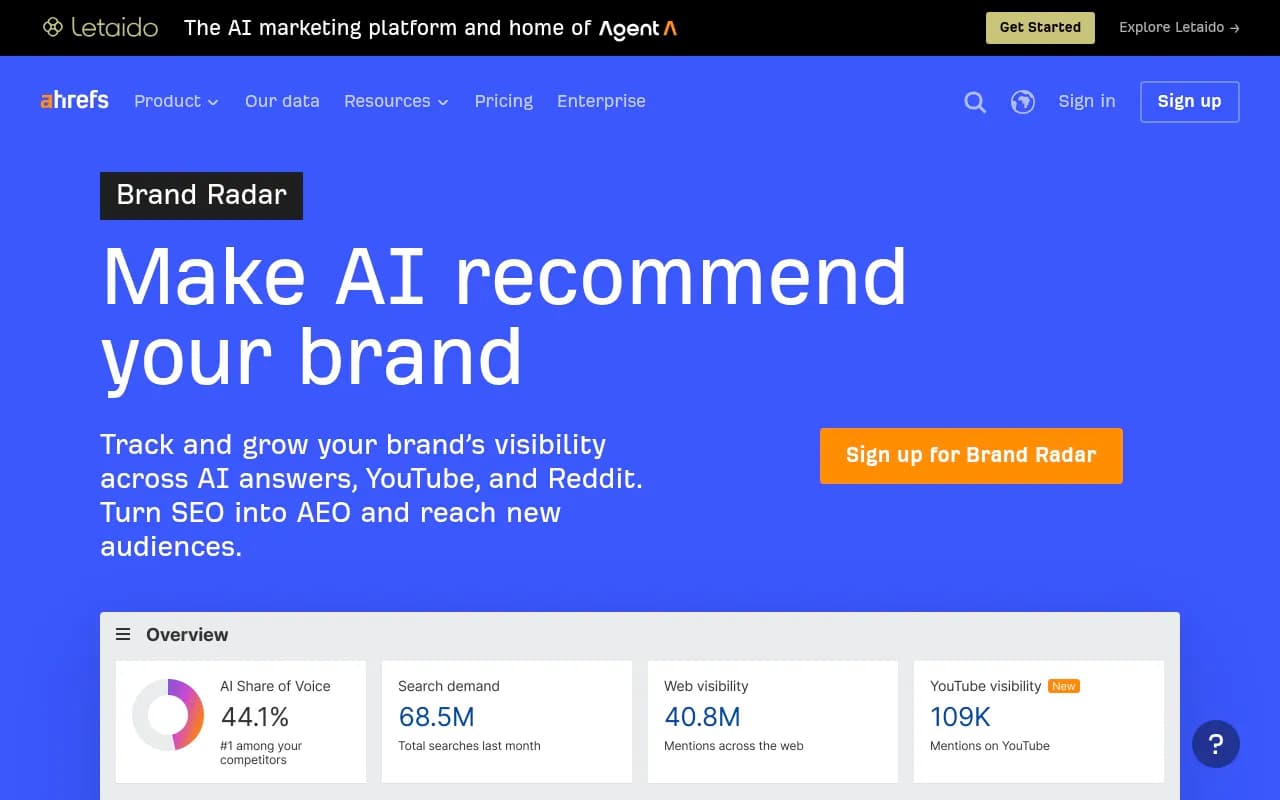
Semrush and Ahrefs Brand Radar are convenient if you already pay for the suite and want AI numbers beside organic data. The trade-off is usually a fixed prompt set and thinner AI-specific detail.
Classic rank trackers adding AI
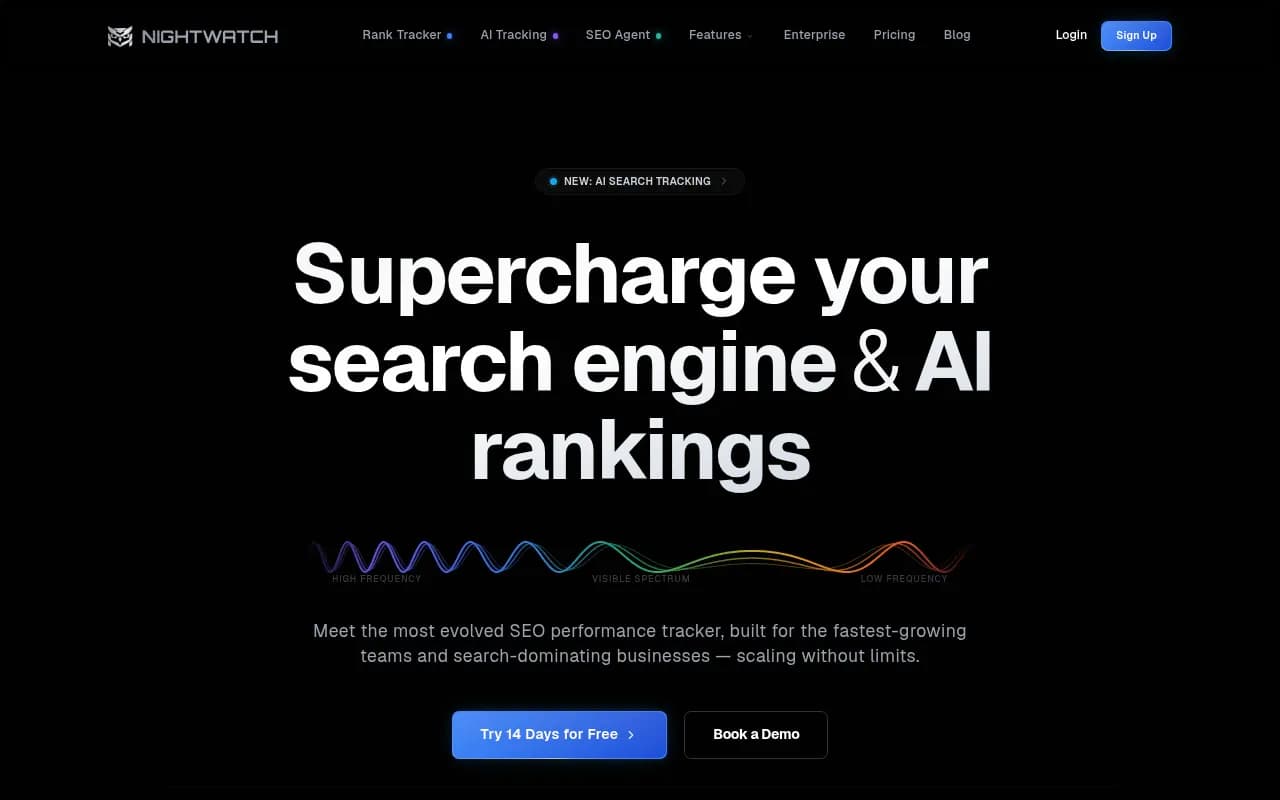
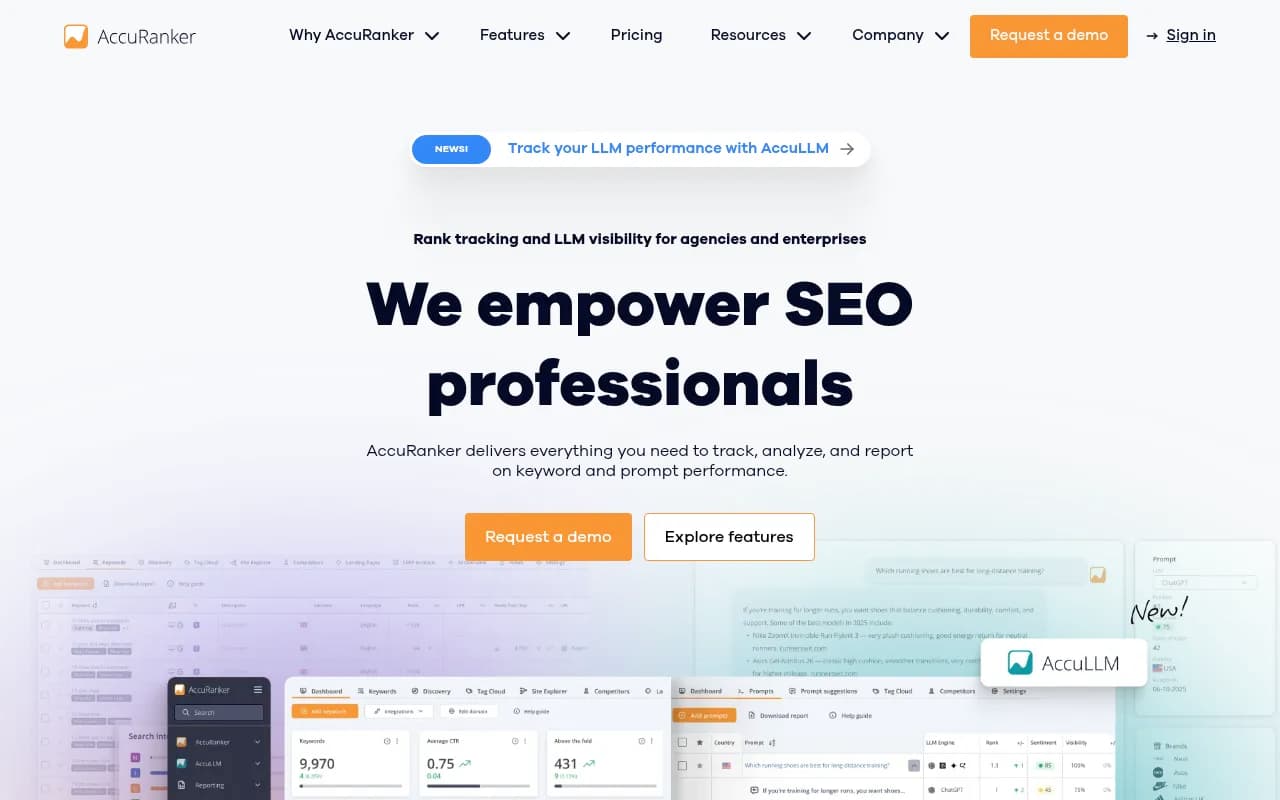
Nightwatch tracks at ZIP-code level across 100,000+ locations and now includes brand presence in ChatGPT, AI Mode and AI Overviews alongside traditional rankings. AccuRanker is the on-demand option agencies like. If your real need is traditional rankings with a little AI on the side, these are reasonable. Just don't expect deep generated-answer analysis.
Evidence-first AI Overviews tools
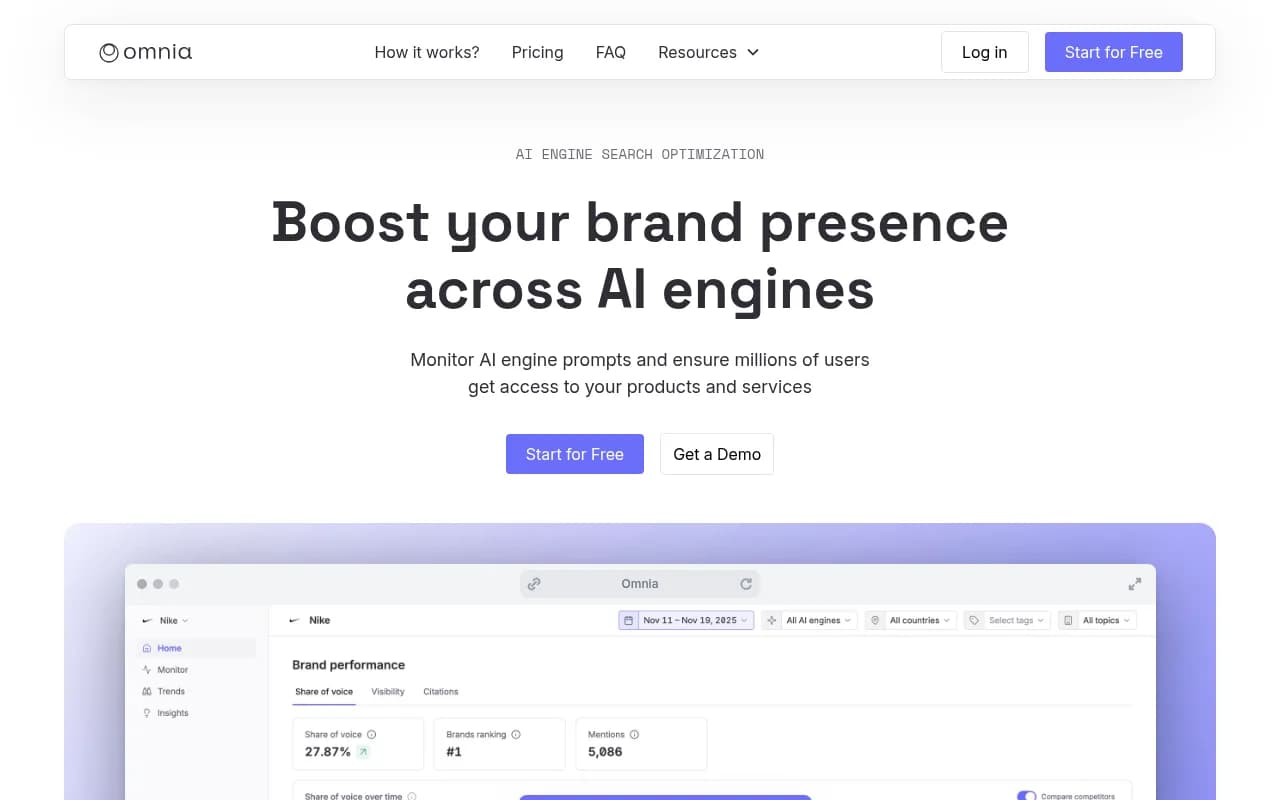
Omnia pushes hard on archived SERPs, URL-level citations and geo-specific tracking. That is the right instinct for AI Overviews specifically, even if its own ranking of itself deserves a pinch of salt.
Full visibility platforms
If you want to move from "what's my number" to "why, and what do I change", the tools that connect tracking to actual site data tend to hold up better under scrutiny. Promptwatch tracks real consumer interfaces, shows citations and which pages get cited, adds IP-verified AI crawler logs and visitor analytics so you can check whether visibility turns into traffic, and has a content gap and action workflow for fixing what's missing. Because it joins tracking with crawler and traffic data, a surprising score is easier to sanity check. Profound is the other name you'll see in enterprise shortlists.

Profound

For wider browsing, the directory at ai-rank-tools.com lists AI rank trackers by category, and bestgeosoftware.com covers broader GEO platforms.
A 5-step test to find the tracker you can trust
This is the part that matters most. Pick the tool after you've done the work once by hand. You'll know what you need automated and be a much harder customer to oversell.
Step 1: Build a fixed prompt set
Write 20-30 prompts your buyers actually ask. Mix organic ("best X for Y"), competitor comparison, and a few brand-specific. Tag each. Keep the list identical across every tool you test.
Step 2: Pick two or three engines
Choose where your buyers research. For most B2B that's ChatGPT and Google AI Overviews or AI Mode, with Perplexity added if your audience is research heavy. Don't track six on day one.
Step 3: Run it by hand, twice
Run each prompt manually, with the same location and language, at two different times. Record whether you were the recommendation, a listed option, a citation only, or absent. The gaps between the two runs are your baseline noise level. Everything a tool tells you has to be judged against that.
Step 4: Run the same set in each shortlisted tool
Match the location, language, device and engine. Note collection times. When numbers differ from your manual check, open the stored snapshot or response. If the tool can't show you one, that's your answer about how far to trust it.
Step 5: Score the tools on a few questions
| Question | What a good answer looks like |
|---|---|
| Which surface do you measure? | Names the consumer interface per engine |
| How many times is each prompt run? | Multiple runs, or variance shown |
| Can I see the response behind a number? | Stored, timestamped, exportable |
| Are citations extracted at URL level? | Yes, with export |
| Does it separate recommendation from mention? | Yes, or at least position |
| Does it note model updates? | Release annotations or citations-per-response baseline |
The tool that makes its differences understandable beats the one advertising "100% accurate" data. Nathan Ojaokomo's rank tracker comparison says much the same about classic trackers: a star rating on G2 is a poor substitute for your own accuracy test, since it can reflect support or ease of use rather than measurement quality.
Reading the results once you have them
- If two tools disagree but your manual runs also swing between appearing and not appearing, the tools may both be right. Your visibility is unstable. Aim to measure over many prompts and weeks.
- If all tools drop on the same date, check for a model release before you panic. The March 2026 citation drop is a good reminder.
- If a tool shows you mentioned but never cited, that points at content or crawlability, not reputation. Checking AI crawler access is a cheap next step.
- If tools agree on direction and disagree on level, pick one and stick with it. Trends from a consistent instrument are more useful than absolute values from a switching one.
When tracking is the wrong spend
Two cases. If your buyers don't ask AI about your category yet (some regulated or deeply technical infrastructure buyers still run RFPs), ask sales how people first heard about you. If it's never an AI answer, you have time. And if your source material is thin, a tracker will just tell you again and again that you don't show up. You don't need a dashboard for that. You need pages, third-party coverage and citations. Measurement sits on top of that work.
Bottom line
AI rank tracking tools disagree because they measure different things in different ways at different times, and because the thing being measured is itself noisy. Stop looking for the tool with the highest or cleanest number. Look for the one that shows its evidence, reports variance, tracks the surface your customers use, and lets you check a surprising score against real data. Then validate it with an afternoon of manual testing before you sign anything.
If you want first-party numbers on how AI answers behave, the Promptwatch Data hub publishes regularly updated research on citations, fanouts and crawler activity, which is a good benchmark to hold any vendor's claims up against.