Key takeaways
- Yext, Uberall, and SOCi all solve the traditional multi-location problem: keeping listings accurate across directories and local search. They're strong at that, but their AI search coverage is limited.
- SOCi leans into agentic local execution -- it does the work for you across social, reviews, and listings, but it's not built around tracking or improving visibility in ChatGPT, Perplexity, or Claude.
- Uberall is a solid mid-market choice for listings management and local pages, but it's primarily a data distribution platform with limited AI search capabilities.
- Promptwatch is the only platform in this comparison purpose-built for AI search visibility -- tracking how brands appear in LLMs, identifying content gaps, and generating content to close them.
- If your concern is "are we showing up in Google Maps?", Yext or Uberall will serve you well. If your concern is "are we showing up when someone asks ChatGPT which franchise to visit?", you need a different tool entirely.
The local search landscape has split in two. On one side, you have traditional local search: Google Business Profile, Apple Maps, Yelp, Bing Places. On the other, you have AI search: ChatGPT, Perplexity, Claude, Gemini, and Google AI Overviews. These are now genuinely different channels with different mechanics, different content requirements, and different tools to manage them.
Most multi-location platforms were built for the first world. Some are scrambling to address the second. One was built specifically for it.
This comparison breaks down what Yext, Uberall, SOCi, and Promptwatch actually do -- where each one is strong, where each one falls short, and which makes sense depending on what problem you're actually trying to solve.
What multi-location brands actually need in 2026
Before comparing tools, it's worth being clear about what the problem is. For a franchise or enterprise brand with 50, 500, or 5,000 locations, visibility breaks down in a few predictable ways:
- Location data gets stale (wrong hours, closed locations still listed, missing attributes)
- Local content is thin or non-existent, so individual locations don't rank for anything beyond their name
- Reviews go unmanaged, which tanks both local rankings and AI recommendations
- When someone asks an AI assistant "best [category] near [city]", the brand either shows up or it doesn't -- and most brands have no idea which
The first three problems are well-understood and well-served by existing platforms. The fourth is where things get murky. SOCi's own 2026 Local Visibility report found that in AI-driven discovery, most brands simply disappear -- only a handful get cited, and the rest get nothing. That's not a listings problem. That's a content and authority problem that requires a different approach.
Yext
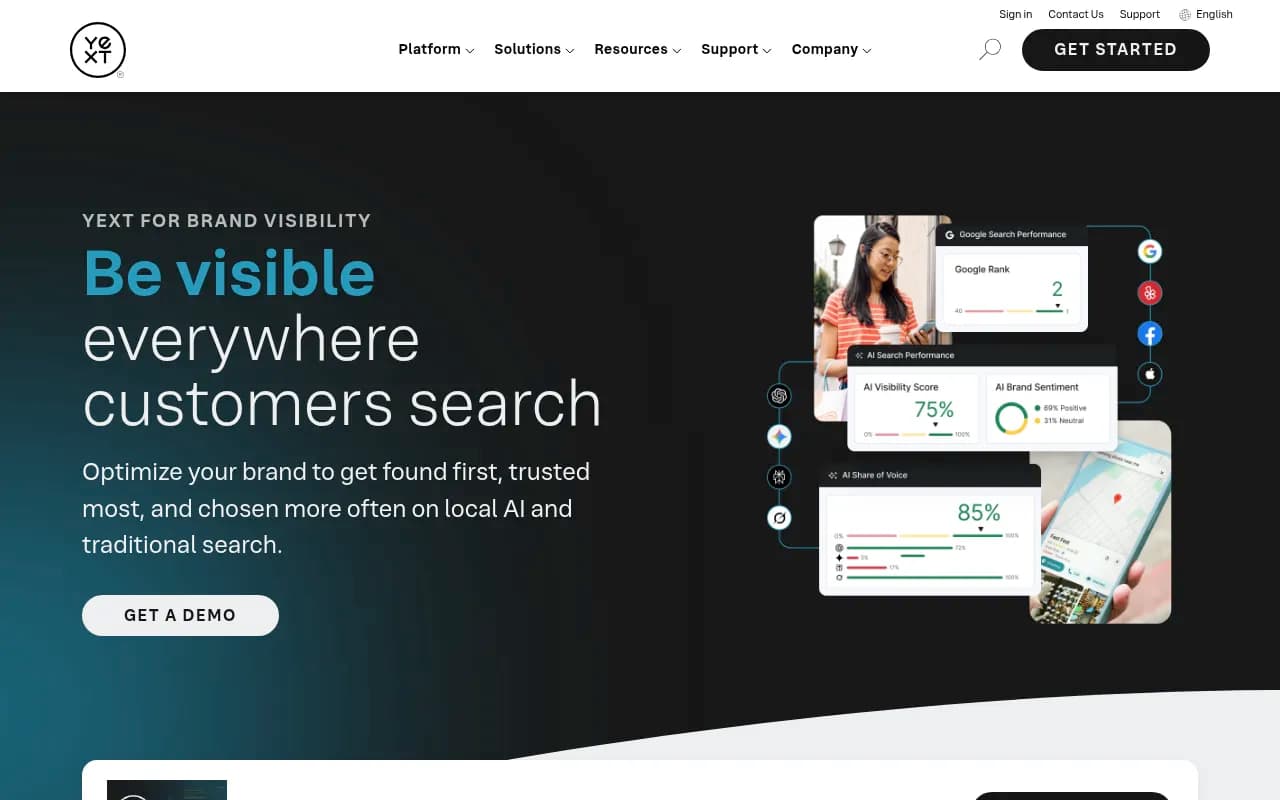
Yext's core product is the Knowledge Graph: a structured data layer that syncs location information across 200+ publishers. For large brands that need consistent NAP (name, address, phone) data everywhere, it's genuinely good at this. The platform also includes location pages, reviews management, and a search product that lets brands power their own site search with structured data.
Where Yext has invested recently is in AI search readiness. The argument is that clean, structured, machine-readable data is what AI models need to cite your locations accurately -- and that's not wrong. If your data is a mess, AI models will either get it wrong or skip you entirely. Yext helps with that foundation.
But Yext's AI story stops there. It doesn't track whether your brand is actually appearing in ChatGPT or Perplexity responses. It doesn't show you which prompts your competitors are winning. It doesn't generate content designed to get cited by LLMs. It's a data infrastructure play, not an AI visibility play.
Yext also operates as a self-service platform. The tools are there, but someone on your team has to use them. For a brand with 500 locations and a lean marketing team, that's a real constraint.
Best for: Brands that need enterprise-grade data syndication and are willing to invest in the platform operationally. Strong if structured data accuracy is the primary gap.
Pricing: Enterprise pricing, typically starting in the tens of thousands annually. Custom quotes required.
Uberall
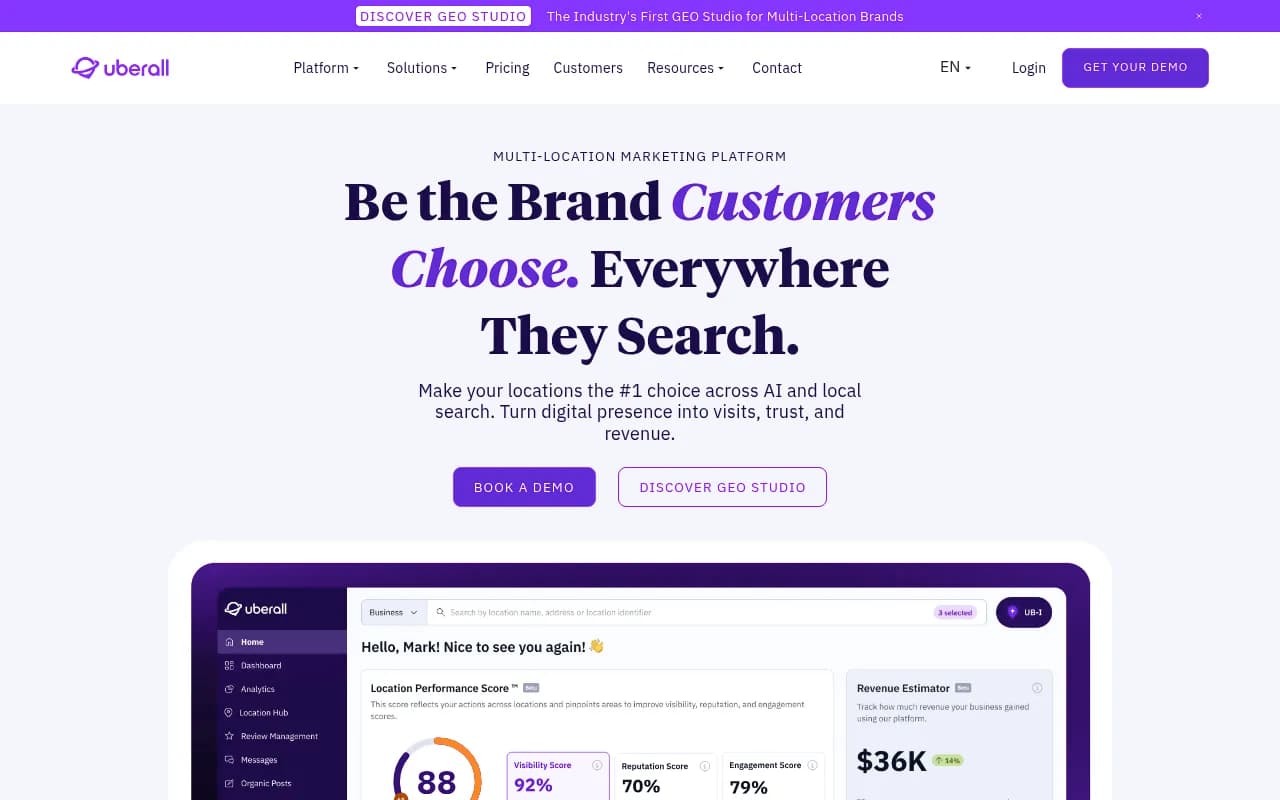
Uberall positions itself as a "hybrid local marketing" platform -- the idea being that it handles both the online presence layer (listings, location pages, reviews) and the in-store/offline connection. It's particularly popular in Europe and has a clean interface that mid-market brands tend to find easier to adopt than Yext.
The platform covers the basics well: listing management across major directories, review monitoring and response tools, local pages with schema markup, and some social posting capabilities. It's a solid operational tool for keeping location data accurate and consistent.
On AI search, Uberall has started adding features to help brands understand their AI visibility -- but it's early. The platform doesn't have the depth of prompt tracking, LLM citation analysis, or content optimization that a dedicated AI visibility platform offers. It's more of a "we're working on it" story than a mature capability.
For franchise brands that want a cleaner, more accessible alternative to Yext without the enterprise price tag, Uberall is worth a look. Just don't expect it to tell you why ChatGPT isn't recommending your locations.
Best for: Mid-market multi-location brands in retail, hospitality, or healthcare that need solid listings management and a manageable interface. Good for European markets.
Pricing: Mid-market pricing, generally more accessible than Yext. Custom quotes for enterprise.
SOCi
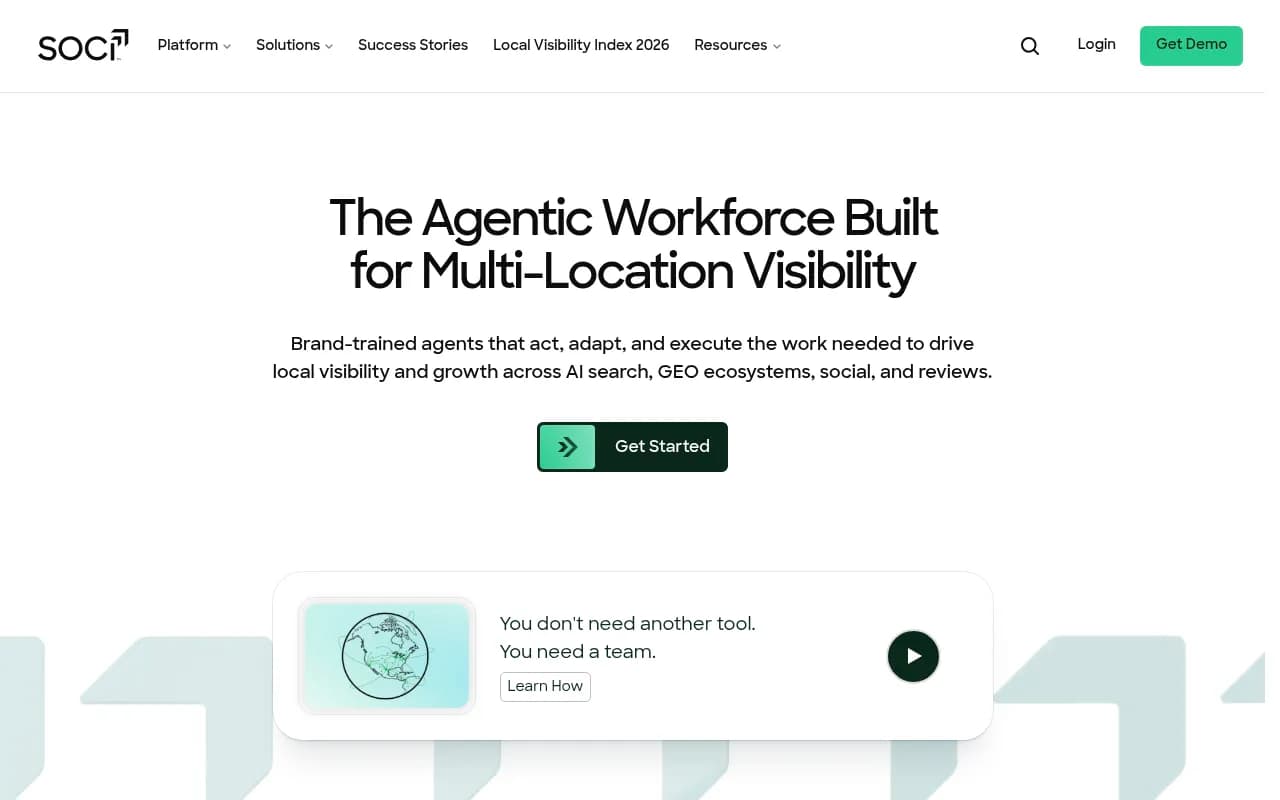
SOCi takes a different angle. Where Yext and Uberall are primarily data distribution platforms, SOCi is built around execution. The platform describes itself as an "agentic workforce for multi-location brands" -- meaning it doesn't just give you tools, it does the work: publishing local social content, responding to reviews, optimizing listings, running local ads.
For franchise brands where individual location managers have limited time or marketing skills, this model is genuinely useful. SOCi's AI agents can handle the repetitive local marketing tasks that would otherwise require either a large corporate team or a lot of franchisee training.
SOCi also released a 2026 Local Visibility report that's worth reading if you're in this space. The headline finding: in AI-driven discovery, very few brands are actually being chosen, and most disappear entirely. SOCi is aware of the AI search shift and has been building toward it.
That said, SOCi's AI visibility capabilities are still primarily about local search (Google, Bing, Apple Maps) rather than LLM search (ChatGPT, Perplexity, Claude). The platform doesn't offer the kind of prompt-level tracking, citation analysis, or content gap identification that you'd need to systematically improve how you appear in AI assistants.
Best for: Franchise brands that want local marketing execution handled for them -- social, reviews, listings -- with minimal reliance on individual location managers. Good for brands where operational consistency is the main challenge.
Pricing: Enterprise pricing, custom quotes. Typically positioned for brands with 50+ locations.
Promptwatch
Promptwatch is a different category of tool. It's not a listings management platform. It doesn't sync your NAP data to directories. What it does is track, analyze, and improve how your brand appears in AI search engines -- ChatGPT, Perplexity, Claude, Gemini, Google AI Overviews, Grok, DeepSeek, and more.

For multi-location and franchise brands, this matters because the question "which [brand] location should I visit in [city]?" is increasingly being answered by AI assistants, not just Google Maps. If you're not tracking those answers, you don't know whether you're winning or losing that channel.
Promptwatch's core loop works like this: first, it shows you which prompts your competitors are appearing for that you're not (Answer Gap Analysis). Then its built-in AI writing agent generates content -- articles, comparisons, location guides -- grounded in actual citation data from 880M+ citations analyzed. Then you track whether that content starts getting cited by AI models, with page-level visibility scores and traffic attribution.
For franchise brands specifically, a few capabilities stand out:
- Multi-location and multi-region tracking, so you can monitor AI visibility by city or market
- Competitor heatmaps showing which brands are winning which prompts across which LLMs
- AI crawler logs showing which pages ChatGPT and Perplexity are actually reading on your site
- Reddit and YouTube tracking, since AI models frequently cite those sources in local recommendations
- ChatGPT Shopping tracking for brands with product or service recommendations in AI carousels
The pricing is also more accessible than the enterprise platforms above: $99/month for a single site, $249/month for the Professional tier (which includes crawler logs and city-level tracking), and $579/month for the Business tier covering five sites.
Best for: Brands that want to understand and improve their visibility in AI search engines specifically. Essential if you're seeing AI-driven traffic and want to know where it's coming from -- or if you suspect you're invisible in LLMs and want to fix it.
How they compare
| Capability | Yext | Uberall | SOCi | Promptwatch |
|---|---|---|---|---|
| Listings management (NAP sync) | Excellent | Good | Good | Not applicable |
| Review management | Good | Good | Excellent | Not applicable |
| Local social publishing | Limited | Limited | Excellent | Not applicable |
| Local pages / location SEO | Good | Good | Moderate | Not applicable |
| AI search tracking (ChatGPT, Perplexity, etc.) | Basic | Early-stage | Limited | Core product |
| Prompt-level visibility scoring | No | No | No | Yes |
| Answer gap analysis (vs competitors) | No | No | No | Yes |
| AI content generation for LLM citations | No | No | No | Yes |
| AI crawler logs | No | No | No | Yes |
| Reddit / YouTube citation tracking | No | No | No | Yes |
| ChatGPT Shopping tracking | No | No | No | Yes |
| Multi-region / multi-language AI monitoring | Limited | Limited | Limited | Yes |
| Traffic attribution from AI search | No | No | No | Yes |
| Pricing transparency | Custom | Custom | Custom | From $99/mo |
The table makes the split clear. Yext, Uberall, and SOCi are competing in the same space -- traditional local search infrastructure -- with different operational models. Promptwatch is in a different category: AI search visibility and optimization.
The real question: which problem are you solving?
These platforms aren't really competing with each other for the same buyer. The decision tree looks something like this:
If your main problem is listing accuracy and data syndication -- wrong hours showing up on Google, inconsistent NAP across directories, locations not appearing in Google Maps -- Yext is the most mature solution. Uberall is a strong alternative if you want something more accessible or have significant European presence.
If your main problem is local marketing execution at scale -- franchisees not posting on social, reviews going unanswered, local content not being created -- SOCi's agentic model is genuinely useful. It removes the dependency on individual location managers doing the work.
If your main problem is AI search visibility -- you don't know whether ChatGPT recommends your brand, you can't see which prompts competitors are winning, you have no way to create content that gets cited by LLMs -- Promptwatch is the tool built for that.
The honest answer for most enterprise brands in 2026 is that you probably need both: a listings/local marketing platform for the traditional local search layer, and an AI visibility platform for the LLM layer. These aren't substitutes; they're addressing different parts of the discovery funnel.
Other tools worth knowing
If you're building out your multi-location visibility stack, a few other platforms are relevant:
BrightLocal is a solid, affordable option for local SEO reporting and citation building -- particularly useful for agencies managing multiple brand clients.
Chatmeter focuses specifically on multi-location reputation and local search, with AI-powered review analysis and competitive benchmarking.
Rio SEO is an enterprise local marketing platform with strong location pages and local SEO capabilities, often used by large retail and hospitality brands.
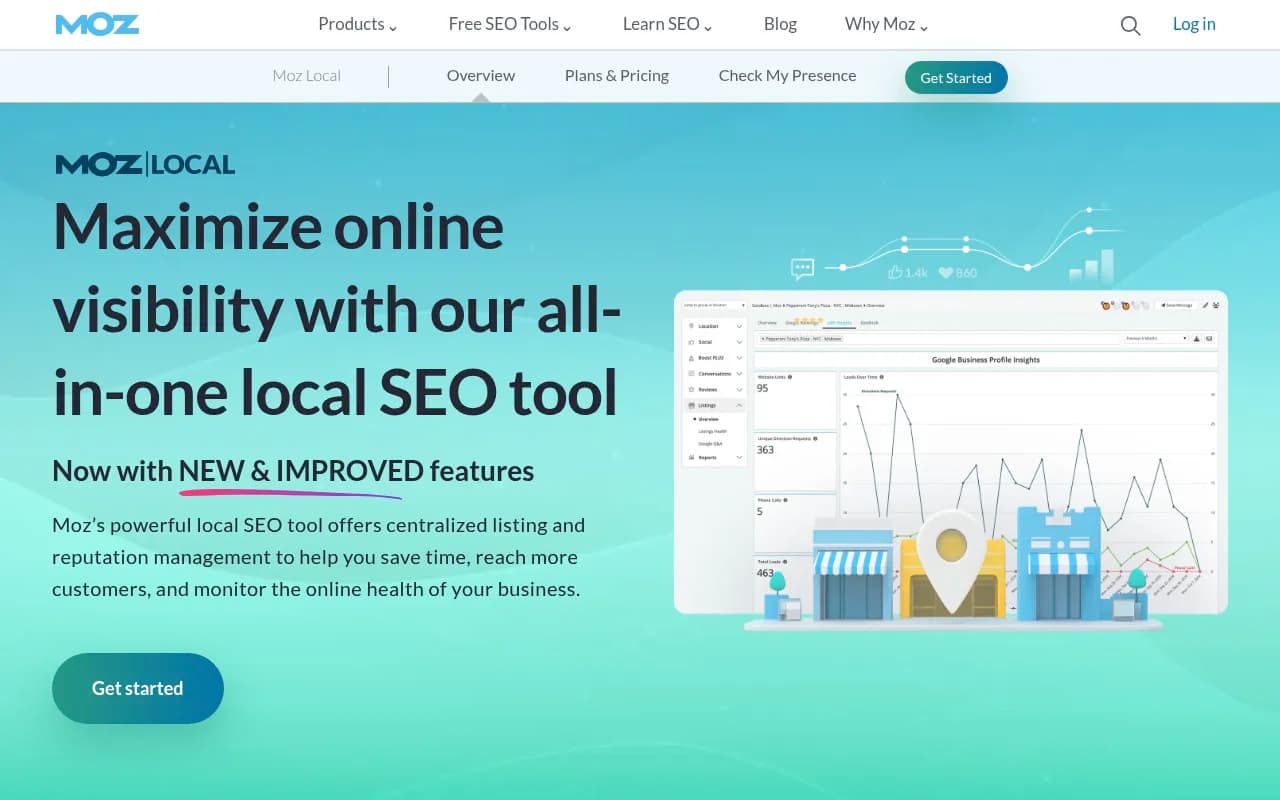
Moz Local is a simpler, more affordable listings management option for brands that don't need the full enterprise stack.
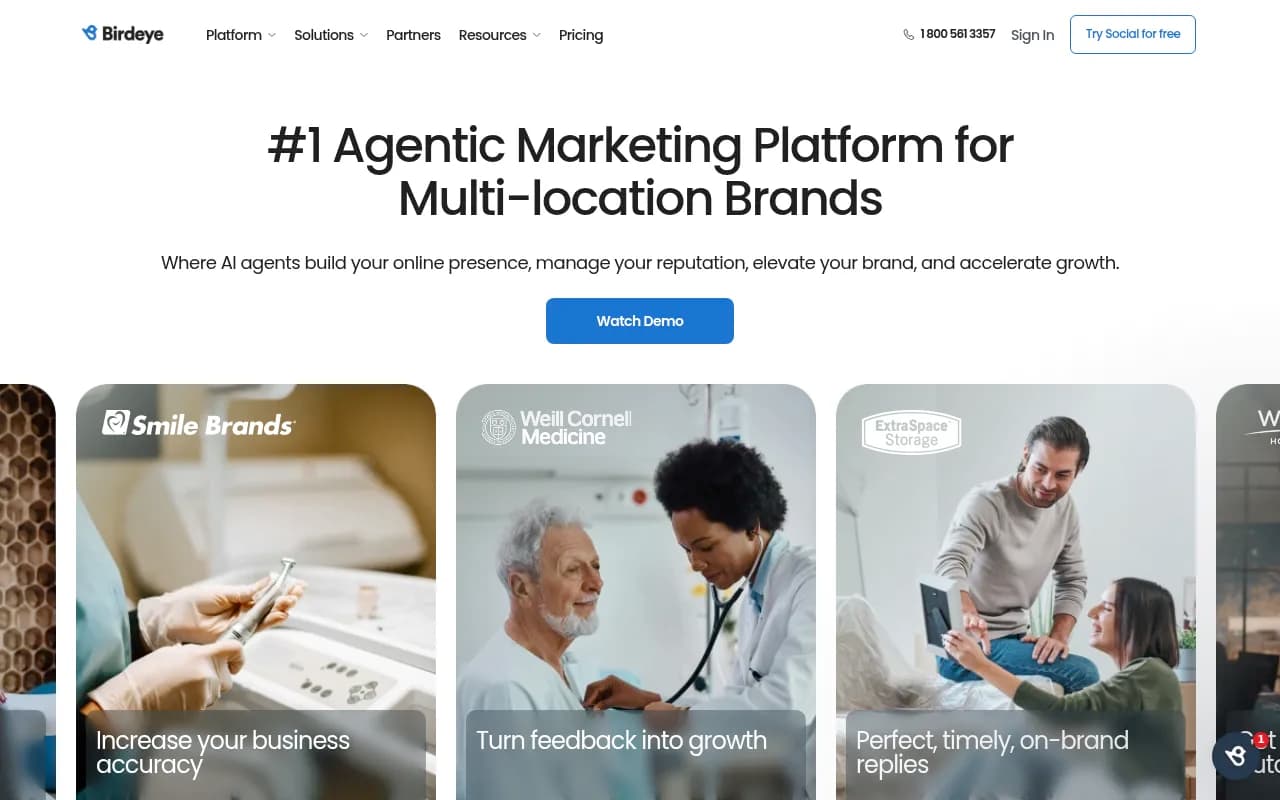
Birdeye covers reviews, listings, and messaging in a unified platform, with a particular strength in healthcare and home services verticals.
What to do next
If you're a franchise or enterprise brand trying to figure out where to start:
-
Audit your current listings accuracy first. If your NAP data is inconsistent across Google, Apple, and Yelp, fix that before worrying about AI search. Yext or Uberall can help.
-
Check whether your brand is actually appearing in AI search. Ask ChatGPT, Perplexity, and Claude questions your customers would ask -- "best [category] in [city]", "which [brand] locations are near [area]". See what comes back. If you're not in the answers, that's a gap.
-
If you're invisible in AI search, the fix isn't better listings data -- it's content. AI models cite pages, articles, and structured content. Promptwatch's Answer Gap Analysis will show you exactly what content is missing and help you create it.
The brands that will win in AI-driven local discovery aren't necessarily the ones with the most locations or the biggest marketing budgets. They're the ones that understand how AI models make recommendations and build content accordingly. That's a new skill, and it requires different tools than the ones that got you here.