SignalHire Review 2026
Contact data platform offering emails and phone numbers sourced from social profiles, with a Chrome extension for LinkedIn and a candidate search database.
Key takeaways
- SignalHire gives you real-time verified emails and phone numbers pulled from 850M+ profiles and 30M+ companies, with a credit-based model that only charges on successful results
- The browser extension works across LinkedIn, GitHub, Twitter/X, Facebook, and most websites -- not just LinkedIn like many competitors
- Built-in email sequences let you run multi-step outreach campaigns directly from the platform, which is unusual at this price point
- Pricing starts at around $39/month for phone-focused plans, making it noticeably cheaper than Apollo.io or ZoomInfo for comparable data
- Data freshness is updated every 7-10 days, which is reasonable but not real-time for company-level changes
- The lead tracker and website visitor identification feature is still U.S.-only, which limits its value for international teams
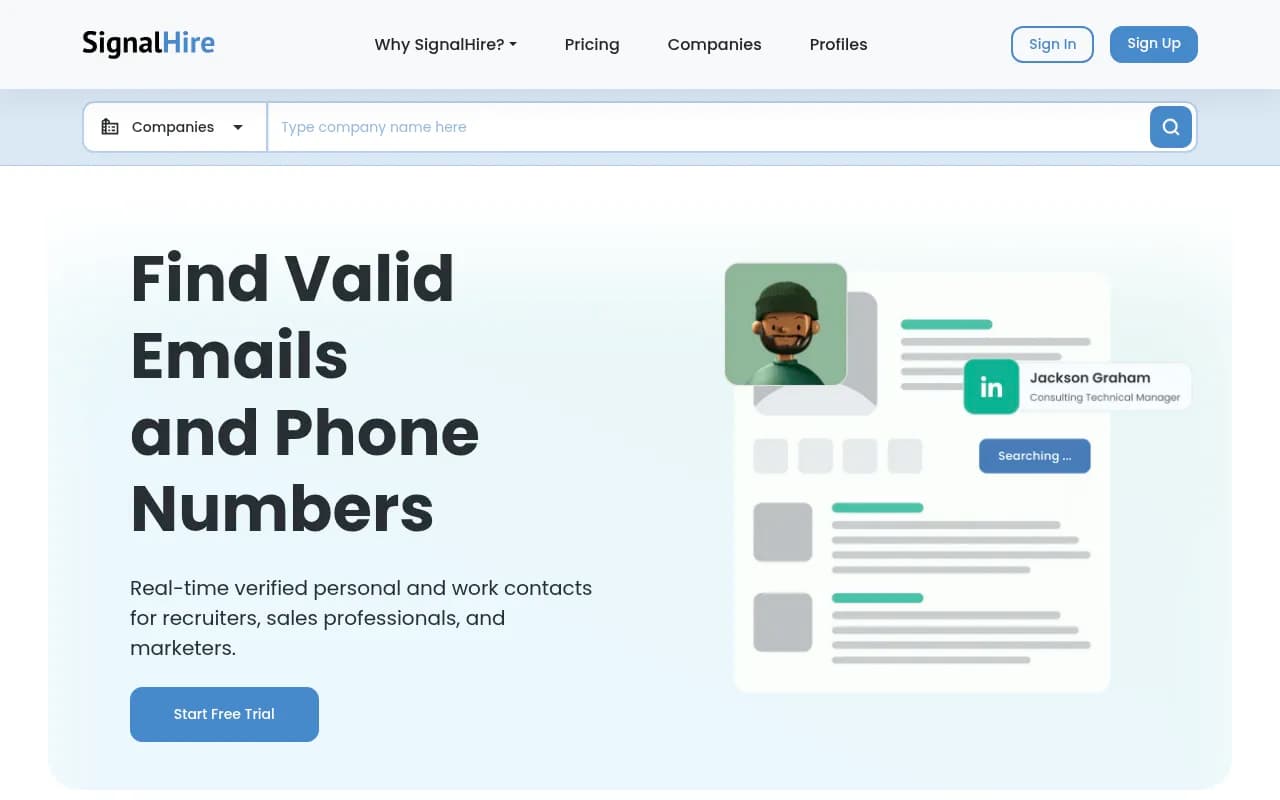
SignalHire is a contact intelligence platform built for recruiters, sales reps, and marketers who need to reach real people -- not just find their LinkedIn profiles. The core product is simple: you give it a name, a social profile URL, or a company, and it returns verified email addresses and phone numbers. What makes it worth looking at in 2026 is the combination of a large database (850M+ profiles), real-time email verification, a browser extension that works on more than just LinkedIn, and a built-in outreach layer that most pure data tools don't include.
The company, SignalHire Sp. z o. o., appears to be Poland-registered based on the legal entity name, though it operates with a U.S. phone number and serves a global customer base. It claims over 3 million users and counts teams at Tesla, Amazon, Microsoft, Deloitte, and MongoDB among its customers. That's a wide range, and the testimonials on the site -- including one from EY's sourcing team and MongoDB's Director of Talent Acquisition -- suggest it's genuinely used by enterprise recruiting teams, not just solo freelancers.
The target audience splits roughly into two groups: recruiters who need to find and contact passive candidates, and B2B sales teams building outbound prospect lists. Marketers doing account-based campaigns are a third use case, though the platform is less optimized for that workflow than something like Apollo or Clay.
Key features
Contact finder with real-time verification
The core feature is email and phone lookup. When you view a profile -- either in the database or via the browser extension -- SignalHire queries its data sources in real time and runs the result through third-party verification before showing it to you. The claimed accuracy is 95%+ for emails with a 3-5% bounce rate, and an 85%+ hit rate on social media profiles. One credit covers all available contact data for a single profile, and you're only charged if the lookup returns a result. That "pay on success" model is genuinely useful -- you're not burning credits on dead ends.
Browser extension (Chrome and Firefox)
The extension is one of SignalHire's clearest differentiators. Most contact-finding extensions are built specifically for LinkedIn. SignalHire's works on LinkedIn, but also on GitHub, Twitter/X, Facebook, Xing, Quora, Meetup, Dribbble, Gmail, and most company "Team" pages. For technical recruiters who source on GitHub, or sales reps who find prospects through Twitter, this is a real advantage. The extension also gives you 10 free credits per month just for having it installed, which is a low-friction way to try the product. One-click export to connected ATS and CRM platforms is built in.
Database search (850M+ profiles)
The searchable database covers 850M+ individual profiles and 30M+ companies. Filters include name, job title, company, location, seniority, and industry. You can save results to Lead Lists or Projects, export to CSV, or push directly to connected ATS/CRM tools. Bulk enrichment runs up to 1,000 profiles per batch. The database is updated every 7-10 days, which is more frequent than some competitors but still means you might occasionally hit stale data for people who changed jobs recently.
Email sequences
This is where SignalHire goes beyond being a pure data tool. The built-in sequences feature lets you build multi-step outreach campaigns with delays, send windows, and automatic pause-on-reply logic. You send from your own mailbox (Outlook/Office 365 or any professional domain), so deliverability isn't routed through a shared IP pool. Open and reply tracking is included. You can add prospects in bulk from Lead Lists or Projects. For small teams that don't want to pay separately for a tool like Outreach or Lemlist, having this built in at the same price point is a meaningful cost saving.
REST API
The API has two main endpoints: a Person API that returns full profiles and verified contacts when you pass a social media URL, email, or phone number; and a Search API that finds people or companies based on filters and returns list-building overviews. Authentication is key-based, credits are tracked in response headers, and rate limits are documented. It's a clean, practical API for teams that want to embed contact discovery into their own products or internal tools. The documentation lives at docs.signalhire.com.
Lead tracker and website visitor identification
This is the newest-feeling part of the product. The lead tracker identifies anonymous website visitors and turns them into named leads with contact data. It includes a kanban-style pipeline with drag-and-drop stages, deadlines, and bulk actions. The catch: it currently only works for U.S.-based visitors. That's a significant limitation for any company with meaningful international traffic. The feature also includes free job board posting integrations, which is a nice touch for recruiting teams.
Bulk enrichment
Upload a CSV or TXT file with a list of people, and SignalHire will enrich up to 1,000 records per run. Results can be exported back to CSV or pushed to connected ATS/CRM platforms. This is useful for sales ops teams cleaning up a prospect list, or recruiters who've scraped a list of candidates from a job board and need contact details.
Who is it for
The clearest fit is in-house recruiting teams and staffing agencies that source passive candidates. A recruiter at a mid-size tech company who needs to reach software engineers on GitHub, or a headhunter building a list of finance executives, will get immediate value from the extension and database. The combination of personal emails (not just work emails) and mobile phone numbers is particularly useful here -- passive candidates don't always respond to LinkedIn InMail, but they do answer their phones.
B2B sales teams doing outbound prospecting are the second core persona. A sales development rep at a SaaS company building a list of VP-level buyers at mid-market companies, or a business development manager at a staffing firm trying to reach HR directors, will find the database filters and bulk enrichment useful. The built-in sequences mean a solo SDR can run their entire outbound workflow -- find contacts, enrich, sequence -- without needing a separate tool.
SignalHire is less well-suited for large enterprise sales teams that need deep intent data, technographic signals, or account-level buying signals. Tools like ZoomInfo or Apollo have more sophisticated intent layers. It's also not the right choice for teams with primarily non-U.S. website traffic who want the visitor identification feature -- that's a real gap right now. Marketing teams running complex ABM programs will likely find the segmentation and enrichment capabilities too basic compared to dedicated ABM platforms.
Integrations and ecosystem
SignalHire connects to a solid range of ATS and CRM platforms. Named integrations include Salesforce, Zoho Recruit, Pipedrive, Recruitee, ActiveCampaign, Workable, Ashby, Crelate, Avionte, ClickUp, and Reply.io. The one-click export from the browser extension means you can push a contact directly to your ATS without leaving the page you're sourcing from.
The REST API covers both person lookup and search, making it possible to build custom integrations for tools not on the native list. API documentation is available at docs.signalhire.com.
There's no native Zapier or Make integration listed prominently, which is a gap for teams that want to automate workflows without writing code. The browser extension is available for both Chrome and Firefox, which is more than most competitors offer (most are Chrome-only).
No mobile app appears to be available, which is fine for a desktop-first workflow but worth noting.
Pricing and value
SignalHire uses a credit-based model with monthly subscription tiers. Based on available pricing data:
- Free/Trial: 10 credits/month with the browser extension installed. A free trial is available for new accounts.
- Phones plan: Starts around $39/month, focused on phone number lookups
- Emails plan: Starts around $57-69/month (pricing varies by billing cycle), focused on email lookups
- Higher tiers: Scale up based on credit volume, with bulk pricing available (one reference shows $69/month for 1,000 credits billed monthly, with a 16% discount for annual billing)
- Enterprise: Custom pricing for high-volume teams and API access at scale
Compared to the main alternatives, SignalHire is meaningfully cheaper than ZoomInfo (which typically runs $10,000+/year for a team) and Apollo.io's paid tiers. It's in a similar range to Lusha and Hunter.io, but with a broader feature set -- particularly the built-in sequences and the multi-platform browser extension. For a solo recruiter or a small SDR team, the value proposition is strong. For a 50-person sales team that needs deep intent data and CRM enrichment at scale, the math gets more complicated.
The "pay on success" credit model is genuinely user-friendly. You're not charged for lookups that return nothing, which reduces the frustration of burning through a monthly credit allotment on bad data.
Strengths and limitations
What it does well:
- The browser extension's multi-platform support (GitHub, Twitter, Facebook, and more) is a real differentiator for technical recruiters and sales reps who source outside LinkedIn
- Real-time email verification with a claimed 95%+ accuracy and 3-5% bounce rate is competitive with the best tools in this category
- Built-in email sequences at this price point is unusual -- most comparable tools make you pay separately for outreach automation
- The "pay on success" credit model is honest and reduces wasted spend
- Customer support gets consistently positive mentions in reviews, which matters when you're dealing with data quality issues
Limitations to be aware of:
- The website visitor identification feature is U.S.-only, which is a significant gap for international teams
- No prominent Zapier/Make integration limits no-code automation options
- Intent data and buying signals are thin compared to Apollo or ZoomInfo -- if you need to know which companies are actively researching your category, this isn't the right tool
- Database freshness at 7-10 day update cycles means recently changed job titles or company moves may not be reflected immediately
- The sequences feature, while useful, is less mature than dedicated outreach tools like Outreach.io or Salesloft -- complex branching logic and A/B testing aren't mentioned
Bottom line
SignalHire is a solid, fairly-priced contact intelligence tool that punches above its weight by including email sequences and a multi-platform browser extension alongside the core data product. Recruiting teams sourcing passive candidates across multiple platforms, and small-to-mid-size sales teams running outbound without a dedicated sequencing tool, will get the most out of it.
Best use case in one sentence: a recruiter or SDR who needs verified emails and phone numbers fast, wants to work across LinkedIn and GitHub without switching tools, and doesn't want to pay Apollo or ZoomInfo prices for a workflow that doesn't need their full feature set.
Tags:
Frequently asked questions
What is SignalHire?
How accurate is SignalHire's contact data?
How much does SignalHire cost?
Does SignalHire work on platforms other than LinkedIn?
What integrations does SignalHire support?
How does SignalHire compare to Apollo.io or ZoomInfo?
Similar and alternative tools to SignalHire