Xofu Review 2026
AI search ranking tool that monitors how brands appear in ChatGPT responses, helping SEO and marketing teams understand their AI search visibility.
Key takeaways
- Xofu focuses specifically on bottom-of-funnel (BOFU) buyer prompts -- "best X for Y" and vendor comparison queries -- rather than generic brand mention tracking
- Lacks content generation, AI crawler logs, traffic attribution, and Reddit/YouTube tracking that Promptwatch offers -- Xofu is a monitoring tool, not an optimization platform
- Good fit for B2B marketing and SEO teams who want to understand AI visibility in purchase-intent queries
- Citation gap analysis shows which sources competitors get cited from, but there's no built-in tooling to act on that data (you'd need to engage their sister company, Citation Labs, separately)
- Free BOFU snapshot available with no signup required; paid tiers exist but pricing is not publicly disclosed
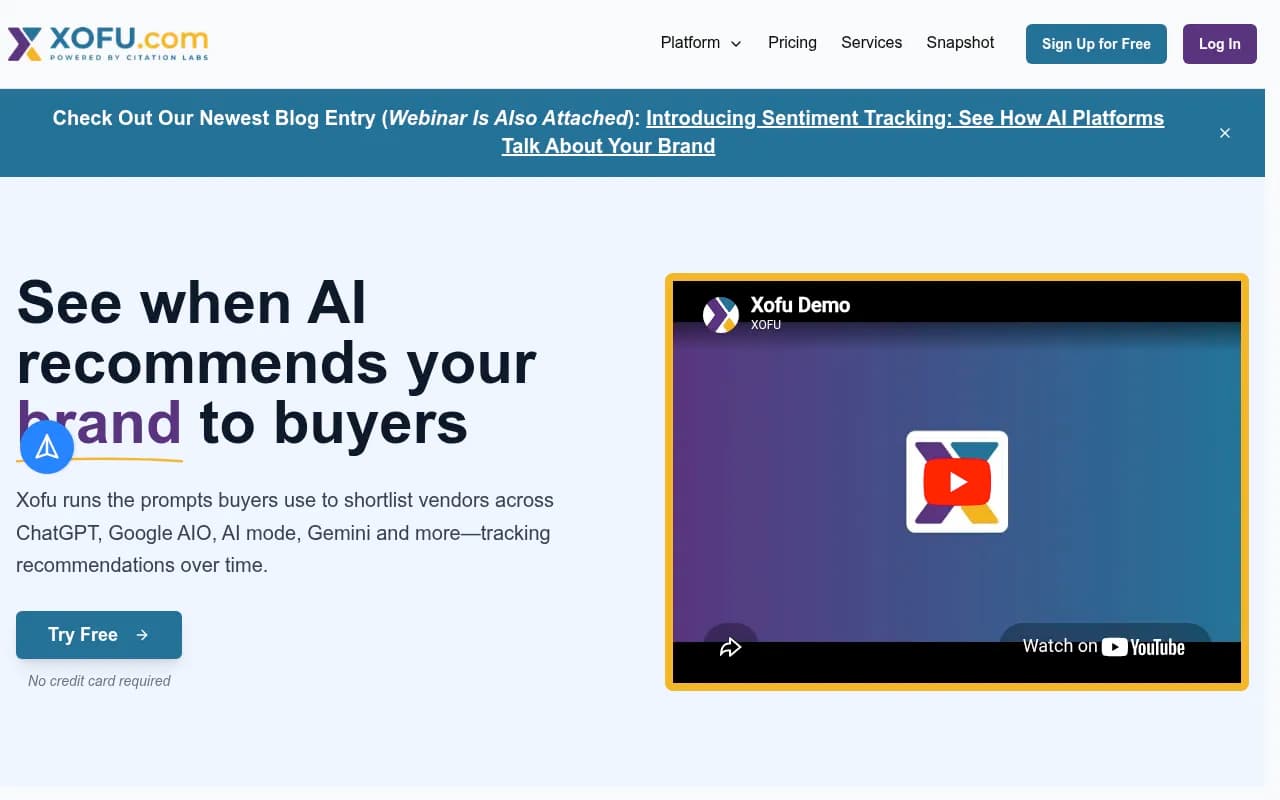
Xofu is an AI search visibility tracker built around a specific and genuinely useful idea: most brands care about showing up when buyers are actively evaluating options, not just when someone types their brand name into ChatGPT. The tool runs what it calls "buyer prompts" -- queries like "best CRM for mid-market sales teams" or "top alternatives to [competitor]" -- across ChatGPT, Google AI Overviews, Google AI Mode, Gemini, and Perplexity, then tracks how often your brand appears in those responses over time.
The company behind Xofu is connected to Citation Labs, a link-building and digital PR agency. That relationship shapes the product's philosophy: Xofu is positioned as the diagnostic layer, with Citation Labs available as a services arm to help you act on what you find. It's an interesting model, though it does mean the tool itself stops short of being a full optimization platform.
The target audience is clearly B2B marketing and SEO teams at companies where pipeline visibility matters more than raw brand awareness. If you're a SaaS company, a professional services firm, or a B2B vendor trying to understand whether AI assistants are recommending you during the vendor shortlisting phase, Xofu is built with that use case in mind.
Key features
Bottom-of-funnel prompt tracking
This is the core differentiator Xofu leads with, and it's a legitimate one. Rather than tracking "what does ChatGPT say about [Brand]?" -- which tells you almost nothing about purchase intent -- Xofu tracks the prompts buyers actually use when evaluating vendors. Think comparison queries, "best X for Y" queries, and solution-evaluation prompts. The tool runs these on a scheduled basis across supported AI platforms and records whether your brand appears in the response. Over time, you get a visibility score and trend line showing whether you're gaining or losing ground.
In practice, this means you're not just checking if AI knows your brand exists -- you're checking if AI recommends you when someone is about to make a buying decision. That's a meaningful distinction.
Competitive benchmarking
Xofu lets you compare your brand against a set of competitors across the same prompt set. For each prompt, you can see which brands show up, track share of voice over time, and identify where you're gaining or losing ground relative to specific competitors. The share-of-voice metric gives you a percentage view of how often you appear versus the competitive set, which is useful for exec-level reporting.
Citation gap analysis
When a competitor shows up in an AI response and you don't, Xofu surfaces which sources and pages the AI cited in that response. This is genuinely useful data -- it tells you which publishers, domains, or content types are influencing AI recommendations in your category. The intended workflow is to use this data to prioritize on-page improvements and identify off-page publishing targets. The limitation is that Xofu itself doesn't help you create that content or earn those citations; that's where Citation Labs comes in as a separate engagement.
Multi-platform monitoring
Xofu runs prompts across ChatGPT, Google AI Overviews, Google AI Mode, and Gemini. The pitch is that you shouldn't overfit to one AI assistant -- a brand might show up well in ChatGPT but poorly in Gemini, and understanding those differences matters. The platform lets you compare results across assistants for the same prompt, which helps you avoid drawing conclusions from a single data source.
Sentiment tracking
A newer addition (announced via a recent blog post and webinar) is sentiment tracking, which monitors not just whether your brand appears in AI responses but how it's described. This is a step toward qualitative visibility analysis -- understanding whether AI platforms are saying positive, neutral, or negative things about your brand when they do mention you. It's a useful layer on top of raw citation tracking.
Free BOFU visibility snapshot
Xofu offers a no-signup-required snapshot tool at xofu.com/bofu that runs a quick check on how your brand stacks up against competitors in buyer-intent AI responses. It takes under two minutes and gives you a basic visibility report. This is a smart acquisition tool and a low-friction way for teams to get a first look at their AI search position before committing to a paid plan.
Prompt-level reporting
Inside the platform, each prompt has its own result view showing which brands appeared, which sources were cited, and how results have changed over time. This granularity is useful for reporting to exec teams -- you can show a specific prompt like "best project management tool for agencies" and demonstrate exactly where you rank versus competitors, with historical trend data.
Citation Labs services integration
Xofu has a formal services pathway through Citation Labs for teams that want help acting on their data. The workflow involves remapping your prompt set, building a prioritized roadmap of on-page changes, developing an off-page plan to earn citations from the sources AI pulls from, and packaging results for internal stakeholders. This is a paid consulting engagement, not a product feature, but it's worth noting as part of the overall offering.
Who is it for
Xofu fits best with B2B marketing and SEO teams at companies where AI-assisted vendor discovery is a real part of the buying process. Think SaaS companies with $10K-$100K ACV deals, professional services firms, or any vendor in a category where buyers actively compare options before purchasing. If your buyers are typing "best [category] tool for [use case]" into ChatGPT or Perplexity, Xofu is designed to tell you whether you're showing up in those answers.
It's also a reasonable fit for SEO agencies managing clients in competitive B2B categories, particularly agencies that already have a content or link-building practice and want to add AI visibility reporting to their service offering. The prompt-level reporting and share-of-voice metrics are structured in a way that translates reasonably well into client-facing dashboards.
Who should probably look elsewhere: consumer brands, e-commerce companies, or any brand where the buying journey doesn't involve AI-assisted vendor research. Xofu's BOFU framing is a strength for B2B but a mismatch for categories where buyers don't use AI to shortlist vendors. Teams that need to go beyond monitoring -- generating content, tracking AI crawler behavior, attributing AI traffic to revenue -- will also find Xofu's feature set too limited.
Integrations and ecosystem
Xofu's integration story is minimal based on available information. There's no mention of Google Search Console integration, Slack notifications, Zapier support, or API access on the public-facing site. The primary data export mechanism appears to be in-platform reporting rather than connections to external tools.
The most notable "integration" is the relationship with Citation Labs, which functions as a services layer rather than a technical integration. If you want to act on Xofu's data at scale, you're essentially engaging a separate agency rather than using built-in tooling.
There's no mention of a browser extension, mobile app, or Looker Studio connector. For teams that need to pull AI visibility data into existing reporting stacks, this is a gap worth noting.
Pricing and value
Xofu does not publish pricing on its website. The knowledge base references "subscription tiers" and a "flexible pricing plan for projects," but specific numbers aren't publicly available. A free trial is available (no credit card required), and the free BOFU snapshot tool is accessible without any account creation.
Without public pricing, it's hard to make a direct comparison to competitors. For reference, tools in this space range from around $99/month for entry-level plans (Promptwatch's Essential tier) up to several hundred dollars per month for more comprehensive platforms. Given Xofu's feature set -- solid monitoring with limited action capabilities -- it would need to be priced competitively to justify the gaps relative to more full-featured platforms.
The free snapshot tool is genuinely useful as a starting point and lowers the barrier to evaluating the product.
Strengths and limitations
What Xofu does well:
- The BOFU framing is smart and differentiated. Tracking buyer-intent prompts rather than brand-name queries is a more meaningful signal for revenue-focused teams, and Xofu has built its entire product around this idea.
- Citation gap analysis -- seeing which sources AI cites when competitors show up instead of you -- is a concrete, actionable output that most monitoring tools don't surface this clearly.
- The free BOFU snapshot is a low-friction entry point that delivers real value before you commit to anything.
- Sentiment tracking (newer feature) adds a qualitative layer that goes beyond simple citation counting.
Honest limitations:
- Monitoring-only. Xofu shows you where you're invisible but doesn't help you fix it. There's no content generation, no AI writing agent, no on-page optimization tooling. Acting on the data requires either doing it yourself or engaging Citation Labs as a separate paid service.
- No AI crawler logs. Understanding how AI crawlers are actually accessing your site -- which pages they read, how often they return, what errors they encounter -- is a capability Xofu doesn't offer. Platforms like Promptwatch include this, which matters for diagnosing why AI models aren't citing your content.
- No traffic attribution. Xofu can't connect AI visibility to actual website traffic or revenue. There's no code snippet, GSC integration, or server log analysis to close the loop between "we showed up in AI answers" and "that drove pipeline."
- No Reddit or YouTube tracking. A significant portion of AI citations come from Reddit threads and YouTube content. Xofu doesn't surface these sources, which means you're missing part of the picture when trying to understand what's influencing AI recommendations in your category.
- No prompt volume or difficulty scoring. You can't prioritize which prompts to target based on how many buyers are actually using them or how competitive they are. This makes it harder to focus effort on high-value, winnable queries.
- Limited model coverage. Xofu covers ChatGPT, Google AIO, AI Mode, and Gemini. It doesn't appear to monitor Perplexity, Claude, Grok, DeepSeek, Mistral, or Meta AI -- a narrower view than platforms tracking 10+ models.
- No public pricing. Having to contact sales or sign up just to understand cost is a friction point for teams doing vendor evaluation.
Bottom line
Xofu is a focused, well-framed monitoring tool for B2B teams that want to understand their AI visibility in buyer-intent queries. The BOFU angle is genuinely useful, and citation gap analysis gives you a starting point for figuring out why competitors show up instead of you. If you just need to answer "how often does AI recommend us when buyers are shortlisting vendors?" and you're okay doing the optimization work separately, Xofu is worth evaluating.
That said, if you need to go beyond monitoring -- generating content that gets cited, tracking AI crawler behavior, attributing AI traffic to revenue, or covering a broader set of AI models -- Promptwatch is the stronger choice. It covers the full loop from gap identification to content creation to results tracking, which Xofu's current feature set doesn't match.
Best use case: B2B SaaS or professional services teams that want scheduled, prompt-level tracking of AI vendor recommendations and competitive share of voice, and are comfortable handling content optimization through their existing team or agency.
Frequently asked questions
What is Xofu?
Who is Xofu built for?
How much does Xofu cost?
What AI platforms does Xofu monitor?
Does Xofu help you improve AI visibility or just track it?
How does Xofu compare to other AI visibility tools?
Similar and alternative tools to Xofu