Salesmotion Review 2026
Sales intelligence tool that surfaces account-level insights and buying signals to help reps prioritize outreach and personalize their approach.
Key takeaways
- Salesmotion runs three AI agents (Signal, Research, Outreach) that work continuously across your entire account territory -- not just the 20 accounts a rep can manually track
- Pricing starts at $85/month for 1 user and 100 monitored accounts, scaling by accounts rather than seats -- a meaningful structural difference from most sales tools
- Customers like Cytel, Guild Education, and Incredible Health report 50% less research time, 6 hours saved per rep per week, and 2x more meetings booked
- Integrates natively with Salesforce, HubSpot, Salesloft, Outreach, Lemlist, and Clay; also ships an MCP server for bringing account intelligence into Claude, Cursor, and other AI tools
- Best fit for B2B sales teams at SaaS companies, life sciences, and IT services firms where timing and context matter more than volume
- Weaker on inbound or product-led growth motions; primarily built for outbound-heavy teams
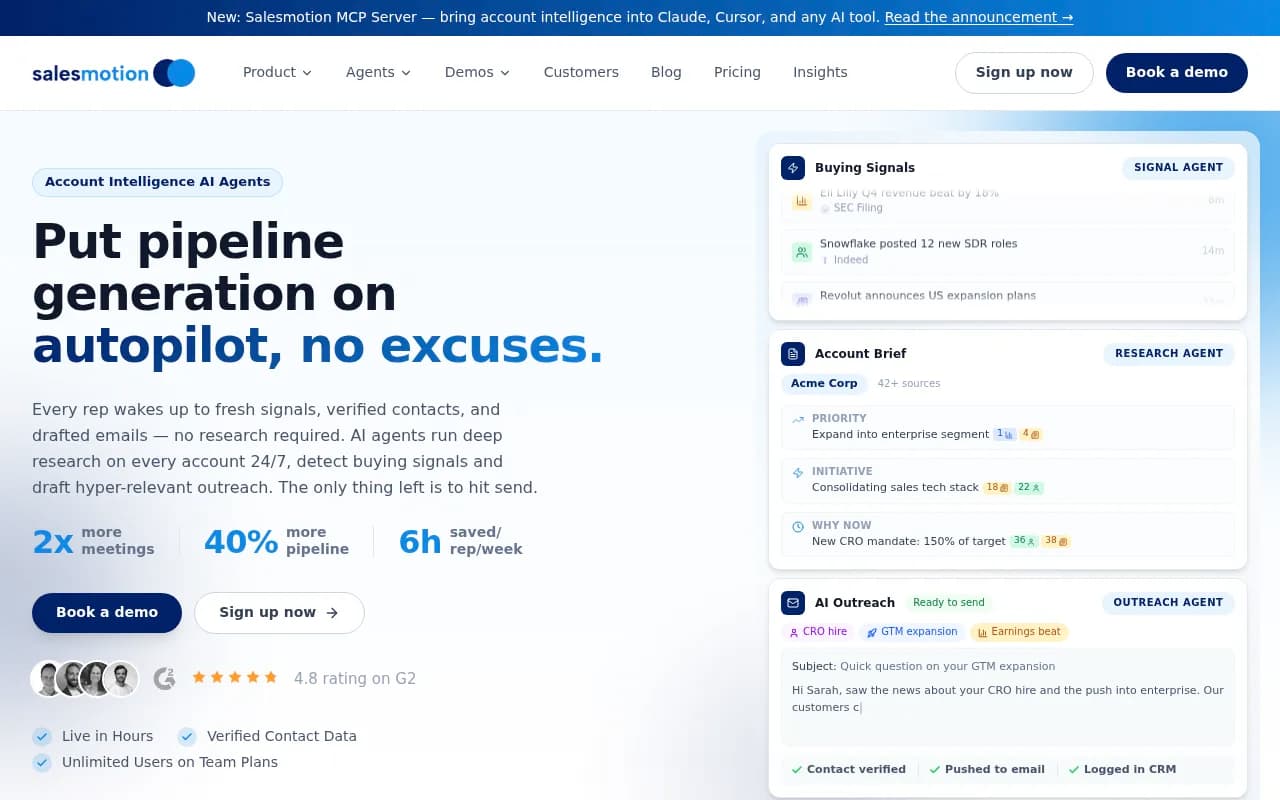
The core problem Salesmotion is solving is one every sales leader recognizes: your reps manage hundreds of accounts but can only meaningfully research a handful each week. A new CRO gets appointed at a target account on Monday. A competitor churns. An earnings call reveals a budget unlock. By the time a rep stumbles across any of this, the window has closed or a competitor already sent the email. Salesmotion's answer is to assign three AI agents to every account in your territory and have them run that research continuously, 24/7, so reps wake up to signals and drafted outreach rather than a blank page.
The company positions itself against both legacy data vendors (ZoomInfo, Apollo) and the DIY approach of stitching together ChatGPT, Google News, and browser tabs. The argument is straightforward: data vendors give you contact lists, not context; ChatGPT is reactive and doesn't scale across 500 accounts; Salesmotion is proactive and does the work automatically. It's a clean positioning that holds up on inspection. The platform has a 4.8 rating on G2 and counts Clari, Domo, Sigma, Seismic, Synthesia, and Frontify among its customers -- a roster that skews toward mid-market and enterprise SaaS, which tells you something about where it fits best.
Key features
Signal Agent -- 1,000+ source monitoring
This is the engine underneath everything else. The Signal Agent continuously scans news, LinkedIn, SEC filings, earnings calls, job postings on Indeed, Crunchbase funding data, Business Wire press releases, Seeking Alpha, Apple Podcasts, and dozens of other sources. The signal feed surfaces events like "New CRO appointed," "Series C raised," "12 new SDR roles posted," or "VP Engineering departing" in near real-time -- minutes to hours after they happen, not days. The breadth here is genuinely impressive. Most sales intelligence tools cover news and job postings; Salesmotion also pulls from earnings call transcripts, SEC filings, and even podcasts, which catches strategic signals that don't make it into press releases. For life sciences teams, it even monitors ClinicalTrials.gov -- a niche but meaningful differentiator for CROs and CDMOs selling into pharma.
Deep Research Agent -- account briefs from 42+ sources
When a signal fires, the Research Agent pulls together a SWOT-style account brief synthesizing executive changes, hiring patterns, company initiatives, earnings analysis, and competitive moves. The brief cites its sources -- every data point links back to the original article, filing, or job posting -- so reps can verify anything in one click. Cytel's Head of Sales Operations described it as consolidating five separate research tools into one. The brief format is structured around "Strategic Priorities," "Key Initiatives," and "Why Now" sections, which maps directly to how a good AE would prep for a discovery call. The claim that this replaces 3 hours of research with 5 minutes is aggressive, but the underlying logic is sound: most of that research time is spent toggling between tabs, not thinking.
Outreach Agent -- signal-anchored email and LinkedIn drafts
The third agent takes the account brief and the triggering signal and drafts outreach. Not a template with merge fields -- an email that references the specific signal (the CRO hire, the EMEA expansion, the earnings beat) and connects it to a relevant value proposition. The example on the site is illustrative: "Saw you're hiring a BDR Manager in London to support your EMEA expansion. Scaling a new region post-funding is exciting -- but ramping reps fast is the hard part." That's a real email, not a placeholder. Reps can review, edit, and send directly from the platform or push to their sales engagement tool.
Verified contact data
Salesmotion includes contact verification as part of the workflow -- not a separate enrichment step. When the Outreach Agent drafts a message, it surfaces a verified contact (name, email, phone) for the right person at the account. The platform pushes verified contacts directly to email and logs them in the CRM. This matters because the signal-to-outreach loop breaks down if you have to go find the contact yourself.
CRM and sales engagement integrations
Native integrations with Salesforce and HubSpot for CRM sync, and Outreach, Salesloft, and Lemlist for sales engagement. The Salesforce integration is described as a managed package install that takes 15-30 minutes with no developer resources. Clay is also listed as an integration, which opens up more advanced enrichment workflows for RevOps teams who are already building in Clay. Signals, briefs, and outreach drafts push directly into these tools so reps don't have to context-switch.
MCP Server -- account intelligence in any AI tool
A newer addition: Salesmotion launched an MCP (Model Context Protocol) server that brings account intelligence into Claude, Cursor, and any MCP-compatible AI tool. This is an interesting move. It means a rep or RevOps engineer can query Salesmotion's account data directly inside their AI environment of choice, rather than only through the Salesmotion UI. For teams already building AI-assisted workflows, this is a meaningful extension.
REST API and platform layer
Beyond the MCP server, Salesmotion exposes a REST API with its own pricing tier (free tier at 100 credits/month, Build tier at $99/month for 2,500 credits). This is aimed at teams that want to build custom workflows on top of the signal and research infrastructure -- think RevOps teams piping signals into custom dashboards or triggering sequences based on specific event types.
Role-based views
The platform adapts its interface for different roles: SDRs get a signal-driven prospecting view focused on territory coverage and outreach drafts; Enterprise AEs get deeper account briefs and strategic context; Sales Leaders get team-level visibility into account coverage and deal context; CSMs get renewal and expansion signals; RevOps gets the API and workflow layer. This isn't just marketing segmentation -- the underlying data needs are genuinely different across these roles.
Who is it for
The clearest fit is outbound-heavy B2B sales teams at companies where timing matters. Think SaaS AEs managing 200-500 accounts who currently rely on Google Alerts and occasional LinkedIn checks to stay current. Or SDR teams at companies with long sales cycles where a leadership change or budget event is the difference between a cold call and a warm one. The platform's customer roster -- Clari, Domo, Sigma, Seismic, Synthesia, Frontify, Guild Education -- is almost entirely B2B SaaS, which makes sense: these are companies selling to other companies where strategic context and "why now" messaging directly affect conversion rates.
Life sciences is a specific vertical where Salesmotion has invested deliberately. The ClinicalTrials.gov integration and the Cytel case study (50% less research time, 30% faster account planning) suggest the platform handles the complexity of pharma and biotech account intelligence reasonably well. CROs and CDMOs selling into large pharma accounts have to track clinical trial phases, regulatory filings, earnings guidance, and procurement signals simultaneously -- that's exactly the kind of multi-source synthesis the Research Agent is built for.
Team size sweet spot is roughly 5-50 reps. Small enough that the platform's "unlimited users on team plans" pricing is attractive, large enough that the research bottleneck is a real problem. A solo founder doing outbound doesn't need this. A 200-person enterprise sales org might need more customization than the out-of-the-box setup provides.
Who should probably look elsewhere: inbound-led teams, product-led growth companies, or anyone whose sales motion is primarily reactive (responding to inbound leads). The platform is built around proactive outbound -- if your pipeline comes from marketing and your reps are mostly running demos, the signal-detection layer won't move the needle much.
Integrations and ecosystem
The integration story is solid for a tool at this price point. On the CRM side, Salesforce and HubSpot are both natively supported. The Salesforce integration is the more mature of the two, with a managed package install and field mapping that reportedly takes under 30 minutes. HubSpot is described as "close behind."
For sales engagement, Outreach, Salesloft, and Lemlist are all supported -- covering the three most common platforms in the mid-market. The workflow is: signal fires, Research Agent generates brief, Outreach Agent drafts email, rep reviews and pushes to their SEP with one click. Clay integration opens up more complex enrichment and routing workflows for RevOps teams.
The MCP server is worth calling out again because it's genuinely novel in this category. Bringing account intelligence into Claude or Cursor means sales engineers and RevOps teams can build on top of Salesmotion's data in their existing AI environments. It's early, but it signals (pun intended) a platform-first ambition rather than just a point solution.
The REST API has its own pricing tier and documentation, which suggests it's meant to be used, not just listed as a feature. The LLM infrastructure underneath uses Anthropic, OpenAI, and Google Gemini -- the platform is model-agnostic at the infrastructure level, which is sensible given how fast the underlying model landscape is moving.
No browser extension is mentioned, and there's no mobile app referenced on the site. For a tool that's meant to surface signals proactively, the lack of a mobile notification layer is a minor gap -- though most sales teams are desk-based for the outreach workflow anyway.
Pricing and value
Salesmotion's pricing structure is account-based rather than seat-based, which is a meaningful differentiator:
- Starter: $85/month -- 1 user, 100 monitored accounts
- Team: $349/month -- 5 users included, 500 monitored accounts
- Business: $999/month -- unlimited users, larger account volumes (exact number not specified on public pricing)
The "unlimited users on team plans" claim on the homepage appears to apply to the Business tier. The Team plan includes 5 users, which is still more generous than per-seat pricing at comparable tools.
For the API:
- Free: $0 -- 100 credits/month, no credit card required
- Build: $99/month -- 2,500 credits, $0.040/credit overage
Compared to ZoomInfo (which can run $15,000-$25,000/year for a small team) or even Apollo (which starts around $49/user/month), Salesmotion's pricing is accessible. The $85/month entry point is low enough that a single AE can try it without a budget approval process. The $349/month team plan covering 5 users and 500 accounts is genuinely competitive for what it delivers.
The value math is straightforward: if the platform saves 6 hours per rep per week (as Guild Education reports), and you're paying $349/month for 5 reps, that's roughly $70/rep/month to recover 24 hours of selling time per month per rep. That's a reasonable trade even before you factor in pipeline impact.
No free trial is explicitly advertised on the main site, but there's an interactive demo available and a "sign up now" CTA alongside the book-a-demo option, suggesting some form of self-serve access exists.
Strengths and limitations
What it does well:
The breadth of signal sources is the standout. Monitoring earnings calls, SEC filings, podcasts, and ClinicalTrials.gov alongside the standard news and job posting feeds means Salesmotion catches signals that most competitors miss entirely. A competitor that only monitors news and LinkedIn will miss the CFO's comment on an earnings call about "consolidating vendor spend" -- Salesmotion won't.
The account-based pricing model is genuinely customer-friendly. Most sales tools charge per seat, which means costs scale with headcount and create friction around adding new reps. Salesmotion's model scales with the number of accounts you're monitoring, which aligns the cost with the value delivered.
The three-agent architecture (Signal, Research, Outreach) creates a coherent workflow rather than a collection of features. The handoff from signal to brief to outreach draft is automatic -- reps don't have to manually trigger each step. That's the difference between a tool that saves time and one that actually changes behavior.
The MCP server launch shows genuine platform ambition. Most sales intelligence tools are closed systems; Salesmotion is building toward an open data layer that other tools can build on.
Honest limitations:
Contact data accuracy is always a concern with any tool that includes verified contacts, and Salesmotion doesn't publish accuracy rates. The site says "every insight links back to its original source" for research data, but contact verification is a harder problem. Teams should plan to validate contact data against their existing enrichment tools, at least initially.
The platform is clearly optimized for outbound prospecting. Account expansion, renewal signals, and CSM workflows are mentioned but feel secondary to the core SDR/AE prospecting use case. CSMs at enterprise accounts with complex renewal dynamics may find the signal types too prospect-focused.
Pricing transparency could be better. The Business tier at $999/month doesn't specify the account limit, and there's no public information on enterprise pricing. Teams with 1,000+ accounts to monitor will need to contact sales, which adds friction to the evaluation process.
There's no mention of intent data (third-party behavioral signals like G2 page views or Bombora topic surges) in the feature set. Salesmotion focuses on first-party public signals (news, filings, job postings) rather than anonymous behavioral intent. For teams that rely heavily on intent data as a prioritization layer, this is a gap -- though Salesmotion would argue that public signals are more actionable than anonymous intent anyway.
Bottom line
Salesmotion is the right tool for outbound-focused B2B sales teams who are losing deals because their reps don't have time to research accounts properly. The three-agent architecture genuinely automates the research-to-outreach workflow in a way that scales across a full territory, not just the top 10 accounts. At $349/month for a five-person team, the ROI math is easy to justify if the platform delivers even a fraction of the time savings its customers report.
The best single use case: a SaaS company with 5-20 AEs each managing 200+ accounts, where "why now" messaging is the difference between a booked meeting and a deleted email, and where the current research process is a mix of Google Alerts, occasional LinkedIn checks, and pre-call scrambling.
Tags:
Frequently asked questions
What is Salesmotion?
How much does Salesmotion cost?
How is Salesmotion different from ZoomInfo or Apollo?
What integrations does Salesmotion support?
What buying signals does Salesmotion track?
Is there a free trial available?
Similar and alternative tools to Salesmotion