Key takeaways
- Klue is the closest like-for-like Crayon alternative -- same sales battlecard focus, similar pricing, and now includes win-loss analysis. Pick it if you want a direct swap.
- Kompyte (now part of Semrush) is cheaper and simpler, good for teams that want automated tracking without a dedicated CI analyst.
- Similarweb is the right choice if traffic data and digital benchmarking matter as much as competitive messaging.
- AlphaSense is in a different league entirely -- built for financial and strategic research, not sales enablement.
- Feedly Market Intelligence and Contify work well for strategy and innovation teams that need broad market monitoring rather than sales-focused battlecards.
- Visualping is the budget option -- not a CI platform, but useful for lightweight competitor page monitoring.
- Valona Intelligence targets large enterprises needing geopolitical and strategic signals, not just competitor website changes.
Crayon has built a solid reputation as a competitive intelligence platform for revenue teams. It monitors competitor activity across web, social, job postings, and content channels, then packages that data into battlecards and sales plays. For teams with a dedicated CI analyst and a real sales enablement motion, it works well. The case studies on their site -- a 22% increase in competitive win rate at Salsify, $6M in influenced revenue at Cognism -- are compelling, even if those results depend heavily on how the platform is actually used.
So why are people looking for alternatives?
The most common reasons: price (Crayon typically starts around $1,500-$2,500/month and scales up from there), the requirement to sit through a sales demo before you can even see pricing, and the fact that some teams find it more than they need. A small startup doesn't need an enterprise CI platform. A strategy team focused on market trends rather than sales battlecards might find Crayon too narrow. And some teams just want to try something before committing to a five-figure annual contract.
Here's an honest look at the best alternatives.
Klue
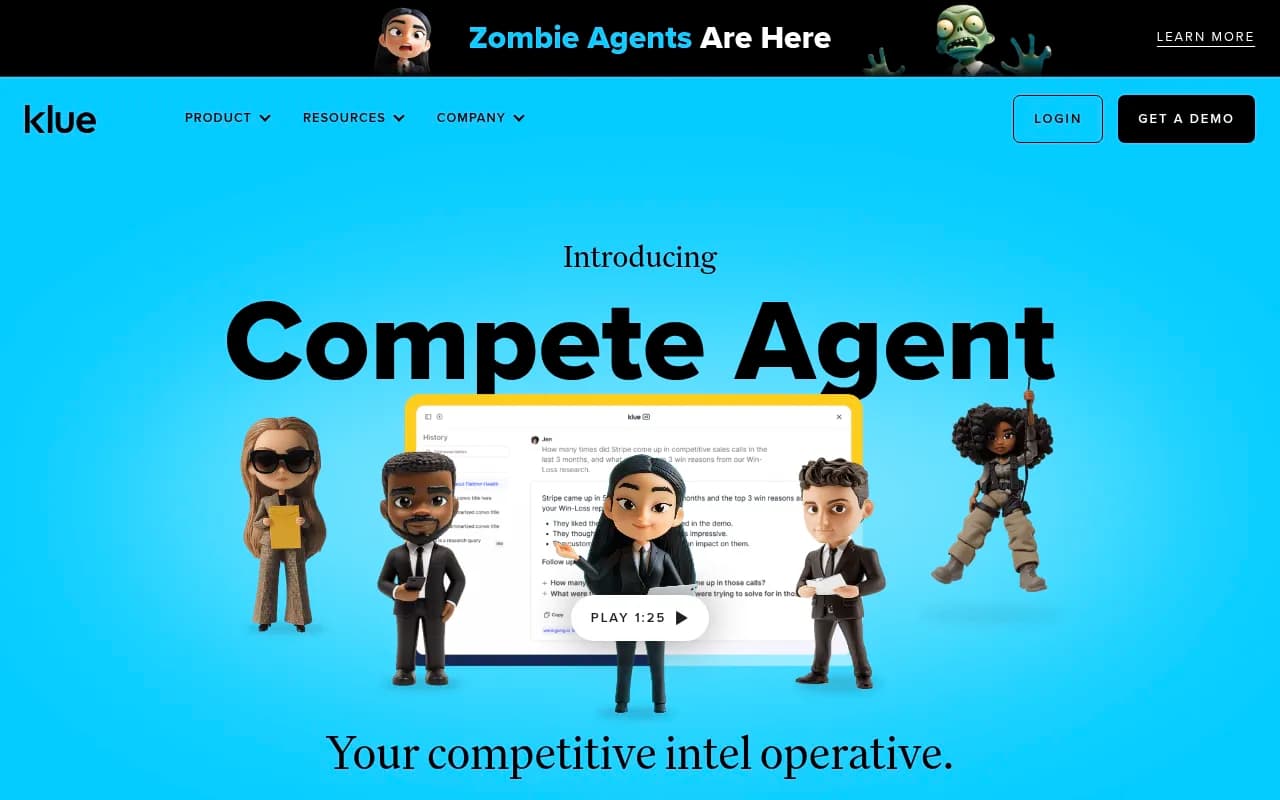
Klue is the most direct Crayon competitor. Both platforms are built around the same core idea: collect competitive intelligence automatically, then make it easy for sales reps to use via battlecards. If you're evaluating Crayon, you're almost certainly also looking at Klue.
The key differences come down to a few things. Klue has leaned harder into win-loss analysis as a native feature -- their platform now combines competitive intel with structured buyer feedback, which Crayon handles more through integrations. Klue's "Compete Agent" (launched in 2026) is their AI layer that tries to eliminate manual curation work and push real-time deal intelligence directly to reps in their existing tools.
In terms of battlecard quality, both platforms are strong. Klue's interface tends to get slightly better marks from product marketing managers for ease of curation. Crayon's AI-generated content features are more mature and have been around longer.
Pricing is similarly opaque -- Klue starts around $16,000/year on annual contracts, which puts it in the same ballpark as Crayon. Neither platform has a free tier or self-serve option.
The honest trade-off: if you want win-loss analysis baked in rather than bolted on, Klue has an edge. If you want more mature AI content generation for battlecards, Crayon is slightly ahead. For most teams, the decision comes down to which sales process you prefer and which integrations matter most.
Best for: Product marketing and CI teams that want a direct Crayon alternative with native win-loss analysis.
Kompyte
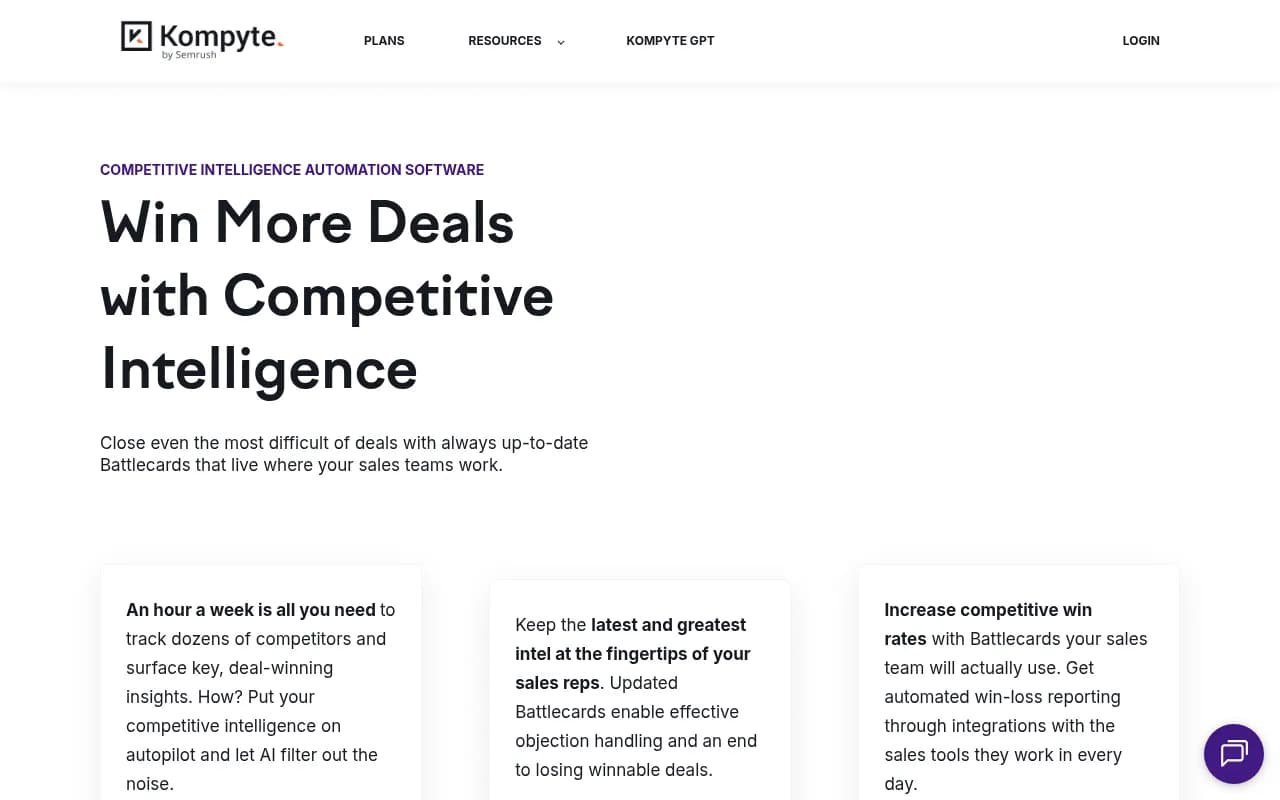
Kompyte was acquired by Semrush a few years back, which is either a selling point or a concern depending on your perspective. On the positive side, it means the platform has Semrush's data infrastructure behind it. On the other hand, it's not a standalone company anymore, and the roadmap is tied to Semrush's priorities.
The core product tracks competitor websites, reviews, job postings, ads, and social content automatically. AI filters the noise and surfaces what's actually worth paying attention to -- their claim that "an hour a week is all you need" is roughly accurate for teams that aren't running a full CI program.
Where Kompyte differs from Crayon: it's simpler and (typically) cheaper, but it's also less sophisticated. The battlecard builder is functional but not as polished. The AI-generated insights are more basic. It's a good fit for teams that want automated monitoring and decent battlecards without needing a dedicated CI analyst to make the platform work.
The Semrush integration is genuinely useful if you're already a Semrush customer -- you get SEO and competitive web data alongside CI tracking in one place.
Pricing is annual contract, quote-based, but generally comes in below Crayon for comparable seat counts.
Best for: Marketing and sales teams that want automated competitor tracking without the complexity (or price) of a full CI platform. Especially good if you're already in the Semrush ecosystem.
Similarweb
Similarweb is a different kind of tool. It's not a CI platform in the Crayon sense -- it doesn't generate battlecards or push insights to sales reps. What it does is give you deep visibility into competitor digital performance: traffic estimates, traffic sources, audience demographics, keyword data, ad spend signals, and engagement metrics.
If your competitive questions are "how much traffic is our competitor getting from paid search?" or "which channels are driving their growth?" then Similarweb is genuinely excellent. If your questions are "how do we handle objections about competitor X's pricing?" then Similarweb won't help much.
One thing worth noting: Similarweb has been building out an AEO/GEO suite for tracking AI search visibility, which puts it in a different category from traditional CI tools. For teams that care about how competitors appear in AI search results, this is increasingly relevant.
Pricing is more accessible than Crayon -- plans start from $125/month with a free tier available. Enterprise plans scale to $1,000-$5,000+/month depending on data depth and seats.
Best for: Marketing and strategy teams that need traffic intelligence and digital benchmarking. Works well alongside a CI tool like Klue or Crayon rather than as a direct replacement.
AlphaSense

AlphaSense is in a completely different category. It's built for financial and strategic research -- searching across 500M+ documents including earnings call transcripts, SEC filings, broker research, and trade publications. The AI surfaces insights from sources that most CI tools don't touch at all.
This is not a sales enablement tool. There are no battlecards. There's no integration with your CRM to push competitive talking points to reps. What AlphaSense does is help strategy teams, investors, and corporate development professionals understand what's happening at a company from a financial and strategic perspective.
If you're a product marketing manager looking for a Crayon replacement, AlphaSense is probably not the answer. If you're a strategy or corporate development team that needs deep research on competitors' financial moves, partnerships, and executive statements, it's genuinely powerful.
Pricing is enterprise-tier, annual contracts, not publicly listed. Expect to pay significantly more than Crayon.
Best for: Corporate strategy, M&A, investment, and research teams. Not a fit for sales enablement or marketing CI.
Contify

Contify sits between a news aggregator and a CI platform. It collects and curates intelligence from web, news, and social sources on competitors, customers, and market trends, then delivers tailored feeds to different teams. The customer list includes Wipro, EY, BCG, Cisco, and Accenture -- which tells you something about who it's built for.
Compared to Crayon, Contify is more focused on broad market monitoring and less focused on sales enablement. You won't get the same quality of battlecard generation or CRM integration. What you do get is more flexibility in what you monitor -- it's not just competitors, but customers, partners, regulatory changes, and industry trends.
The pricing model is more accessible than Crayon -- there's a 7-day free trial, and paid plans are quote-based but generally come in lower for smaller teams.
Best for: Strategy, market intelligence, and business development teams at mid-to-large companies that need broad market monitoring rather than sales-specific battlecards.
Feedly Market Intelligence
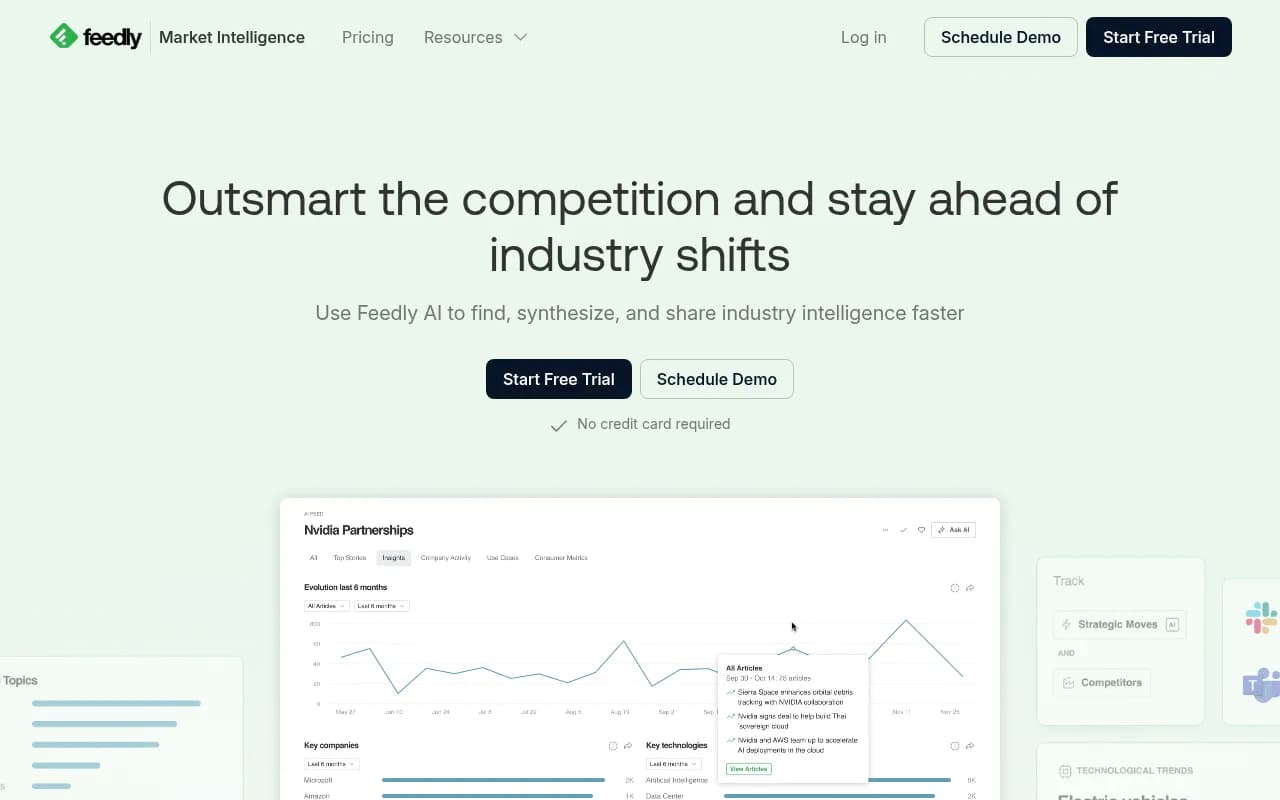
Feedly started as an RSS reader and evolved into a market intelligence platform. The Market Intelligence product uses AI to monitor thousands of sources -- trade publications, research journals, tech blogs, social media -- and synthesize what's relevant for strategy and innovation teams.
It's genuinely good at what it does: reducing the noise from a huge volume of sources and surfacing what matters. Lufthansa's innovation team reported 3-5x faster intelligence gathering, which tracks with the product's strengths.
What it doesn't do: generate sales battlecards, integrate with CRM, or push competitive insights to sales reps. It's a research and monitoring tool, not a sales enablement tool. The gap between Feedly and Crayon is significant if your primary use case is equipping sales teams.
The pricing is much more accessible -- there's a free tier, and the Pro plan starts around $8/month. The Market Intelligence enterprise tier is priced on request but is generally lower than Crayon.
Best for: Strategy, innovation, and research teams that need to monitor a broad set of sources and synthesize trends. Not a fit for sales enablement.
Visualping
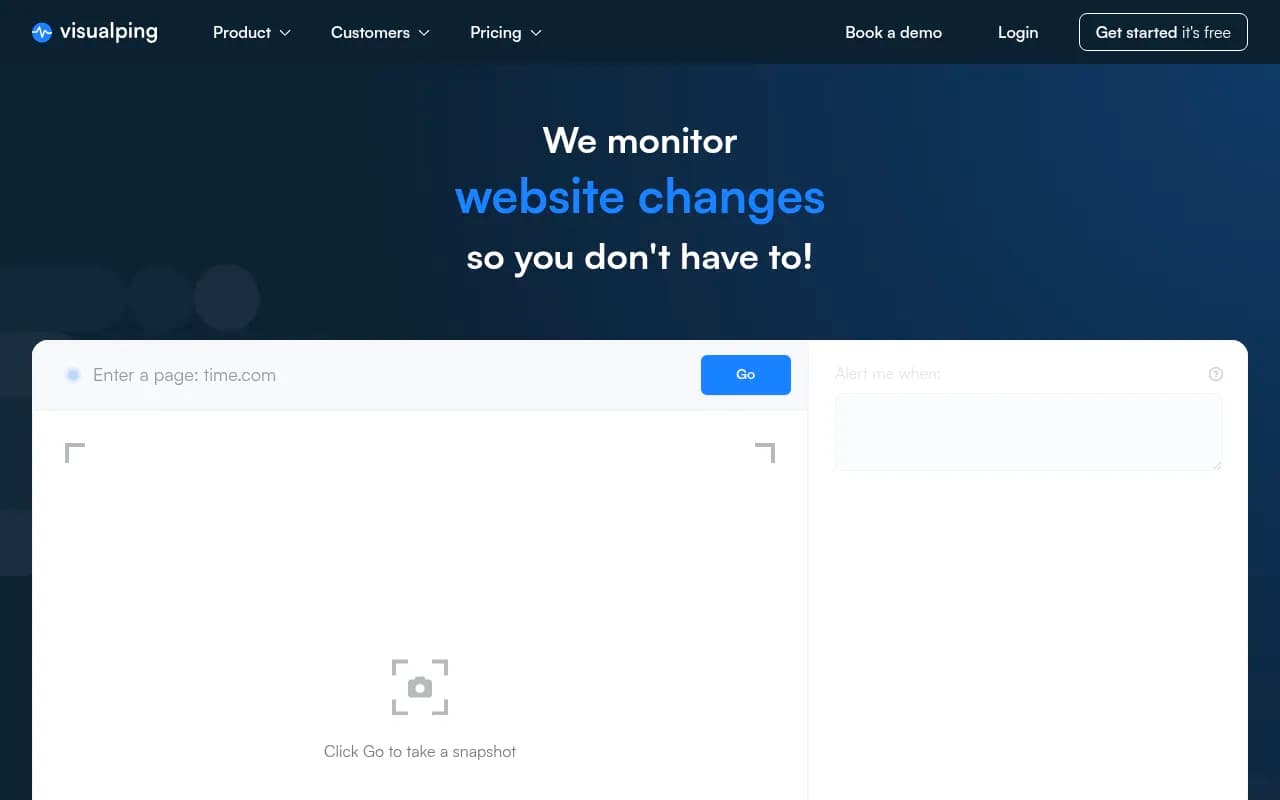
Visualping is the simplest tool on this list by a wide margin. It watches specific web pages for changes and sends you an alert when something changes -- with a before-and-after screenshot so you can see exactly what shifted.
This is not a CI platform. It doesn't analyze competitive positioning, generate battlecards, or integrate with your sales stack. What it does is tell you when a competitor's pricing page changes, when they update their product features page, or when a new job posting appears.
For a small team that just wants to know when something changes on a competitor's website, Visualping is cheap and effective. The free tier covers basic monitoring, and paid plans start at $10/month. Business plans from $100/month cover more pages and more frequent checks.
The honest comparison to Crayon: Visualping does one small piece of what Crayon does, and it does it simply and cheaply. It's not a replacement -- it's a complement, or a starting point for teams that aren't ready for a full CI platform.
Best for: Small teams or individuals who want lightweight competitor page monitoring without committing to an enterprise CI platform.
Valona Intelligence

Valona Intelligence is an enterprise market intelligence platform that monitors 200,000+ verified sources and uses agentic AI to surface competitive signals, geopolitical risks, regulatory changes, and market trends. Their customer list -- ABB, Kellogg's, BASF, Bosch, Unilever, Philips -- tells you this is built for large, global organizations.
The platform's early warning system is its most distinctive feature: it claims to surface disruptions 3-6 months ahead of when they hit mainstream news. For companies operating in complex, global markets where regulatory or geopolitical shifts can materially affect strategy, this kind of lead time is genuinely valuable.
Compared to Crayon, Valona is broader and more strategic. It's not built for sales battlecards or rep enablement -- it's built for C-suite and strategy teams that need to understand what's happening in their competitive and macro environment before it becomes obvious.
Pricing starts around $25,000/year, making it one of the more expensive options on this list.
Best for: Large enterprises with dedicated market intelligence or strategy functions, particularly those operating in regulated or geopolitically complex industries.
How to choose: a quick guide
The right tool depends almost entirely on what you're actually trying to do.
If your primary goal is equipping sales reps with competitive battlecards and talking points, the real choice is between Crayon and Klue. They're the two most mature platforms for this use case. Klue wins if you want native win-loss analysis; Crayon wins if you want more mature AI content generation. Both require annual contracts and dedicated resources to get value.
If you want automated competitor tracking without the full CI platform overhead, Kompyte is worth a look -- especially if you're already a Semrush customer.
If you need traffic and digital benchmarking data, Similarweb fills a gap that none of the pure CI tools cover well.
If your team is focused on strategy and market trends rather than sales enablement, Feedly Market Intelligence or Contify are more appropriate -- and significantly cheaper.
If you're doing financial or strategic research at an enterprise level, AlphaSense is in a category of its own.
If you just want to know when a competitor's website changes, Visualping is $10/month and does exactly that.
And if you're a large enterprise that needs geopolitical and strategic early warning signals, Valona Intelligence is the most specialized option available.
One thing none of these tools cover well: how your brand appears in AI search results like ChatGPT, Perplexity, or Google AI Overviews. That's a separate (and increasingly important) problem -- if AI visibility is on your radar, Promptwatch tracks exactly that across 10 AI models and helps you act on what you find.

The competitive intelligence space has a lot of overlap in marketing language but real differences in what each tool actually does. Match the tool to the job, not the other way around.