AWeber Review 2026
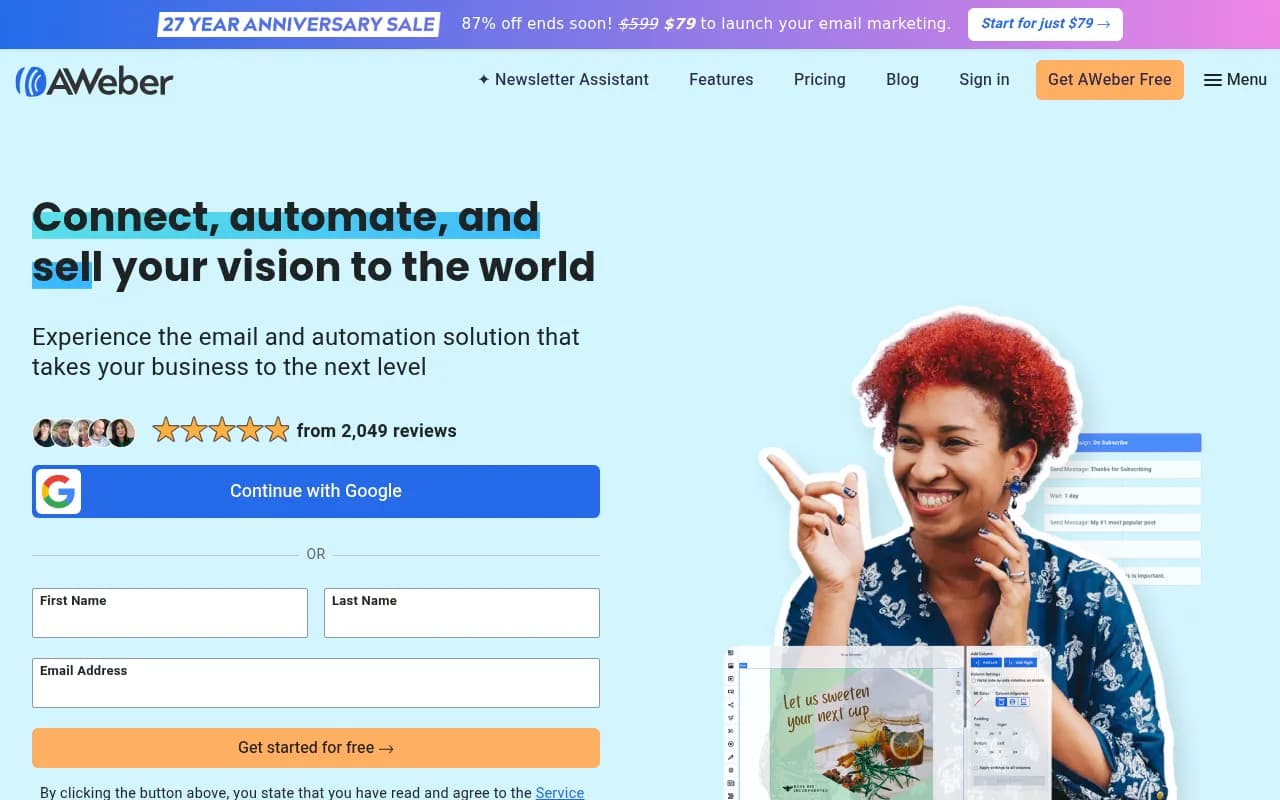
AWeber is a veteran email marketing platform for small businesses and creators, offering AI-powered email writing, drag-and-drop design, automation workflows, landing pages, and 750+ integrations. Free up to 500 subscribers, paid plans from $15/mo.
Key takeaways
- AWeber has been around for 27 years, making it one of the most established email marketing platforms for small businesses and solo creators
- The AI writing assistant is a genuine differentiator -- it learns your tone and drafts ready-to-send newsletters automatically, which most competitors at this price point don't offer
- 24/7 live support included on every plan, including free -- a real advantage over Mailchimp, Kit, and Constant Contact
- Pricing starts at $15/month (Lite) or free up to 500 subscribers, with a Plus plan at $30/month that unlocks unlimited automations and landing pages
- The platform is solid but not the most advanced option for high-volume senders or teams that need sophisticated segmentation and CRM-style features
AWeber launched in 1998, which makes it older than most of its current competitors. That longevity is both a strength and a source of occasional friction -- the platform has had to modernize itself repeatedly while keeping a large existing customer base happy. The result is a tool that feels genuinely mature in some areas (deliverability, support, integrations) and still catching up in others (UI polish, advanced segmentation). For small businesses and individual creators who want reliable email marketing without a steep learning curve, AWeber remains a strong choice in 2026.
The company is based in Chalfont, Pennsylvania, and has stayed independent and bootstrapped throughout its history -- no VC funding, no acquisition drama. That stability shows in how the product is run: consistent pricing, no sudden feature removals, and a support team that actually picks up the phone. Over 1 million entrepreneurs have used AWeber at some point, and the platform currently holds a 4.9-star rating across 2,000+ Google reviews, which is unusually high for a tool in this category.
The target audience is clearly small business owners, content creators, affiliate marketers, and course sellers -- people who need email marketing to work without dedicating hours to it every week. AWeber isn't trying to compete with enterprise platforms like Salesforce Marketing Cloud or HubSpot. It's competing with Mailchimp, Kit (formerly ConvertKit), MailerLite, and Constant Contact for the attention of the solo operator or small team.
Key features
AI-powered email writing assistant
This is AWeber's most prominently marketed feature right now, and it's more useful than the typical "AI writes your subject line" gimmick you see elsewhere. AWeber's AI assistant learns your business context, tone, and products, then drafts full newsletters automatically on a weekly cadence. You can review and edit before sending, but the idea is that the heavy lifting -- the blank page problem -- is handled. In practice, the output quality depends on how much context you give the system upfront, but users report that it saves significant time compared to writing from scratch. The AI also helps build signup forms and can generate email copy on demand.
Drag-and-drop email builder
AWeber's email builder has been around long enough to be genuinely refined. The drag-and-drop interface supports a wide range of content blocks -- text, images, buttons, dividers, social links, video thumbnails -- and the template library includes hundreds of pre-designed options. The builder is responsive by default, so emails look good on mobile without extra configuration. One thing worth noting: AWeber supports both HTML and plain-text emails, and you can edit the raw HTML directly if you want more control. That flexibility matters for developers or designers who find visual builders limiting.
Email automation workflows
The automation system lets you build sequences triggered by subscriber actions: joining a list, clicking a link, making a purchase, reaching a tag, or hitting a date-based condition. On the Plus plan, automations are unlimited, which is a meaningful advantage over Lite (capped at 3). The visual workflow builder is straightforward -- drag conditions and actions onto a canvas, connect them, and you're done. It's not as sophisticated as ActiveCampaign's automation builder, but for welcome sequences, nurture campaigns, and abandoned cart flows, it covers the common use cases well.
Landing page builder
AWeber includes a landing page builder with professional templates for lead capture, product sales, and link-in-bio pages. The Plus plan removes limits entirely; Lite users get 3 landing pages. The builder uses the same drag-and-drop interface as the email editor, so there's no new learning curve. You can connect a custom domain, add payment processing via Stripe or PayPal, and embed signup forms directly. For creators who don't have a full website, this is a practical way to have a functional web presence without paying for a separate tool.
Web push notifications
Beyond email, AWeber lets you send browser push notifications to subscribers who opt in. This is a channel most email-only platforms don't touch, and it's included in the platform rather than requiring a third-party integration. Push notifications can be automated alongside email sequences or sent as standalone broadcasts. Open rates for push notifications tend to be higher than email, so having both channels in one tool is genuinely useful for engagement-focused creators.
AWeber MCP (ChatGPT and Claude integration)
This is a newer addition that lets you control your AWeber account through natural language in ChatGPT or Claude. You can draft and schedule emails, manage subscribers, and check campaign stats through a chat interface. It's a clever use of the Model Context Protocol standard, and AWeber claims to be one of the few email platforms to support it. Whether this becomes a primary workflow for most users is debatable, but it's a real differentiator for tech-forward users who live in AI chat interfaces.
Done-for-you setup service
For $79 (currently discounted from $599), AWeber's team will build out your entire email marketing setup in 7 days: branded templates, a welcome sequence, a landing page, a thank-you page, and signup forms. You also get a 1:1 setup call and 30 days of unlimited edits. This is an unusual offering for an email platform and makes a lot of sense for business owners who know they need email marketing but don't want to spend days configuring it themselves.
Deliverability and list management
AWeber has built its reputation partly on deliverability. The platform uses permission-based sending by default, maintains strong relationships with major ISPs, and provides tools to manage list hygiene -- bounce handling, unsubscribe management, and spam complaint tracking. You can segment subscribers by tags, custom fields, or engagement behavior. The segmentation isn't as granular as what you'd get from ActiveCampaign or Klaviyo, but it's sufficient for most small business use cases.
Analytics and reporting
Every plan includes email tracking: open rates, click rates, bounces, unsubscribes, and geographic data. The Plus plan adds advanced reporting with more granular subscriber insights and sales tracking. You can see which specific links got clicked, how individual subscribers have engaged over time, and how your campaigns compare to industry benchmarks. The reporting interface is clean and readable, though it lacks the custom dashboard flexibility of more enterprise-oriented tools.
Who is it for
AWeber fits best for solo creators, bloggers, affiliate marketers, and small business owners who are either just starting with email marketing or who've been using a basic tool and want something more capable without jumping to a complex platform. A food blogger building a recipe newsletter, a fitness coach selling online programs, or a local service business running promotional campaigns -- these are the people AWeber is built for. The free plan (up to 500 subscribers) makes it genuinely accessible for anyone just starting out.
The done-for-you setup service is particularly well-suited for business owners who know email marketing matters but don't have the time or technical confidence to set it up themselves. A restaurant owner, a real estate agent, or a small e-commerce brand that wants professional email marketing without hiring a marketing agency will find real value here.
AWeber is less ideal for larger teams that need advanced CRM integration, complex multi-step behavioral automation, or sophisticated A/B testing at scale. If you're running a SaaS company with 50,000+ subscribers and need lead scoring, deep Salesforce sync, or predictive send-time optimization, you'll outgrow AWeber quickly. Similarly, high-volume e-commerce brands with complex segmentation needs will find Klaviyo or ActiveCampaign more capable. AWeber also isn't the right fit for agencies managing dozens of client accounts -- the multi-account management tools aren't built for that use case.
Integrations and ecosystem
AWeber connects with over 750 apps, which is one of its genuine strengths. Key integrations include:
- E-commerce: Shopify, WooCommerce, Etsy, SamCart, PayPal, Stripe
- Website builders: WordPress, Squarespace (via Zapier)
- Course platforms: Teachable, Kajabi, Thinkific
- Lead generation: JotForm, ClickFunnels, OptinMonster
- Social media: Facebook Lead Ads
- Automation hubs: Zapier, Make (formerly Integromat)
- Design: Canva (for creating email graphics)
- Music/creator platforms: BeatStars
The AWeber API is available through their developer portal at labs.aweber.com, and it's a REST API with OAuth authentication. It's reasonably well-documented and supports list management, subscriber operations, and campaign data. There's also a GitHub presence where AWeber maintains some open-source libraries and tools.
The MCP integration with ChatGPT and Claude is the most novel addition to the ecosystem in recent years. It's not a traditional integration -- it's a protocol that lets AI assistants take actions in your AWeber account through natural language. For developers and AI-forward users, this opens up interesting workflow possibilities.
AWeber doesn't have a native mobile app for account management (beyond the subscriber-facing experience), which is a gap compared to some competitors. Browser-based access works fine on mobile, but a dedicated app would be a welcome addition.
Pricing and value
AWeber's pricing structure in 2026:
- Free: Up to 500 subscribers, 1 email list, 3 landing pages, 3 automations, 3 users, 24/7 support. AWeber branding on emails.
- Lite: $15/month (billed monthly) or $20/month equivalent billed annually. Up to 500 subscribers, 1 list, 3 landing pages, 3 automations. Scales with subscriber count.
- Plus: $30/month (billed monthly) or $20/month billed annually. Up to 500 subscribers, unlimited lists, unlimited landing pages, unlimited automations, unlimited users, advanced reporting, sales tracking, no AWeber branding. Scales with subscriber count.
- Done For You: Plus plan + $79 setup fee (limited-time price, regular $599). Includes full expert setup in 7 days.
Pricing scales with subscriber count across all paid plans. The annual billing discount brings Plus down to $20/month, which is competitive with MailerLite's comparable tier and cheaper than Mailchimp's Essentials plan at similar subscriber counts.
Compared to Kit (ConvertKit), AWeber's Plus plan is similarly priced but includes 24/7 live support that Kit doesn't offer on lower tiers. Compared to Mailchimp, AWeber's free plan is more generous in terms of support access, though Mailchimp's free tier allows up to 500 contacts with more template variety. MailerLite is the closest competitor on price, with a comparable free plan and paid tiers starting around $10/month -- slightly cheaper than AWeber for basic use.
The done-for-you setup at $79 is genuinely good value if you'd otherwise spend 10+ hours configuring everything yourself. The 30-day unlimited edits policy means you're not locked into whatever the team builds.
Strengths and limitations
What AWeber does well:
- 24/7 live support on every plan, including free. This is rare. Most competitors restrict live support to paid tiers, and phone support is almost unheard of at this price point. AWeber has won multiple Stevie Awards for customer service, and the support quality is consistently cited in user reviews.
- Deliverability track record. 27 years of sending email means AWeber has established relationships and infrastructure that newer platforms are still building. Permission-based sending is enforced, and list hygiene tools are solid.
- AI writing assistant that actually drafts full emails. Not just subject line suggestions -- full newsletter drafts in your voice, delivered weekly. For time-strapped creators, this is a meaningful time saver.
- Generous free plan with real support access. 500 subscribers, 3 automations, 3 landing pages, and 24/7 support for free is a strong offer for anyone just starting out.
- 750+ integrations. The breadth of the integration library means AWeber fits into almost any existing tech stack without requiring Zapier as a workaround.
Honest limitations:
- Segmentation is basic compared to competitors. If you need behavioral scoring, complex conditional logic across multiple lists, or CRM-style contact management, AWeber's segmentation tools will feel limiting. ActiveCampaign and Klaviyo are significantly more capable here.
- UI feels dated in places. Despite ongoing updates, parts of the interface still feel like they were designed in 2015. The email builder is functional but not as polished as MailerLite's or Beehiiv's. New users coming from modern tools may find the navigation unintuitive at first.
- No native SMS channel. Many competitors (Klaviyo, Omnisend, ActiveCampaign) now include SMS marketing alongside email. AWeber is email and push notifications only, which limits multi-channel campaigns.
- Subscriber count-based pricing gets expensive at scale. Like most email platforms, costs rise with list size. At 10,000+ subscribers, AWeber's Plus plan becomes more expensive than some alternatives, and the feature set doesn't necessarily justify the premium over MailerLite at that scale.
Bottom line
AWeber is a reliable, well-supported email marketing platform that earns its reputation among small business owners and individual creators. The combination of a genuinely useful AI writing assistant, 24/7 live support on every plan, a solid free tier, and 750+ integrations makes it one of the more complete offerings at this price point. If you're a creator, blogger, or small business owner who wants email marketing that works without constant tinkering, AWeber is worth a serious look.
The best use case: a solo creator or small business owner who wants to start building an email list, automate a welcome sequence, and send regular newsletters -- without hiring a developer or spending weeks learning a complex platform.
Frequently asked questions
Is AWeber free to use?
How does AWeber compare to Mailchimp?
What is AWeber's AI writing assistant?
Does AWeber offer email automation?
What integrations does AWeber support?
Who should NOT use AWeber?
Similar and alternative tools to AWeber