Clozd Review 2026
Conducts and analyzes win-loss interviews with buyers to uncover why deals are won or lost, providing competitive insights directly tied to sales outcomes.
Key takeaways
- Clozd combines AI-powered async interviews ("Flex Interviews") with human-led live interviews to collect candid buyer feedback at scale -- a hybrid approach most competitors don't offer
- Covers the full customer lifecycle: win-loss analysis, implementation feedback, customer experience, and retention/churn analysis
- The "Ask Clozd" AI search tool lets any team member query the interview database in plain language, which makes insights actually accessible rather than buried in reports
- Pricing is not publicly listed and requires a sales conversation; onboarding fees reportedly range from $5,000 to $20,000+ based on third-party sources, making this a mid-market to enterprise play
- Not a self-serve tool -- Clozd's value proposition is heavily tied to its managed services and expert interviewer network, which means it's not the right fit for teams wanting a lightweight DIY solution
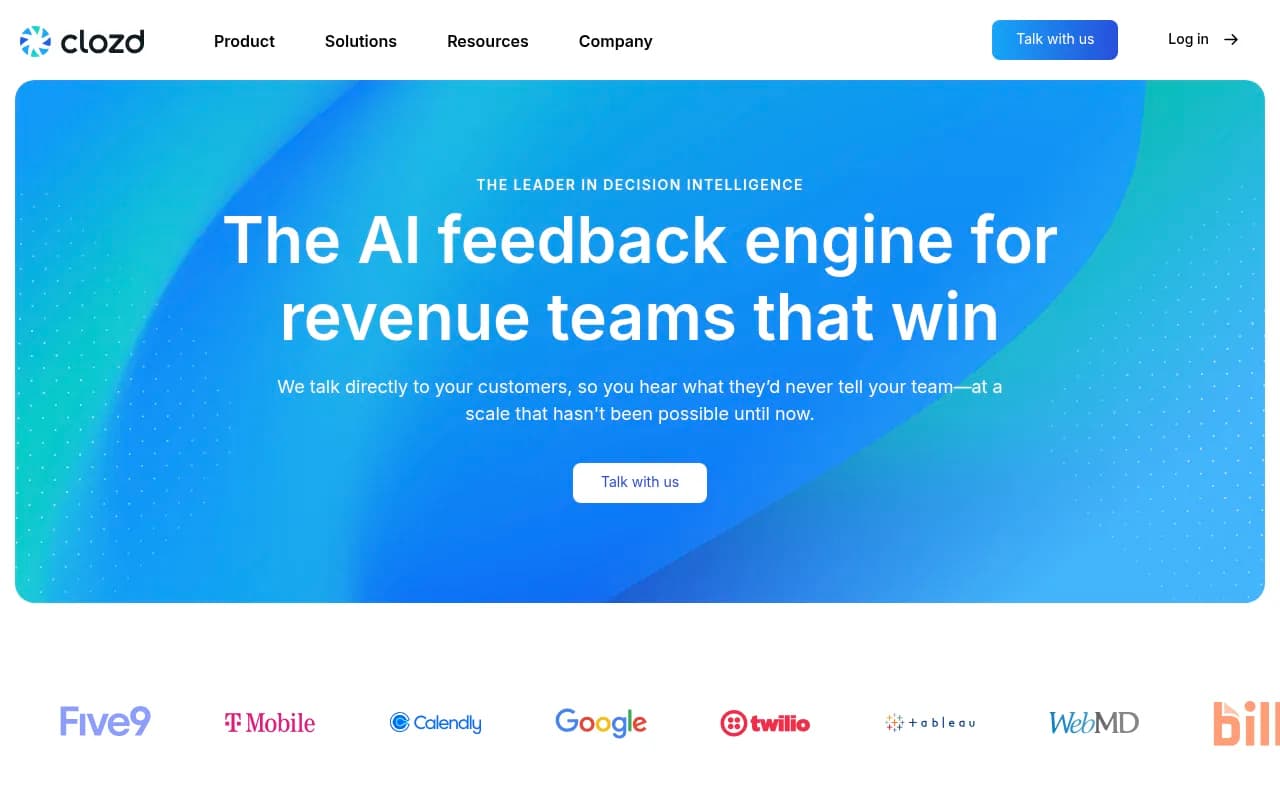
Clozd is a buyer intelligence platform built specifically for B2B revenue teams who want to understand the real reasons behind deal outcomes. Founded in the US and now serving companies like AuditBoard, Clearbit, Qualtrics, and Tableau, Clozd sits at the intersection of qualitative research and sales intelligence. The core premise is simple but hard to execute: buyers rarely tell your sales reps the full truth about why they chose a competitor. Clozd's job is to get that truth out of them through structured, third-party interviews -- and then surface it in a way that sales, marketing, product, and customer success teams can actually use.
The platform has expanded well beyond its original win-loss focus. Today it covers implementation feedback (how onboarding is going), customer experience (ongoing satisfaction and expansion signals), and retention analysis (why customers churn or stay). That expansion makes Clozd less of a point solution and more of a continuous buyer intelligence layer across the entire customer journey. The target audience is mid-market to enterprise B2B companies -- typically those with deal sizes large enough to justify the investment in structured interview programs.
Clozd has been around since the early 2020s and has built a strong reputation in the competitive intelligence and product marketing communities. Their G2 reviews consistently highlight the quality of insights and the consultative nature of the team. The company is clearly investing in AI -- the recent addition of Flex Interviews (AI-conducted async interviews) and Ask Clozd (an AI search layer over interview data) signals a push toward scale without sacrificing depth.
Key features
Win-loss analysis The flagship use case. When a deal closes (win or loss), Clozd reaches out to the buyer for an interview. The platform handles outreach, scheduling, and incentives automatically. The resulting interview -- whether live or AI-conducted -- gets transcribed, tagged, and summarized. You see themes like "pricing was a factor in 34% of losses" or "integration capabilities were cited in 41% of wins," with actual buyer quotes attached. This is qualitative data with quantitative structure, which is genuinely useful for competitive positioning.
Flex Interviews (AI-conducted async interviews) This is Clozd's answer to the scale problem. Traditional win-loss programs rely on human interviewers, which limits how many interviews you can run per month. Flex Interviews use an AI interviewer that conducts asynchronous conversations -- buyers respond on their own time, the AI probes for depth, and the whole thing gets analyzed automatically. The quality won't match a skilled human interviewer for complex enterprise deals, but for high-volume, mid-market pipelines it's a practical way to get coverage you'd otherwise miss.
Live Interviews with expert consultants For deals where depth matters more than volume, Clozd's network of certified industry interviewers conducts live conversations. These are trained professionals who know how to get past polite deflection and surface the real objections. The Hello Heart case study on their site is a good example: a sales rep heard "no," but the Clozd interviewer heard "not now" -- and that distinction led to a $500k opportunity being re-engaged. That kind of nuance is hard to get from a survey or an AI agent.
Ask Clozd (AI-powered search) One of the more practical features in the platform. Ask Clozd lets any team member type a natural language question -- "What are buyers saying about our pricing vs. Competitor X?" or "What implementation issues came up most in Q1?" -- and get an answer synthesized from the interview database. This solves a real problem: most companies collect research and then it sits in a folder nobody reads. Ask Clozd makes the data conversational and accessible to people who aren't analysts.
Retention and churn analysis Beyond win-loss, Clozd applies the same interview methodology to customer churn. When a customer cancels or goes quiet, Clozd conducts an exit interview to find out why. The platform then surfaces patterns -- are customers leaving because of a specific feature gap? A competitor's pricing? A bad onboarding experience? This feeds directly into customer success and product roadmap decisions.
Implementation feedback Post-sale onboarding is where a lot of B2B deals quietly die. Clozd captures structured feedback from customers during and after implementation to identify friction points before they become churn risks. This is a relatively newer use case for the platform but one that makes sense given how much revenue is lost to poor onboarding in complex software sales.
Themes and analytics dashboard The platform automatically tags interview content and surfaces themes with frequency data. You can filter by deal size, industry, competitor, sales rep, time period, and other dimensions. This lets you answer questions like "Do we lose to Competitor X more often in enterprise deals than mid-market?" without manually reading through transcripts.
CRM and workflow integrations Clozd connects with Salesforce and other CRMs to pull deal data and push insights back into the tools your team already uses. Insights can also be shared via Slack or email, which matters for getting findings in front of sales reps who aren't going to log into another platform.
Who is it for
Clozd is built for B2B companies with a defined sales process and deal sizes large enough to justify structured buyer research. The sweet spot is companies doing $10M-$500M+ in ARR, with sales cycles long enough that understanding why deals are won or lost actually changes behavior. Think SaaS companies selling to mid-market and enterprise buyers, professional services firms, or any B2B business where competitive differentiation is a real strategic concern.
The primary buyers are product marketers and competitive intelligence professionals who own win-loss programs, but the platform is designed to serve multiple stakeholders. Sales leaders use it to identify coaching opportunities and deal-killers. Product teams use it to validate roadmap priorities. Customer success teams use it to get ahead of churn. The "Ask Clozd" feature is specifically designed to make insights accessible to people who don't have time to read research reports.
Clozd is not a good fit for early-stage startups (the investment doesn't make sense at low deal volumes), self-serve SaaS companies with high-velocity, low-touch sales, or teams that want a lightweight DIY survey tool. If you're looking for something you can set up in an afternoon and run yourself, Clozd is not that. The value proposition is tied to the managed service layer -- the expert interviewers, the program management, the AI analysis. Strip that away and you're paying for infrastructure you don't need.
Integrations and ecosystem
Clozd connects with Salesforce for deal data sync, which is the most important integration for most customers -- it's how the platform knows which deals to follow up on and how it pushes insights back into the CRM. Slack integration lets teams receive interview summaries and key quotes without logging into the platform. Email delivery is also supported for stakeholders who prefer that.
The integration hub on their site suggests additional connections, though the full list isn't publicly detailed. Given the enterprise focus, it's reasonable to expect support for HubSpot and other major CRMs, but Salesforce appears to be the primary integration.
There's no public API documentation visible on the site, and no mention of a browser extension or mobile app. The platform is web-based and appears to be primarily a desktop experience. For teams that need custom data pipelines or want to build on top of the interview data, the lack of a visible self-serve API could be a limitation.
Pricing and value
Clozd does not publish pricing on its website. Based on third-party sources including Vendr, onboarding and implementation fees alone can range from $5,000 to $20,000+ depending on complexity and user count. The overall investment is positioned as mid-market to enterprise, and the sales process requires a demo conversation before any numbers are discussed.
This pricing model is consistent with the managed service nature of the product -- you're not just buying software, you're buying a program that includes expert interviewers, program management, and ongoing analysis. For companies where a single deal is worth $50k-$500k+, the ROI math can work out clearly. AuditBoard reportedly improved their win rate by 5% using Clozd data; Clearbit saw a 10%+ improvement in gross retention. Those are meaningful numbers if the underlying deal economics are large enough.
For smaller companies or teams with tighter budgets, the lack of a self-serve tier or transparent pricing is a real barrier. There's no free trial mentioned, and the "talk with us" CTA on every page makes it clear this is a consultative sales process. Competitors like Wynter or simpler survey tools offer lower entry points, though they sacrifice the depth and managed service component that Clozd's customers consistently cite as the differentiator.
Strengths and limitations
What Clozd does well:
- The hybrid interview model (AI async + human live) is genuinely differentiated. Most competitors pick one or the other. Clozd's ability to run high-volume AI interviews while reserving human interviewers for complex deals gives customers flexibility that matters at scale.
- The expert interviewer network is a real moat. Trained interviewers who know how to probe past surface-level answers are hard to replicate, and the case studies on the site show concrete examples of insights that wouldn't have surfaced through surveys or self-serve tools.
- Ask Clozd solves the "insights graveyard" problem. Making interview data queryable in plain language means the research actually gets used, which is a bigger problem than most companies admit.
- The expansion into retention analysis and implementation feedback makes Clozd a more complete customer intelligence platform rather than a narrow win-loss tool.
Honest limitations:
- No transparent pricing is a real friction point. Enterprise buyers are used to this, but it slows down evaluation and makes it hard to compare against alternatives without going through a full sales cycle.
- The managed service model means you're dependent on Clozd's team for execution. If you want full control over your interview program -- custom questions, your own interviewers, your own cadence -- the platform may feel constraining.
- No visible self-serve API or developer documentation limits how technically sophisticated teams can integrate the data into their own workflows or BI tools.
- The platform is heavily focused on B2B software and professional services. Companies in other verticals (manufacturing, healthcare, retail) may find the methodology less directly applicable without significant customization.
Bottom line
Clozd is the right choice for B2B companies with meaningful deal sizes who are serious about understanding buyer behavior and want a managed program rather than a DIY tool. The combination of AI-powered async interviews, expert human interviewers, and an AI search layer over the resulting data is a genuinely strong product -- and the customer outcomes cited (5% win rate improvement at AuditBoard, 10%+ GRR improvement at Clearbit) suggest it delivers real value when the conditions are right.
Best use case in one sentence: a mid-market or enterprise B2B SaaS company with $20M+ ARR that wants to run a systematic win-loss and retention intelligence program without building the research infrastructure in-house.
Tags:
Frequently asked questions
What is Clozd?
Who is Clozd best suited for?
How much does Clozd cost?
What is the difference between Flex Interviews and Live Interviews?
Does Clozd integrate with Salesforce?
Is there a free trial or self-serve option?
Similar and alternative tools to Clozd