Eesel AI Review 2026
AI-powered platform supporting content generation, technical SEO audits, and on-page optimization. Designed to reduce manual SEO work for content teams and agencies.
Key takeaways
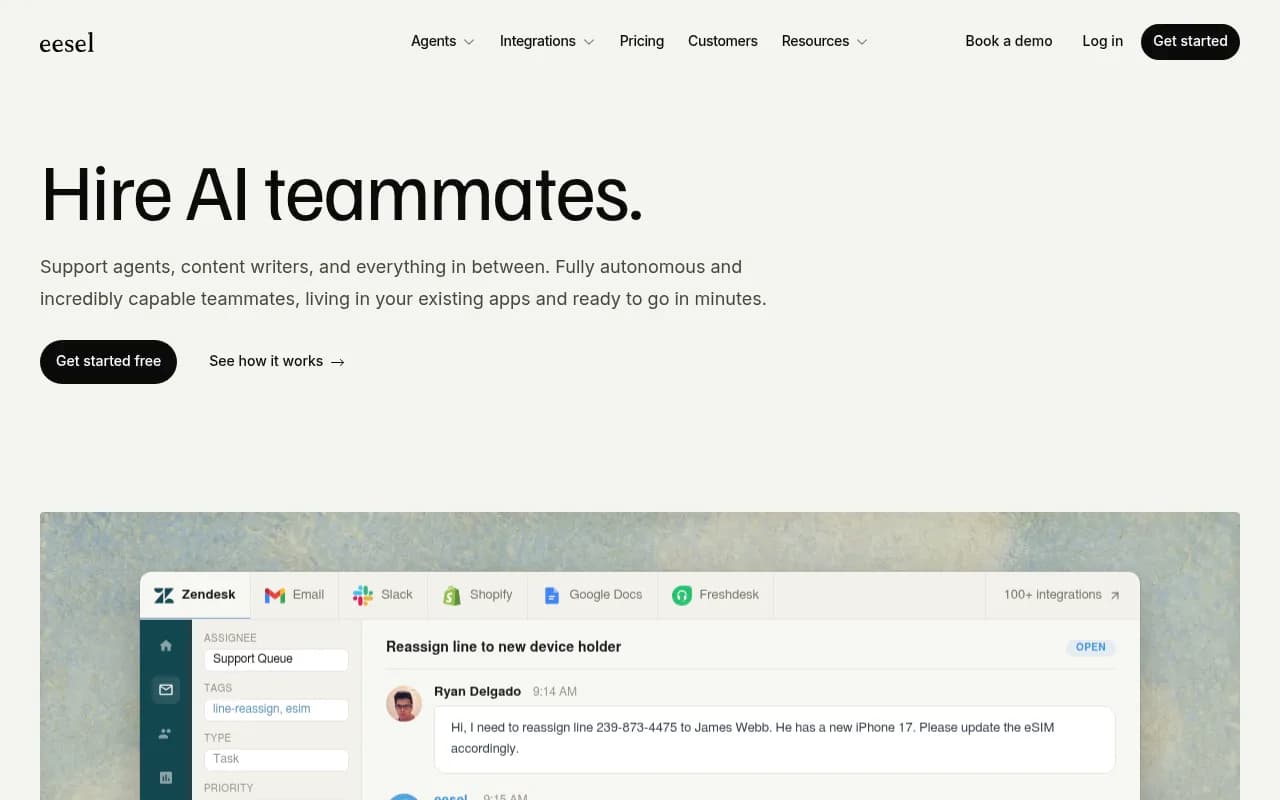
- Eesel AI is an autonomous AI agent platform, not an SEO tool -- it deploys AI teammates inside Zendesk, Slack, Freshdesk, Intercom, and 100+ other apps to handle customer support, content writing, and internal operations
- Customers like Smava process 100,000+ support tickets per month through Eesel, and Design.com handles 50,000+ tickets monthly via Freshdesk
- Pricing is usage-based with no platform fee or per-seat charges -- you pay per AI resolution, starting at $0.29 per resolution
- Strong fit for support-heavy SaaS companies, e-commerce brands, and internal IT teams; less suited for teams needing deep analytics, complex routing logic, or traditional chatbot builders
- Onboarding is genuinely fast -- connect your apps, brief the AI like a teammate, and it starts handling tickets within minutes
Eesel AI is an AI agent platform that lets companies deploy autonomous AI teammates directly inside the tools they already use. Think of it less as a chatbot builder and more as hiring a virtual employee who lives in Zendesk, Slack, Freshdesk, or your website -- one who reads your documentation, learns your policies, and handles work without needing a human to babysit every interaction.
The company positions itself around three core use cases: customer support (handling helpdesk tickets), content writing (drafting blog posts), and e-commerce assistance (answering product questions, processing returns). The pitch is that you brief eesel like you'd brief a new hire -- explain your tone, your rules, your escalation thresholds -- and it follows through autonomously. Customers like Anytime Fitness use it to power member support across locations, while BitGo runs it inside Slack to surface internal documentation instantly.
Eesel has built a notable customer base across industries, with case studies from logistics SaaS (CartonCloud), fintech (Global Pay), and consumer brands (Ecosa). The platform's multi-channel approach -- connecting knowledge from Zendesk, Google Docs, Notion, Confluence, and more into a single AI brain -- is what differentiates it from single-channel chatbot tools.
Key features
Autonomous ticket handling Eesel's core capability is reading, triaging, and responding to support tickets without human intervention. In Zendesk and Freshdesk, it acts as a first-responder agent: it reads the ticket, searches relevant documentation, tags the ticket appropriately, and drafts or sends a response. Smava runs 100,000+ tickets per month through this system in German, which is a meaningful proof point for non-English deployments. You can set escalation rules -- for example, "loop me in for any refund over $500" -- and eesel respects those thresholds.
Multi-channel knowledge ingestion Rather than requiring you to rebuild a knowledge base from scratch, eesel connects to your existing sources. It ingests from Zendesk help articles, Google Docs, Notion pages, Confluence wikis, Salesforce records, HubSpot, Shopify product catalogs, and more. CartonCloud's deployment uses 717 knowledge items across Salesforce and Slack. The AI learns from all of these simultaneously, so a support agent answering a question about API rate limits can pull from both your help center and your internal engineering docs.
Natural language briefing Instead of building decision trees or configuring complex rule engines, you brief eesel conversationally. In Slack, you can literally message it: "Handle the support queue this afternoon, flag anything tricky." It confirms, processes the queue, and reports back. This is genuinely different from traditional chatbot platforms where you spend weeks mapping conversation flows. The tradeoff is that complex conditional logic is harder to audit -- you're trusting the AI's interpretation of your instructions.
AI blog writer Eesel includes a blog writing agent that researches, drafts, and publishes content in your brand voice. You give it a topic, it produces a full post. This is a lighter-weight content tool compared to dedicated SEO writing platforms -- it's more about volume and speed than keyword optimization or SERP targeting. Good for teams that need a steady stream of support documentation or product content, less useful if you need detailed SEO briefs or competitive content analysis.
E-commerce agent For Shopify and similar stores, eesel can answer product questions, recommend items based on customer needs, check stock, and handle order inquiries. The demo shows it recommending a specific jacket with price, temperature rating, and review score -- then offering to add it to cart. This is closer to a sales assistant than a basic FAQ bot.
Website live chat Beyond helpdesk platforms, eesel can be embedded as a live chat widget on any website. It uses the same knowledge base as your other channels, so customers get consistent answers whether they're in Zendesk, Slack, or your website chat.
Configurable escalation and approval workflows You can define rules for when eesel should escalate to a human, request approval before taking action, or simply flag a ticket without responding. The refund threshold example from the marketing site is a good illustration -- eesel handles routine cases autonomously and surfaces edge cases for human review. This is important for teams worried about AI making costly mistakes.
Multi-language support Smava's German-language deployment at 100,000+ tickets per month is the clearest evidence that eesel handles non-English support at scale. The platform doesn't advertise a specific list of supported languages, but the architecture (built on top of major LLMs) means it inherits their multilingual capabilities.
Who is it for
The clearest fit is customer support teams at SaaS companies and e-commerce brands that are drowning in ticket volume. If your team is handling thousands of tickets per month and a significant portion are repetitive -- password resets, order status, policy questions, basic troubleshooting -- eesel can absorb that volume without adding headcount. The Ecosa case study (10,000+ tickets per month across Zendesk, Slack, and website) and Design.com (50,000+ tickets via Freshdesk) show what this looks like at scale.
Internal IT and operations teams are another strong fit. BitGo's use case -- an eesel agent in Slack that answers internal questions and surfaces documentation -- is something any company with a large knowledge base and frequent internal queries can replicate. If your IT helpdesk spends half its time answering the same questions about VPN setup or expense policies, an eesel agent in Slack can handle that first layer.
E-commerce brands on Shopify with high product inquiry volume are a natural third persona. The combination of product catalog ingestion, order management integration, and live chat deployment means eesel can handle the full pre-purchase and post-purchase conversation without a human agent.
Who should probably look elsewhere: teams that need detailed analytics on conversation quality, complex branching logic with visual flow builders, or deep CRM integration beyond what eesel's connectors offer. Also, if your support cases are highly technical and require genuine problem-solving rather than documentation lookup, eesel's retrieval-based approach will hit its limits.
Integrations and ecosystem
Eesel advertises 100+ integrations. The most prominent ones visible in the product:
- Helpdesk platforms: Zendesk, Freshdesk, Intercom, Jira Service Management
- Communication: Slack, email
- Knowledge bases: Notion, Confluence, Google Docs
- CRM and sales: Salesforce, HubSpot
- E-commerce: Shopify
- Website: Embeddable chat widget
The GitHub organization (github.com/eeselapp) exists, suggesting some developer-facing tooling, though the platform is primarily a no-code/low-code product. There's no prominent public API documentation visible from the marketing site, but enterprise customers likely have access to API-level integration.
The multi-source knowledge ingestion is the integration story that matters most -- eesel's value comes from connecting all your existing content sources into one AI brain, not from any single integration.
Pricing and value
Eesel's pricing model is usage-based: no platform fee, no per-seat charges, no monthly minimum. You pay per AI resolution. Based on available pricing data, resolutions start at approximately $0.29 each.
This model is genuinely unusual in the AI agent space, where most competitors charge flat monthly fees or per-seat licenses. For teams with variable ticket volumes, this is attractive -- you're not paying for capacity you don't use. For high-volume deployments (100,000+ tickets per month like Smava), the per-resolution cost adds up, but at that scale you'd likely be on a negotiated enterprise arrangement.
The free trial is available without a credit card, which lowers the barrier to testing. The Featurebase pricing reference mentions $29/seat/month as a starting point in some contexts, but the primary pricing page emphasizes the usage-based model with no seat fees -- these may reflect different product tiers or historical pricing.
For comparison, Intercom Fin (mentioned by a customer who switched to eesel) charges per resolution at a higher rate and is less customizable. Traditional helpdesk automation tools like Zendesk's native AI features are more expensive and less flexible. Eesel's usage-based model makes it accessible for smaller teams while scaling to enterprise volumes.
Strengths and limitations
What it does well:
- The onboarding speed is real. Connecting existing apps and briefing the AI conversationally is genuinely faster than building traditional chatbot flows. Multiple customers mention being productive within days.
- Multi-source knowledge ingestion is a meaningful differentiator. Most chatbot tools require you to rebuild your knowledge base in their format. Eesel reads what you already have.
- The usage-based pricing model removes the risk of paying for unused capacity, which is a real problem with flat-fee AI tools.
- Multi-language support at scale (the Smava German deployment) is a credible proof point that the platform handles non-English use cases seriously.
- Customer testimonials are specific and verifiable -- named individuals with titles, not anonymous quotes.
Honest limitations:
- The blog writer and content features are basic compared to dedicated content platforms. There's no keyword research, SERP analysis, or SEO optimization built in. It's a drafting tool, not a content strategy tool.
- Analytics and reporting appear limited from what's visible publicly. Teams that need detailed conversation analytics, CSAT tracking, or resolution rate dashboards may find the reporting thin.
- Complex conditional logic is harder to configure and audit compared to visual flow builders. If you need precise control over every conversation branch, the natural language briefing approach can feel opaque.
- The platform is primarily retrieval-based -- it answers questions by searching your documentation. For support cases that require genuine reasoning or multi-step problem-solving, it will escalate or struggle.
Bottom line
Eesel AI is a solid choice for support-heavy teams that want to automate ticket handling without rebuilding their knowledge base or hiring more agents. The usage-based pricing, fast onboarding, and multi-channel knowledge ingestion make it practical for SaaS companies and e-commerce brands handling thousands of tickets monthly.
Best use case in one sentence: deploy eesel if you want an AI agent that reads your existing Zendesk, Notion, and Google Docs content and starts handling support tickets in Slack or Freshdesk within a day, without building conversation flows from scratch.
Tags:
Frequently asked questions
What is Eesel AI?
How much does Eesel AI cost?
What integrations does Eesel AI support?
Is Eesel AI suitable for non-English support?
How does Eesel AI differ from traditional chatbot builders?
Who is Eesel AI best suited for?
Similar and alternative tools to Eesel AI