Key takeaways
- Question-based keyword research tools (AlsoAsked, AnswerThePublic, kwrds.ai, KeywordsPeopleUse) are now essential for AI search optimization, not just traditional SEO
- AlsoAsked pulls live People Also Ask data and shows hierarchical question trees -- ideal for understanding how AI models chain related queries
- AnswerThePublic is the most visually intuitive but relies on older autocomplete data and has limited free usage
- kwrds.ai is built specifically for AI search, pulling questions from ChatGPT, Perplexity, and PAA simultaneously
- KeywordsPeopleUse aggregates questions from Google, Reddit, and Quora -- the exact sources AI models frequently cite
- Tracking whether your content actually gets cited by AI engines requires a separate tool like Promptwatch
Why question-based keyword research matters more in 2026
The shift is real and it's not subtle. When someone types a query into ChatGPT or Perplexity, they're not entering a two-word phrase -- they're asking a full question, often a nuanced one. "Best running shoes for flat feet under $150" or "how do I fix a leaking radiator valve without turning off the water." These are conversational, specific, and intent-rich.
Traditional keyword research tools were built for a different era. They're great at telling you that 12,000 people search "running shoes" per month. They're less useful at telling you what questions those people are actually asking, or what questions AI models are synthesizing answers for.
That's where question-based keyword tools come in. They surface the real language people use -- the phrasing that ends up in People Also Ask boxes, Reddit threads, Quora answers, and increasingly, in the training data and retrieval context that shapes what ChatGPT or Perplexity says.
The four tools in this guide -- AlsoAsked, AnswerThePublic, kwrds.ai, and KeywordsPeopleUse -- each approach this problem differently. Let's break them down.
AlsoAsked
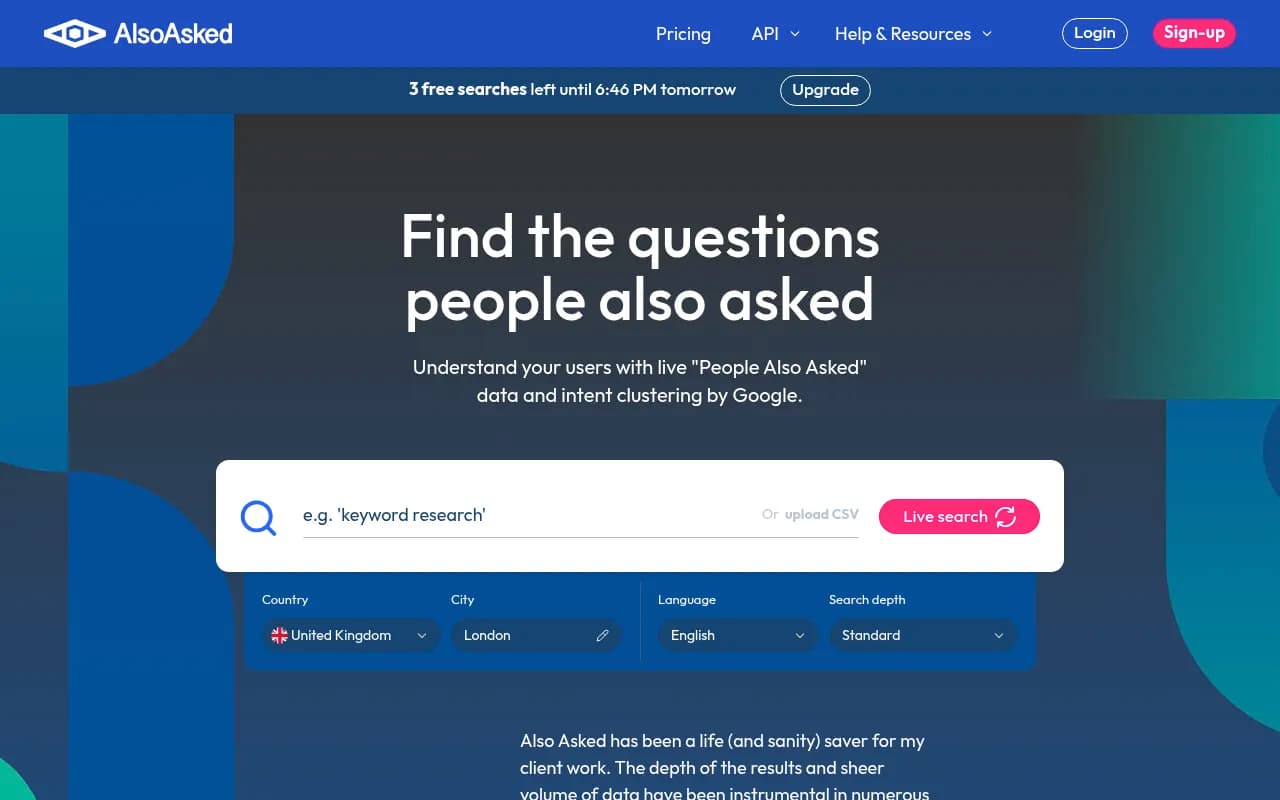
AlsoAsked scrapes Google's People Also Ask (PAA) data in real time and presents it as a hierarchical tree. You enter a seed question, and it shows you not just the top PAA results but the follow-up questions that appear when users click on each answer.
This is genuinely useful because it mirrors how AI models think. When ChatGPT answers a question, it's often synthesizing answers to several related sub-questions. AlsoAsked makes that branching structure visible.
What it's good at
The tree visualization is the main draw. You can see that "how to start a podcast" branches into "what equipment do I need for a podcast," which branches into "do I need a mixer for a podcast," and so on. That's a content map, not just a keyword list.
For AI search specifically, this matters because AI models often answer a primary question by addressing several sub-questions in sequence. If your content covers the full tree, you're more likely to be cited.
AlsoAsked also lets you export data as a CSV or image, which is handy for content planning. The free tier is limited (a handful of searches per month), but the paid plans start at around $15/month and are reasonable for solo content creators.
Limitations
The data is Google-specific. It doesn't tell you what questions are being asked in Perplexity, or what ChatGPT tends to follow up with. It's also entirely dependent on PAA data, which Google can change or suppress at any time. Some niches have sparse PAA coverage.
AnswerThePublic
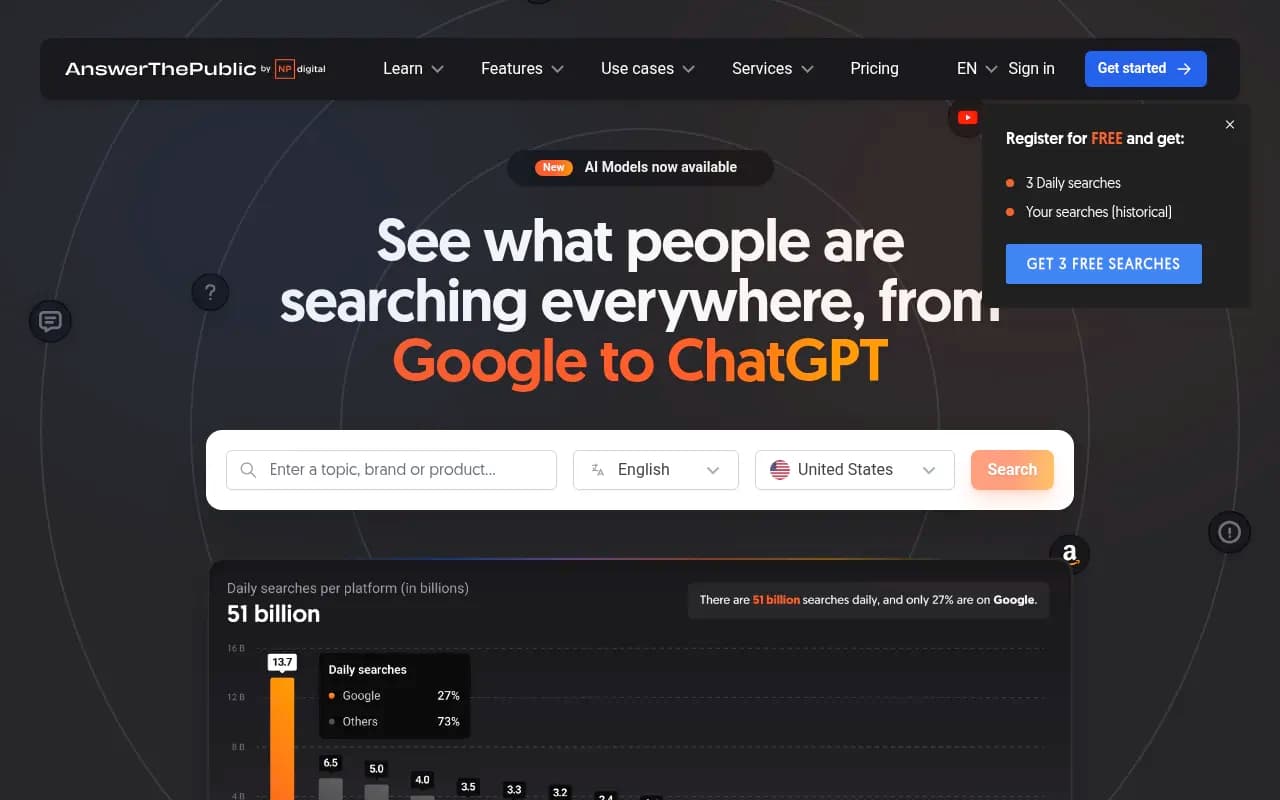
AnswerThePublic has been around since 2014 and is probably the most recognizable name in question-based keyword research. It pulls from Google and Bing autocomplete data and organizes results into categories: questions (who, what, where, when, why, how), prepositions (for, with, without, near), comparisons, and alphabetical variations.
The visual output -- a sunburst diagram with your keyword at the center -- is immediately recognizable and genuinely useful for getting a broad sense of how a topic branches out.
What it's good at
Breadth. AnswerThePublic generates a huge volume of keyword variations quickly. For content ideation at the top of a funnel, it's hard to beat. The preposition and comparison categories often surface angles that pure question research misses ("running shoes vs trail shoes," "running shoes for nurses").
It's also the most beginner-friendly of the four tools. The interface is clean, the visualizations are easy to share with clients or stakeholders, and the learning curve is minimal.
Neil Patel's team acquired AnswerThePublic in 2022 and has since integrated it with Ubersuggest, which adds search volume data to the question results -- a meaningful improvement over the original tool.
Limitations
The free tier is now very restricted (three searches per day). The data comes from autocomplete, which reflects what people have searched historically -- it's not real-time PAA data like AlsoAsked. For AI search optimization specifically, autocomplete data is less directly relevant than PAA or forum-based questions.
It also doesn't show question hierarchy or branching. You get a flat list of questions, not a map of how they relate.
kwrds.ai
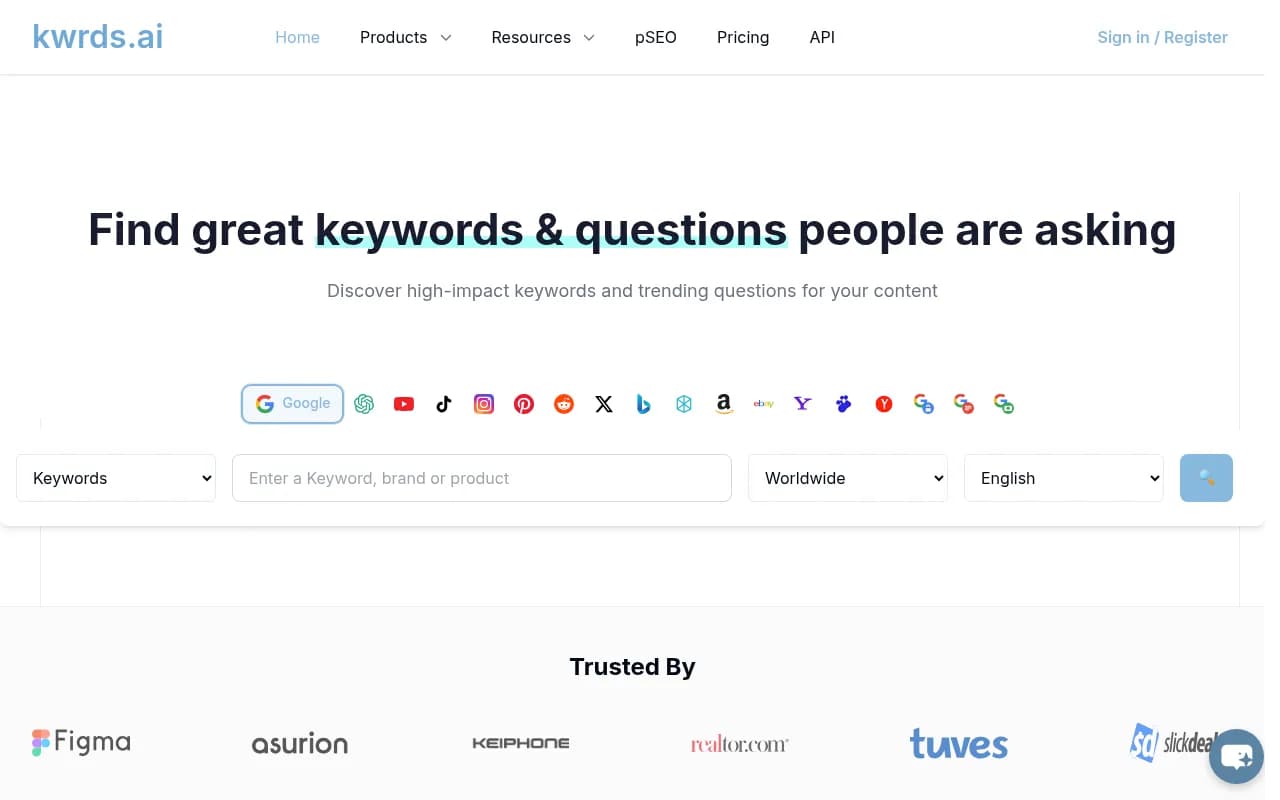
kwrds.ai is the newest of the four tools and the one most explicitly built with AI search in mind. It pulls People Also Ask data from Google but also generates related questions using AI, and it lets you see what questions are being asked across multiple platforms simultaneously.
What it's good at
The multi-platform angle is the key differentiator. kwrds.ai can show you PAA data alongside AI-generated question expansions, which gives you a broader view of the question space around a topic. It's particularly useful for finding "AI search opportunities" -- questions that have high intent but where existing content is thin or low-quality.
The tool also shows PAA data for different countries and languages, which matters if you're doing international content work. The interface is clean and the data exports well.
For teams specifically trying to rank in AI search engines, kwrds.ai is the most purpose-built option in this comparison. It's thinking about the same problem you are.
Limitations
It's newer, which means the data coverage isn't as deep as AlsoAsked or AnswerThePublic in some niches. The AI-generated question expansions are useful but can occasionally drift from what people actually search. Pricing is competitive but the free tier is limited.
KeywordsPeopleUse
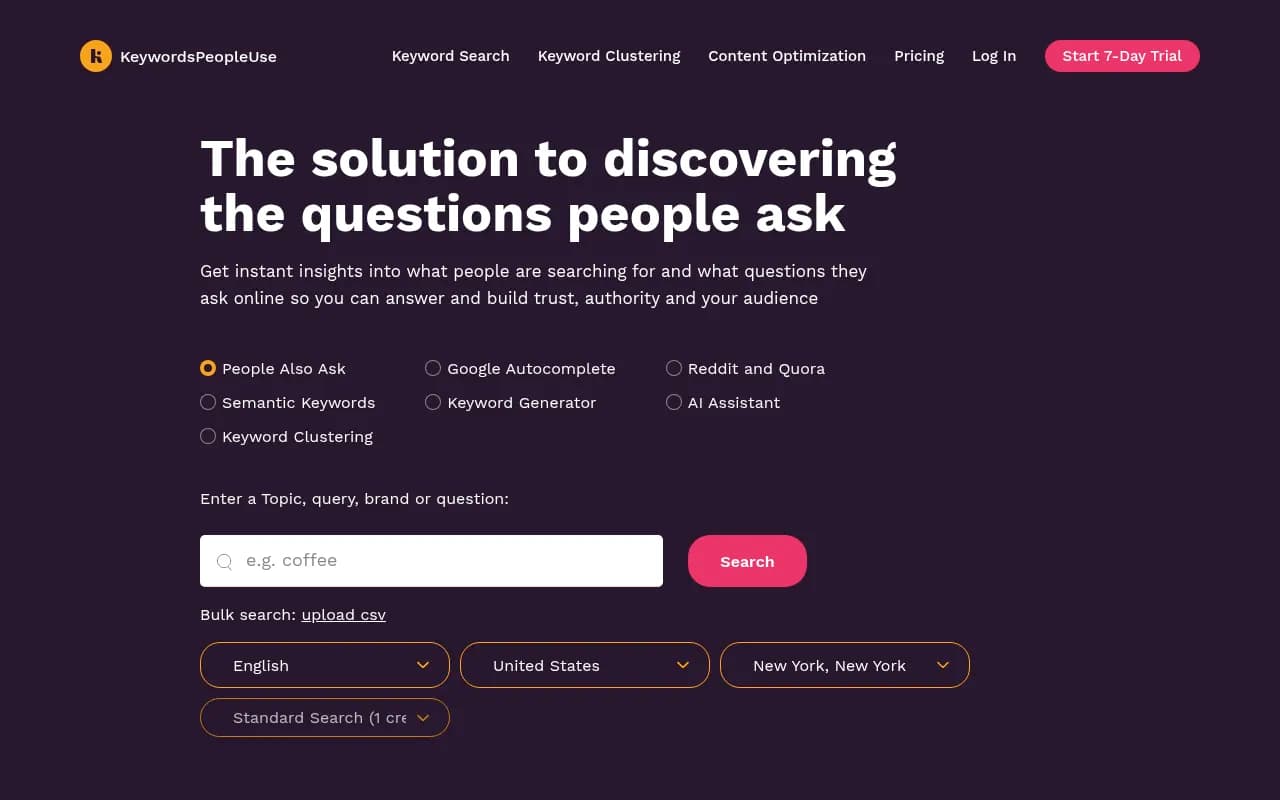
KeywordsPeopleUse takes a different approach from the other three. Instead of focusing purely on Google data, it aggregates questions from Google, Reddit, Quora, and other platforms. This is significant because Reddit and Quora are two of the most frequently cited sources in AI-generated responses.
What it's good at
The multi-source aggregation is genuinely valuable for AI search optimization. If you want to know what questions people are asking about a topic in a way that's likely to influence AI responses, looking at Reddit and Quora discussions is more relevant than looking at autocomplete data alone.
KeywordsPeopleUse also shows you the actual questions people are asking in forums, not just keyword variations. "My radiator is making a banging noise at night -- is this dangerous?" is a different kind of insight than "radiator noise causes." The former is how people actually phrase problems; the latter is how SEOs think about them.
The tool includes search volume estimates and difficulty scores, making it more of an all-in-one research tool than AlsoAsked (which is more visualization-focused).
Limitations
The Reddit and Quora data can be noisy. Not every forum question represents a meaningful search opportunity. You need to apply judgment to filter the genuinely useful questions from the one-off posts. The interface is functional but not as visually polished as AnswerThePublic.
Head-to-head comparison
| Feature | AlsoAsked | AnswerThePublic | kwrds.ai | KeywordsPeopleUse |
|---|---|---|---|---|
| Data source | Google PAA (live) | Google + Bing autocomplete | Google PAA + AI expansion | Google, Reddit, Quora |
| Question hierarchy/tree | Yes | No | Partial | No |
| Search volume data | No | With Ubersuggest | Yes | Yes |
| AI search focus | Indirect | No | Yes | Indirect |
| Reddit/Quora data | No | No | No | Yes |
| Multi-language support | Yes | Yes | Yes | Limited |
| Free tier | 3 searches/month | 3 searches/day | Limited | Limited |
| Starting price | ~$15/mo | ~$11/mo | ~$29/mo | ~$19/mo |
| Best for | Content mapping, PAA optimization | Broad ideation, beginners | AI search keyword research | Forum-based question research |
How to use these tools together
The honest answer is that no single tool covers everything. Here's a workflow that makes sense:
Start with kwrds.ai to identify AI search opportunities -- questions that are actively being asked and where AI engines are generating responses. This gives you your target list.
Use AlsoAsked to map the question hierarchy around your top targets. This tells you what sub-questions your content needs to answer to cover a topic comprehensively.
Run your topics through KeywordsPeopleUse to find the Reddit and Quora discussions that are shaping how people phrase these questions. These phrasings often end up in AI training data and retrieval context.
Use AnswerThePublic for broader ideation when you're exploring a new topic area and want to understand the full question landscape before narrowing down.
This combination covers PAA data, AI-specific question research, forum-based phrasing, and broad autocomplete coverage -- which is a pretty complete picture of how people are asking questions in 2026.
The gap these tools don't fill
Here's something worth being clear about: all four of these tools help you find questions to target. None of them tell you whether your content is actually being cited by AI engines after you publish it.
That's a different problem. You can write a perfectly structured answer to a high-value question and still not appear in ChatGPT or Perplexity responses. Understanding why -- and fixing it -- requires tracking your AI visibility over time, analyzing which pages are getting cited, and identifying where competitors are showing up but you're not.
For that part of the workflow, tools like Promptwatch are built specifically to close the loop: find the gaps, create content, track whether it's working.

The keyword research tools in this guide are the starting point. They help you identify what to write about. But the full picture of AI search optimization includes knowing whether what you've written is actually getting picked up.
Which tool should you start with?
If you're new to question-based keyword research and want something visual and easy to use: AnswerThePublic. It's the most approachable and the Ubersuggest integration adds useful search volume context.
If you're specifically trying to optimize for AI search engines and want the most purpose-built tool: kwrds.ai. It's thinking about the same problem you are.
If you're doing content planning and want to map out how a topic branches hierarchically: AlsoAsked. The tree visualization is uniquely useful for understanding how AI models chain related queries.
If your content strategy involves targeting questions from forums and communities (which is smart, given how often Reddit and Quora appear in AI citations): KeywordsPeopleUse.
For most teams, the right answer is to use at least two of these tools together. They're cheap enough that combining kwrds.ai and AlsoAsked, for example, costs less per month than a single Ahrefs seat.
The question-based approach to keyword research isn't a trend -- it's a correction. Search has always been about questions. The tools are finally catching up to that reality.