Key takeaways
- A ChatGPT rank tracker for an agency is judged on four things: how many clients it holds, how many AI answers it collects per client, how branded the reports are, and how data leaves the tool.
- Divide a plan's monthly answer allowance by your client count. That number is what each client's report actually rests on, and most pricing pages leave the maths to you.
- Promptwatch, Rankscale, Rank Prompt, Nightwatch and SE Ranking all take agency work seriously, but they differ a lot on white-label depth, client portals and whether they help you fix problems or only report them.
- Prices in vendor-authored comparisons change often. Check every pricing page before you commit.
- Scheduled, branded reporting matters less than having one sentence per client that a client can repeat to their boss.
What an agency actually needs from a ChatGPT rank tracker
A ChatGPT rank tracker for a solo site owner and one for an agency are different products wearing the same name. The solo version goes deep on one brand. The agency version has to hold twenty or fifty brands, keep their data separate, and produce something a client will open on a Monday morning without you hand-assembling slides.
A few criteria separate tools that survive agency load from those that bolt on an extra seat and call it a day:
- Multi-client management: clean separation between accounts and permissioned access so one client never sees another's data.
- White-label reports: your logo and colors, ideally scheduled and emailed automatically.
- Client portals: a branded login, not just a PDF.
- Answers per client: the real data volume behind each report.
- Data export: API, Looker Studio or CSV so you can push numbers into your own reporting stack.
- Prospecting: a quick visibility check on a prospect before a sales call.
- Action layer: whether the tool tells you what to do next, or leaves you with a score.
I would add one more that vendor guides rarely mention: honesty about what the numbers mean. One of the Reddit comments in the research for this guide put it well: most clients do not want causation, they want a sentence they can repeat to their own boss without getting caught out. Pick the tool that helps you write that sentence.
Do the per-client maths first
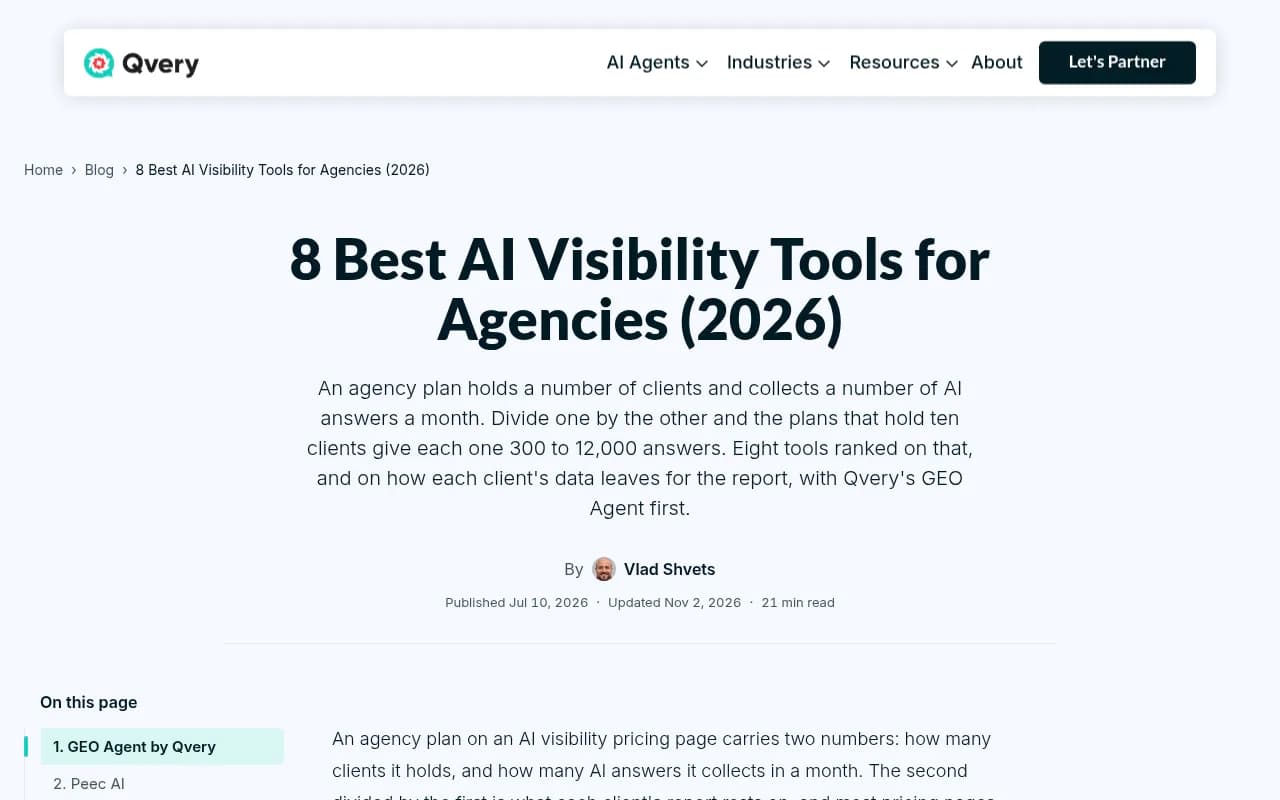
Qvery's October 2026 comparison made a point I like: an agency plan has two numbers on the pricing page, clients held and AI answers collected per month. Divide the second by the first. For a roster of ten, Qvery found that figure ranges from about 300 answers a month per client to 12,000. That is a forty-fold difference in how much evidence sits behind a client report.
Here is a quick example using figures from vendor pages. Rankscale's Growth plan is listed at $385 with up to 22,000 answers and 50 dashboards. With ten clients, that is roughly 2,200 answers per client each month. Promptwatch's Growth agency plan is $399 with 25,000 responses and unlimited projects, which is about 2,500 per client at ten clients, and it scales down per client as you add more.
The lesson is not that one number is better. It is that a plan allowing 50 clients and 22,000 answers is a plan that, filled to capacity, gives each client around 440 answers a month. Decide whether that is enough for the reports you want to sell.
Why ChatGPT tracking is harder than it looks
Before comparing tools, it helps to know what they are trying to measure. ChatGPT does not answer from a single search. Promptwatch Data's ChatGPT query fanouts report notes that one prompt can trigger several separate web searches, though the chart data shows the average has moved around: about 2.15 fanouts per response in early December 2025 and about 1.84 by early March 2026, with fanouts returning in April at 1.0 per response. Average query length also fell from about 117 characters to about 53.
For agencies that has a practical meaning. If a tracker only reports on the literal prompt a user typed, it misses how ChatGPT actually searches. And when ChatGPT changes behaviour, prompt sets need a re-audit, or your before-and-after charts compare two different things.
Source counts vary by engine too. According to Promptwatch's average sources per response data, ChatGPT cites about 5 sources per web-search answer, Google AI Overviews about 10, and Perplexity almost exactly 10 every day. Copilot swung from under 2 to nearly 17 sources within weeks. If you are showing a client a before-and-after chart, Perplexity is the steadiest engine, and a Copilot swing is more likely a retrieval change on Microsoft's side than anything your client did.
Another detail that matters for client reporting: ChatGPT stopped sending a referrer on October 8, 2026, so AI traffic attribution needs a workaround like tagging with utm_source=chatgpt.com. A tracker that connects visibility to traffic needs to handle that.
The tools compared
| Tool | White-label | Multi-client | Data export | Best for |
|---|---|---|---|---|
| Promptwatch | White-label PDFs on Enterprise; branded PDF reports and scheduled delivery on agency plans | Unlimited projects on agency plans | API, MCP, Looker Studio, CSV and Excel | Agencies that want tracking plus execution |
| Rankscale | White-labeled share links on Growth ($385) | 50 dashboards on Growth | REST API | Dashboard-first reporting |
| Rank Prompt | White-label reports on Agency ($149/mo) | 50 brands; 500 on Agency Plus ($299/mo) | API | Price-sensitive agencies |
| Nightwatch | White-label reports on Professional (EUR 159/mo) | 25 websites | Looker Studio, API | Rankings next to AI answers |
| SE Ranking | White label for platform and reports via Agency Pack | Plan dependent | Data Studio, export, API | Existing SE Ranking users |
| Semrush | White-label report | Plan dependent | Excel, CSV, Sheets, PDF | Teams already in the Semrush suite |
| Ayzeo | White-label PDF and DOCX on Pro ($149/mo) | Client projects | PDF and DOCX | Pitch-heavy agencies |
Prices come from the vendor pages and vendor-authored comparisons quoted in the research. Treat them as a starting point and confirm on each pricing page.
Promptwatch
Promptwatch is the option I would look at first if you want the work done, not just reported. It is an AI visibility platform that tracks how ChatGPT, Gemini, Claude, Perplexity, Google AI Overviews, Google AI Mode, Copilot and others mention and cite a brand, using the real interfaces of those products instead of only APIs. It then goes further than most trackers: Content Agents write and publish pages, an Action Board prioritizes the to-do list, and IP-verified crawler logs plus visitor analytics show whether a page was read, cited and clicked.

For agencies the relevant details are practical:
- Agency plans have unlimited projects, prompts and team seats, with all AI models, Agent Chat, Brand Narrative, crawler logs, visitor analytics, site audit, custom reports, and MCP and API access.
- Kick-off is $199/mo (10,000 responses), Growth is $399/mo (25,000 responses), and Scale is $799/mo (65,000 responses, tracking every 12, 6 or 1 hours, local GEO/SEO targeting, Fact Check and an audit log). Agencies can also create pitch projects to show prospects their gaps before they sign. Check promptwatch.com/pricing for current numbers.
- PDF reports of any dashboard can be scheduled to any inbox. White-label exports with your own branding, a white-label dashboard and a client portal sit on Enterprise, as does SSO. Agency plans do not include the Content Agent, so agencies that need content generation or a client portal talk to sales about Enterprise.
- Prompt tracking covers country, state and city, and each monitor is fixed to one language and location, so client markets never mix.
- Monks, whose clients include Netflix, BMW and Asana, uses Promptwatch's Answer Gap Report and Visibility Score to build content roadmaps. See the Monks case study.
The honest caveat: if all you want is a cheap branded PDF for a small client and you do not plan to act on the data, Promptwatch's depth is more than you need. If you do act on the data, being able to go from gap to published page to measured result in one product saves a lot of tool-juggling. There is a head-to-head page against Profound and a guide to agencies for more detail, and you can start with the 7-day free trial on monthly billing or a free AI visibility report.
Rankscale
Rankscale is agency-focused and leans on dashboards. According to Qvery's review, its Growth plan at $385 gives you 50 dashboards, up to 22,000 answers, white-labeled share links and the REST API. A ten-client agency on that plan has room for forty more clients, with about 2,200 answers per client per month today.
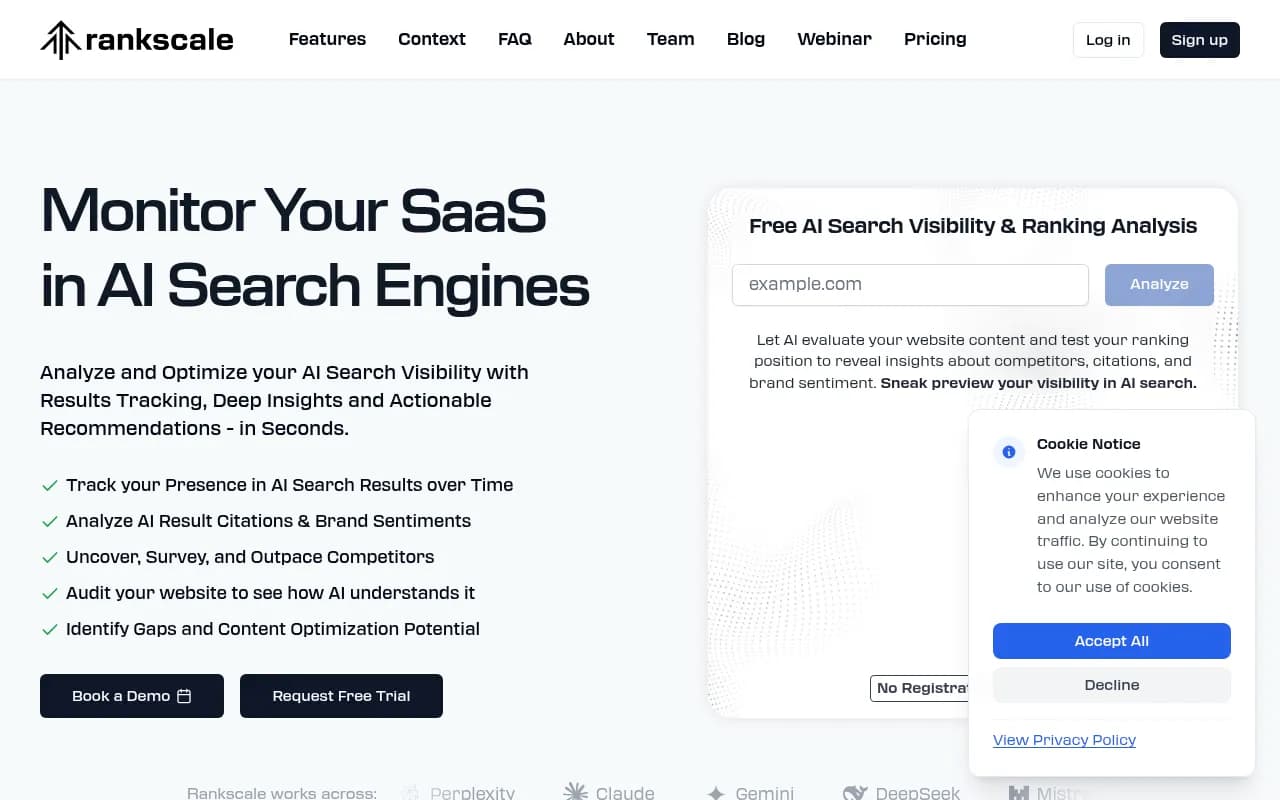
Share links are a nice lightweight alternative to a full client portal: you send a link, the client sees the branded dashboard. The trade-off is that you manage the data volume carefully as your roster grows.
Rank Prompt
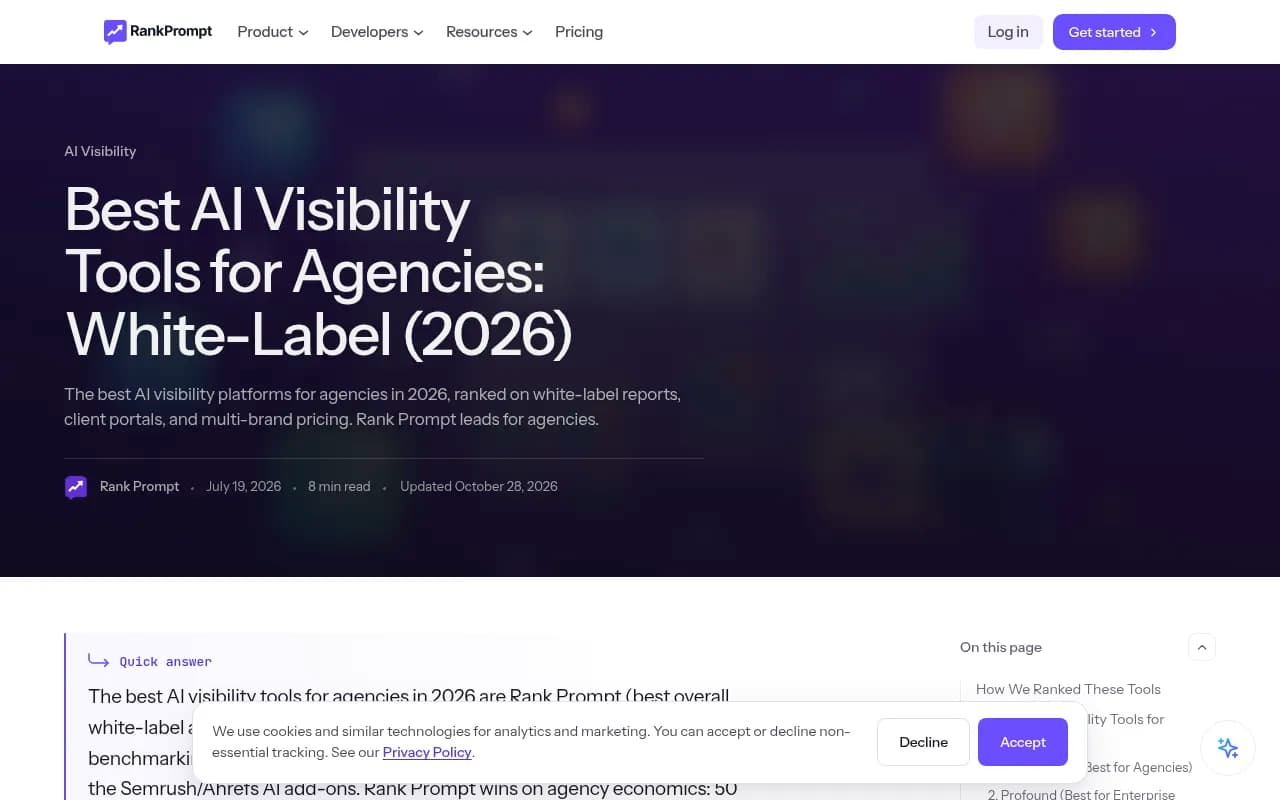
Rank Prompt is the budget-friendly agency pick. Per its own site, the Agency plan is $149/mo with white-label reports emailed to clients after every scheduled run and 50 brands. Agency Plus at $299/mo adds a full agency dashboard, client logins, prospecting and 500 brands, and there is a free first report to prove it out.
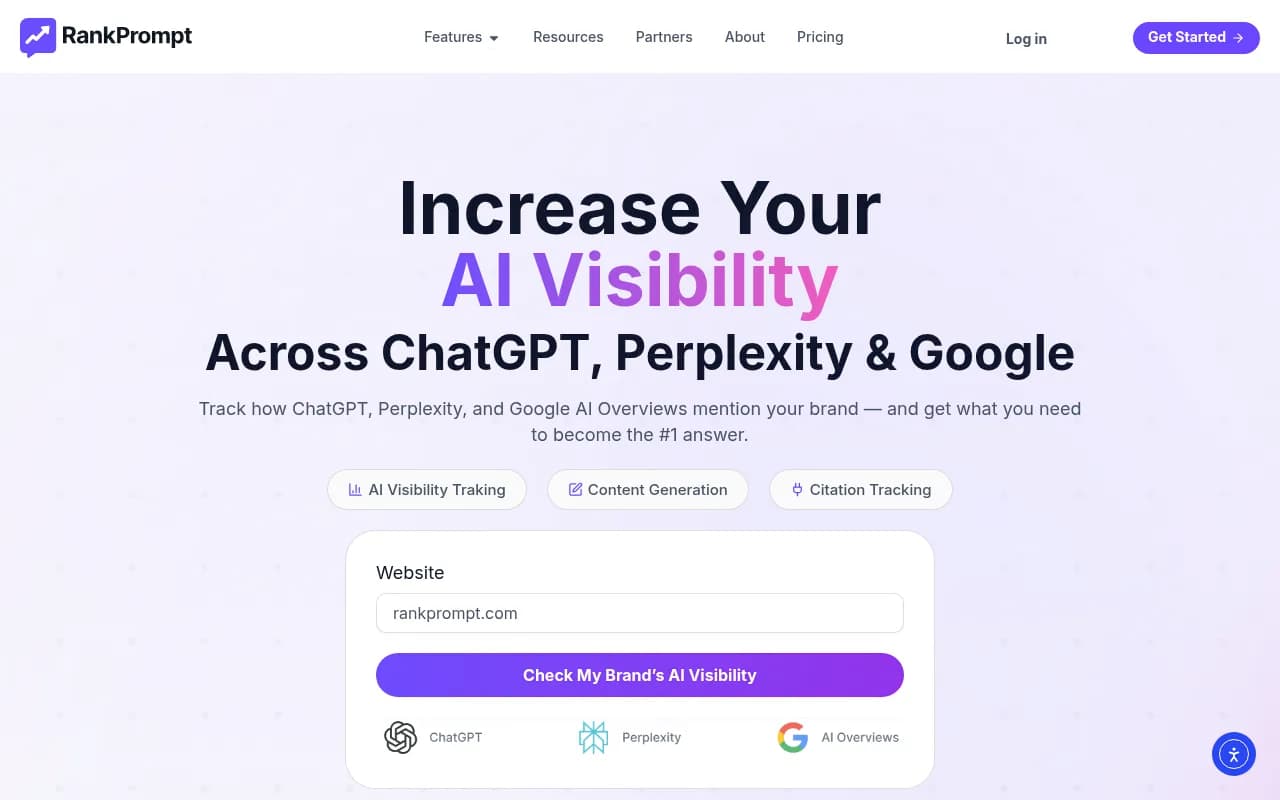
A caution: the comparison guide that ranks Rank Prompt first is published by Rank Prompt itself. The pricing looks strong, but verify it against the pricing page and test how well the reports hold up for your own clients.
Nightwatch
Nightwatch counts websites, not clients. Its Professional plan at EUR 159 a month holds 25 websites with white-label reports, unlimited user seats, Looker Studio and the API. White-label reports start at the Professional tier, with no add-ons.
Its real strength is putting traditional rankings next to AI answers in a single account, which is useful if your clients still care about Google positions as much as ChatGPT mentions.
SE Ranking
SE Ranking offers white label for the platform and the reports through its Agency Pack, with client seats in the same add-on. Data leaves via Data Studio, export and API. One agency-focused comparison notes that white-label reporting is on the higher Business tier rather than the entry plan, so check which tier you actually need.
Semrush
Semrush gives you a white-label report and exports via Excel, CSV, Sheets and PDF. If your agency already lives in Semrush, adding AI visibility there keeps one login for rankings and answers. The downside, as with most traditional SEO suites that add AI tracking, is typically shallower AI-specific data.
Other trackers worth a look
A few more tools in the catalog come up for agency work:
- Ayzeo has white-label PDF and DOCX reports at $149/month on Pro, plus a Prospect Scanner you can run live on a sales call. Its reports carry only your branding, while the live dashboard runs on ayzeo.com.
- Peec AI and OtterlyAI are lighter monitoring tools, popular for competitor benchmarking and simple setups.

Otterly.AI

- AccuRanker is a reliable multi-client rank tracker for classic keyword rankings, from about $116/mo for 1,000 keywords. Its white-label is limited to report branding rather than a client portal, per one agency comparison.
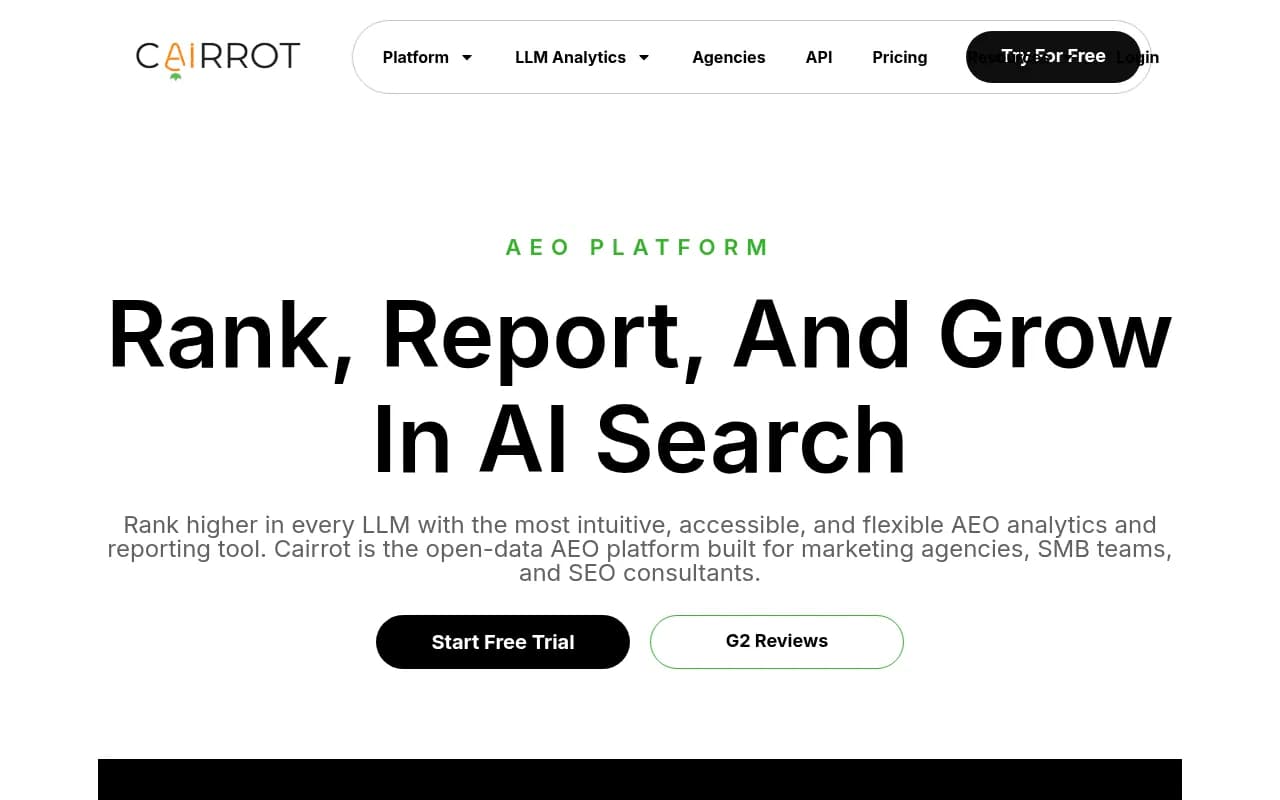
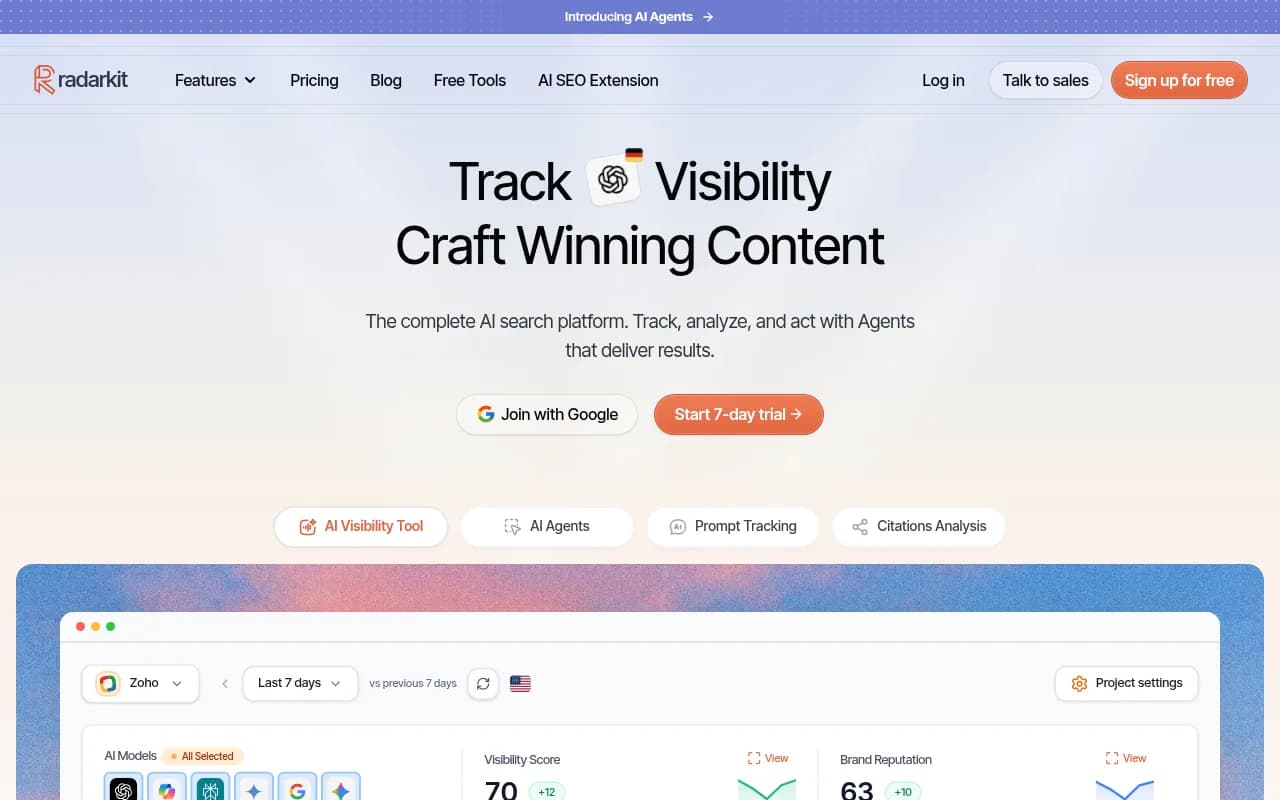
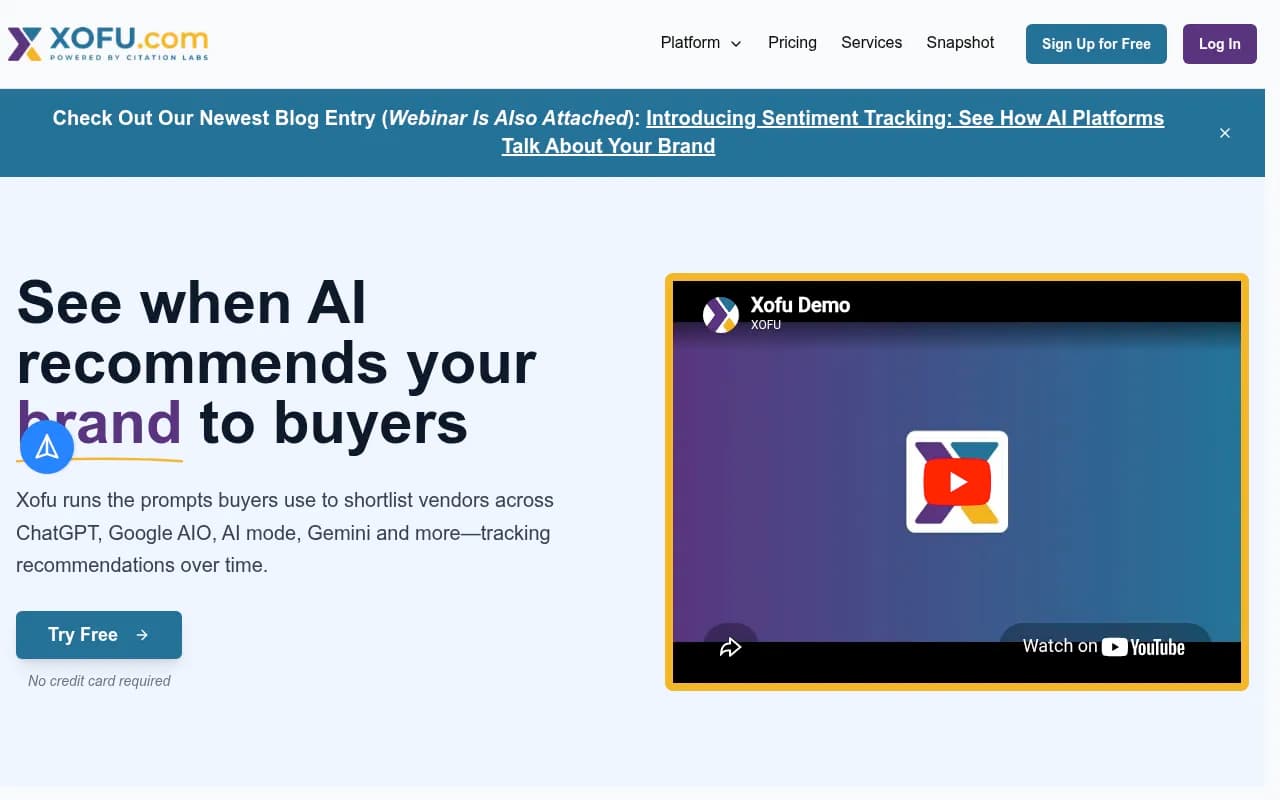
- Cairrot, Radarkit AI and Xofu all target LLM rank tracking for marketing agencies or brand teams.
For a wider view, the GEO software directory at bestgeosoftware.com lists far more options than any one guide can cover.
How to choose
Start from how clients read their numbers
Some clients want a branded PDF in their inbox on the first of the month. Others want a login. A few want a live link they can show their board. Your reporting format should match theirs, and each tool above handles one of those better than the others.
Check the reporting stack
If your reporting already runs through Looker Studio, Nightwatch, SE Ranking and Promptwatch (Looker Studio from Professional on brand plans, and available through the API) fit easily. If you work in spreadsheets, check CSV and Excel exports. If you build automations, check the API limits per hour.
Test permissions before you buy
Ask to test role-based access. You want to expose a limited dashboard to a stakeholder without them being able to browse other clients. This is the failure that bites agencies most, and a sales deck will not show it.
Decide whether you need execution
Prompt trackers answer "Was my client mentioned?" Platforms with an action layer answer "What do we publish next, and did it work?" If your retainers include content, the second type usually pays for itself, since you stop paying for a tracker plus a separate content tool plus a separate analytics tool.
A short evaluation checklist
- Divide monthly answers by your client count and compare across tools.
- Ask for a sample white-label report with your real branding applied.
- Confirm whether the client portal is on your plan tier, not just listed on the site.
- Check which AI models are included and whether the tool uses real interfaces or only APIs.
- Confirm tracking frequency. Daily is standard, but launches and campaigns often need more.
- Test how the tool handles ChatGPT traffic attribution after the October 2026 referrer change.
- Ask what happens to your data if you downgrade or cancel.
Final thoughts
For most agencies the shortlist is short. If you want tracking plus execution and have clients where AI visibility drives revenue, Promptwatch is the strongest all-in-one choice. If you need a cheap branded deliverable fast, Rank Prompt and Rankscale are worth a trial. If rankings and AI answers need to sit side by side, Nightwatch and SE Ranking make sense. Whatever you pick, run the answers-per-client division first, then run a trial with one real client before moving the whole roster.
Agencies that would rather hand the whole thing off can look at 1001 SEO Media, which runs AI search and GEO work for clients and uses Promptwatch for AI visibility tracking.