Key takeaways
- Google Business Profile drives a lot of local traffic, but AI search engines like ChatGPT, Perplexity, and Google AI Overviews are increasingly where buying decisions start -- and GBP data alone won't get you cited there.
- Multi-location brands face a compounded problem: inconsistent NAP data, thin location pages, and no AI-specific content strategy mean most locations are invisible in AI answers.
- The best GEO platforms for local brands combine AI visibility tracking with the ability to act on what they find -- not just dashboards that show you the problem.
- Different tools serve different needs: enterprise platforms like Yext and Uberall handle listing syndication at scale, while dedicated GEO tools like Promptwatch handle the AI citation layer.
- The smartest stack in 2026 pairs a local marketing platform (for listings and reviews) with a GEO platform (for AI search visibility and content optimization).
Why Google Business Profile is no longer the whole game
For years, local SEO meant one thing: get your Google Business Profile right, build citations, collect reviews, and watch the map pack rankings climb. That playbook still matters. According to Birdeye's State of Google Business Profile 2025, website visits account for 47.8% of GBP interactions, so local search visibility is still a real first touchpoint.
But something shifted. When someone asks ChatGPT "what's the best HVAC company near me?" or "which hotel chain has the best loyalty program?", Google Business Profile data doesn't automatically flow into that answer. AI models pull from a different set of sources: structured content on your website, third-party reviews, forum discussions, news coverage, and whatever else their training data and real-time retrieval systems have indexed.
For a single-location business, this is manageable. For a brand with 50, 200, or 2,000 locations, it's a serious problem. Each location needs to be findable not just in Google Maps but in the AI answers that are increasingly where customers start their research.
That's the gap GEO platforms are built to close.
What makes local and multi-location GEO different
Standard GEO is already complex. You're tracking brand mentions across 10+ AI models, analyzing which prompts trigger citations, and figuring out why competitors show up when you don't. Local GEO adds several layers on top of that:
Location-level granularity. A brand with 300 locations needs to know which locations are being cited in AI answers and which aren't. City-level or state-level tracking matters here -- a national brand might have strong AI visibility in New York but be completely absent in Phoenix.
NAP consistency at scale. AI models often pull business information from aggregated sources. If your address or phone number is inconsistent across directories, that inconsistency can bleed into AI-generated answers. This is where traditional local SEO hygiene directly affects AI visibility.
Location page quality. Thin location pages -- the kind that just swap out a city name in a template -- don't give AI models much to work with. Each location page needs enough unique, substantive content that an AI model can actually cite it as a useful source.
Review signals. Reviews on Google, Yelp, and Trustpilot are part of what AI models use to assess brand credibility. For multi-location brands, review volume and recency need to be managed at the location level, not just the brand level.
The platform landscape: what's actually out there
The tools available to local and multi-location brands fall into a few distinct categories. Understanding which category solves which problem saves a lot of time.
Traditional local marketing platforms
These are the platforms that have been handling listings, reviews, and local social for years. They're mature, well-integrated, and built for scale.
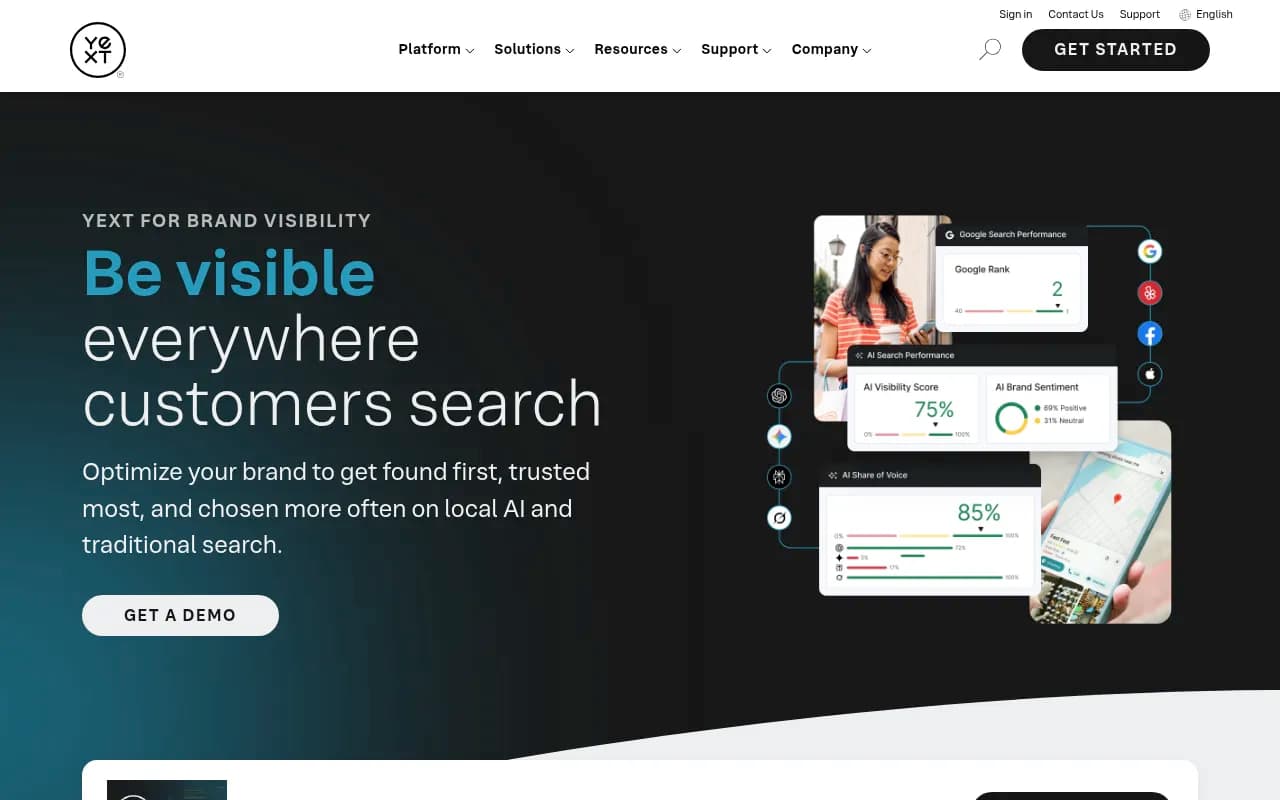
Yext is the most established name here. It syncs your business data across hundreds of directories and publisher networks, and in 2026 it has added AI search visibility features to its core offering. For enterprise brands that need clean, consistent data flowing everywhere, Yext is still a strong anchor.
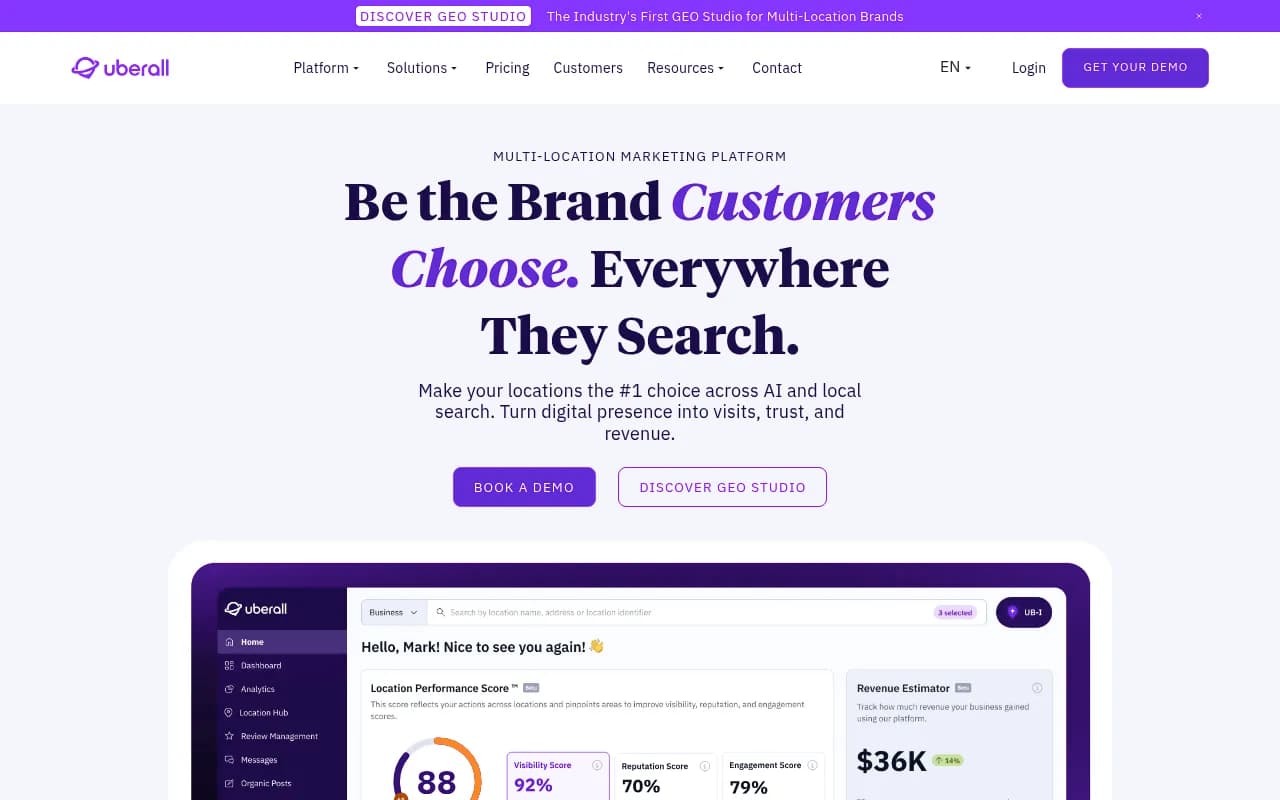
Uberall takes a similar approach but with a stronger emphasis on the "near me" experience and AI search integration. Their platform now covers both traditional local search and AI search visibility in a single dashboard.
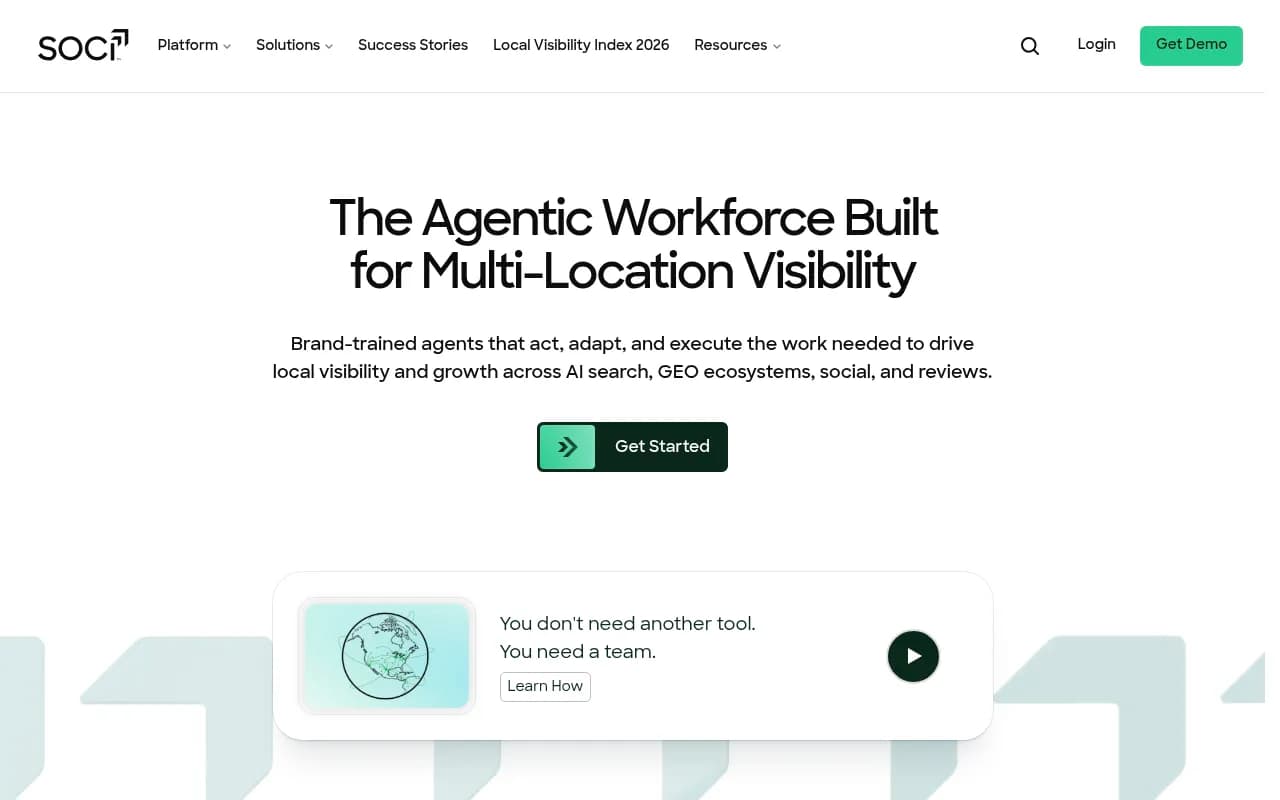
SOCi is built specifically for multi-location brands and focuses heavily on local social, reviews, and reputation management. It's less focused on AI search visibility specifically but handles the operational complexity of running marketing across hundreds of locations.
BrightLocal is a solid mid-market option for agencies managing local SEO for multiple clients. It's strong on rank tracking, citation auditing, and reporting, though its AI search features are still catching up to dedicated GEO tools.
Rio SEO and Partoo are worth mentioning for enterprise local marketing, particularly for brands with international footprints.


Dedicated GEO and AI visibility platforms
This is where things get more interesting for 2026. These tools are built specifically to track and improve how brands appear in AI-generated answers -- which is a fundamentally different problem from managing local listings.
Promptwatch is the most complete option here, and the one I'd recommend as the primary GEO layer for any serious multi-location brand. It tracks visibility across 10 AI models (ChatGPT, Perplexity, Claude, Gemini, Google AI Overviews, Grok, DeepSeek, Copilot, Meta AI, and Mistral), with state and city-level tracking available on the Professional plan. What separates it from monitoring-only tools is the action loop: it identifies which prompts competitors are visible for that you're not, then helps you create content specifically engineered to get cited. For multi-location brands, the ability to track AI visibility at a geographic level is particularly valuable.

Profound is a strong enterprise option with deep prompt intelligence features. It's well-regarded for large teams that need to understand AI visibility at scale, though it sits at a higher price point.
Profound

Chatmeter deserves a specific mention here because it's one of the few platforms that explicitly bridges local reputation management and AI search visibility. If you're managing reviews and local listings for a multi-location brand and want AI visibility in the same platform, Chatmeter is worth evaluating.
Otterly.AI and Peec AI are lighter monitoring tools. They'll show you where you appear in AI answers, but they don't help you fix the gaps. Fine for getting started, but they'll feel limiting quickly.
Otterly.AI


Moz Local handles the citation and listing side of local SEO well, and pairs naturally with a dedicated GEO tool for the AI layer.
Comparison: which platform does what
| Platform | Local listings | Review management | AI visibility tracking | Location-level AI tracking | Content gap analysis | Content generation |
|---|---|---|---|---|---|---|
| Yext | Excellent | Good | Basic | No | No | No |
| Uberall | Excellent | Good | Emerging | Limited | No | No |
| BrightLocal | Good | Good | Limited | No | No | No |
| SOCi | Good | Excellent | No | No | No | No |
| Chatmeter | Good | Excellent | Emerging | Limited | No | No |
| Promptwatch | No | No | Excellent | Yes (city/state) | Yes | Yes |
| Profound | No | No | Excellent | Limited | Partial | No |
| Otterly.AI | No | No | Basic | No | No | No |
| Peec AI | No | No | Basic | No | No | No |
The table makes the gap obvious. Traditional local platforms are strong on the operational side but weak on AI visibility. Dedicated GEO platforms are the opposite. For most multi-location brands, the answer is a combination.
Building the right stack for your scale
The right combination depends on how many locations you're managing and how sophisticated your current setup is.
Small to mid-size (1-50 locations)
At this scale, you probably don't need a full enterprise local marketing platform. BrightLocal handles citations and rank tracking well at a reasonable price. For AI visibility, Promptwatch's Essential or Professional plan gives you the tracking and content tools you need without enterprise pricing.
The key priority at this scale: make sure your location pages are substantive. Each page should answer the specific questions a customer in that city would ask -- not just a template with a swapped city name. That content is what AI models will actually cite.
Mid-market (50-500 locations)
This is where operational complexity starts to matter. You need a platform that can manage listings and reviews at scale without requiring manual work for each location. Yext or Uberall handles that layer well.
For AI visibility, Promptwatch's Professional plan covers up to 2 sites with state and city-level tracking, which is useful for understanding geographic gaps. The content generation features become particularly valuable here -- creating location-specific content that's actually worth citing is time-consuming at scale, and AI-assisted generation grounded in real citation data speeds that up considerably.
Enterprise (500+ locations)
At this scale, you're likely already using Yext or a similar platform for listings. The question is what sits on top for AI visibility.
Profound is worth evaluating for enterprise teams that need deep prompt intelligence and can absorb a higher price point. Promptwatch's Business or Agency plan handles the optimization side -- particularly the Answer Gap Analysis, which shows exactly which prompts competitors are winning that you're not, and the content generation pipeline to close those gaps.
For brands with significant review volume, pairing Chatmeter or Reputation.com with Promptwatch gives you both the local reputation layer and the AI visibility layer.
The content problem that most platforms ignore
Here's something that doesn't get talked about enough in local GEO discussions: the reason most local brands are invisible in AI answers isn't a tracking problem. It's a content problem.
AI models cite sources that actually answer questions well. A location page that says "We're the best plumber in Denver! Call us today!" is not getting cited by ChatGPT. A page that explains how Denver's altitude affects pipe pressure, what permits are required for plumbing work in Colorado, and what the typical cost range is for a water heater replacement in the Denver metro -- that's the kind of content that gets cited.
Most local marketing platforms don't help you create this content. They manage your existing data. Dedicated GEO platforms like Promptwatch go further: the Answer Gap Analysis identifies the specific questions AI models are answering about your category where you have no content, and the built-in writing agent generates articles grounded in real citation data. That's a meaningful difference for a brand trying to build AI visibility from scratch across dozens of locations.
Reviews still matter -- more than you might think
One thing the AI visibility conversation sometimes misses: reviews are part of the "source stack" that AI models draw from. When ChatGPT or Perplexity recommends a local business, it's often drawing on review data from Google, Yelp, and other platforms.
This means the review management work you're doing in platforms like SOCi, Chatmeter, or Birdeye directly feeds into your AI visibility. High review volume, recent reviews, and reviews that mention specific services or locations all help AI models build a more confident picture of your brand.
For multi-location brands, this is an argument for taking review management seriously at the location level, not just the brand level. A location with 12 reviews from 2021 is going to be less visible in AI answers than a location with 150 recent reviews that mention specific services.
What to look for when evaluating a GEO platform for local use
A few questions worth asking any platform vendor:
Can it track AI visibility at the city or state level? Brand-level tracking tells you your overall visibility but misses geographic gaps. If you have 200 locations and 40 of them are invisible in AI answers for their local market, you need to know which 40.
Does it monitor the AI models your customers actually use? Google AI Overviews is critical for local search. ChatGPT and Perplexity matter for research-stage queries. Make sure the platform covers the models relevant to your category.
Does it help you fix gaps, or just show them? Most platforms stop at monitoring. The ones that help you create content, optimize existing pages, and track the results of those changes are significantly more valuable.
How does it handle multi-location content at scale? Generating unique, substantive content for 200 location pages is a real operational challenge. Ask whether the platform has tools to help with this, and whether the content it generates is actually grounded in citation data or just generic AI output.
Does it integrate with your existing local marketing stack? If you're already using Yext for listings or a review management platform, look for GEO tools that can pull in that data or at least not require you to maintain everything twice.
The bottom line
Google Business Profile is still important. Citations still matter. Reviews still matter. None of that goes away.
But the brands that will win local search in 2026 are the ones that understand AI search as a separate channel with its own logic -- and build for it deliberately. That means substantive location content, consistent data across all sources, active review management, and a GEO platform that can tell you where you're invisible and help you fix it.
For most multi-location brands, the right answer is a two-layer stack: a mature local marketing platform for the operational work, and a dedicated GEO platform for the AI visibility layer. Promptwatch covers the GEO layer well, with the geographic tracking and content generation features that multi-location brands specifically need. Pair it with whatever local platform already fits your scale, and you have a defensible setup for how local search actually works now.