Key takeaways
- Google AI Mode is a separate surface from AI Overviews. A tracker that only says "Google" may not cover it, so check for AI Mode support by name before you buy.
- For B2B SaaS, the useful output is citation share by domain, fan-out queries and self-citation rate. A list of brand mentions alone is not enough.
- Promptwatch is the end-to-end option: it collects AI Mode data from the real interface and also writes and publishes content to fix gaps. Peec AI, Otterly and Profound are mostly monitoring tools.
- Almost every public "best AI Mode tracker" list is written by a vendor that ranks itself first. Treat pricing and coverage claims as a starting point and check them on the vendor's own pricing page.
- Start with a small prompt set built around buyer questions ("best X for Y", "X vs Y", "alternatives to X"), run it for a month, then decide whether you need a fixing tool or only a dashboard.
Why AI Mode needs its own tracking
Google AI Mode is the conversational tab inside Google Search. It builds multi-turn answers with Gemini, fans a question out into many sub-searches, and cites sources inline. AI Overviews, the summary box above regular results, behaves differently and shows different sources.
For B2B SaaS this matters because evaluation research is conversational. A buyer types "which CRM works for a 20-person fintech with Salesforce migration needs" and follows up three times. If your brand is missing from that session, no ranking report from the old SERP will tell you.
The citation mix is also odd. According to Promptwatch's Google AI Mode citation share data for June 2026 (May 31 to Jun 26), google.com took 7.31% of all AI Mode citations. That is more than YouTube (2.88%) and Reddit (2.52%) combined, and up from 4.24% in May. Google-owned properties together make up over 10% of citations, because AI Mode often answers with Maps listings, Business Profiles and Google support content before it touches the open web. No independent site in the top 17 cleared 1%.
Two things follow for a SaaS marketer. First, a big slice of the citation pool is not yours to win, so share on the remaining pool is small and every point counts. Second, a tracker that only reports "mentioned: yes/no" hides most of what is going on.
What to look for in an AI Mode tracker
I would score every tool on the same short list before looking at price.
Real interface data, not only API calls
AI Mode answers in the browser can differ from what a model API returns. Tools that scrape or simulate the actual AI Mode interface, by country and language, give you numbers closer to what a buyer sees. Ask each vendor how they collect.
Citation share by domain
You want to see which domains get cited for your prompts, including Google-owned surfaces and Reddit. The June data above shows why: the competitor that beats you might be a Google Maps listing or a Reddit thread, not another vendor.
Fan-out queries
AI Mode splits one question into several searches. If your tool shows those sub-queries, you learn which pages to write. If it does not, you are guessing. The Promptwatch query fan-out guide explains how to use them.
Prompts that match B2B buying
Tracking a branded query is a vanity check. Useful prompt sets cover category discovery, comparisons, integration questions and "alternatives to [competitor]". Persona support helps here, because a CFO and a developer ask differently.
Closing the loop
Seeing a gap is half the job. Can the tool help you write the page, publish it, and later confirm that AI Mode picked it up? Most cannot.
Pricing that scales with prompts
B2B SaaS teams usually track a few hundred prompts across a few markets. Compare cost per tracked response rather than the headline monthly fee.
Comparison table
Pricing and coverage below come from vendor-published listicles (the KIME comparison, dated April 2026) and, for Promptwatch, its own pricing page. I have not verified every vendor's AI Mode support independently, so confirm before you commit.
| Tool | Core focus | AI Mode coverage | Starting price | Best for |
|---|---|---|---|---|
| Promptwatch | End-to-end AI visibility and GEO, with content agents | Yes, real interface | $95/mo (Essential) | Teams that want to track and fix |
| Peec AI | Conversational AI visibility | Yes | EUR 85/mo | SaaS and B2B reporting |
| Profound | Enterprise AI visibility | Enterprise tier | $99/mo listed | Large brands |
| Otterly.AI | Prompt-based tracking | Add-on | $29/mo | Small budgets |
| Nightwatch | AI plus classic rank tracking | Add-on | $39/mo plus AI add-on | Agencies with mixed SEO needs |
| LLM Pulse | Recommendations and sentiment | Limited | EUR 49/mo | Brand and PR monitoring |
| Writesonic | GEO plus content | Yes | $199/mo | Teams wanting content in the same tool |
| seoClarity | Enterprise SEO plus AI | Yes | $2,500+/mo | Global enterprises |
| Keyword.com | Verified rank and AI tracking | Yes | $4/mo | Accuracy-minded agencies |
The best Google AI Mode rank trackers for B2B SaaS
1. Promptwatch
Promptwatch is the option I would look at first if the goal is to improve AI Mode visibility rather than only report on it. It tracks Google AI Mode from the real user interface, in the country and language you choose, alongside ChatGPT, AI Overviews, Gemini, Perplexity, Copilot and others.

What matters for SaaS:
- Prompt tracking with volumes, difficulty scores, personas and query fan-outs, so you can see the sub-searches AI Mode runs for a buyer question.
- Citation Trends that classify every citation by content type and source type, with Directory as its own type, which is where G2 and Capterra sit.
- Brand Narrative, which pulls out the individual claims AI makes about you and competitors, such as "expensive for small teams", and groups them by Pricing, Features, Support and Reputation.
- IP-verified AI crawler logs and visitor analytics, so you can tell an access problem from a content problem, then see whether AI traffic converts.
- The Content Agent (Business plan) plans, writes and publishes pages to WordPress, Webflow or Framer against your visibility gaps. A weekly Action Board lists what to do next.
Crisp, a customer messaging SaaS, reported 2x higher conversion rates from AI traffic than from traditional channels and scaled to 5-10 articles a day. Read the Crisp case study for the workflow.
Pricing: Essential $95/mo, Professional $245/mo, Business $579/mo, with agency plans from $199/mo and a 7-day free trial on monthly billing. Confirm at promptwatch.com/pricing. The free AI visibility report is a no-login way to see where you stand first. If you are weighing it against a monitoring-only tool, see Promptwatch vs Peec and Promptwatch vs Profound.
Honest limit: the Content Agent and faster-than-daily tracking start at the Business tier, so Essential users get monitoring and analysis but not automated publishing.
2. Peec AI
Peec AI is the name that shows up most in SaaS-focused lists, and vendor listicles position it for SaaS and B2B teams tracking AI recommendations. It is clean and quick to set up, with a starting price listed around EUR 85/mo.

It is a reporting tool. You see visibility, sources and competitors. You will need another workflow for content, crawler analysis and traffic attribution.
3. Profound
Profound targets large brands with a broad engine list. One listicle says AI Mode support sits on the Enterprise tier, which matters if you are a mid-sized SaaS company expecting it at the entry price.
Profound

Strong monitoring, higher price points, and no agentic execution in the way Promptwatch has it.
4. Otterly.AI
Otterly is the budget pick, with a listed entry price of $29/mo and AI Mode as an add-on. It suits a founder-led team that wants to check a few dozen prompts and see how often the brand shows up.
Otterly.AI

Expect basic tracking: no crawler logs, no content generation, and light analysis.
5. Nightwatch
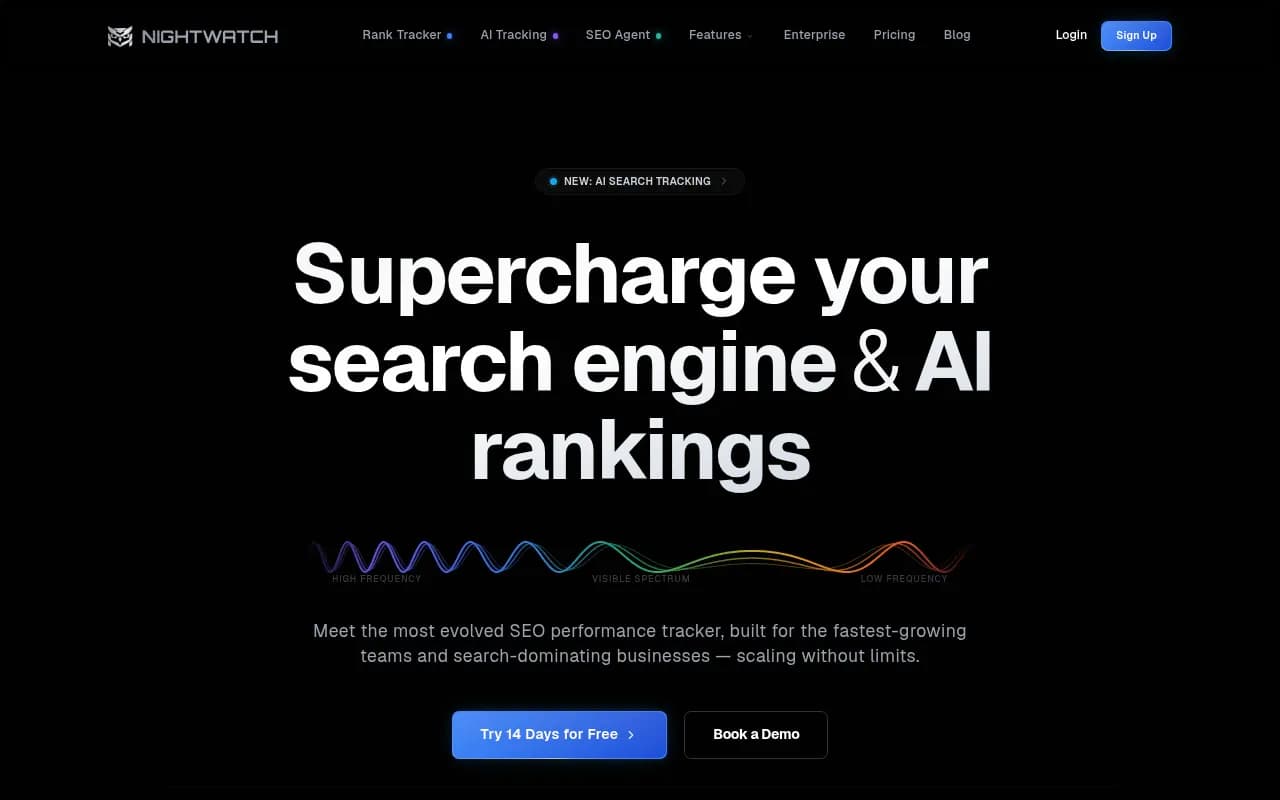
Nightwatch is a classic rank tracker that added AI monitoring. If your team already lives in keyword rank reports and wants AI Mode in the same place, it is a reasonable fit. The AI coverage is an add-on on top of a $39/mo base.
6. LLM Pulse
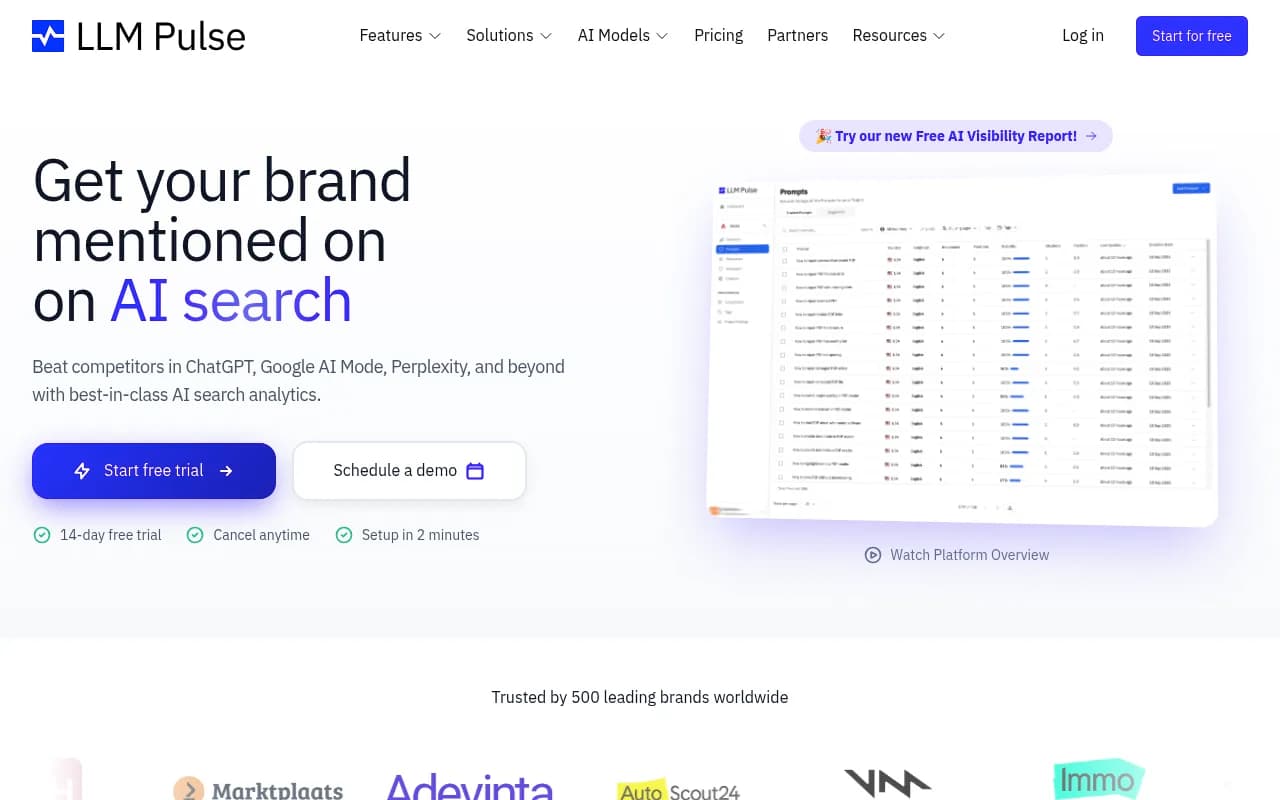
LLM Pulse leans into brand recommendations and sentiment, and its own SaaS guide talks about pushing AI visibility into HubSpot and Salesforce. The comparison I saw lists Google coverage as limited, so test AI Mode specifically.
7. Semrush and Ahrefs Brand Radar
If you already pay for Semrush or Ahrefs, the built-in AI modules are convenient. The tradeoff is fixed prompt sets and shallower AI-specific data, with no crawler logs or AI traffic attribution.

8. Others worth a look
AthenaHQ, Scrunch, Rankscale, Omnia and Gauge show up in independent shortlists of AI Overviews and AI Mode trackers. SE Ranking's SE Visible is another monitoring option if you already use SE Ranking.


For a wider survey of platforms, the directories at bestgeosoftware.com and ai-rank-tools.com are useful places to browse.
A note on the sources behind these rankings
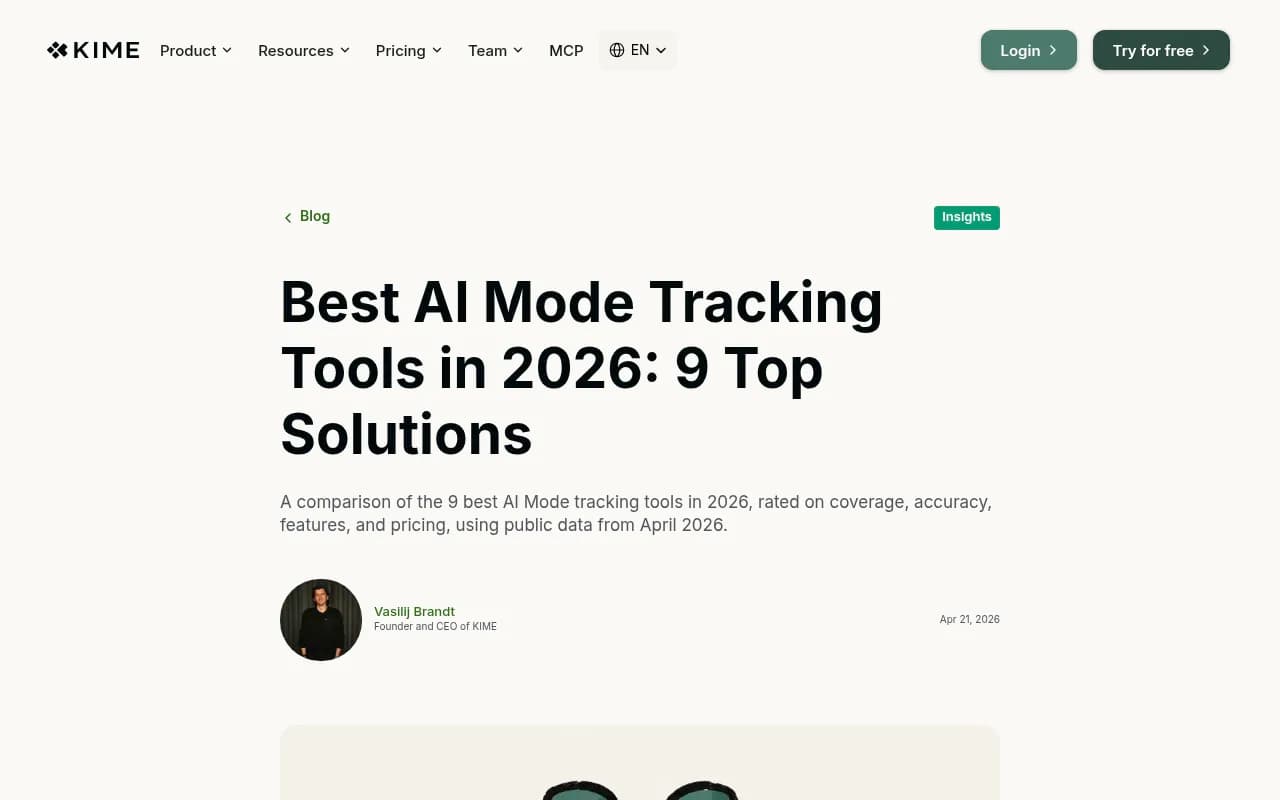
The screenshot above is the KIME comparison I used for pricing. It is useful, but KIME ranks itself first. The LLM Pulse SaaS guide ranks LLM Pulse first. SE Visible's list is published by SE Ranking. That is normal for this category, but it means the rankings tell you less than the feature tables do.
I also could not find an independent test of AI Mode tracking accuracy. Until one exists, run your own: take 20 prompts, check them by hand in a clean browser session, and compare against what each trial shows.
How to run a B2B SaaS AI Mode tracking program
Build the prompt set
Start with 40-60 prompts in four buckets: category ("best project management software for agencies"), comparison ("X vs Y"), alternatives ("Y alternatives"), and integration or use-case questions. Add personas for the economic buyer and the technical evaluator.
Read the right metrics
Low share of voice is a coverage problem. Late position is a prominence problem. Mentions without citations to your own domain point to content or crawlability. Weak sentiment is a reputation problem. The Promptwatch metrics overview defines each one.
Fix what the data shows
Promptwatch's June 2026 AI Mode report recommends tightly scoped pages that each fully answer one question, then tracking whether AI Mode pulls them into its fan-out. For SaaS, that usually means comparison pages, integration docs and pricing explainers.
The ChatGPT software data is a useful cross-check. In Promptwatch's software citation report (Sep 28 to Oct 4, 2026), docs and help centers earned 2.64% of software citations and vendor sites 2.01%, about three times the share of review sites and analysts at 1.57%. G2 was at 0.73% and Capterra at 0.32%. That is ChatGPT, not AI Mode, but the practical advice carries over: keep G2 and Capterra profiles current and publish crawlable docs.
Watch the crawlers
If AI bots cannot read your docs, no amount of content fixes it. Use crawler logs or a quick check with the Agentic Readiness Check.
Tie it to pipeline
Send AI-referred visits to your analytics and CRM. Attribution is messy, so the attributing AI traffic guide is worth a read.
Which tool should you pick?
| Situation | Pick |
|---|---|
| You want to track and then fix, with content published to your CMS | Promptwatch |
| You only need a clean dashboard for a few prompts | Peec AI or Otterly.AI |
| Large enterprise with procurement requirements | Profound or seoClarity (Promptwatch is also ISO/IEC 27001 certified) |
| You live inside an existing SEO suite | Semrush, Ahrefs Brand Radar or Nightwatch |
| Agency with many clients | Promptwatch agency plans or Rankscale |
If you are choosing an agency rather than software, 1001 SEO Media runs GEO programs for B2B brands and uses Promptwatch as its visibility platform.
Questions to ask before you sign
- Is Google AI Mode tracked by name, on my plan, from the real interface?
- Can I set country and language per monitor?
- Do I get fan-out queries and domain-level citation share?
- Can I export data or pull it by API into Looker Studio or my warehouse?
- What happens when prompt volume grows?
Take the free trial of two tools, run the same 20 prompts, and compare against a manual check. That one afternoon will tell you more than any listicle, including this one.