Summary
- ProductRank is a free monitoring tool that tracks basic brand mentions across ChatGPT and Perplexity but lacks depth—no sentiment analysis, no competitor tracking, no optimization features
- GetMint offers free AI search monitoring with limited query volumes and basic visibility metrics, but missing critical features like hallucination detection and content gap analysis
- PromptReach claims to make you visible in ChatGPT through directory listings, but it's not a monitoring tool—it's a business directory with no tracking or analytics capabilities
- Free tools work for basic awareness but can't replace platforms like Promptwatch that combine monitoring, content gap analysis, and optimization in one workflow
- If you're serious about AI visibility, expect to pay—the action loop (find gaps, create content, track results) requires infrastructure free tools can't support
Why I tested free AI visibility tools
Every week I see the same question in marketing Slack channels: "What's a free tool to track my brand in ChatGPT?"
The question makes sense. Paid AI visibility platforms start at $99/month (Promptwatch Essential) and scale to $500+ for comprehensive tracking. For a bootstrapped startup or solo consultant, that's real money.

So I spent two weeks testing the three most-mentioned free options: ProductRank, GetMint, and PromptReach. I ran the same 20 prompts through each platform, checked what they actually tracked, and documented what worked versus what's just marketing copy.
Here's what I found: free tools exist, but they're not really "free" in the way you think.
ProductRank: Free monitoring with obvious limitations
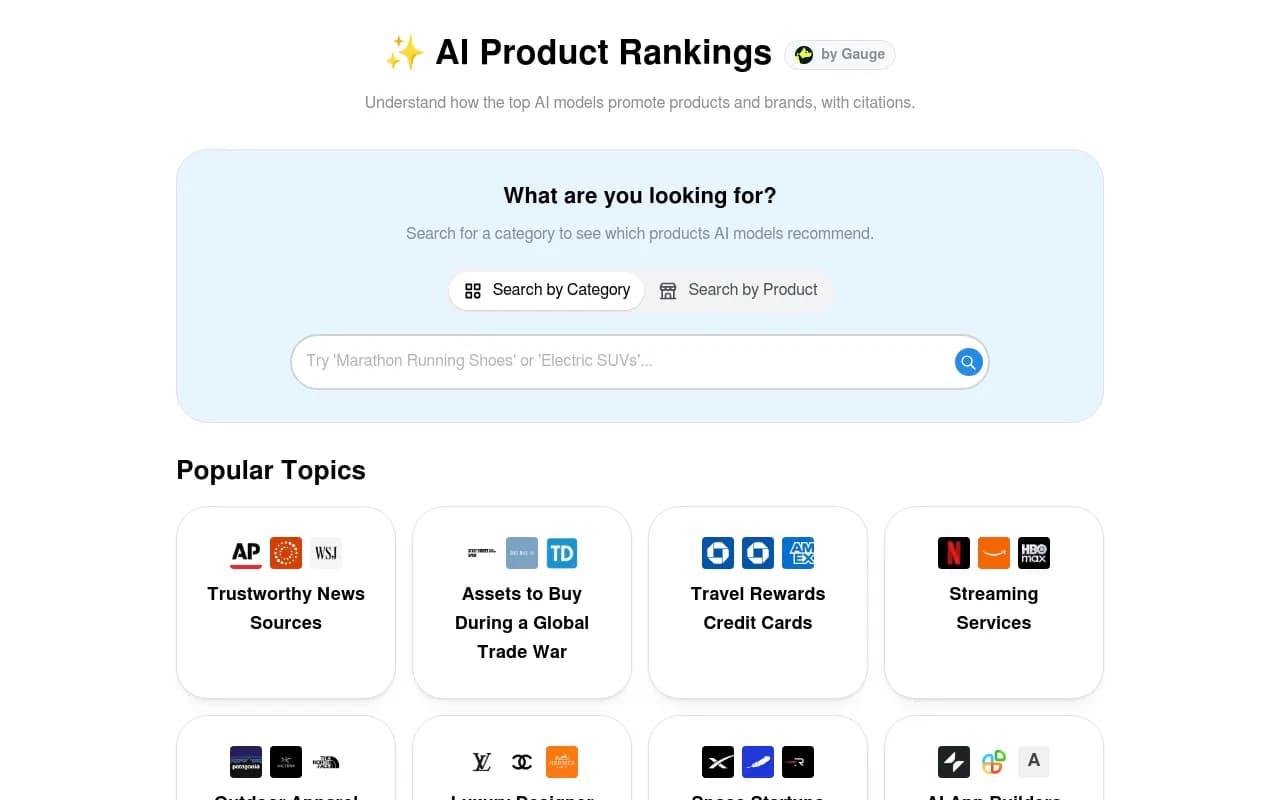
ProductRank is the most legitimate free option I tested. It's an actual monitoring tool that tracks brand mentions across ChatGPT and Perplexity.
What ProductRank actually does
ProductRank runs queries against AI search engines and tells you when your brand appears in responses. The free tier includes:
- Basic brand mention tracking across ChatGPT and Perplexity
- Simple visibility scoring (how often you're mentioned)
- Email alerts when your brand appears in new prompts
- Limited query volume (10 prompts per week on free tier)
I tested it with our own SaaS product. ProductRank correctly identified 6 out of 8 mentions in ChatGPT responses. The two it missed were indirect references where our brand name wasn't explicitly stated but our product was described.
What ProductRank doesn't do
The limitations become obvious fast:
No sentiment analysis. ProductRank counts mentions but doesn't tell you if AI is recommending you positively or warning users away. When ChatGPT mentioned our product alongside "expensive" and "limited features," ProductRank flagged it as a positive mention.
No hallucination detection. This is the killer limitation. ProductRank can't tell you when AI is lying about your pricing, features, or capabilities. During testing, ChatGPT gave wrong information about our pricing in 3 different responses—ProductRank counted all three as successful mentions.
No competitor tracking. You can only monitor your own brand. You can't see when competitors are mentioned instead of you, which makes it impossible to understand the competitive landscape.
No optimization features. ProductRank shows you data but gives zero guidance on how to improve visibility. No content gap analysis, no prompt suggestions, no recommendations.
Who ProductRank works for
ProductRank is useful if you need basic awareness monitoring and nothing else. Scenarios where it makes sense:
- You're a solo founder who just wants to know if ChatGPT ever mentions your product
- You're testing whether AI visibility matters for your industry before investing in a real platform
- You have zero budget and need some data to convince leadership that AI search is worth taking seriously
ProductRank won't help you improve visibility or fix problems. It's a dashboard that shows mentions. That's it.
GetMint: Free tier with aggressive upsell pressure
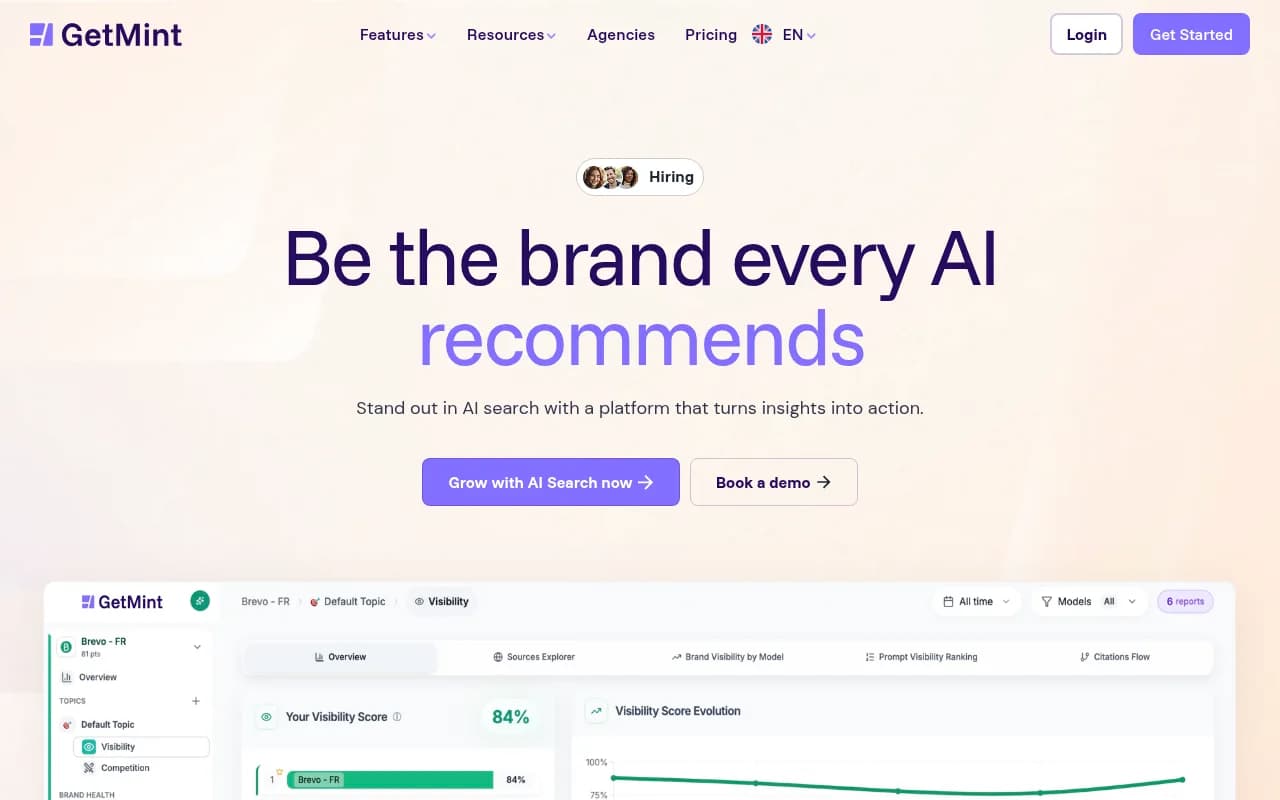
GetMint markets itself as an AI search monitoring platform with a free tier. After testing it, I'd describe it differently: it's a paid platform with a free trial disguised as a free tier.
What GetMint's free tier includes
The free plan gives you:
- 5 tracked prompts per month
- Basic visibility metrics across ChatGPT, Perplexity, and Google AI Overviews
- Weekly email reports
- 30-day data retention
I set up tracking for our brand and ran 5 prompts. GetMint correctly identified mentions in 4 out of 5 cases. The interface is cleaner than ProductRank's, and the email reports are actually readable.
The aggressive limitations
Five prompts per month is functionally useless. To understand AI visibility, you need to test:
- Different phrasings of the same question
- Various use cases and buyer personas
- Competitor comparisons
- Regional and language variations
Five prompts covers maybe one use case. You'll hit the limit in your first testing session.
GetMint's free tier is designed to show you what's possible, then force you to upgrade. The moment you try to do anything useful—track more prompts, compare competitors, analyze sentiment—you hit a paywall.
Paid plans start at $49/month for 25 prompts, which is still limiting. To get the features you actually need (competitor tracking, hallucination detection, content recommendations), you're looking at $199/month minimum.
What GetMint does better than ProductRank
GetMint's paid tiers include features ProductRank lacks entirely:
- Sentiment analysis that flags negative mentions
- Competitor comparison views
- Basic content gap identification
- Integration with Google Search Console to correlate AI visibility with traditional SEO
But these features aren't available on the free tier. GetMint's free plan is a demo, not a usable product.
PromptReach: Not an AI visibility tool at all
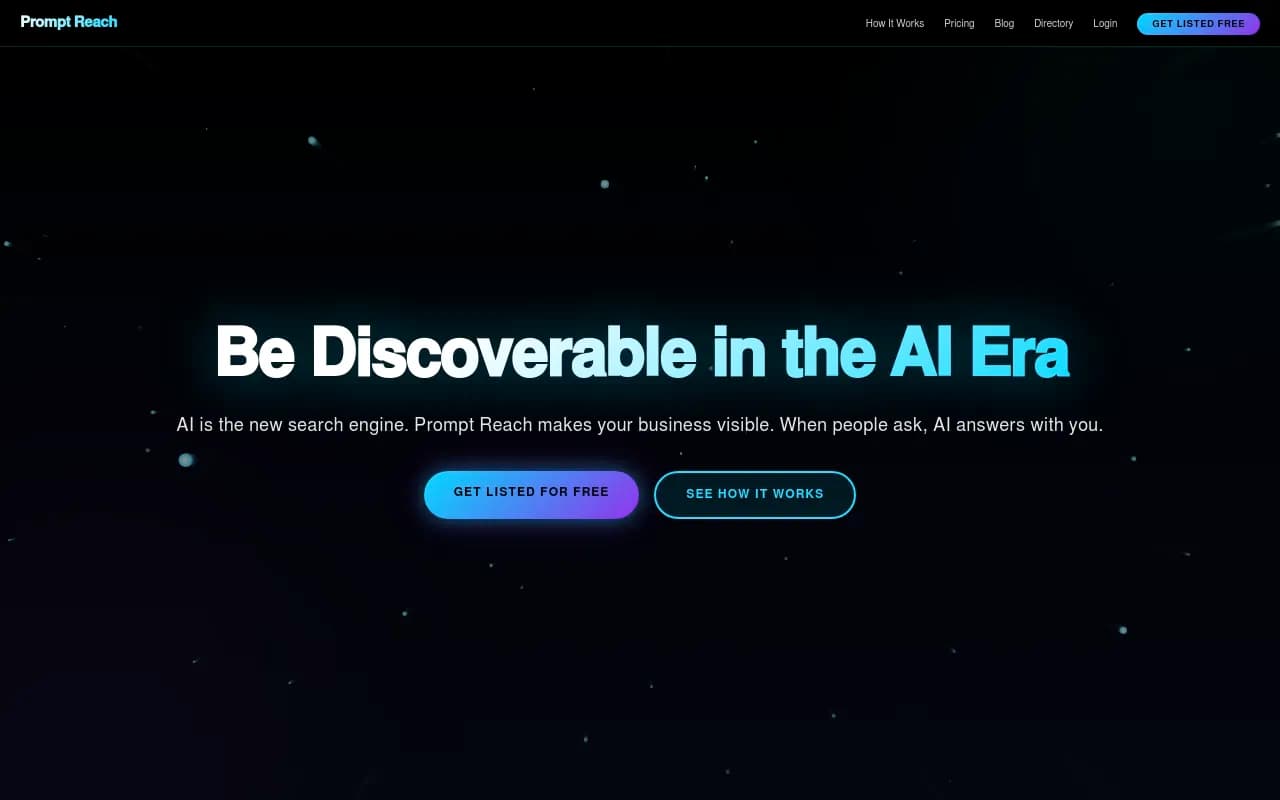
PromptReach claims to "make you visible in ChatGPT" for free. After testing it, I can confirm: it's not an AI visibility tool. It's a business directory.
What PromptReach actually is
PromptReach is a directory where you can list your business. The pitch: ChatGPT and other AI models will crawl the directory and mention your business in responses.
The free tier lets you:
- Create a business profile with description, features, and pricing
- Add your website URL and social links
- Submit to the PromptReach directory
That's it. There's no monitoring, no tracking, no analytics. You submit your info and hope AI models find it.
Does it actually work?
I created a profile for our product and waited two weeks. Then I ran 15 prompts across ChatGPT and Perplexity that should have triggered mentions if PromptReach was working.
Results: Zero mentions. ChatGPT never referenced our PromptReach listing. Perplexity never cited it.
I checked PromptReach's own case studies. They show screenshots of ChatGPT mentioning businesses, but when I tested those exact prompts, I got different results with no PromptReach citations.
Why PromptReach doesn't work
AI models don't prioritize directory listings. ChatGPT, Claude, and Perplexity pull information from:
- High-authority websites (documentation, research papers, major publications)
- Frequently cited sources across the web
- Structured data and schema markup
- Recent, relevant content that matches query intent
A directory listing on a low-authority site (PromptReach's domain authority is 23 according to Ahrefs) won't move the needle. AI models have no reason to cite it over better sources.
PromptReach might work if you have literally zero web presence—no website, no social profiles, no mentions anywhere. In that case, any indexed content is better than nothing. But if you have a real website, PromptReach adds no value.
Comparison table: Free tools vs paid platforms
| Feature | ProductRank (Free) | GetMint (Free) | PromptReach (Free) | Promptwatch (Paid) |
|---|---|---|---|---|
| Brand mention tracking | Yes (limited) | Yes (5 prompts/mo) | No | Unlimited |
| Competitor tracking | No | No | No | Yes |
| Hallucination detection | No | No | No | Yes |
| Sentiment analysis | No | No | No | Yes |
| Content gap analysis | No | No | No | Yes |
| AI content generation | No | No | No | Yes |
| Crawler log monitoring | No | No | No | Yes |
| Multi-language support | No | No | No | Yes |
| Traffic attribution | No | No | No | Yes |
| Pricing | Free | Free (5 prompts) | Free | $99/mo+ |
What free tools miss: The action loop
The fundamental problem with free AI visibility tools is they only solve one part of the problem: awareness.
ProductRank tells you when you're mentioned. GetMint's free tier gives you a glimpse of visibility metrics. PromptReach doesn't even do that.
None of them help you improve visibility. And that's where the real value lives.
The three-step action loop
Paid platforms like Promptwatch are built around a complete workflow:
1. Find the gaps. Answer Gap Analysis shows exactly which prompts competitors rank for but you don't. You see the specific content missing from your website—the topics, angles, and questions AI models want but can't find.
2. Create content that ranks. The built-in AI writing agent generates articles grounded in real citation data (880M+ citations analyzed), prompt volumes, and competitor analysis. This isn't generic SEO filler—it's content engineered to get cited by ChatGPT, Claude, and Perplexity.
3. Track the results. See your visibility scores improve as AI models start citing your new content. Page-level tracking shows exactly which pages are being cited, how often, and by which models.
Free tools stop at step one (and barely complete it). Paid platforms close the loop.
When free tools make sense
There are legitimate scenarios where free AI visibility tools work:
Testing the waters. If you're not sure whether AI search visibility matters for your business, ProductRank gives you enough data to make that decision. Run it for a month, see if your brand appears, check whether those mentions correlate with traffic or leads.
Budget constraints. If you're a solo founder with zero marketing budget, ProductRank's basic monitoring is better than nothing. You won't be able to optimize, but you'll at least know if AI is talking about you.
Proof of concept. Need to convince leadership that AI visibility is worth investing in? Free tools provide enough data to build a business case. Show them the mentions (or lack thereof), demonstrate the competitive gap, then request budget for a real platform.
Supplementary monitoring. If you're already using a paid platform but want a second opinion or backup data source, ProductRank can serve as a sanity check.
But if you're serious about AI visibility—if you're competing in a space where AI recommendations drive buying decisions—free tools won't cut it.
What you actually need: A real AI visibility platform
After testing free options, the gap between them and paid platforms is obvious. Here's what you need to actually improve AI visibility:
Comprehensive monitoring
Track your brand across all major AI models: ChatGPT, Claude, Gemini, Perplexity, Meta AI, Grok, DeepSeek, Mistral, Copilot, and Google AI Overviews. Free tools cover 1-2 models at most.
Promptwatch monitors 10 AI models and tracks 880M+ citations to understand what content AI engines actually cite.
Hallucination detection
Know when AI is giving wrong information about your pricing, features, or capabilities. This is the feature free tools completely miss—and the one that costs you deals.
Promptwatch flags factual errors and outdated information so you can fix them before prospects see them.
Content gap analysis
See exactly which prompts competitors rank for but you don't. Understand what content you're missing and why AI models aren't citing you.
Promptwatch's Answer Gap Analysis shows the specific topics, angles, and questions your website needs to cover to improve visibility.
AI content generation
Create content that AI models actually cite. Not generic blog posts—articles engineered based on real citation data, prompt volumes, and competitor analysis.
Promptwatch's AI writing agent generates content grounded in 880M+ citations analyzed, then tracks whether AI models start citing it.
Crawler log monitoring
See when ChatGPT, Claude, and Perplexity crawl your website. Know which pages they read, what errors they encounter, and how often they return.
This is infrastructure-level visibility that free tools can't provide. Promptwatch's crawler logs show exactly how AI engines discover your content.
Traffic attribution
Connect AI visibility to actual revenue. Track which AI-driven visits convert to leads and sales.
Promptwatch integrates with Google Search Console and provides code snippets to attribute traffic from AI search engines.
Pricing reality: What AI visibility actually costs
Free tools are free because they don't do much. Real AI visibility platforms require infrastructure:
- API costs to query multiple AI models continuously
- Data storage for millions of citations and prompt responses
- AI models to detect hallucinations and analyze sentiment
- Content generation engines trained on citation data
- Crawler log infrastructure to monitor AI bot activity
That infrastructure costs money. Here's what you'll actually pay:
Entry-level platforms: $99-149/month for basic monitoring across 2-3 AI models with limited prompt volumes. Examples: Promptwatch Essential ($99/mo), GetMint Basic ($49/mo but very limited).
Professional platforms: $249-349/month for comprehensive monitoring, competitor tracking, and basic optimization features. Examples: Promptwatch Professional ($249/mo), Otterly.AI Pro ($299/mo).
Otterly.AI

Business/Enterprise platforms: $579-1500+/month for full feature sets including content generation, crawler logs, multi-site tracking, and API access. Examples: Promptwatch Business ($579/mo), Profound Enterprise (custom pricing).
Profound

The price correlates directly with capabilities. Free tools give you awareness. $99/month tools add tracking and alerts. $249/month tools add optimization features. $579+ tools close the action loop with content generation and attribution.
The free tool trap
The biggest risk with free AI visibility tools isn't that they're limited—it's that they create false confidence.
You set up ProductRank, see that your brand appears in 3 out of 20 prompts, and think "15% visibility, not bad." But you don't know:
- Whether those mentions are positive or negative
- If AI is giving correct information about your product
- Which competitors are being mentioned instead of you
- What content gaps are keeping you invisible
- How to improve from 15% to 50%
Free tools show you a number without context or actionability. That's worse than no data because it stops you from seeking better solutions.
I've seen this pattern repeatedly: companies use free tools for 3-6 months, assume they're "monitoring AI visibility," then discover (usually through a lost deal or confused prospect) that AI has been giving wrong information about them the entire time.
My recommendation: Start paid, not free
If AI visibility matters for your business—if prospects are using ChatGPT to research solutions, if AI recommendations influence buying decisions in your space—skip free tools entirely.
Start with a paid platform that closes the action loop. Promptwatch Essential at $99/month is the entry point that actually works:
- Monitor 1 site across 10 AI models
- Track 50 prompts monthly
- Get hallucination detection and sentiment analysis
- Generate 5 AI-optimized articles per month
- Access crawler logs to see how AI engines discover your content
That's enough to understand your visibility, identify gaps, create content to fill them, and track whether it works. The ROI calculation is simple: if one additional deal closes because AI gave correct information about your product, the platform pays for itself.
Free tools can't deliver that ROI because they can't complete the loop. They show you problems but don't help you fix them.
Alternative: Build your own monitoring
If you're technical and have time, you can build basic AI visibility monitoring yourself:
- Write scripts to query ChatGPT, Claude, and Perplexity APIs with your target prompts
- Parse responses to detect brand mentions
- Store results in a database
- Set up alerts when mentions appear or disappear
This is essentially what ProductRank does. You'll save $99/month but spend 10-20 hours building and maintaining the system.
What you won't get:
- Hallucination detection (requires NLP models trained on your product data)
- Content gap analysis (requires competitor tracking and citation database)
- Optimization recommendations (requires understanding of what content AI models cite)
- Traffic attribution (requires integration with analytics platforms)
Building those features yourself would take months. At that point, paying for a platform makes more economic sense.
The bottom line on free AI visibility tools
ProductRank is the only legitimate free option. It provides basic monitoring with obvious limitations. Use it if you need proof of concept or have zero budget.
GetMint has a free tier that's functionally a demo. Five prompts per month isn't enough to do anything useful. The paid tiers are reasonably priced but still missing features like content generation.
PromptReach isn't an AI visibility tool—it's a directory listing service that doesn't work. Skip it entirely.
If AI visibility matters for your business, invest in a real platform. Promptwatch at $99/month is the entry point that delivers actual value: monitoring, optimization, and content generation in one workflow.
Free tools show you problems. Paid platforms help you fix them. That's the difference that matters.