Key takeaways
- Original research works for PR and AI search because it gives reporters a new number and gives LLMs a specific, attributable fact to quote.
- Press coverage produces a short burst of visibility. The public hub page for the study is the long-lived citation asset, so build it first and keep it updated.
- Publish the methodology next to the findings. Sample size, dates, and question wording are what make a study safe for an editor or a model to cite.
- Be careful with the often-quoted "30-40% visibility boost". It comes from a 2024 Princeton paper on adding statistics, quotations, and citations to content, not from publishing original research.
- Measure citations, crawler visits, and AI referrals alongside backlinks and pickups, or you will not know whether the study worked.
Why research is the one PR asset both audiences want
Most company announcements matter to the company. A study is different. It hands a reporter a finding about a question their readers already care about, and it hands an AI engine a clean, quotable data point with a source attached.
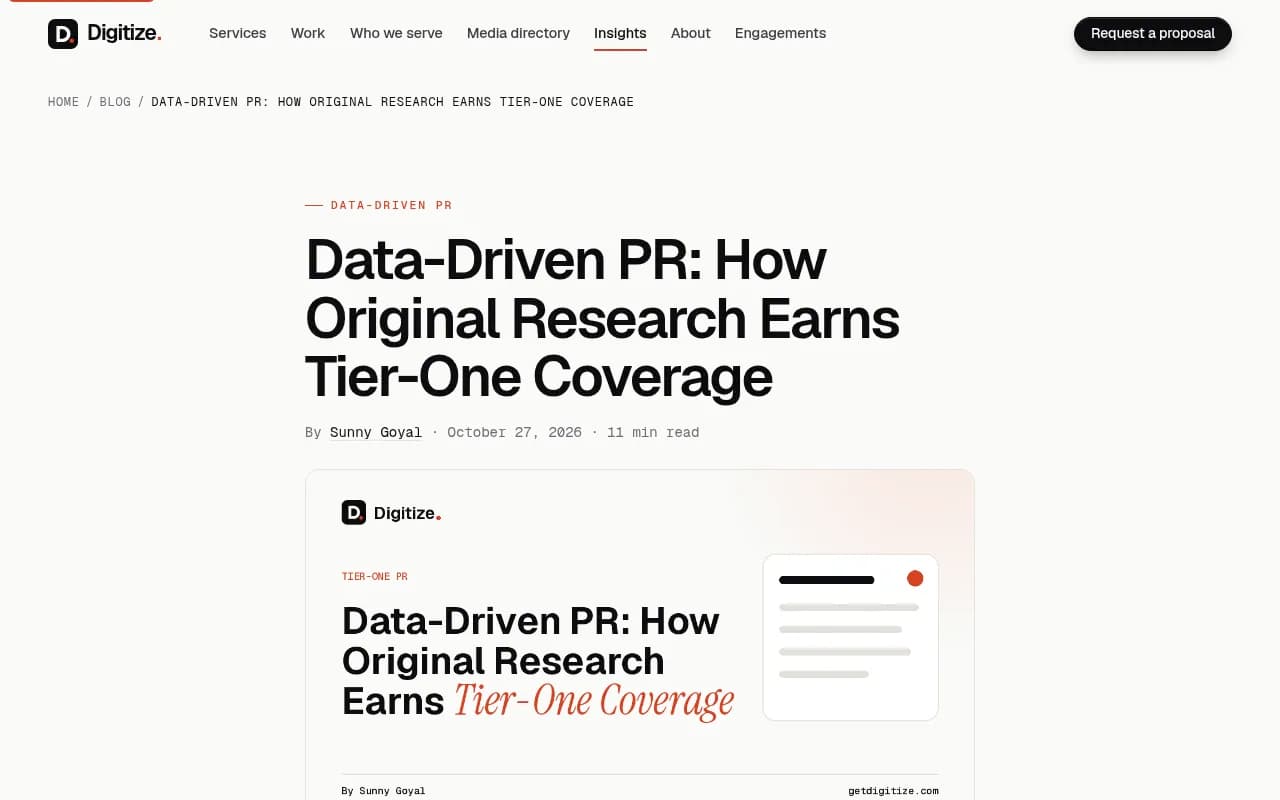
The journalist side is documented. Per Digitize's write-up of Muck Rack's State of Journalism 2026, 40% of journalists say original data or research is among the things they value most in a pitch, and 86% say at least some of their stories begin with a PR pitch. The same piece cites Cision's 2025 State of the Media report, where 86% of journalists immediately reject pitches that don't fit their beat. So the research has to be relevant first and clever second.
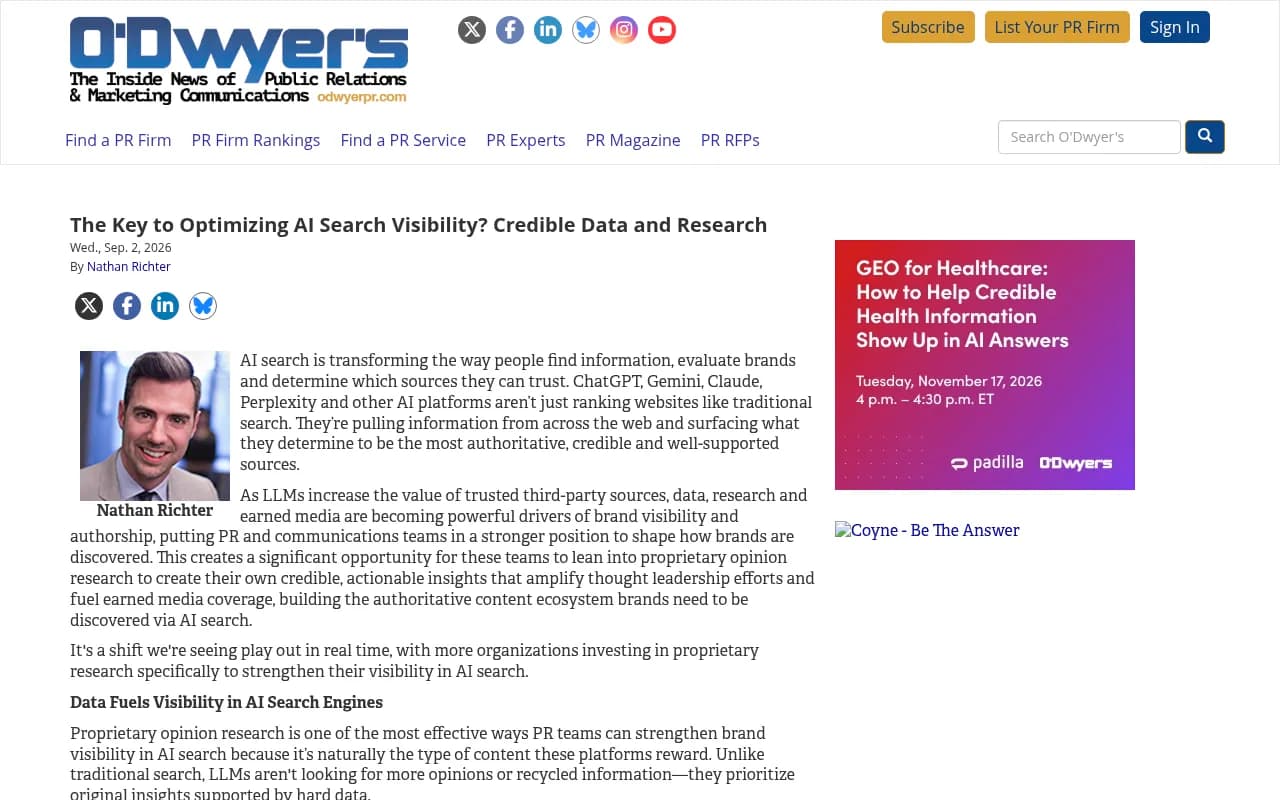
The AI side is newer but moving the same direction. O'Dwyer's PR News argued in September 2026 that as LLMs put more weight on trusted third-party sources, data, research, and earned media become drivers of brand visibility, which puts communications teams in a stronger position than they used to be.
I like this framing because it ends a tired turf war. PR, SEO, and content teams all want the same asset. A good study is one project that feeds backlinks, coverage, AI citations, and sales conversations.
What the 30-40% number actually says
You will see "original research gives a 30-40% AI visibility boost" in a lot of blog posts. Slow down on that one. The figure traces back to the 2024 Princeton paper on Generative Engine Optimization (KDD 2024). That paper tested content modifications, and found that adding statistics, quotations, and citations were among the most effective, with top methods improving visibility by 30-40% in its benchmark.
That is a result about how you write a page. It is not a measurement of what happens when you run a survey and publish it. The directional lesson still holds: models can extract and attribute specific data points more easily than vague narrative. Just don't put "30-40%" in a pitch deck as proof that research works.
Pick a question worth owning
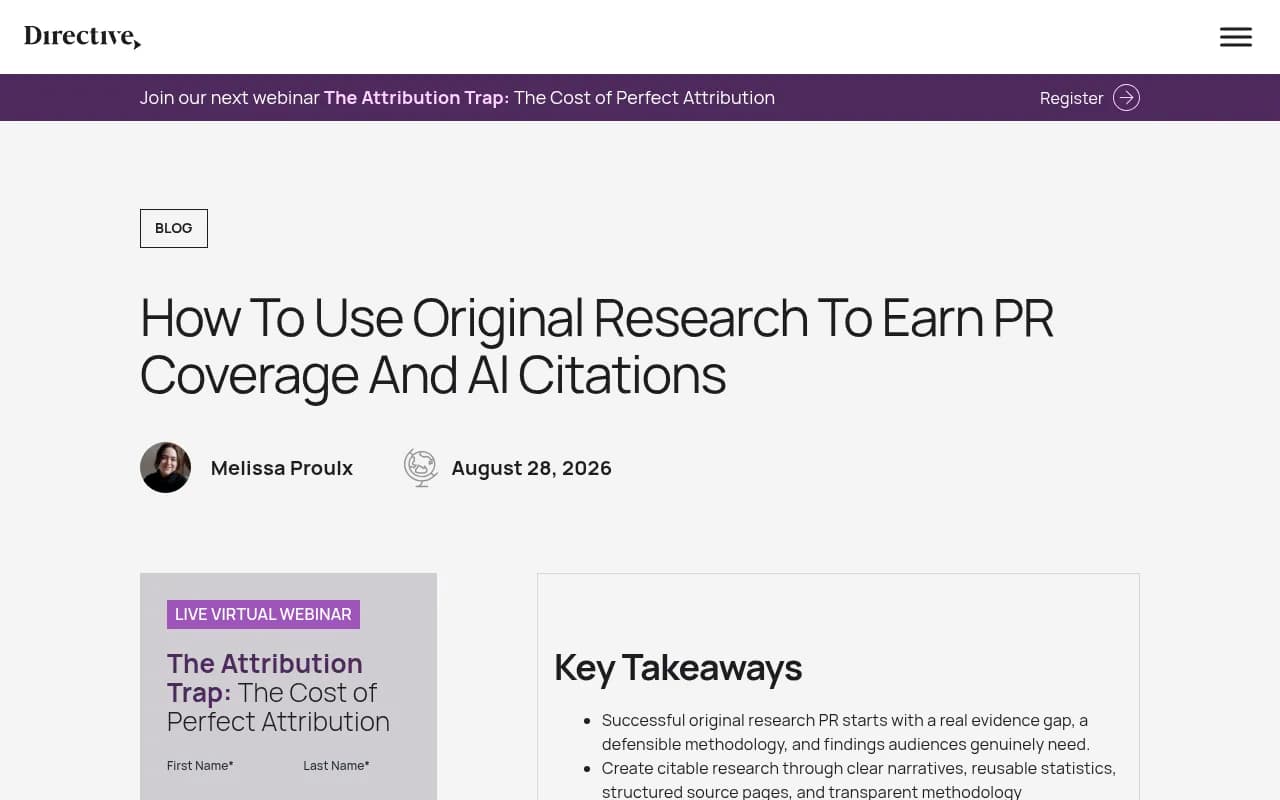
Most branded research fails before the first survey response comes in. It is built as a campaign asset, not a source. Directive's guide on this makes the point well: you want research designed for reuse, meaning a real evidence gap, a defensible method, and findings people keep coming back to.
Good places to look for a gap:
- Questions your sales team hears every week and cannot answer with a number
- Prompts buyers type into ChatGPT or Gemini where the cited sources are thin, outdated, or wrong
- Analyst reports and competitor studies with obvious holes
- Your own product or platform data, which nobody else can replicate
- Existing press coverage on your beat that repeats the same stale statistic
The filter I use: could a reporter write a headline from one number, and could only you have produced that number? If either answer is no, keep looking.
Proprietary data beats commissioned opinion polls
Surveys are fine and often necessary. But first-party data, like aggregated platform usage, citations you have tracked, or benchmarks from your customer base, is harder to copy and easier to defend. Promptwatch Data is a good example of the model. Its public reports are built from the company's own tracking of citations and crawler activity, which is why other publications can cite them and why they work as a repeatable beat rather than a one-off.
No data team? The Subscribe PR piece on this topic suggests a simple rule that holds up whatever source you use: publish the method with the finding.
Design the study so it survives scrutiny
Digitize puts it bluntly: research has to be sound enough to survive an editor's scrutiny, specific enough to headline, and published openly so others can cite it for months. Three practical consequences.
Write the method before you collect data
Decide sample size, dates, geography, question wording, and how you will handle outliers. Then put all of it on the page. Reporters check this. Models also pick up on it, since a statement like "in a survey of 1,200 US marketers in September 2026" is a self-contained claim that can be lifted into an answer with its context intact.
Plan for several headline numbers, not one
One number gets one story. Five to eight distinct findings give you multiple pitches to different beats, plus a stack of individually quotable statistics for AI engines. Cut the data by industry, region, company size, and over time so each reporter can get a version relevant to them.
Date everything and commit to a refresh
AI engines are sensitive to freshness, and journalists distrust stale data. Put the collection period in the title or first paragraph, and decide now whether this is an annual or quarterly series. A recurring study becomes a source people return to, which is the whole point.
Build the hub page before you pitch anyone
Here is the part most PR teams get backwards. They spend weeks on the press release and an afternoon on the web page. The data says to flip that.
Promptwatch Data tracked every page ChatGPT cited on July 6, 2026 for 90 days, and published the results in its ChatGPT content half-life report. News pages decayed fastest: about a quarter were never cited again after day zero, half were gone after 36 days, and 41% were still cited at day 60. Landing pages and docs lasted longest, with 78% and 76% still cited after 30 days and 69% and 67% after 60.
The report does not measure research studies as a category, so treat the implication as inference. Press coverage of your study will behave like news: a quick spike. A durable, public landing page for the study behaves like the formats that last. That page is what you want models to find in month three.
What the hub page should contain
| Element | Why it matters |
|---|---|
| Dated title and summary with the top 3-5 findings | Gives models and reporters a self-contained answer |
| Each statistic in plain text, one per sentence | Easy to extract and attribute |
| Charts with text captions and alt text | Images alone are invisible to most crawlers |
| Full methodology section | Lets editors verify, lets models cite with context |
| Downloadable data (CSV) and embeddable charts | Encourages reuse and linking |
| Named author and company attribution | Makes the source unambiguous |
| Changelog or "last updated" date | Signals freshness for the refresh cycle |
Keep the study on one stable URL. Don't gate the findings behind a form. A PDF-only report is a bad idea, since it is harder to crawl and nobody links to a download button.
Where research sits among cited content types
Promptwatch Data's ChatGPT citation share by content type report (Sep 28 to Oct 4, 2026) found product pages at 22.4% of classified citations and landing pages at 16.8%, followed by listicles (13.6%), how-tos (8.7%), articles (6.1%), comparisons (5.9%), and news (5.7%). The report has no separate "research" category, so I will not claim studies are the most cited type. Depending on how you publish, a study would land under articles, news, or landing pages.
That is a reason to make the hub page work like a landing page for the topic: clear heading, direct claims, links to related product or service pages. And it is a reason to pair the study with the formats ChatGPT does cite heavily, such as comparisons and how-tos built on your findings.
Pitch for journalists first, then for models
The coverage matters twice. It earns links and credibility, and it creates third-party pages that AI engines treat as corroboration. Directive's framing is useful here: use PR to earn coverage, backlinks, attribution, and discoverability across media, search, and AI platforms at once.
A pitching sequence that works
- Build a target list by beat, not by outlet prestige. One reporter who covers your exact topic beats ten generalists.
- Lead with the finding, in one sentence, with the number. Link the hub page and offer the underlying data.
- Offer exclusives to one or two top-priority outlets, then release to everyone else with a short embargo.
- Give each reporter a cut of the data relevant to their region or sector.
- Offer a named spokesperson who can explain the method.
- Follow up once with a new angle, not a reminder.
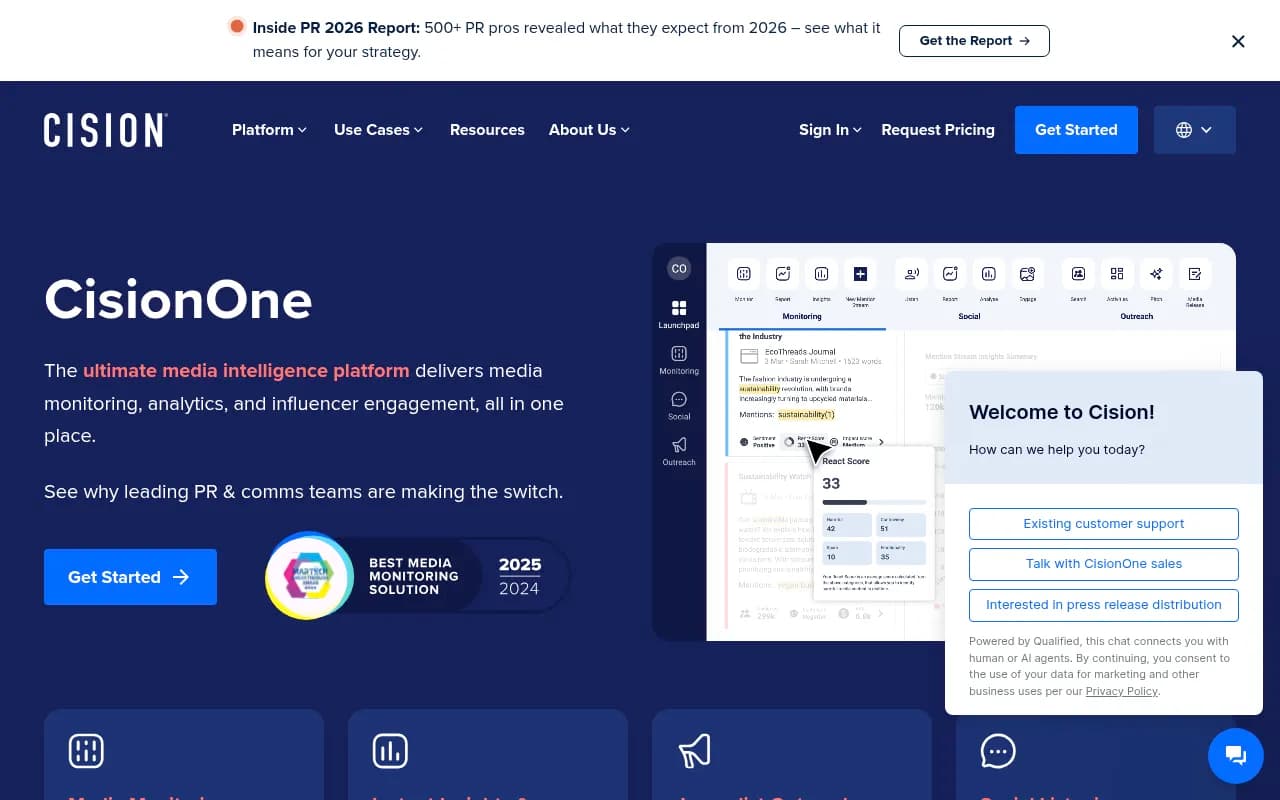
Tools in the PR and media category can help you find the right contacts and track pickups, such as CisionOne and Meltwater.
For researching what is already being said on your beat and what content earns shares, BuzzSumo is useful when scoping the evidence gap.
Collecting your own data without a research team
If you need survey data, platforms like SurveyMonkey and Qualtrics cover panel sourcing and basic analysis. Wynter is built for B2B buyer panels when you need responses from a specific ICP.
For charts that reporters can actually use, Tableau and Metabase both handle the analysis and visuals.
Extend the shelf life after launch week
A study that gets one news cycle and dies wasted most of its value. Here is how to keep it in circulation.
- Break it into spin-off pieces: one article per finding, each linking back to the hub page
- Publish a how-to or comparison that applies the data to a real decision, since those formats tend to stay cited
- Update the hub page when new data arrives and say so in a visible changelog
- Brief your executives and sales team so the numbers show up in podcasts, LinkedIn posts, and decks
- Re-pitch the data to new reporters when a related news event happens (newsjacking works well with a ready dataset)
If your content team is stretched, AI-assisted content tools can handle the derivative pieces, but the research itself needs human sign-off. Don't let a writing tool invent statistics. A single wrong number attributed to your study damages exactly the trust you are trying to build.
Make the study readable to AI crawlers
A great study that bots cannot read earns nothing. Check the basics:
- The hub page renders without JavaScript, or is served pre-rendered
- robots.txt does not block the AI crawlers you want, such as GPTBot, OAI-SearchBot, ClaudeBot, and PerplexityBot
- Key statistics sit in HTML text, not inside images or embedded iframes
- The page is in your sitemap and linked from relevant pages on your own site
Promptwatch has a free AI crawler URL inspector and a robots.txt generator for AI for the basics. Note that markdown files are not a shortcut: Promptwatch Data's markdown in AI search report found they make up just 0.05% of AI search citations.
Measure what the study actually did
Launch-week coverage count is the easy metric and the least informative one. Directive recommends measuring authority, commercial impact, and long-term reuse, and I agree. Track these in three layers.
Earned media and links
Pickups, referring domains, and whether outlets link to the hub page or to your homepage. A pickup without a link still helps, because AI engines can read an unlinked brand mention on a cited page. Mention-tracking tools can catch those.
AI citations and visibility
Track a fixed set of prompts that your study should influence, and watch whether your hub page or the coverage of it gets cited over the following weeks. Tools like Promptwatch do this across ChatGPT, Gemini, Perplexity, Google AI Overviews and others. Its Page Tracker lets you watch a specific URL and see which prompts and responses cite it, and its IP-verified crawler logs show whether AI bots are reading the page at all. That separates an access problem from a content problem.

Other trackers worth a look when comparing options include Profound, Otterly.AI, and Peec AI. For a broader list, the GEO software directory at bestgeosoftware.com is a good place to compare.
Profound

Otterly.AI


Traffic and pipeline
Use analytics to isolate AI-referred sessions and conversions, and ask new leads how they found you. Promptwatch's guide to attributing AI traffic covers the setup, including the fact that ChatGPT stopped sending a referrer on October 8, 2026, so tagging with utm_source=chatgpt.com matters. Google Analytics and Google Search Console fill in the rest.
| Layer | Metric | How to check |
|---|---|---|
| Earned media | Pickups, referring domains, link target | Media monitoring, backlink tool |
| AI search | Citations of hub page, mentions in answers, citation rank | AI visibility platform |
| Crawling | AI bot visits and errors on the hub page | Crawler logs or server logs |
| Traffic | AI-referred sessions and conversions | Analytics with UTM tagging |
| Pipeline | Leads that mention the study | CRM source fields, sales feedback |
Common mistakes
- Gating the data. Reporters and bots both skip it.
- Burying the method. If an editor cannot verify it in two minutes, they move on.
- One-and-done publishing. A study never updated loses its freshness advantage.
- Overclaiming. Don't say "studies show research gets cited most by AI" unless you can point to measurement. The evidence so far is directional.
- Ignoring the beat. Cision's finding that most journalists reject off-beat pitches applies to data stories as much as press releases.
- Skipping AI measurement. Without a baseline of prompts and citations before launch, you cannot show change after it.
A simple launch checklist
- Identify the evidence gap and confirm no one else owns the number.
- Write the method, collect the data, and sanity-check outliers.
- Draft five to eight headline findings with a cut for each target beat.
- Build the hub page with text statistics, captions, methodology, data download, and dated title.
- Confirm AI crawlers can read the page.
- Record a baseline of AI citations for related prompts.
- Pitch by beat with exclusives, then wide release.
- Publish spin-off articles and applied how-tos.
- Review citations, crawler visits, links, and leads at 30, 60, and 90 days.
- Schedule the next refresh before you forget.
Where an agency fits
If you do not have the people to run the study, the pitching, and the AI measurement together, that is a reasonable thing to outsource. 1001 SEO Media runs digital PR and generative engine optimization as one service, which suits research-led campaigns where coverage and AI citations have to be planned together.
The takeaway
Research is worth the effort because one project pays off in several places: press, links, AI answers, and sales conversations. But the payoff depends on the unglamorous parts, namely a defensible method, a durable hub page, and honest measurement. Build the page like it will be read in six months, because that is when the models will still be citing it.
For current numbers on how AI engines pick sources, browse the Promptwatch Data hub, and re-check before quoting, since the figures change month to month.