Key takeaways
- AI search (ChatGPT, Perplexity, Google AI Overviews) is now a real traffic and revenue channel for clients — but it requires different tracking and optimization than traditional SEO
- The core agency workflow is three steps: identify which prompts competitors appear for but your client doesn't, create content engineered to get cited, then track and report visibility improvements
- "Ranking" in ChatGPT is probabilistic, not positional — you're optimizing for citation frequency and brand mention rate, not a fixed #1 spot
- Most monitoring-only tools leave you stuck after step one; the platforms that also help with content creation and gap analysis are where agencies get real leverage
- Client reporting needs to translate AI visibility metrics into business outcomes — share of voice, citation growth, and traffic attribution are the three numbers that matter
One of their clients made £175K from ChatGPT in a 90-day window. The same brand made £13.9M from traditional SEO in the same period. Thomas Phillips, founder of DTC SEO Agency, shared those numbers on the D2C Diaries podcast, and his conclusion was blunt: AI search is real, but it's not replacing SEO fundamentals. It's adding a new layer on top of them.
That's the honest framing agencies need right now. ChatGPT is not a replacement channel. It's an emerging one with its own mechanics, its own metrics, and its own optimization levers — and clients are starting to ask about it whether you're ready or not.
This playbook is for agencies that want to get ahead of those questions, build repeatable workflows, and deliver reports that actually mean something.
Why AI search is now an agency deliverable
ChatGPT has over 400 million weekly active users as of early 2026. Perplexity is processing hundreds of millions of queries a month. Google's AI Overviews appear on a significant share of searches. These aren't beta features anymore — they're where a meaningful slice of your clients' potential customers are getting answers.
The problem is that AI search doesn't work like Google. There's no index you can check, no position 1 to aim for, no keyword density formula that guarantees inclusion. When someone asks ChatGPT "what's the best project management tool for construction teams?", the model draws on its training data, real-time web browsing (where enabled), and citation sources to generate an answer. Whether your client gets mentioned depends on how well their content is understood, cited, and associated with the right topics by these models.
That's a solvable problem. But it requires a different workflow than traditional SEO.
The three-step agency workflow for AI visibility
Step 1: Find the gaps
Before you can improve a client's AI visibility, you need to know where they stand. This means running a structured set of prompts across the AI engines your client's customers actually use — ChatGPT, Perplexity, Google AI Overviews, Gemini — and recording when and how the client appears.
The specific prompts matter a lot. You want to test:
- Category-level queries ("best [product category] for [use case]")
- Comparison queries ("X vs Y")
- Problem-based queries ("how do I solve [specific problem]")
- Brand-specific queries (to check accuracy and sentiment)
The gap analysis is where you identify which of these prompts competitors are appearing for but your client isn't. That's your content roadmap.
Promptwatch has an Answer Gap Analysis feature built specifically for this — it shows you the exact prompts where competitors are visible and you're not, so you're not guessing at what to create.

Step 2: Create content that gets cited
Here's the thing most agencies miss: AI models don't cite pages because they're well-optimized for keywords. They cite pages because those pages are the clearest, most authoritative answer to a specific question. The content requirements are different.
What tends to get cited:
- Direct, specific answers to the exact question being asked (not buried in a 3,000-word article)
- Content that establishes clear entity associations (your client's brand connected to specific topics, use cases, and categories)
- Third-party mentions and citations (Reddit discussions, review sites, industry publications that reference your client)
- Structured content — comparison tables, numbered lists, FAQ sections — that AI models can easily extract
The backlink and credibility fundamentals still apply. Phillips made this point clearly: the strategy behind ranking in ChatGPT and ranking in Google is "almost identical." Entity trust, content depth, and digital PR are the levers. AI has just added new surfaces where that authority gets expressed.
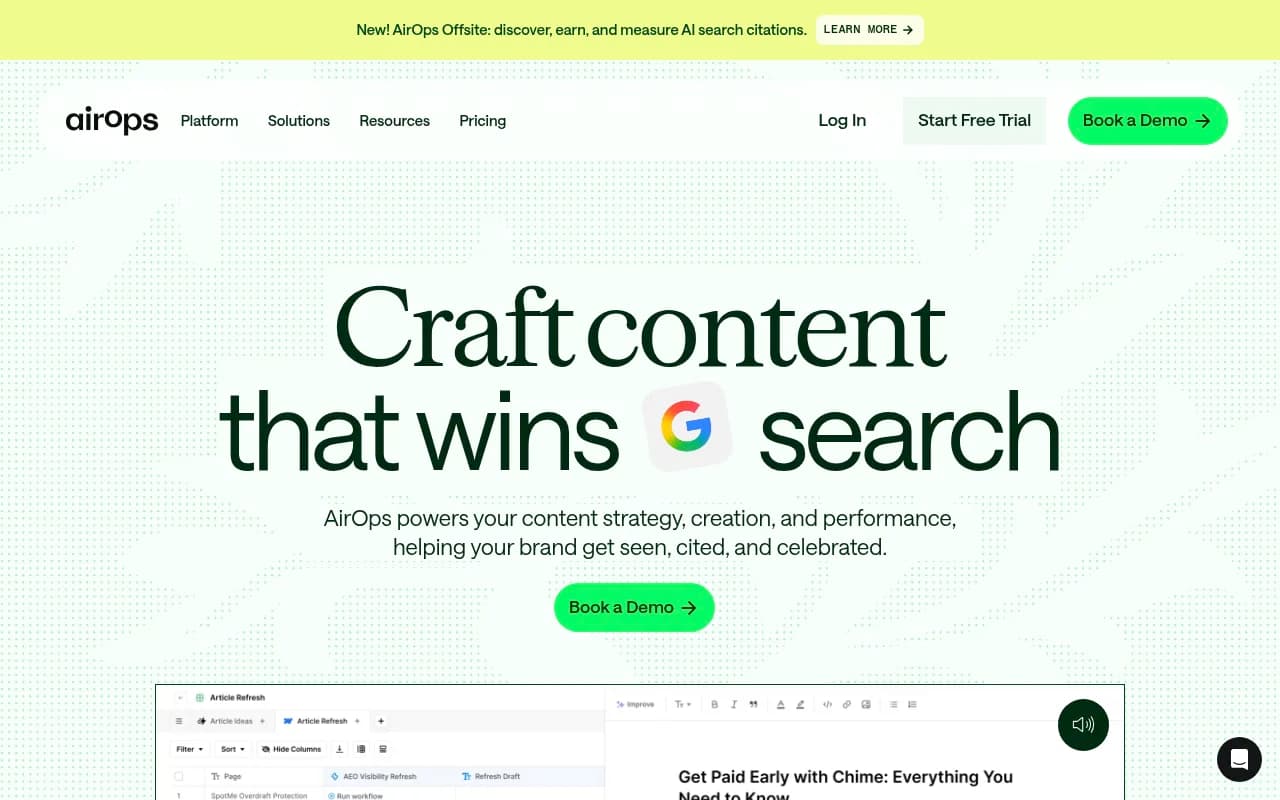
For content creation at scale, tools like AirOps help agencies build content workflows grounded in citation data rather than generic SEO templates.
Step 3: Track and report
This is where most agencies currently have a gap. They can see that a client's website traffic is changing, but they can't attribute it to AI search specifically or show which AI engines are driving it.
The metrics that matter for client reporting:
- Brand mention rate: What percentage of relevant prompts include the client's brand in the response?
- Share of voice: How does the client's mention rate compare to named competitors across the same prompt set?
- Citation frequency: Which specific pages are being cited, and how often?
- Traffic attribution: Is AI search driving actual sessions and conversions?
The last one is the hardest. Most AI engines don't pass referrer data cleanly, so you need either a code snippet on the client's site, Google Search Console integration, or server log analysis to connect AI visibility to actual traffic.
Tools for agency AI visibility work
The market for AI visibility tools has expanded fast. Here's how to think about the categories:
Monitoring platforms
These track brand mentions across AI engines and give you the share-of-voice data you need for client reporting.
Otterly.AI is a solid entry point for agencies getting started — it covers ChatGPT, Perplexity, and Google AI Overviews with clean reporting.
Otterly.AI

Peec AI offers similar monitoring with a straightforward interface, good for clients who want a self-serve dashboard.

Rankshift tracks brand visibility across ChatGPT, Perplexity, and other AI search engines with a focus on competitive benchmarking.

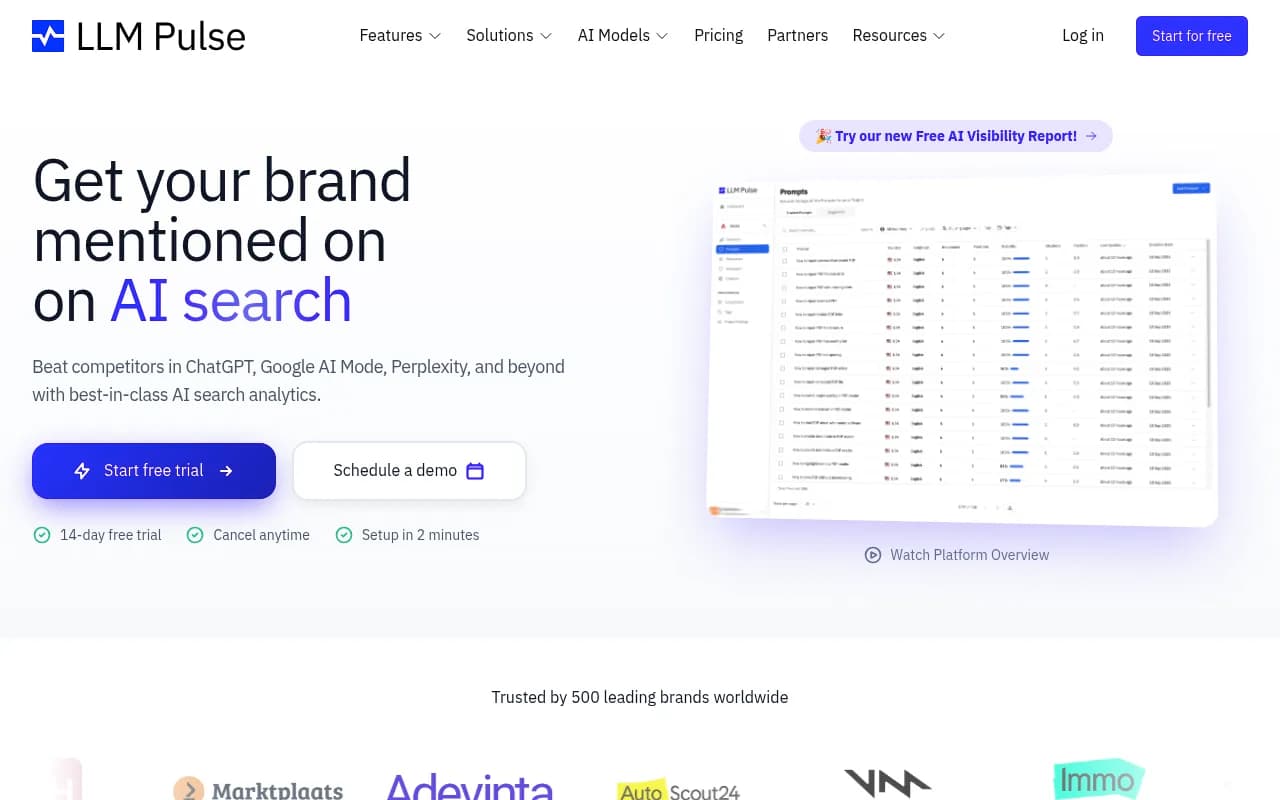
LLM Pulse is worth looking at for agencies that need to track across a wider range of models including DeepSeek and Mistral.
Full-cycle optimization platforms
The monitoring-only tools give you data but leave the "what do we do about it" question unanswered. If you want a platform that helps with gap analysis, content creation, and tracking in one place, the options are narrower.
Promptwatch covers the full loop: gap analysis, built-in AI content generation grounded in citation data, page-level tracking, AI crawler logs, and traffic attribution. For agencies managing multiple clients, the multi-site support and white-label reporting options are practical.
Profound is another enterprise-tier option with strong monitoring capabilities, though it's priced for larger clients.
Profound

AthenaHQ has good tracking but is more monitoring-focused — it doesn't have the content generation side.

Content creation tools
For the content production side of the workflow, a few tools are worth having in the stack:
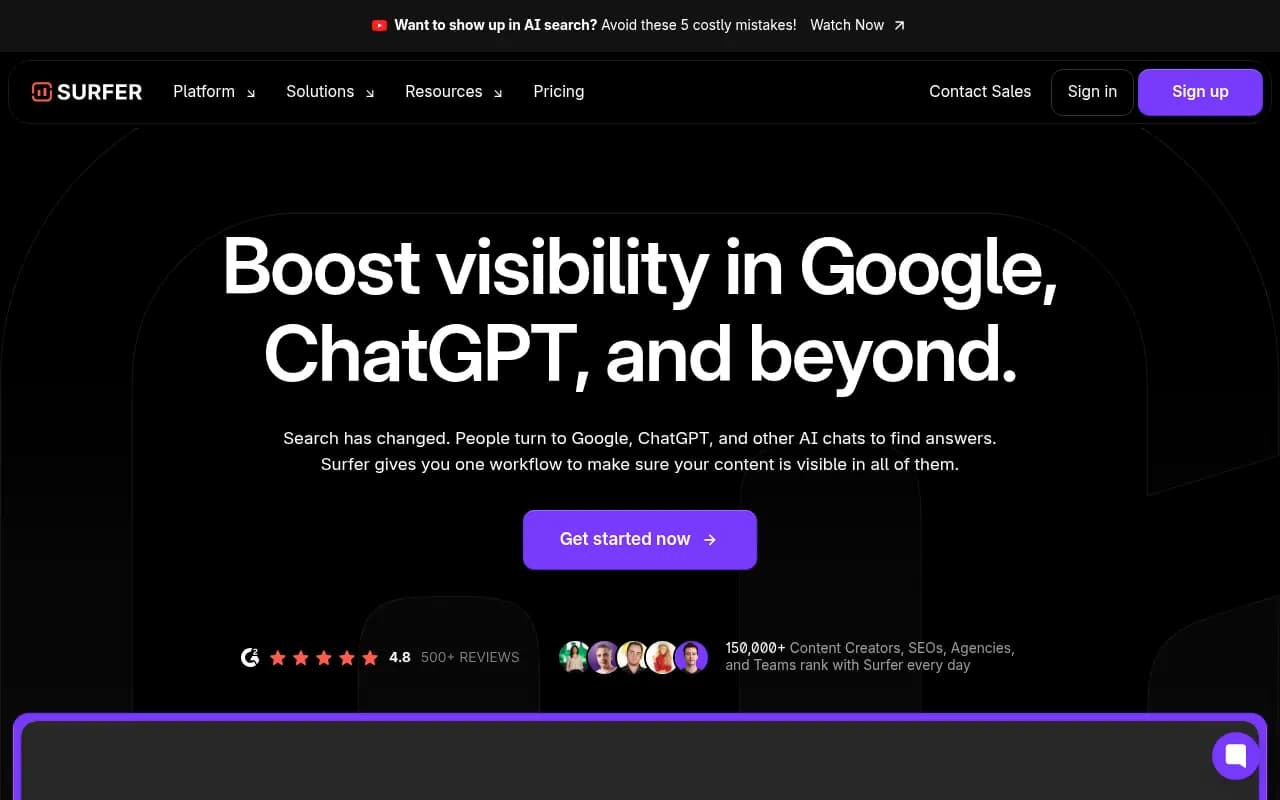
Surfer SEO remains useful for content briefs that need to satisfy both traditional search and AI citation requirements — the content scoring aligns well with what AI models want to cite.
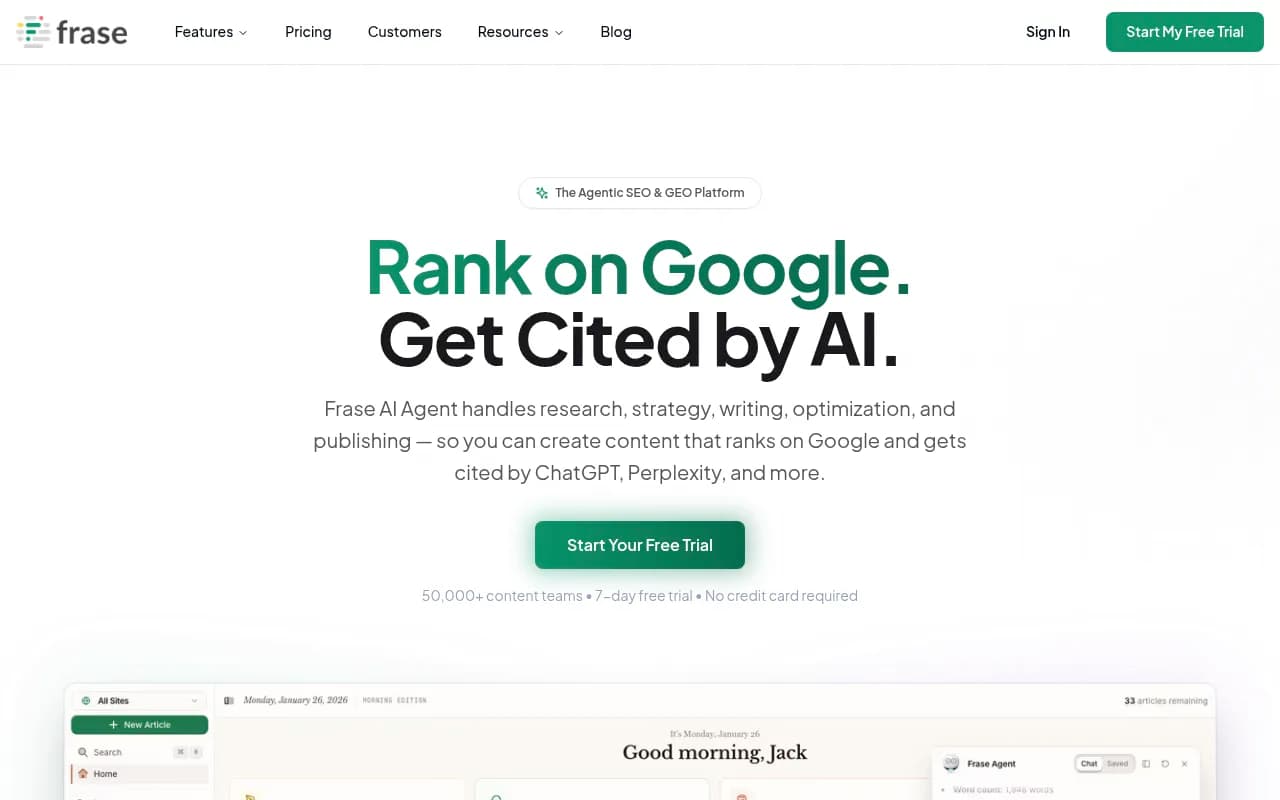
Frase is good for research-heavy content, especially when you need to quickly understand what sources are currently being cited for a topic.
MarketMuse helps with topic modeling and content gap analysis at the site level, which complements the prompt-level gap analysis from AI visibility tools.
Comparison: AI visibility tools for agencies
| Tool | Monitoring | Gap analysis | Content generation | Crawler logs | Traffic attribution | Agency features | Starting price |
|---|---|---|---|---|---|---|---|
| Promptwatch | Yes (10 models) | Yes | Yes | Yes | Yes | Multi-site, white-label | $99/mo |
| Profound | Yes (9+ models) | Limited | No | No | No | Yes | Higher |
| Otterly.AI | Yes | No | No | No | No | Basic | Lower |
| Peec AI | Yes | No | No | No | No | Basic | Lower |
| AthenaHQ | Yes | Limited | No | No | No | Yes | Mid |
| Rankshift | Yes | No | No | No | No | Basic | Lower |
The pattern is clear: most tools stop at monitoring. If you want to actually move the needle for clients — not just report on where they stand — you need a platform that helps you identify what to create and then tracks whether it worked.
Building a repeatable agency workflow
Here's how to structure this as a repeatable monthly process for each client:
Month 1: Baseline and audit
- Define a prompt library of 30-50 queries relevant to the client's category, use cases, and competitors
- Run the prompts across ChatGPT, Perplexity, and Google AI Overviews (minimum)
- Record mention rate, share of voice vs named competitors, and which pages (if any) are being cited
- Identify the top 10 gap prompts — high-volume queries where competitors appear but the client doesn't
This baseline becomes your benchmark for all future reporting.
Ongoing: Monthly optimization cycle
Each month:
- Run the full prompt library again and compare to baseline
- Identify new gaps that have emerged (competitors publishing new content, new query patterns)
- Publish 2-4 pieces of content targeting the highest-priority gaps
- Check AI crawler logs to confirm new content is being discovered and indexed by AI engines
- Update the client report with visibility trends
The content you publish doesn't need to be long. A focused 600-word FAQ page that directly answers a specific question often outperforms a 3,000-word pillar post for AI citation purposes. Structure matters more than length.
Quarterly: Strategy review
Every quarter, do a deeper competitive analysis:
- Which competitors have gained visibility and why?
- Are there new AI engines worth tracking for this client's audience?
- Is the traffic attribution showing actual conversions from AI-referred sessions?
- What's the ROI story for the client?
Client reporting that actually lands
The biggest challenge agencies face is translating AI visibility metrics into terms clients care about. "Your brand mention rate increased from 23% to 41%" is accurate but abstract. Here's how to make it concrete:
Frame share of voice competitively. Clients respond to "you're now mentioned in 41% of relevant AI responses, up from 23%, while Competitor X dropped from 55% to 48%" much better than raw numbers. It tells a story about market position.
Connect visibility to traffic. Even rough attribution helps. If you can show that sessions from AI referrers (Perplexity, ChatGPT with browsing, etc.) increased 60% in the same period visibility improved, the case for continued investment is obvious.
Show the content-to-citation pipeline. When a specific piece of content you created starts getting cited in AI responses, document it. "This article we published in March is now cited in 34% of ChatGPT responses to [query]" is a concrete proof point that the work is working.
Use the right benchmarks. AI visibility is still early enough that even modest improvements are significant. A client going from 0% mention rate to 20% on a high-volume query category is a real win — frame it that way.
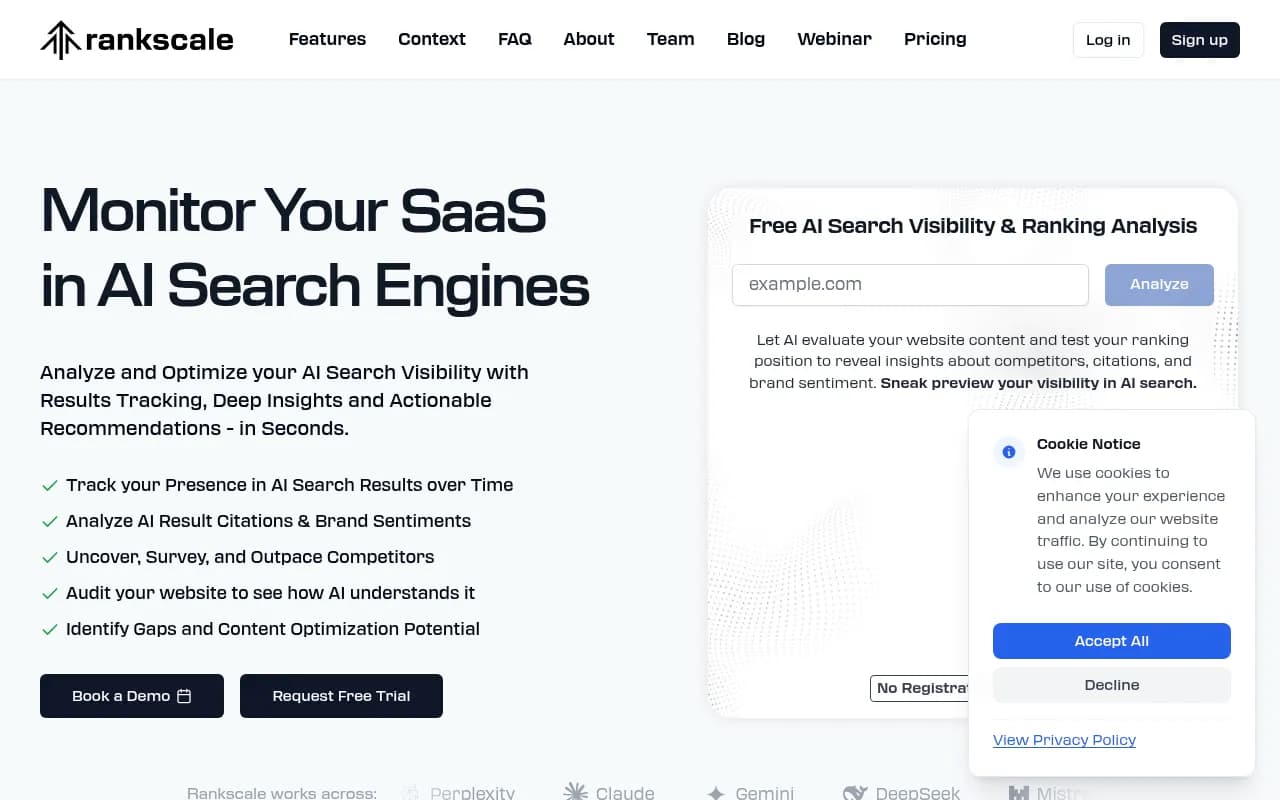
For agencies that want a structured reporting template, Rankscale is built specifically for agency-style AI visibility reporting with client-ready exports.
The technical side agencies often skip
Two technical factors that significantly affect AI visibility and are easy to overlook:
AI crawler access. If a client's robots.txt is blocking GPTBot, ClaudeBot, or PerplexityBot, the AI engines literally can't read their content. Check this first. It's a five-minute fix that can have an outsized impact.
Page rendering. Many AI crawlers struggle with JavaScript-heavy pages. If a client's key pages are rendered client-side, the crawlers may be seeing a blank page. Tools like Screaming Frog can help you audit this quickly.
Structured data. Schema markup (FAQ schema, HowTo schema, Article schema) helps AI models understand and extract content from pages. It's not a magic bullet, but it reduces friction for the models trying to parse what a page is about.
Pricing and packaging for clients
A few practical notes on how to package AI visibility work:
Most agencies are adding AI visibility as a module on top of existing SEO retainers rather than selling it as a standalone service. A typical add-on structure looks like:
- Monitoring and monthly reporting: $500-1,500/month depending on the number of prompts and engines tracked
- Optimization (gap analysis + content creation): $2,000-5,000/month depending on content volume
- Full-service (monitoring + optimization + attribution): $3,500-8,000/month for mid-market clients
The tool costs are manageable. Promptwatch's Professional plan at $249/month covers 2 sites with 150 prompts and 15 articles — enough for a mid-sized client. The Business plan at $579/month covers 5 sites, which works for agencies managing multiple accounts under one subscription.
The margin on AI visibility work is currently strong because the supply of agencies that can actually do it well is limited. That won't last forever, but right now there's a real first-mover advantage for agencies that build the capability.
Where to start
If you're building this capability from scratch, the sequence that makes sense:
- Pick one client where AI visibility is clearly relevant (B2B SaaS, e-commerce with considered purchases, professional services)
- Set up monitoring with a tool like Promptwatch or Otterly.AI and run a baseline audit
- Identify 3-5 high-priority gap prompts and create targeted content for each
- Track for 60-90 days and document what moves
- Package that case study and use it to sell the capability to other clients
The fundamentals — good content, clear entity associations, credible third-party mentions — are the same ones that have always driven search visibility. AI search has just added new surfaces where that authority gets expressed, and new tools to measure it.
The agencies that build this workflow now will have a significant advantage when every client starts asking about it in 12 months. Most already are.