Key takeaways
- Most teams need both. Google and Bing still send the traffic that pays the bills, while ChatGPT, AI Overviews and Perplexity increasingly shape which brands get shortlisted.
- "AI SEO tools" is three different categories: AI-assisted content tools, AI visibility (GEO) platforms, and classic suites that bolted on AI tracking. Roundups often blur them.
- Traditional tools answer "where do I rank?" AI visibility tools answer "am I mentioned, cited and clicked inside AI answers?"
- Backlink and domain-authority metrics matter less for AI citations than you might expect. In Promptwatch Data, mid-authority sites earned most of ChatGPT's citations.
- A lean stack: Search Console plus one crawler plus one rank/research suite, then one AI visibility platform that also helps you fix gaps.
The confusion at the heart of this question
Search "AI SEO tools" and you get lists that put Semrush, Surfer, Ahrefs, Clearscope, Frase and ChatGPT side by side. Darkroom's 2026 roundup does exactly this. It is not wrong, but it hides the real question, because those tools do very different jobs.

So before asking whether you need both, define both. I split the market into three buckets.
| Category | Core question | Examples | Replaces traditional tools? |
|---|---|---|---|
| Traditional SEO suites and crawlers | Where do I rank, who links to me, what is broken? | Ahrefs, Semrush, Moz Pro, Screaming Frog, Google Search Console | n/a |
| AI-assisted SEO content tools | How do I write and optimize a page faster? | Surfer SEO, Clearscope, Frase, NeuronWriter | No, they sit on top of SERP data |
| AI visibility (GEO) platforms | Do AI engines mention, cite and send traffic to me? | Promptwatch, Profound, Otterly.AI, Peec AI | No, they cover a different surface |
The first bucket measures a ranked list of links. The third measures a synthesized answer. Different outputs, different measurement.
What traditional SEO tools still do better
I will say it plainly: nothing in the AI visibility category replaces a decent crawler, a backlink index or Search Console. They do jobs AI tools don't try to do.
Keyword research and rank tracking
Volume, difficulty and SERP positions are still the cleanest demand signal available. Ahrefs, Semrush and SE Ranking handle this well, and cheaper options like Mangools or Ubersuggest cover small sites.
Technical auditing
Broken links, redirect chains, canonical errors, slow pages. If your site can't be crawled and rendered, nothing else matters, including AI citations. Screaming Frog, Sitebulb and Lumar remain the workhorses here.

First-party search data
Google Search Console and Bing Webmaster Tools are free and are the only source of your actual impressions and clicks. Keep them in the stack regardless of budget.
Backlinks
Links still influence Google rankings, so link indexes from Ahrefs, Majestic and Semrush keep their value for classic SEO work. For AI citations, the picture is different, as covered below.
What AI visibility tools measure that classic tools can't
A rank tracker has no concept of "the brand was named third in a ChatGPT answer, cited from a competitor's comparison page." That is the gap AI visibility platforms fill.
The typical capabilities:
- Prompt tracking across ChatGPT, Perplexity, Gemini, Google AI Overviews and others, with mention rate, position and sentiment
- Citation analysis showing which URLs AI engines pull from, yours or third parties'
- Competitor share of voice inside answers
- AI crawler visibility (which bots hit your site and what they hit)
- Traffic attribution from AI platforms
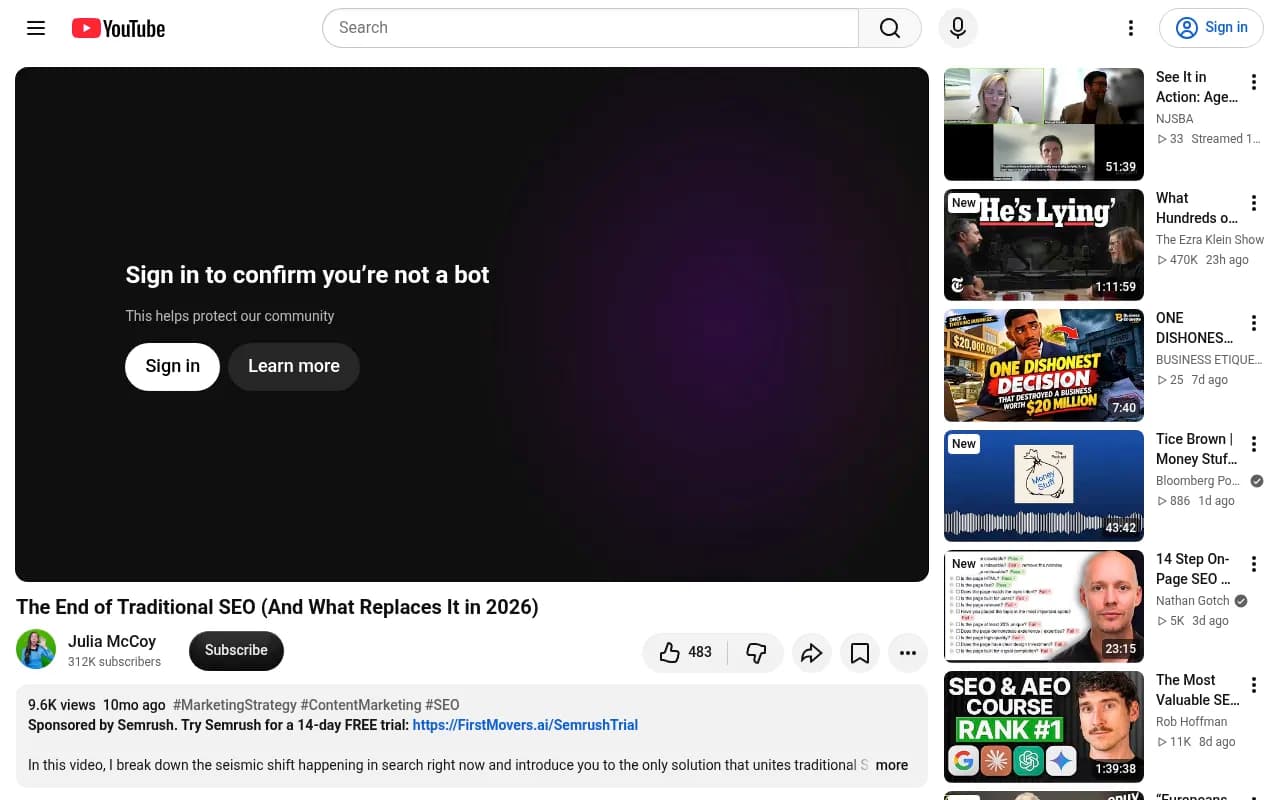
The measurement unit changes. As the Julia McCoy video puts it, monitoring prompts matters more than tracking keywords. Note that video is sponsored by Semrush and carries affiliate links, so treat its framing as promotional. The underlying point still holds up.
Why the data differs from classic SEO
AI answers vary by model, country, and even by day. ChatGPT also fans a single prompt out into several web searches. According to Promptwatch's ChatGPT query fanout data, searches per response sat around 2.15 in early December 2025 and eased to about 1.84 by early March 2026, while average query length shortened from roughly 117 characters to the high 80s. Those are searches you never see in a keyword tool, and they reward headings that read like short, focused queries.
And behavior shifts without warning. Promptwatch Data found ChatGPT began using the site: operator at scale on August 8, 2026, jumping from about 0.4% to about 17% of fanout queries overnight. Meanwhile Reddit's share of ChatGPT citations fell from roughly 4% to 0.5% on August 14, 2026. A static keyword playbook doesn't survive that kind of change, so you need ongoing measurement.
Where the two worlds disagree
This is the part most "you need both" articles skip. The signals that predict success are not identical.
Authority metrics
SEO tools sell domain rating and authority scores. In August 2026, sites with domain rank 46 to 75 earned almost half of ChatGPT citations, while DR 91 to 100 fell to about 3%. A mid-sized site with a strong, specific page can get cited over a giant. That doesn't make links worthless, but it does mean a backlink-first strategy is a weaker bet for AI visibility.
Content types
Listicles and blog posts dominate classic SEO advice. For ChatGPT, Promptwatch Data from Sep 28 to Oct 4, 2026 shows product pages at 22.4% of citations and landing pages at 16.8%, together about 39%. Listicles were 13.6%, how-tos 8.7%, comparisons 5.9%. For commercial prompts like "best CRM for small businesses", product pages, landing pages, listicles and comparisons made up almost 70% of citations.
So your money pages matter more for AI than traditional content-marketing instincts suggest.
Social and community sources
In the same period, ChatGPT drew just 0.46% of citations from social platforms, while Google AI Overviews drew 12.2%. YouTube alone was 4.28% in AI Overviews. A single community strategy won't work across engines. This is exactly the kind of per-engine nuance that a classic suite can't show you.
Formats that don't matter
If you have been told to ship markdown files for AI: markdown made up only 0.05% of AI search citations. It serves agents, not AI search.
Do you really need both? It depends on who you are
| Situation | Traditional tools | AI visibility tools | Verdict |
|---|---|---|---|
| Local service business, small budget | Yes (Search Console, a basic suite) | Free scan or a cheap tier | Mostly traditional, spot-check AI |
| B2B SaaS, content-led | Yes | Yes | Both, with AI tracking early |
| Ecommerce | Yes | Yes, plus shopping visibility | Both |
| Publisher or media | Yes | Yes, citations and referrals | Both |
| Agency | Yes | Yes, with white-label reports | Both |
| Developer tool or API | Yes | Yes, including coding-agent recommendations | Both |
PBJ Marketing's view is that traditional SEO can survive alongside AI tools but will hit growth problems long term. Semrush says you need both, which is a vendor position, though I agree with the conclusion. The honest caveat: the research I pulled contains no independent study of how much AI referral traffic converts versus organic, so don't let anyone sell you a precise ROI number. Measure your own.
The AI content tools question
Surfer, Clearscope, Frase, MarketMuse and NeuronWriter help you write pages that cover a topic the way top results do. They are useful, but they optimize against Google's SERP, not against AI answers. Treat them as content workflow tools, and judge them separately from visibility tracking.

Pure content generators (Jasper, Copy.ai, Writesonic) have a different limit: they don't know what AI engines currently cite, so they write without a target. Grounding them in citation data is what turns volume into results.
Choosing an AI visibility platform
This is the newest category and the one with the widest quality gap. Many tools stop at "were you mentioned?" A few go further. What I would check:
- Does it monitor real interfaces or only APIs? User-facing answers can differ from API outputs.
- Does it show why you aren't cited (crawler logs, site audits), not just that you aren't?
- Does it connect to traffic, so you can see visits and conversions from AI platforms?
- Does it help fix the gap, with content briefs or drafts, or leave you with a dashboard?
- Is the pricing per response sensible at your volume?
Promptwatch is the one we use at 1001 SEO Media and recommend most, mainly because it covers that whole checklist: real-UI tracking across ChatGPT, AI Overviews, Gemini, Perplexity and more, IP-verified AI crawler logs, AI traffic analytics, and a Content Agent plus Action Board that turn gaps into published content. Plans start at $95/month with a free tier, but confirm at promptwatch.com/pricing.

How the main options compare:
| Tool | Type | Strength | Gap |
|---|---|---|---|
| Promptwatch | AI visibility and optimization | Tracking, crawler logs, traffic, content creation and publishing | More to learn than a simple tracker |
| Profound | Enterprise AI visibility | Deep monitoring | Higher price, monitoring-centered |
| Otterly.AI | Prompt tracker | Easy to start | Light on crawler logs and content |
| Peec AI | Prompt tracker | Clean reporting | Monitoring-focused |
| Semrush AI Toolkit | Suite add-on | One login with SEO data | Fixed prompt sets, shallower AI data |
| Ahrefs Brand Radar | Suite add-on | Pairs with Ahrefs data | Shallower AI-specific data |
Profound

Otterly.AI



If you are already a Semrush or Ahrefs customer, their AI add-ons are a reasonable first step, since you avoid another login. Just know you are trading depth for convenience. To browse the wider field, the GEO software directory lists dozens of options.
A practical stack at three budgets
Lean (under about $150/month)
- Google Search Console and Bing Webmaster Tools (free)
- Screaming Frog free tier or SiteGuru for audits
- Mangools or SE Ranking for keywords and ranks
- Promptwatch's free tier or its free AI visibility report for a baseline
Mid-size team
- Ahrefs or Semrush for research, links and rank tracking
- Sitebulb or Screaming Frog for technical work
- Surfer or Clearscope if you publish a lot
- A paid AI visibility platform with crawler logs and traffic attribution
Agency or enterprise
- Enterprise suite (seoClarity, BrightEdge, Botify) for scale
- A GEO platform with white-label reporting and multi-region tracking
- Reporting tool such as Whatagraph or Looker Studio to unify both views
If hiring beats tooling for you, a specialist agency can run both tracks. 1001 SEO Media combines technical SEO and GEO work, but only go that way if you'd otherwise have nobody owning the work.
How to run both without doubling the workload
The good news is the work overlaps more than the tool lists suggest.
- Fix the foundation once. Crawlability, clean architecture, fast pages and accurate structured data help Google and AI crawlers alike.
- Check AI crawler access. Make sure robots.txt and your CDN aren't blocking the bots you want. Server logs tell you the truth here.
- Map prompts to pages. Take the prompts AI answers for your category, and see which of your pages should be the cited source. Write headings that read like short queries.
- Prioritize money pages. Product, landing and comparison pages carry the largest citation share, so audit those first.
- Reuse research. Keyword tools and AI prompt data reinforce each other. Search Console queries make good seed prompts.
- Report once. Put organic clicks and AI-referred sessions in the same dashboard so stakeholders see one channel story.
- Re-audit after model updates. Citation behavior moves. Promptwatch Data recorded a drop in citations per response around the GPT-5.3 rollout on March 4, 2026. Quarterly checks aren't enough.
Mistakes I see teams make
- Buying an AI visibility tool and never acting on it. A dashboard of mentions doesn't change anything by itself.
- Cancelling traditional tools because "SEO is dead." Google traffic hasn't vanished, and the technical base feeds both channels.
- Judging AI writing tools as visibility tools. They are different categories.
- Chasing one engine's quirks. Reddit tactics that worked in ChatGPT last spring were mostly irrelevant by August.
- Treating vendor claims as proof. Case-study percentages in sponsored content, like a 429% AI referral lift, are unverified. Test on your own data.
Bottom line
Keep your traditional tools for what they measure well: demand, rankings, links and technical health. Add one AI visibility platform for what they can't see: mentions, citations, crawler behavior and AI-driven traffic. Skip the overlap, resist the urge to buy five trackers, and put the saved budget into fixing the pages that AI engines should be citing. For more options in each category, the directories at surferstack.com and ai-rank-tools.com are good places to compare. Pricing and features change quickly, so confirm current details on each vendor's site before you commit.