Intercom Review 2026
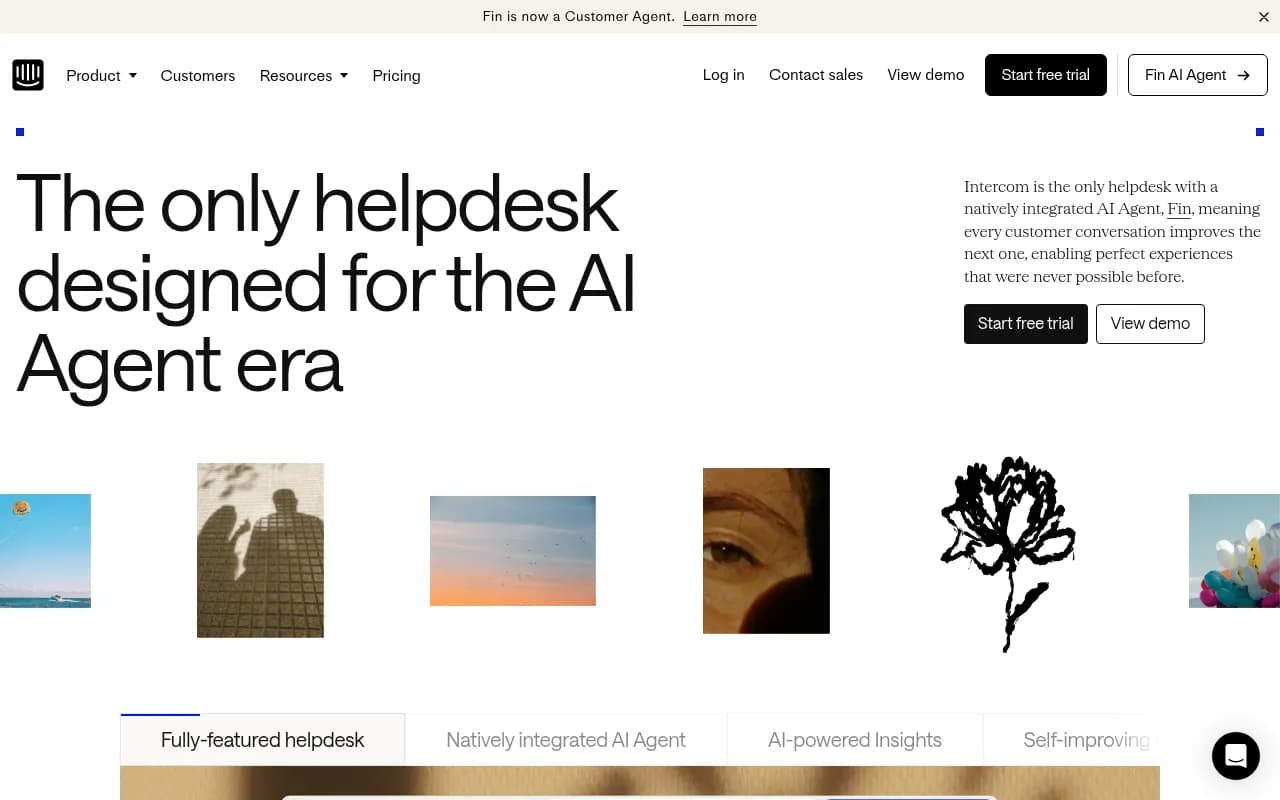
Intercom is an AI-native customer service platform combining a full helpdesk with Fin, its natively integrated AI agent. Built for SaaS, e-commerce, and tech companies, it handles omnichannel support, automated ticketing, proactive engagement, and AI-powered QA in one unified workspace.
Key takeaways
- Intercom is one of the most complete AI-first customer service platforms available in 2026, combining a full helpdesk, AI agent (Fin), agent Copilot, and QA tooling in a single product.
- Pricing starts at $29/seat/month (billed annually) plus $0.99 per AI-resolved outcome -- the per-outcome model is cost-effective at scale but can surprise teams with unpredictable monthly bills.
- The native integration between Fin and the human agent workspace is genuinely differentiated: shared customer records, seamless handoffs, and a self-improving feedback loop between AI and human reps.
- Best suited to mid-market SaaS, fintech, and e-commerce companies with 5-200 support agents who want to reduce ticket volume without sacrificing quality.
- Smaller teams or those with simple support needs may find the pricing complexity and feature depth overkill compared to lighter alternatives like Freshdesk or Help Scout.
Intercom has been around since 2011, founded in San Francisco (now headquartered in Dublin) by Eoghan McCabe, Des Traynor, Ciaran Lee, and David Barrett. It started as a simple in-app messaging tool and spent years building out a full customer communications platform. The pivot that matters most right now happened around 2023-2024, when Intercom went all-in on AI with the launch of Fin, its proprietary AI agent. By 2026, Fin is no longer a bolt-on chatbot -- it's the centerpiece of the entire product, and Intercom has repositioned itself as "the only helpdesk designed for the AI Agent era."
That's a bold claim, but it's not entirely marketing fluff. What separates Intercom from most AI-enhanced helpdesks is that Fin and the human agent workspace share the same data layer. There's no separate AI product talking to a separate ticketing system through a fragile API bridge. The customer record, conversation history, behavioral data, and knowledge base are all unified, which means Fin can actually do useful things like check order status, escalate with full context, and learn from how your best human agents handle edge cases.
The target audience is primarily tech-forward companies -- SaaS businesses, fintech apps, e-commerce platforms, and consumer apps -- that are dealing with high conversation volumes and want to automate a significant chunk of them without building their own AI infrastructure. Intercom's customer list includes Anthropic, Clay, Lightspeed, Rocket Money, and Gamma, which tells you something about the profile: fast-growing companies with technically sophisticated support teams.
Key features
Fin AI Agent is the headline feature and the one Intercom has invested most heavily in. Fin handles customer queries end-to-end -- it reads your knowledge base, pulls from connected data sources, takes actions via integrations, and resolves conversations without human involvement. The key differentiator here is that Fin is trained on your specific content and customer data, not just generic LLM knowledge. It can be deployed across chat, email, and other channels. Pricing for Fin is outcome-based: you pay $0.99 per resolved conversation, which aligns incentives well (you only pay when it actually works) but requires careful monitoring to avoid bill shock.
Copilot is the AI assistant for human agents. It sits inside the agent workspace and does things like surface relevant knowledge base articles mid-conversation, draft reply suggestions, summarize long conversation threads, and pull context from past interactions. Lightspeed reported that agents using Copilot closed 31% more conversations per day in testing -- that's a meaningful productivity number. Copilot is included in the base plan rather than priced separately, which is a better deal than some competitors who charge extra for AI assist features.
Omnichannel inbox consolidates conversations from email, live chat, WhatsApp, phone, and social channels into a single workspace. This isn't unusual for a modern helpdesk, but Intercom's implementation is cleaner than most because the same customer record powers every channel. An agent switching from a chat conversation to an email thread with the same customer sees the full history without toggling between views.
AI-enhanced ticketing converts conversations into tickets automatically, with AI handling categorization, prioritization, and routing. The one-click conversion from conversation to ticket is genuinely useful for complex issues that need to be tracked across multiple teams. SLA management and escalation triggers are configurable without engineering support, which matters for support ops teams who don't want to wait on a developer every time they need to adjust a workflow.
No-code automations let support managers build routing rules, SLA policies, and escalation workflows through a visual builder. The automation engine is reasonably powerful -- you can build conditional logic based on customer attributes, conversation content, and behavioral data. It's not as flexible as something like Zapier for complex multi-step workflows, but for standard support operations it covers most use cases.
Insights and QA is where Intercom has made some of its most interesting recent investments. The Insights feature (also marketed as part of the Fin product at fin.ai/insights) gives 100% coverage across AI and human conversations -- every interaction is automatically scored and categorized. Features include:
- CX Score: an AI-generated quality metric across all conversations
- Topics Explorer: surfaces what customers are asking about, with trend detection
- Always-on QA: real-time monitoring against custom quality standards with instant alerts
This is more sophisticated than the manual QA sampling most helpdesks offer. The catch is that the depth of these analytics features depends on which plan you're on.
Proactive engagement tools cover onboarding flows, product tours, in-app tooltips, checklists, push notifications, and targeted message sequences. This is a legacy strength from Intercom's early days as a product messaging tool. The no-code visual builder for message journeys is solid, and the behavioral targeting (based on product usage, custom attributes, and live data) is more granular than what you'd get from a pure helpdesk like Zendesk.
Customer intelligence gives agents and Fin access to rich, real-time user and company records including conversation history, behavioral data, and custom attributes. This data layer is what makes personalized service actually possible -- Fin can reference a customer's subscription tier, recent actions, or past issues without the agent having to look anything up manually.
Integrations number over 350 out of the box, including Salesforce, Stripe, Jira, HubSpot, Slack, and GitHub. The REST API is well-documented and widely used. There's also a developer platform for building custom apps that surface inside the Intercom workspace.
Who is it for
The sweet spot for Intercom is a SaaS company with somewhere between 10 and 500 support agents, a product-led growth motion, and a genuine interest in reducing support volume through AI rather than just adding headcount. Think: a B2B SaaS company with 50 agents handling 10,000+ conversations per month, where even a 30% automation rate from Fin translates to real cost savings. The per-outcome pricing for Fin makes the math work at that scale -- if Fin resolves 3,000 conversations at $0.99 each, that's $2,970/month in AI costs, which is likely cheaper than the human labor it replaces.
E-commerce and fintech companies are also strong fits, particularly those with high volumes of repetitive queries (order status, refund requests, account issues) that Fin can handle without human involvement. Rocket Money is a good example of this profile -- a consumer fintech app with a large user base and predictable support patterns.
Intercom is probably not the right choice for very small teams (under 5 agents) who don't need the full platform depth and would be better served by something like Help Scout or Freshdesk's lower tiers. It's also a harder sell for companies with highly complex, regulated support environments (healthcare, legal) where AI automation carries more risk and the compliance requirements are more demanding. Enterprise companies with deeply customized Salesforce Service Cloud or Zendesk setups may also find migration costs prohibitive.
Integrations and ecosystem
Intercom's integration library covers the major CRM, billing, project management, and communication tools most support teams use:
- CRM: Salesforce, HubSpot
- Billing: Stripe, Chargebee
- Project management: Jira, Linear, GitHub
- Communication: Slack, WhatsApp, SMS
- Analytics: Amplitude, Mixpanel, Segment
- E-commerce: Shopify
The REST API is comprehensive and well-documented, with SDKs for JavaScript, Ruby, Python, PHP, and other common languages. Webhooks are available for real-time event-driven integrations. There's also a Messenger SDK for embedding the Intercom widget in mobile apps (iOS and Android).
The App Store (intercom.com/app-store) hosts third-party apps built on the developer platform. Quality varies, but the core integrations (Salesforce, Stripe, Jira) are maintained by Intercom directly and are generally reliable.
Mobile apps for iOS and Android let agents manage conversations on the go, though the mobile experience is more limited than the desktop workspace for complex workflows.
Pricing and value
Intercom's pricing in 2026 has two components:
Helpdesk seats: Starting at $29/seat/month (billed annually) or approximately $39/seat/month on monthly billing. The Advanced plan runs around $99/seat/month with additional features including more automation capabilities, advanced reporting, and higher limits.
Fin AI Agent: $0.99 per resolved outcome. This is charged on top of the seat cost. A "resolution" is defined as a conversation Fin handles without requiring human escalation.
There's also a startup program offering significant discounts (up to 90% off in year one) for early-stage companies, which makes Intercom accessible for funded startups that might otherwise find the pricing steep.
The per-outcome model is genuinely interesting from an alignment perspective -- you're not paying for Fin to try and fail, only for conversations it actually resolves. But it does create budget unpredictability. A support team that suddenly gets hit with a product incident generating thousands of conversations could see a significant Fin bill that month.
Compared to Zendesk, Intercom's pricing is competitive at the mid-market level, though Zendesk's enterprise tier has more granular controls. Freshdesk is cheaper for basic helpdesk functionality but lacks Intercom's native AI depth. Salesforce Service Cloud is significantly more expensive and complex to implement.
The startup discount program is worth noting for early-stage companies: 93% off in year one, 50% in year two, 25% in year three. That's a meaningful on-ramp for companies that want to build on Intercom from day one without the full cost burden.
Strengths and limitations
What Intercom does well:
- Native AI integration: The fact that Fin and the human workspace share the same data layer is a real architectural advantage. Handoffs between Fin and human agents are genuinely seamless in a way that bolt-on AI chatbots aren't.
- Copilot productivity gains: The agent Copilot is one of the better implementations of AI assist in a helpdesk. The 31% conversation volume increase reported by Lightspeed is consistent with what other teams report.
- Proactive engagement: The outbound messaging and onboarding tools are more sophisticated than what most pure helpdesks offer. If you want to do product-led onboarding and support in the same platform, Intercom is hard to beat.
- Insights and QA coverage: 100% conversation scoring across AI and human interactions is genuinely useful for support managers who want to understand quality at scale without manual sampling.
- Startup program: The tiered discount structure makes Intercom accessible for early-stage companies in a way that competitors don't match.
Where it falls short:
- Pricing complexity and unpredictability: The combination of per-seat and per-outcome pricing requires careful monitoring. Teams with variable support volumes can find monthly costs hard to forecast.
- Complexity for small teams: The platform is deep, and getting full value from it requires investment in setup, configuration, and ongoing management. A 3-person support team probably doesn't need most of what Intercom offers.
- Enterprise customization: For very large enterprises with complex compliance requirements, custom SLA structures, or deeply integrated legacy systems, Zendesk or Salesforce Service Cloud may offer more flexibility in certain areas.
- Cost at scale: At high seat counts, the per-seat pricing adds up quickly. A 200-agent team on the Advanced plan is looking at $19,800/month in seat costs alone before Fin outcomes.
Bottom line
Intercom is the strongest choice for mid-market SaaS, fintech, and e-commerce companies that want to genuinely automate a significant portion of their support volume while maintaining quality. The native integration between Fin and the human agent workspace is the real differentiator -- it's not just a chatbot bolted onto a helpdesk, it's a system where AI and human agents actually share context and improve each other over time.
Best use case: a SaaS company with 20-150 support agents handling high volumes of repetitive queries, where Fin can realistically resolve 30-50% of conversations autonomously and Copilot can meaningfully accelerate the rest.
Frequently asked questions
What is Intercom?
How much does Intercom cost?
What is Fin, and how does it work?
Is there a free trial for Intercom?
Who is Intercom best suited for?
What integrations does Intercom support?
Similar and alternative tools to Intercom