ListKit Review 2026
B2B contact database focused on triple-verified emails, allowing sales teams to build targeted lead lists quickly without worrying about bounce rates.
Key takeaways
- ListKit combines an AI-powered company search with a built-in triple-verification engine, so you get targeted lead lists without needing separate email verification tools
- Starting at $83/month (annual), it's priced competitively against Apollo.io and ZoomInfo for small-to-mid-sized sales teams
- The 731M+ profile database is solid, but the platform is narrower in scope than full sales intelligence tools -- no CRM-native features, sequencing, or intent data
- Best fit for cold email agencies and outbound-focused sales teams that want clean, exportable lists fast
- Not a great fit for teams that need deep intent signals, technographic enrichment, or built-in email sequencing
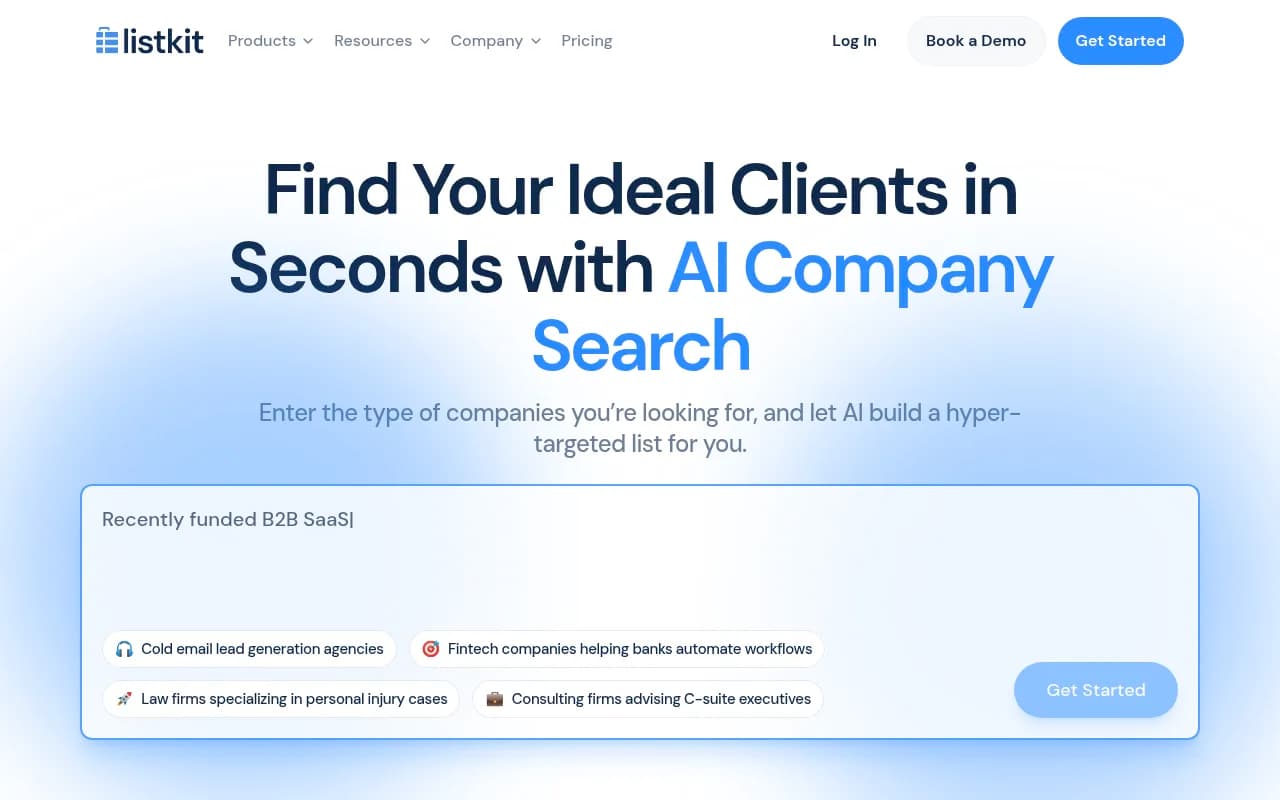
ListKit is a B2B contact database and lead generation platform built specifically around one workflow: find companies, verify contacts, export and go. The pitch is simple -- you describe the type of company you want to target in plain English, the AI builds a list, and then a triple-verification engine scrubs every email before you download it. No bounces, no wasted outreach budget, no third-party verification tools sitting in a separate tab.
The platform targets sales teams and cold email agencies that are tired of paying for leads that don't deliver. The core frustration it's solving is real: most B2B databases are full of stale or unverified emails, and teams end up paying for Apollo or ZoomInfo exports and then running them through Hunter.io or NeverBounce anyway. ListKit collapses that two-step process into one.
It's a relatively young product -- the positioning and feature set suggest a company that launched in the early 2020s and has been iterating quickly on the AI search angle. The "Wall of Love" on their site shows a growing base of cold email agencies and founder-led sales teams using it to run outbound campaigns at scale.
Key features
AI Company Search
This is the headline feature and genuinely the most interesting thing about ListKit. Instead of building filters manually (industry, headcount, revenue, etc.), you type a plain-English description of the companies you want -- "funded fintech companies with 100+ employees" or "CPG eCommerce brands hosted on Shopify" -- and the AI interprets that into a targeted company list.
The re-prompting capability is worth noting. You can iterate on your prompt until the output matches what you actually want, which is more useful than it sounds. Traditional filter-based tools require you to know the right taxonomy (SIC codes, NAICS categories, etc.). The AI approach lets you describe intent rather than category, which tends to produce more relevant results for niche targeting.
The database behind it has 731M+ profiles, which is competitive with mid-tier alternatives like UpLead and Lusha, though it's smaller than Apollo's claimed 275M+ contacts (Apollo focuses on contacts, ListKit on profiles broadly).
Triple-Verification Engine
ListKit's most defensible claim is its triple-verification process. Rather than just checking email syntax or doing a basic MX record lookup, the system runs each email through three verification layers before it's included in an export. The result, according to their site, is approximately 98% deliverability.
What makes this meaningful in practice: most databases verify emails at the time of collection, not at the time of export. Emails go stale fast -- people change jobs, companies shut down, domains expire. ListKit's approach of verifying at export time (or close to it) is the right architecture for this problem. The claim that it replaces tools like NeverBounce or ZeroBounceis a real value proposition if it holds up at scale.
Plain-English filtering for contacts
Beyond company search, you can filter contacts within those companies by role, seniority, department, and other attributes. The AI layer extends to contact filtering as well, so you can say "VP of Marketing at companies with 50-200 employees in SaaS" rather than manually stacking filter conditions.
Unlimited users
All plans include unlimited users, which is a meaningful differentiator for agencies managing multiple team members or clients. Apollo, for example, charges per seat at higher tiers. For a cold email agency with 5-10 people building lists, this changes the per-seat math considerably.
Export and download workflow
The workflow is designed to be fast: search, review, verify, export. Exports are in standard CSV format, compatible with any cold email tool (Instantly, Smartlead, Lemlist, etc.). There's no lock-in to a proprietary sequencing tool, which is either a feature or a limitation depending on what you need.
Customer success stories and benchmarks
ListKit publishes detailed campaign results on their site -- specific numbers like "185 positive replies in 1 month" from a real estate marketing firm, or "99% deliverability at scale" for an AI tool targeting movie producers. These are more specific than the vague testimonials most tools publish, and they give a realistic picture of what the platform can produce when used well.
Who is it for
The clearest fit is cold email agencies -- teams that build outbound campaigns for multiple clients and need clean, targeted lists quickly. The unlimited users policy makes it economical for agencies, and the AI search feature speeds up the list-building process that would otherwise eat hours of manual filtering. An agency running 10 client campaigns simultaneously can build lists for each without paying per-seat fees or running separate verification passes.
Founder-led sales teams at early-stage B2B companies are another strong use case. If you're a SaaS founder doing your own outbound, you don't want to learn Apollo's full filter system or pay for ZoomInfo's enterprise pricing. ListKit's plain-English search lowers the barrier to building a decent list in under an hour.
It's also a reasonable fit for SDR teams at mid-market companies that run high-volume cold email. The 98% deliverability claim matters a lot here -- at 10,000 emails per month, a 5% bounce rate is the difference between a healthy sender reputation and getting your domain flagged.
Who should probably look elsewhere: enterprise sales teams that need deep intent data (G2 buyer intent, Bombora, etc.), teams that want built-in sequencing and CRM sync, or anyone who needs technographic data beyond basic hosting/tech stack signals. ListKit is a list-building tool, not a full sales intelligence platform. If you need Salesforce enrichment, account scoring, or multi-touch attribution, you'll need to pair it with other tools.
Integrations and ecosystem
ListKit's integration story is intentionally lean. The platform exports to CSV, which works with any cold email tool. There's no native Salesforce or HubSpot integration listed on the site, which is a gap for teams that want to push leads directly into a CRM without a manual import step.
The platform works well alongside tools like:
- Instantly.ai and Smartlead for cold email sequencing
- Clay for enrichment and personalization workflows
- NeverBounce / ZeroBounceis (though ListKit positions itself as a replacement for these)
There's no public API mentioned on the site, and no Zapier or Make integration listed. For agencies that want to automate list delivery to clients or trigger workflows based on exports, this is a limitation worth noting.
No mobile app is available -- this is a web-based tool designed for desktop use.
Pricing and value
ListKit uses a credit-based pricing model with unlimited users across all plans. Based on available data:
- Starter: approximately $83/month on annual billing (the lowest tier)
- Higher tiers: custom plans available, with pricing scaling based on credit volume
The annual billing discount is meaningful -- monthly pricing is higher, so committing annually is the way to go if you're planning to use it consistently.
Compared to alternatives:
- Apollo.io starts free but charges per seat at higher tiers and doesn't include built-in verification at the same level
- UpLead starts around $99/month with a 95% data accuracy guarantee -- similar positioning, but without the AI search feature
- ZoomInfo is enterprise-priced and overkill for most of ListKit's target audience
- Lusha is comparable in price but more focused on individual contact lookup than bulk list building
For a cold email agency or small SDR team, ListKit's pricing is competitive. The unlimited users policy is the biggest differentiator in the pricing structure -- it's genuinely unusual at this price point.
Strengths and limitations
What it does well:
- The AI plain-English search is genuinely faster than manual filter stacking, especially for niche targeting like "Shopify brands in the CPG space with 50-200 employees"
- Triple-verification at export time is the right approach to deliverability -- verifying stale data at collection time is a known weakness of most databases
- Unlimited users across all plans is a real advantage for agencies and small teams
- The workflow is clean and focused -- it doesn't try to be a full sales platform, which keeps the UX fast
Honest limitations:
- No native CRM integrations means an extra manual step for teams using Salesforce or HubSpot
- No intent data, technographics depth, or account scoring -- you're working with firmographic targeting only
- The database at 731M+ profiles is solid but not the largest available; for very niche verticals, coverage gaps are possible
- No API or automation integrations limits how much you can build around it in a larger tech stack
- The platform is entirely focused on list building -- there's no sequencing, no analytics on campaign performance beyond what you bring back from your email tool
Bottom line
ListKit is a well-executed, focused tool for one specific job: building clean, targeted B2B lead lists fast. The AI search feature and triple-verification engine together solve two real problems that plague cold email teams -- bad targeting and high bounce rates -- without requiring a complex setup or a large budget.
Cold email agencies and outbound-focused sales teams at early-to-mid-stage B2B companies will get the most out of it. If you need a full sales intelligence platform with intent data, CRM sync, and built-in sequencing, ListKit isn't that -- but it was never trying to be.
Tags:
Frequently asked questions
What is ListKit?
How much does ListKit cost?
How does ListKit's triple-verification work?
Who is ListKit best for?
Does ListKit integrate with CRMs like Salesforce or HubSpot?
How does ListKit compare to Apollo.io?
Similar and alternative tools to ListKit