Key takeaways
- Eesel AI is genuinely good at plugging into your existing apps (Zendesk, Slack, email, Shopify) and acting as an autonomous teammate rather than a bolt-on chatbot. But its usage-based pricing can get unpredictable at scale, and it's not the right fit if you need a full helpdesk or want to build custom agent workflows from scratch.
- If you want a complete AI-native helpdesk (not just an AI layer), Intercom or Zendesk AI are the obvious choices -- though both cost significantly more.
- For pure cost efficiency on support ticket deflection, My AskAI's $0.10/ticket model is hard to beat.
- Tidio is the go-to for SMBs and e-commerce teams that want live chat, AI, and helpdesk in one affordable package.
- Botpress is the developer-friendly option if you want to build something custom with full control over the agent logic.
- Chatbase sits in the middle: no-code, fast to set up, and cheaper than Intercom -- but less powerful for complex workflows.
Eesel AI has carved out a specific niche: drop an AI teammate into the tools your team already uses, train it on your docs and tickets, and let it handle support autonomously. It works inside Zendesk, Slack, email, Freshdesk, Shopify, and Google Docs without requiring you to rebuild your stack. That's genuinely useful.
But people look for alternatives for a few predictable reasons. The usage-based pricing ($0.29 per AI resolution) sounds cheap until you're handling thousands of tickets a month and the bill becomes hard to forecast. The platform also doesn't come with its own helpdesk -- you're always layering it on top of something else, which is either a feature or a limitation depending on your situation. And if you want to build more complex, multi-step agent logic, Eesel's "ready in minutes" simplicity starts to feel like a ceiling.
Here's how the main alternatives stack up.
Intercom
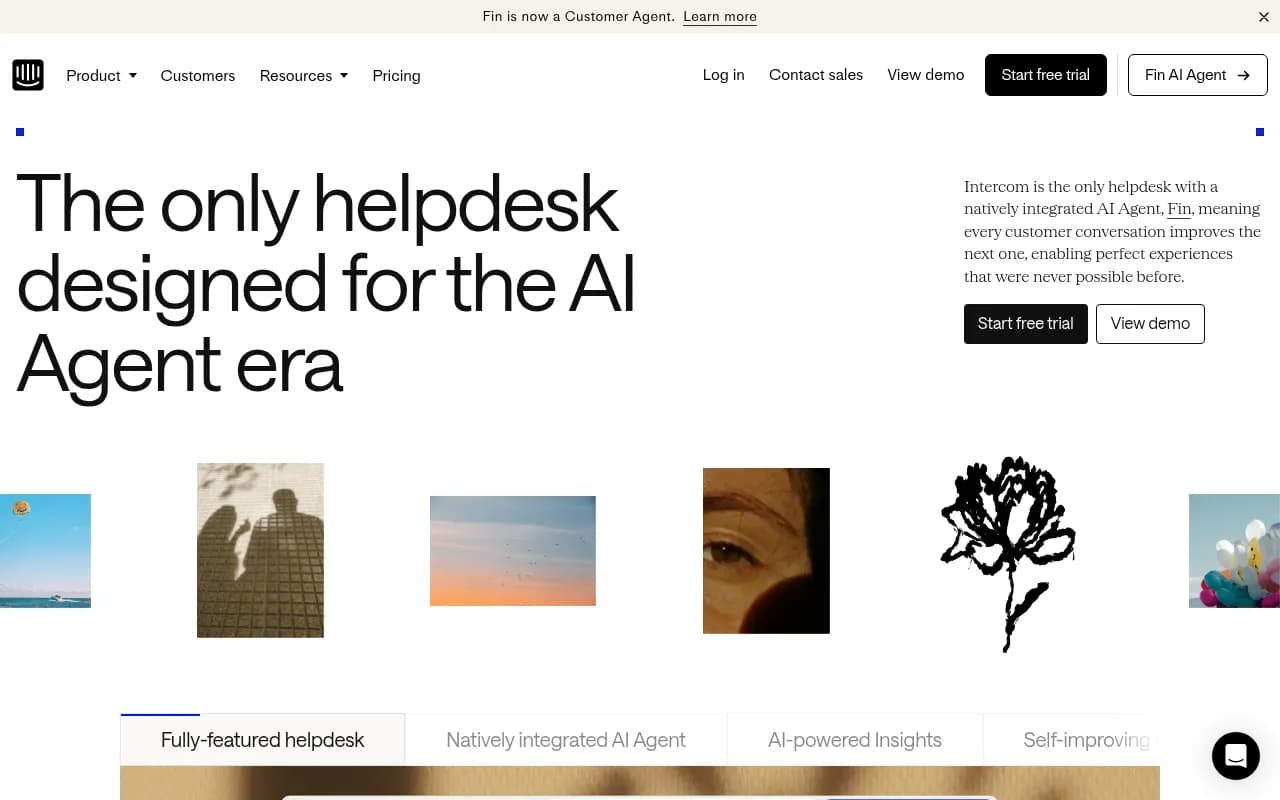
Intercom is probably the most complete AI-native customer service platform available right now. Its AI agent, Fin, is natively integrated -- meaning it learns from every conversation and feeds that back into the system. You're not bolting AI onto a helpdesk; the whole thing is designed around AI from the ground up.
Compared to Eesel, Intercom does a lot more: omnichannel ticketing, proactive messaging, AI-powered quality assurance, a full inbox for human agents, and detailed analytics. Fin handles the AI resolution side, and when it can't, it hands off to a human agent with full context intact.
The trade-off is cost. Intercom starts at $29/seat/month, plus $0.99 per AI-resolved conversation. For a team handling 5,000 AI resolutions a month, that's $4,950 in resolution fees alone, on top of seat costs. Eesel at $0.29/resolution is considerably cheaper per ticket. Intercom also has a startup program offering up to 90% off, which changes the math for early-stage companies.
Where Intercom clearly wins: the depth of the helpdesk, the quality of Fin's responses, and the self-improving feedback loop. Where it loses: price, and the fact that it's a full platform migration, not a drop-in addition to your existing tools.
Best for: SaaS companies and tech teams that want to consolidate their entire support stack into one AI-native platform and can justify the cost.
Zendesk AI
Zendesk is the enterprise default for a reason. It's trusted by 200,000+ companies, has a massive integration ecosystem (1,800+ apps), and its AI layer now includes autonomous agents, a proactive Copilot for human agents, workforce management, and quality assurance -- all in one suite.
If you're already on Zendesk, the AI upgrade is a natural path. If you're not, switching to Zendesk for the AI alone is a big commitment.
Compared to Eesel, Zendesk is in a different weight class. Eesel is designed to sit inside Zendesk and make it smarter. Zendesk AI is Zendesk's own answer to that same problem -- and it's more deeply integrated, obviously. The downside is that Zendesk's AI features are priced on top of an already expensive platform. Suite plans start at $55/agent/month, and the AI agents are an additional cost layer.
For smaller teams, this is overkill. For enterprise teams with complex routing, SLA requirements, and multi-channel support across voice, email, chat, and social, Zendesk's depth is hard to replicate.
Best for: Enterprise teams already invested in the Zendesk ecosystem, or large support operations that need workforce management and QA alongside AI automation.
My AskAI
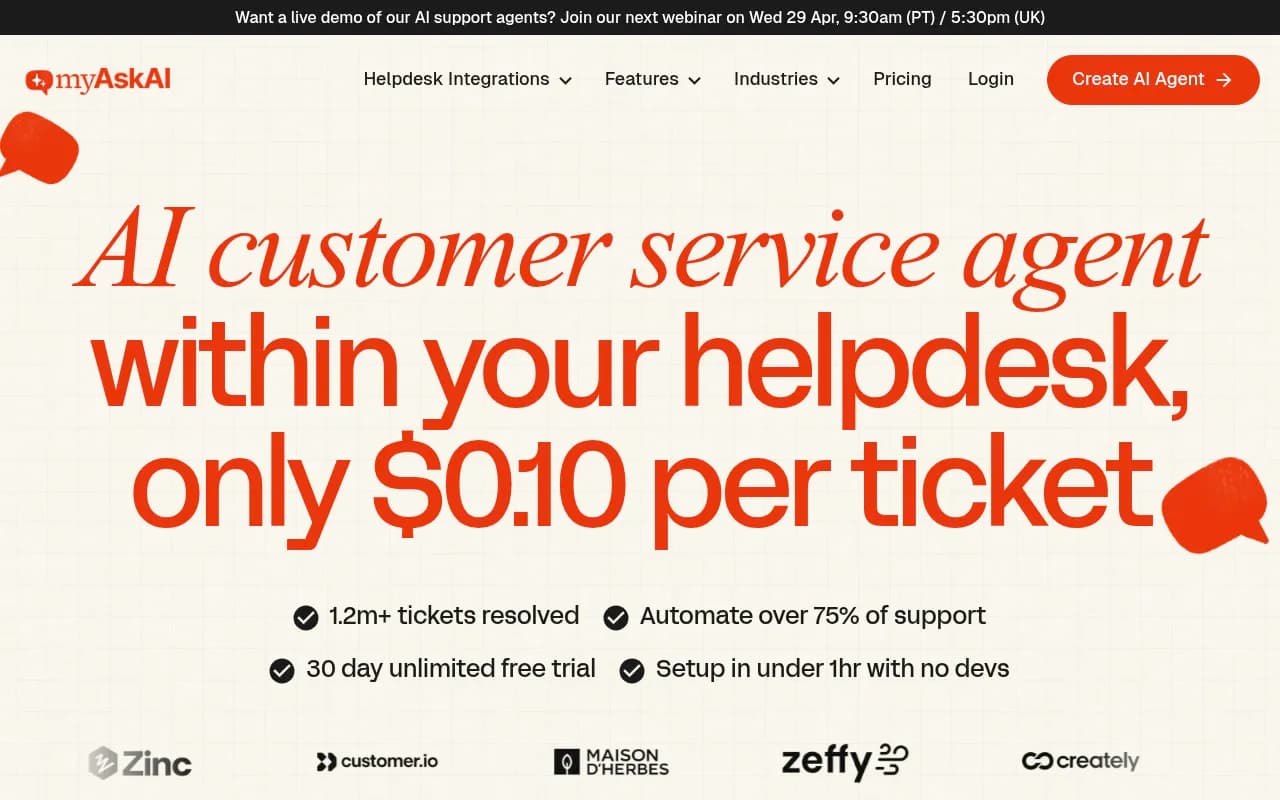
My AskAI takes a different angle: it's not trying to replace your helpdesk, it's trying to deflect tickets before they reach it. It integrates with Zendesk, Intercom, Freshdesk, Gorgias, and HubSpot, and claims to deflect 75%+ of support tickets automatically.
The pricing model is the most interesting thing here. At $0.10 per ticket (compared to Eesel's $0.29 per resolution and Intercom's $0.99), it's the cheapest per-interaction option in this list. The base plan starts at $199/month for 1,000 tickets, with $0.10 overage per ticket beyond that.
The honest limitation: My AskAI is narrower than Eesel. It's focused specifically on support ticket deflection. It doesn't live inside Slack, it doesn't write content, and it doesn't act as a general-purpose AI teammate. If your problem is purely "we have too many support tickets," My AskAI is a cost-effective fix. If you want an AI that can also help with internal knowledge queries, content drafting, or Shopify product questions, you'll hit its limits quickly.
Best for: Support teams on a tight budget who want to reduce ticket volume without replacing their existing helpdesk.
Chatbase
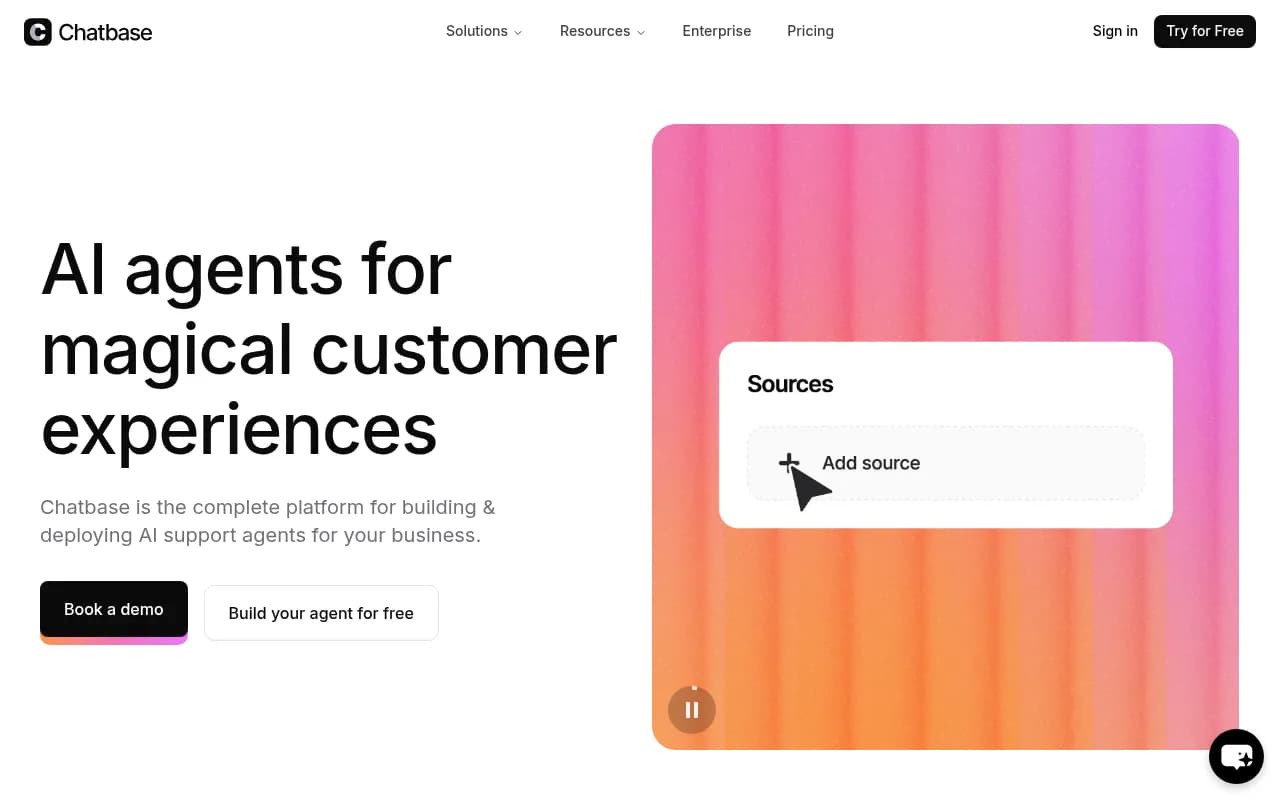
Chatbase is one of the most popular no-code AI agent builders, used by 10,000+ businesses. You train it on your own data (website, PDFs, help docs, Notion pages), connect it to your CRM or helpdesk, and deploy it as a support agent. No coding required.
Compared to Eesel, Chatbase is simpler to set up but less deeply integrated into your existing workflow. Eesel lives inside Zendesk or Slack and acts like a teammate. Chatbase is more of a standalone widget or embedded agent that you point at your content and deploy.
Pricing is more accessible: a free tier with 1 agent and 100 credits/month, then paid plans from around $40/month. That's significantly cheaper than Eesel for low-to-medium volume use cases.
Where Chatbase falls short: it's not as autonomous as Eesel for complex multi-step tasks, and its integrations with existing helpdesks are shallower. It's better at answering questions than taking actions (like updating a ticket, tagging a conversation, or pulling customer data from a CRM).
Best for: Small businesses and startups that want a quick, affordable AI support agent without a complex setup.
Tidio
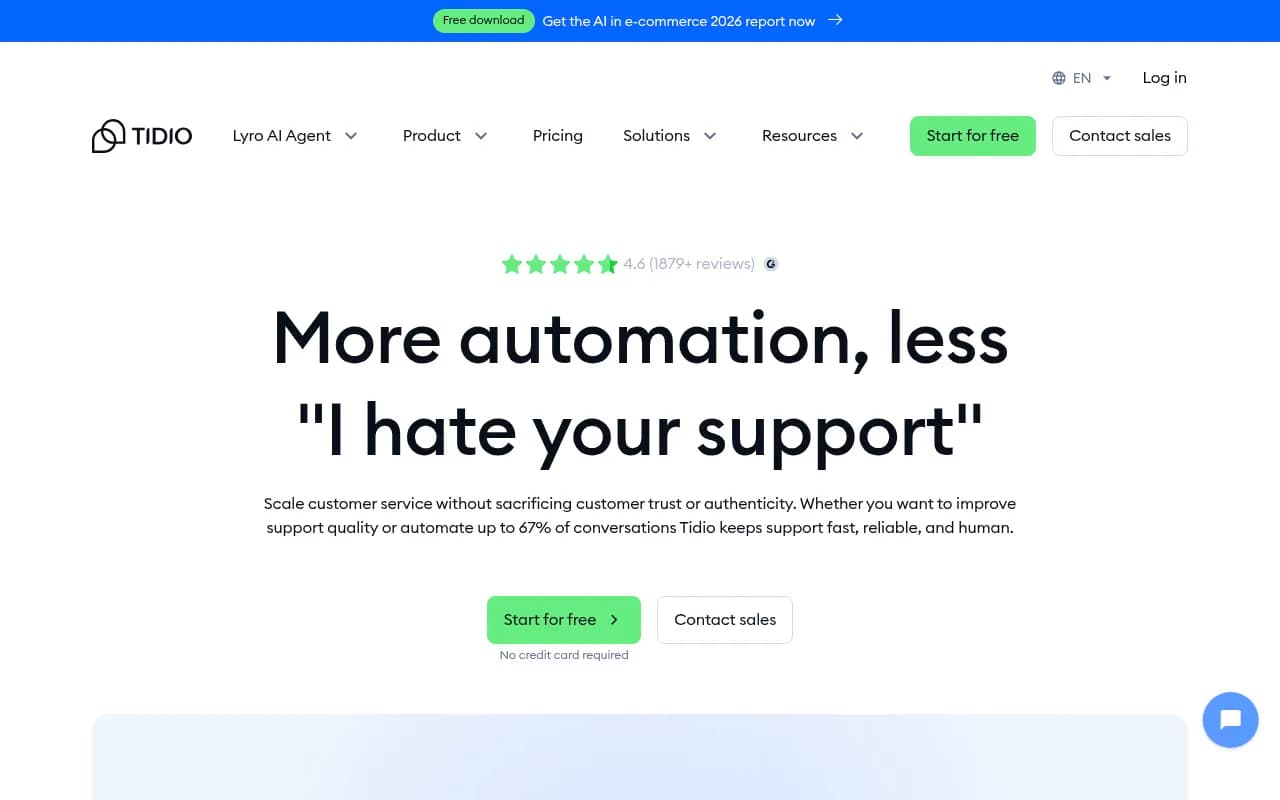
Tidio is a full customer service platform -- live chat, helpdesk, and AI agent (Lyro) in one package. It's trusted by 300,000+ businesses, which gives you a sense of its scale and market fit. Lyro claims to automate up to 67% of conversations while keeping responses on-brand and human-feeling.
The key difference from Eesel: Tidio is a complete platform, not an add-on. You get the helpdesk, the live chat widget, the AI, and the analytics all in one place. Eesel assumes you already have a helpdesk and adds AI on top. Tidio replaces the helpdesk entirely (or supplements it, depending on your setup).
Pricing starts around $24/month on annual billing, with a free tier available. That's very competitive for what you get. The trade-off is that Tidio's AI is less sophisticated than Intercom's Fin for complex cases, and its integrations with enterprise tools are more limited.
For e-commerce teams in particular, Tidio is a strong fit -- it handles Shopify integrations well and has proactive automation features that can capture leads and recover abandoned carts alongside handling support.
Best for: SMBs and e-commerce brands that want live chat, AI, and helpdesk in one affordable tool without needing enterprise-grade complexity.
Lindy AI
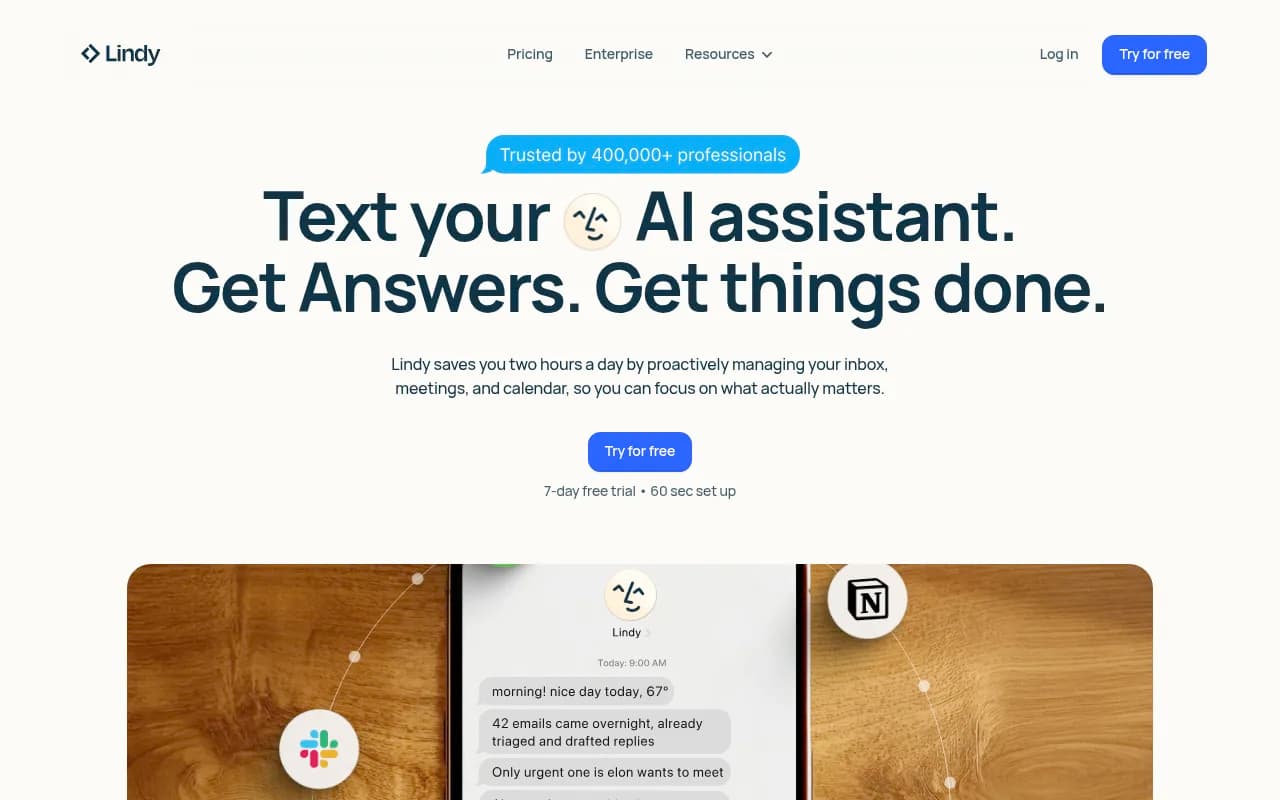
Lindy is a different kind of AI assistant -- less focused on customer-facing support and more on internal productivity. It manages email, meetings, calendars, and CRM updates for professionals, claiming to save 2+ hours per day. It's trusted by 40,000+ professionals and integrates with Gmail, Outlook, Slack, Google Calendar, and iMessage.
Compared to Eesel, Lindy is more personal assistant than support agent. Eesel's strength is handling customer queries at scale inside tools like Zendesk. Lindy's strength is handling the busywork that falls on individual team members -- drafting email replies, scheduling meetings, updating records.
There's some overlap: both can live inside Slack and handle internal queries. But if your goal is deflecting customer support tickets, Lindy isn't the right tool. If your goal is giving your team an AI that handles their administrative overhead, Lindy is genuinely useful.
Pricing: $49.99/month (or $41.99/month annual) after a 7-day free trial. Phone call automation is available from $0.19/minute.
Best for: Individual professionals and small teams who want an AI to handle their personal workflow overhead -- email, scheduling, CRM updates -- rather than customer-facing support.
Botpress
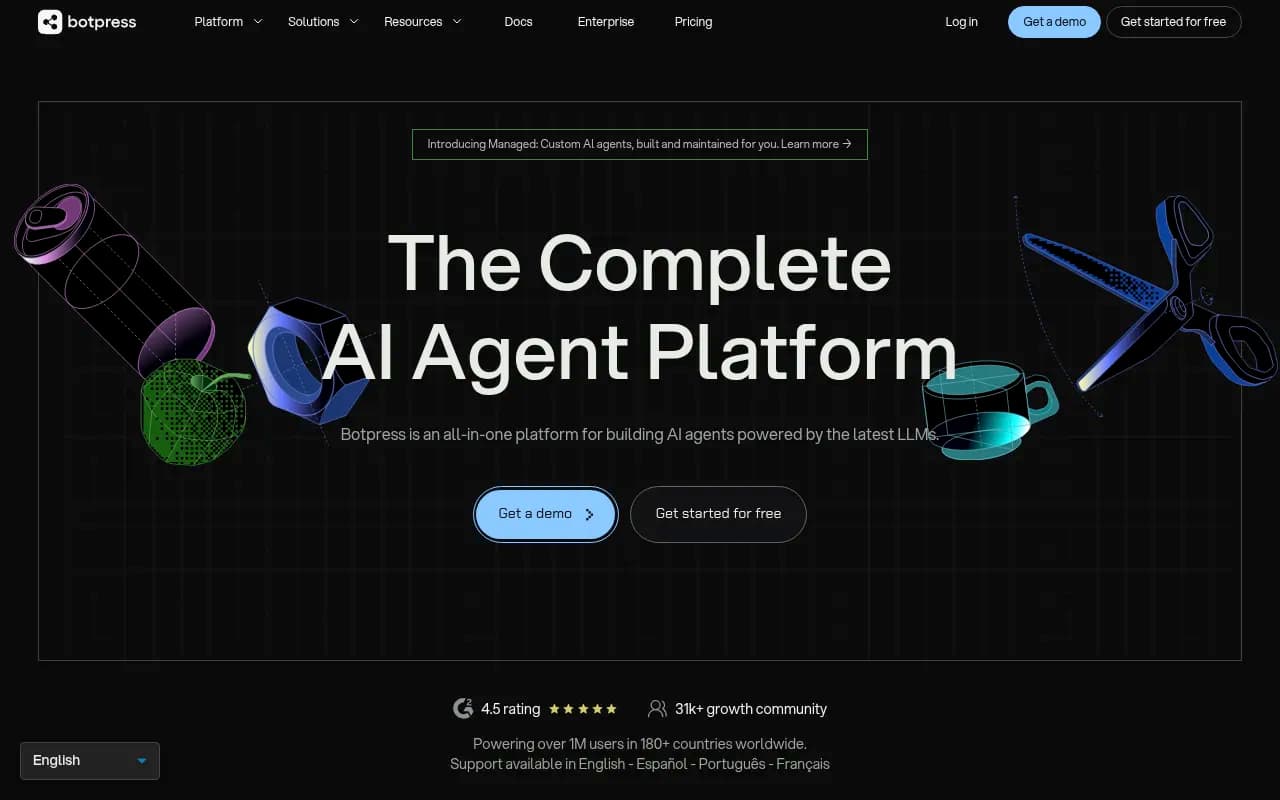
Botpress is the developer-first option in this list. It's an open-source AI agent platform where you build, deploy, and monitor LLM-powered agents from scratch. The core engine (LLMz) handles multi-step logic, memory, tool selection, and code execution internally -- which means you can build genuinely complex agents, not just FAQ bots.
Compared to Eesel, Botpress requires significantly more setup. Eesel is "ready in minutes." Botpress is "ready when you've built it." But what you get in return is full control: custom agent logic, multi-channel deployment (web, WhatsApp, Slack, voice), deep API integrations, and a 31,000+ community for support.
Pricing is generous: a free pay-as-you-go tier, then Plus at ~$89/month, Team at ~$495/month, and a Managed option at ~$1,495/month where Botpress's team builds and maintains the agent for you. The Managed tier is interesting -- it's essentially outsourcing the agent-building work entirely.
The honest downside: if you're not technical, Botpress has a steep learning curve. It's not a plug-and-play tool.
Best for: Developers and technical teams who want to build custom AI agents with full control over behavior, integrations, and deployment channels.
Botsonic
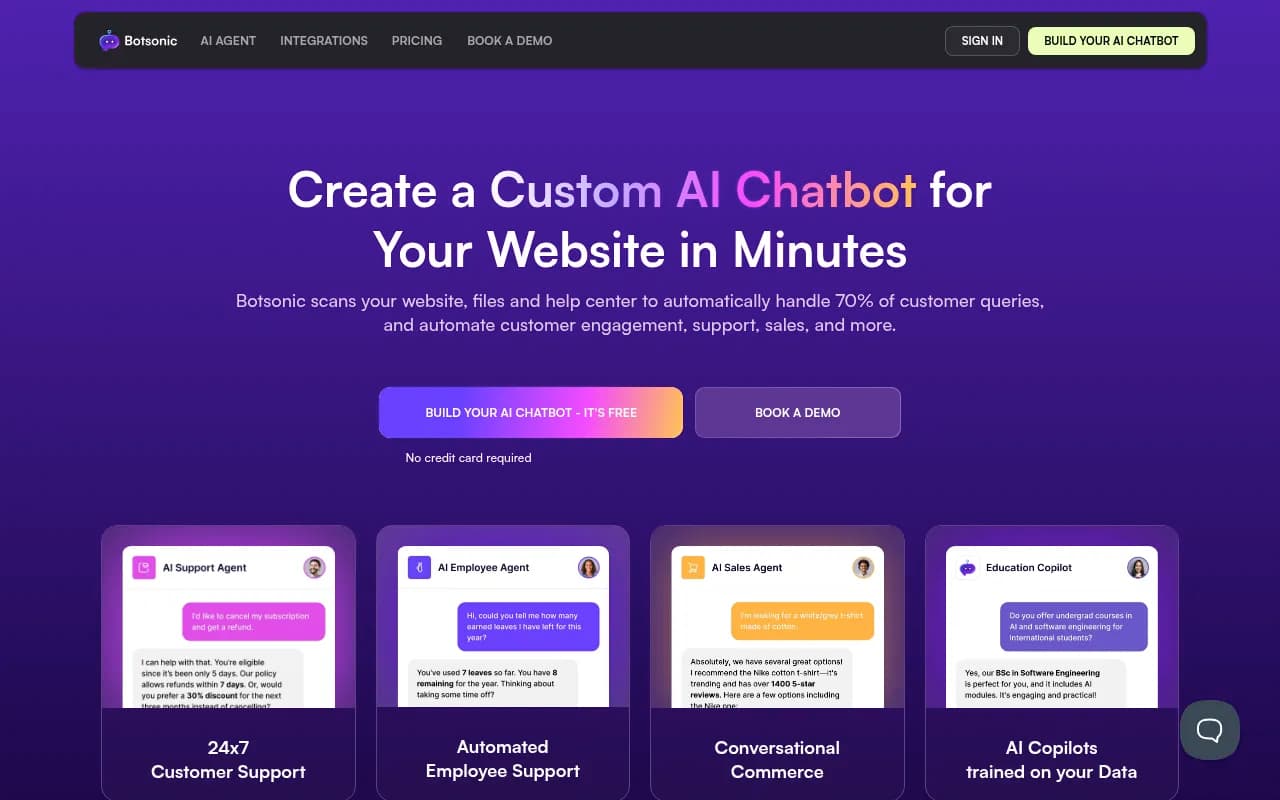
Botsonic is Writesonic's no-code chatbot builder. You point it at your website, files, and help docs, and it trains itself to handle customer queries. It supports 50+ languages, deploys across multiple channels, and claims to automate 70% of customer queries.
It's similar to Chatbase in concept -- no-code, train on your content, deploy as a widget -- but it sits inside the broader Writesonic ecosystem, which includes an AI article writer, SEO checker, and other content tools. If you're already using Writesonic for content, Botsonic is a natural extension.
Compared to Eesel, Botsonic is simpler and cheaper (free tier available, paid from ~$99/month), but it doesn't integrate as deeply into helpdesk workflows. It's better at answering questions than taking actions inside Zendesk or Freshdesk.
The enterprise security angle is worth noting -- Botsonic markets itself as enterprise-ready, which matters for teams with data compliance requirements.
Best for: Content teams and SMBs already using Writesonic who want to add a customer-facing chatbot without switching tools.
Help Scout
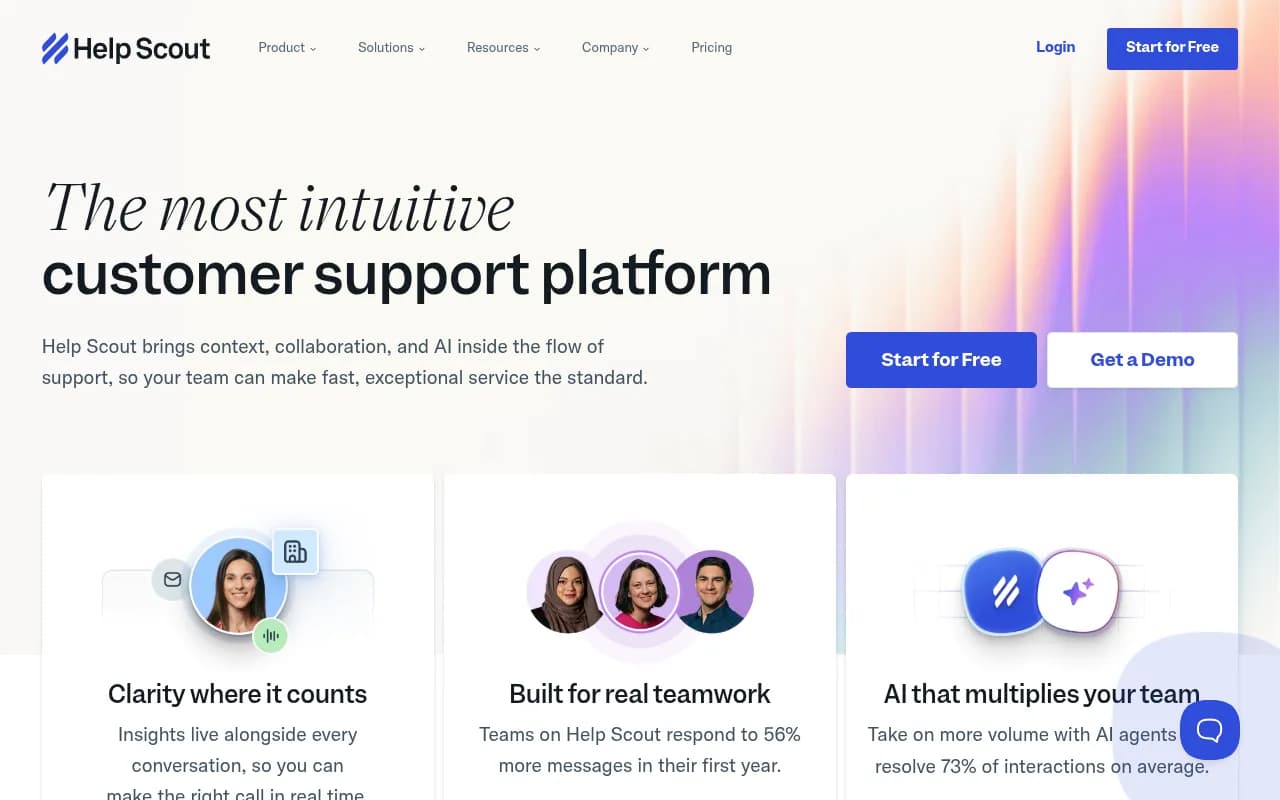
Help Scout is the "human-first" option in this list. It's an intuitive customer support platform built around shared inboxes, live chat (Beacon), a knowledge base (Docs), and AI-powered automation -- but it's designed to keep humans in the loop rather than replace them.
Its AI resolves around 73% of interactions on average, which is competitive. But the philosophy is different from Eesel or Intercom: Help Scout is built for teams that value the quality of human support and want AI to handle the volume, not the relationship.
Pricing is per-user: free plan available, then ~$25/user/month (Standard) or ~$50/user/month (Plus). For small teams, this is very affordable. For larger teams, per-seat pricing adds up.
Compared to Eesel, Help Scout is a complete platform (not an add-on), with a cleaner interface and a stronger focus on team collaboration. It doesn't have Eesel's depth of integration with tools like Slack or Shopify, but its shared inbox and knowledge base are genuinely well-designed.
Best for: Growing teams that want a clean, affordable helpdesk with AI automation but don't want to sacrifice the human touch in their support experience.
Which alternative should you pick?
The right choice depends almost entirely on what you're trying to solve:
If you want to keep your existing helpdesk and just make it smarter, Eesel AI is still a reasonable choice. But if you're open to switching, here's the honest breakdown:
- You need a full AI-native helpdesk: Intercom is the best-built right now, though the cost is real. Zendesk AI is the enterprise alternative if you're already in that ecosystem.
- You want the cheapest per-ticket deflection: My AskAI at $0.10/ticket is the clear winner for pure cost efficiency.
- You're an SMB or e-commerce brand: Tidio gives you live chat, AI, and helpdesk in one affordable package. Hard to beat at that price point.
- You want no-code and fast setup: Chatbase or Botsonic. Chatbase has a slightly larger user base and more helpdesk integrations; Botsonic makes more sense if you're in the Writesonic ecosystem.
- You want to build something custom: Botpress, no question. It's the only genuinely open platform in this list.
- You want AI for your own productivity, not customer support: Lindy is the only tool here built for that use case.
- You want human-first support with AI assistance: Help Scout's philosophy and pricing make it the right fit for teams that care about support quality over automation rates.
None of these tools are perfect for every situation. The best one is the one that fits your existing stack, your ticket volume, and your team's technical comfort level -- not the one with the most impressive demo.