Gong Review 2026
Records, transcribes, and analyzes sales calls and emails to surface competitive mentions, deal risks, and coaching opportunities across the entire pipeline.
Key takeaways
- Gong is the market leader in revenue intelligence, trusted by 5,000+ companies including Fortune 10 enterprises, with 6,200+ G2 reviews averaging 4.7/5
- The platform has evolved well beyond call recording -- it now operates as a full Revenue AI OS with modules for sales engagement (Gong Engage), forecasting (Gong Forecast), enablement (Gong Enable), and AI agents
- Pricing is opaque and enterprise-oriented: a flat annual platform fee plus per-user licensing plus mandatory professional services onboarding makes it one of the more expensive options in its category
- Strong fit for mid-market and enterprise B2B sales teams; overkill and cost-prohibitive for small teams or early-stage startups
- The depth of conversation intelligence and the Revenue Graph data model are genuinely hard to replicate -- competitors like Chorus (now ZoomInfo) and Salesloft haven't caught up on AI sophistication
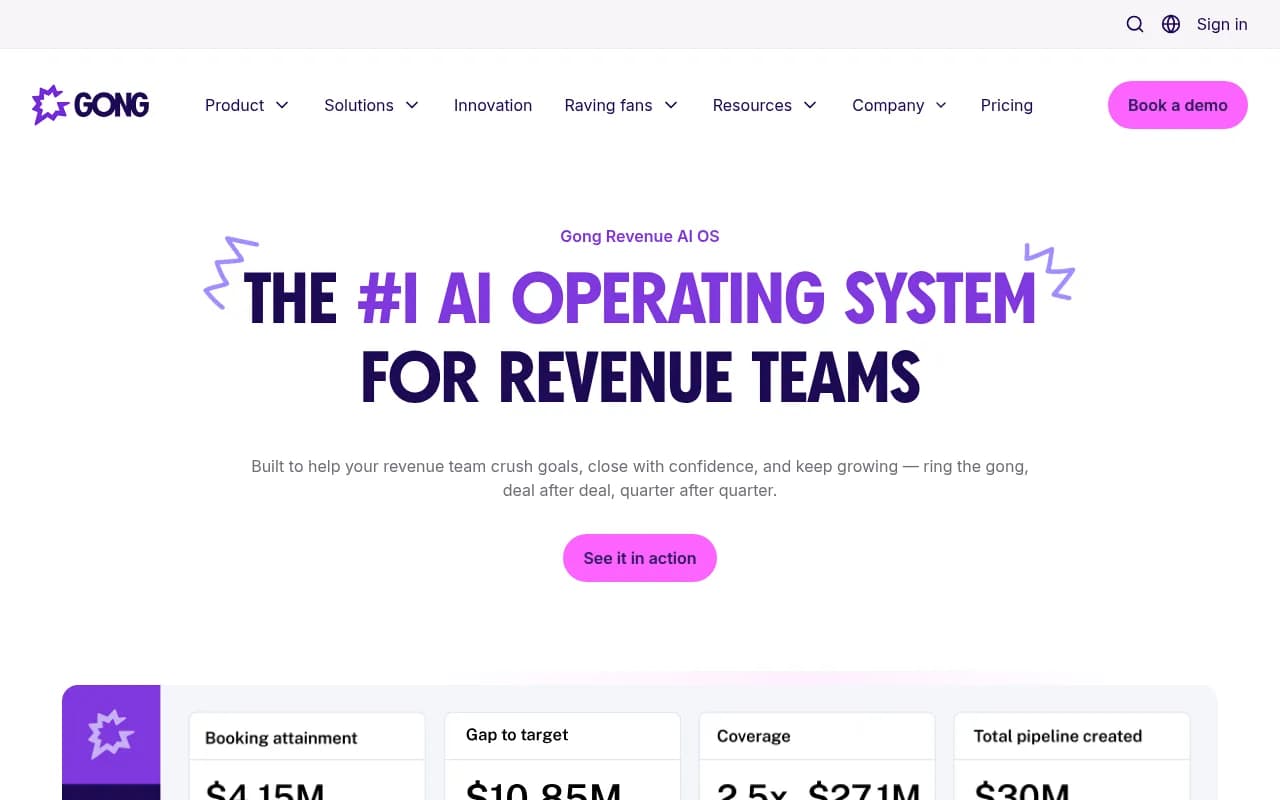
Gong started as a conversation intelligence tool -- record a sales call, get a transcript, see who talked how much. That was 2015. In 2026, it's something considerably more ambitious: a Revenue AI OS that the company positions as the connective tissue for an entire go-to-market organization. The pitch is that every customer interaction, email, meeting, and deal signal flows into a unified data model called the Revenue Graph, and from there, specialized AI agents and purpose-built applications help teams act on what they find.
Whether you buy the "operating system" framing or not, the product has genuinely grown into something that touches nearly every part of a B2B sales motion. Sales reps use it to prep for calls and automate follow-ups. Managers use it to coach without sitting in on every call. RevOps uses it to build forecasts that aren't just rep-submitted gut feelings. Enablement teams use it to build training scenarios from real customer conversations. That breadth is both Gong's biggest strength and the reason it's not the right tool for everyone.
The company, founded by Amit Bendov and Eilon Reshef, raised over $580 million before going quiet on fundraising news. It's been consistently named a leader in the Forrester Wave for Revenue Operations and Intelligence, and a significant chunk of the Fortune 10 reportedly runs on it. The customer list -- LinkedIn, ADP, Dropbox, Canva, Nasdaq, Uber for Business -- reads like a who's who of enterprise SaaS.
Key features
Conversation intelligence and call recording
This is still the core. Gong joins calls via a bot (Zoom, Teams, Google Meet, and phone calls via integrations), records and transcribes them, then runs analysis on top. The transcription quality is strong, and the AI identifies speakers reliably even in multi-participant calls. What makes it more than a transcription tool is the layer of analysis: talk-to-listen ratios, topic detection, sentiment shifts, competitor mentions, pricing discussions, and next steps are all automatically flagged. You can search across every call in your organization for a specific phrase or topic -- useful when you want to know how often "competitor X" comes up in late-stage deals.
Gong Revenue Graph
The Revenue Graph is Gong's underlying data model -- a continuously updated network that connects every interaction (calls, emails, meetings, CRM data) to accounts, contacts, deals, and outcomes. The idea is that instead of isolated call recordings, you get a living picture of every relationship and deal in your pipeline. In practice, this means Gong can surface things like "this deal has gone quiet for 14 days" or "the economic buyer hasn't been on a call in three weeks" without anyone manually tracking it.
Gong Forecast
Gong's forecasting module pulls from actual conversation data rather than relying purely on rep-submitted CRM fields. If a rep marks a deal as "Commit" but the last three calls showed heavy objection language and no discussion of next steps, Gong flags the discrepancy. The result is a forecast that's harder to game. Teams can see pipeline by stage, by rep, by segment, with AI-generated risk scores attached to each deal. For RevOps leaders tired of end-of-quarter surprises, this is one of the more compelling use cases.
Gong Engage
Gong Engage is the sales engagement layer -- sequences, email automation, and outreach prioritization. It's positioned as a Salesloft/Outreach competitor, but with the advantage that it's informed by conversation data. If a prospect responded positively to a specific value prop in a previous call, Gong can surface that context when a rep is writing a follow-up email. The AI helps personalize outreach at scale rather than just blasting templated sequences.
Gong Enable
The enablement module is where things get interesting for sales managers. Gong Enable includes an AI Trainer feature that lets managers build role-play scenarios grounded in real customer conversations. One VP of Sales quoted on the site built 14 training courses with 75+ AI scenarios in about three hours -- that's a meaningful time saving compared to building training content from scratch. Scorecards, call libraries, and automated coaching triggers round out the feature set.
Gong Agents
Gong's AI agents are the newest addition and arguably the most forward-looking part of the product. There are several specialized agents:
- AI Tracker agent: monitors calls for specific topics or signals and triggers actions (like alerting a manager or updating a CRM field) when they're detected
- Gong Assistant: a conversational interface for querying your revenue data -- ask "what are the top objections in deals we lost last quarter?" and get an answer grounded in actual call data
- AI Theme Spotter: surfaces emerging patterns across conversations that humans might miss
- AI Builder: lets RevOps teams build custom agent workflows without code
The agents framework is Gong's answer to the broader AI agent trend, and it's more grounded than most vendor implementations because it's operating on proprietary, high-quality data rather than generic LLM outputs.
Deal intelligence and risk scoring
At the deal level, Gong surfaces risk signals automatically: single-threaded deals (only one contact engaged), deals with no recent activity, deals where the champion has gone dark, pricing discussions that happened too early. These aren't just flags -- they come with context from the actual conversations that triggered them. A manager can click into a risk flag and immediately see the relevant call clip.
Competitive intelligence
Gong tracks competitor mentions across all calls and surfaces them in a dedicated competitive dashboard. You can see which competitors come up most often, at what deal stages, and how those deals tend to resolve. For product and marketing teams, this is genuinely useful market intelligence that doesn't require a separate tool.
Who is it for
Gong's sweet spot is B2B SaaS companies with dedicated sales teams, typically in the 50-1,000 employee range, though it scales well into enterprise. The ideal user is a VP of Sales or CRO at a company running a complex, multi-touch sales process -- think 30-90 day sales cycles, multiple stakeholders, and deals worth $20K+ ACV. At that scale, the ROI math on conversation intelligence is straightforward: if Gong helps close one extra deal per quarter that would have otherwise slipped, it pays for itself.
RevOps and sales enablement leaders are the other primary buyers. RevOps teams use Gong as a system of truth for pipeline data, often running it alongside (or instead of) CRM-native forecasting. Enablement teams use it to build coaching programs that are grounded in what's actually happening in the field rather than what trainers think is happening.
Industries where Gong particularly shines: technology/SaaS (its original home), financial services (with compliance features for call recording), healthcare (HIPAA-compliant configurations available), and manufacturing companies that have moved to inside sales or hybrid models.
Who should probably not use Gong: early-stage startups with fewer than 10 salespeople, companies with very short or transactional sales cycles (e.g., SMB e-commerce), and any team that isn't ready to invest in the onboarding and change management required to get value from a platform this complex. The mandatory professional services fee at purchase is a signal -- this isn't a tool you spin up in an afternoon.
Integrations and ecosystem
Gong's integration story is strong. The Gong Collective marketplace lists hundreds of integrations across CRM, sales engagement, communication, and data tools.
Key integrations include:
- CRM: Salesforce (deep, bidirectional), HubSpot, Microsoft Dynamics
- Video conferencing: Zoom, Microsoft Teams, Google Meet, Webex
- Sales engagement: Salesloft, Outreach (though Gong Engage now competes with these)
- Communication: Slack (deal alerts, call summaries pushed to channels), Microsoft Teams
- Marketing automation: Marketo, HubSpot Marketing
- BI and data: Snowflake, Tableau, Looker (via data export)
- Dialers: RingCentral, Aircall, Dialpad
Gong has a public API that allows enterprise customers to extract call data, transcripts, and analytics for custom workflows. The API is reasonably well-documented and used by RevOps teams building custom dashboards or feeding Gong data into data warehouses.
There's no standalone mobile app worth mentioning for recording, but the mobile experience for reviewing calls and receiving alerts is functional. Browser extensions exist for certain workflows.
Pricing and value
Gong's pricing is deliberately opaque -- you won't find a public pricing page with numbers. Based on widely reported third-party data (including Claap's 2026 pricing analysis), the model works like this:
- Platform fee: a flat annual fee, reportedly starting around $5,000-$7,500/year for smaller teams, scaling up significantly for enterprise
- Per-user licensing: roughly $100-$200 per user per month depending on tier and negotiation, billed annually
- Professional services: mandatory onboarding fee, typically $7,500+ for initial setup
- Add-on modules: Gong Engage, Gong Forecast, and Gong Enable are sold as additional applications on top of the base conversation intelligence license
For a 25-person sales team, total annual cost often lands in the $60,000-$100,000 range. Enterprise deals with hundreds of seats are negotiated individually.
There is no free tier and no self-serve trial -- you go through a demo and sales process. This is a deliberate choice that filters for serious buyers, but it's a real barrier for teams that want to evaluate before committing.
Compared to alternatives: Chorus (ZoomInfo) is often cheaper but has fallen behind on AI capabilities. Salesloft and Outreach are comparable on sales engagement but don't have Gong's depth of conversation intelligence. Clari competes on forecasting. The honest answer is that Gong is expensive, and the value depends heavily on whether your team actually uses it consistently -- shelfware at $80K/year is a painful outcome.
Strengths and limitations
What Gong does exceptionally well:
- The depth and quality of conversation analysis is genuinely best-in-class. The AI models are trained on an enormous proprietary dataset of sales conversations, which means the topic detection, sentiment analysis, and deal risk scoring are more accurate than what you'd get from a generic LLM applied to transcripts.
- The Revenue Graph data model creates a unified view of pipeline health that's hard to replicate by stitching together point solutions. When everything flows into one place -- calls, emails, CRM data, engagement signals -- the cross-signal analysis becomes meaningful.
- Gong Enable's AI Trainer is a standout feature. Building realistic role-play scenarios from actual customer conversations, with AI playing the prospect, is a genuinely novel capability that accelerates rep onboarding and ongoing coaching.
- The competitive intelligence layer is useful beyond just sales -- product and marketing teams regularly mine Gong data for voice-of-customer insights.
- Enterprise-grade compliance and security: SOC 2 Type II, GDPR, HIPAA configurations, and call recording consent management are all handled.
Honest limitations:
- The pricing model is a real problem for mid-market companies. The combination of platform fee, per-seat licensing, and mandatory professional services means the total cost of ownership is higher than most teams budget for initially. There's also a pattern of price increases at renewal that catches some customers off guard.
- The product has grown complex. With Engage, Forecast, Enable, Agents, and the Revenue Graph all as separate modules, new users face a steep learning curve. Getting full value requires sustained adoption effort -- it's not a tool that delivers ROI passively.
- Gong Engage, while improving, still lags behind dedicated sales engagement platforms like Outreach on sequencing sophistication and deliverability tooling. Teams that run high-volume outbound may find it limiting compared to a best-of-breed SEP.
- No self-serve or free trial means evaluation requires going through a sales process, which adds friction for teams that want to test before committing.
Bottom line
Gong is the right choice for B2B sales organizations that run complex, multi-stakeholder deals and are serious about using data to improve performance -- not just track it. The Revenue AI OS framing is more than marketing: the combination of conversation intelligence, deal risk scoring, AI-powered forecasting, and enablement tools in one platform genuinely reduces the number of point solutions a mature GTM team needs.
The best use case in one sentence: a 50-500 person B2B SaaS company that wants to replace gut-feel pipeline reviews with AI-grounded deal intelligence, coach reps at scale without manager bandwidth constraints, and forecast with enough accuracy to stop end-of-quarter surprises.
Tags:
Frequently asked questions
What is Gong and what does it do?
How much does Gong cost?
Is there a free trial for Gong?
Who are Gong's main competitors?
What CRMs does Gong integrate with?
Is Gong suitable for small businesses or startups?
Similar and alternative tools to Gong