Key takeaways
- Banks should buy a GEO platform on workflow and evidence, not on a headline visibility score. Approval gates, audit history, raw answer access and per-platform reporting matter more than a pretty dashboard.
- ChatGPT cites pages describing what a company sells far more than editorial content. Promptwatch Data (Sep 28 to Oct 4, 2026) puts product pages at 22.4% and landing pages at 16.8% of citations, 39% combined.
- Monitoring-only tools are fine for a pilot. Regulated teams usually need monitoring, crawler visibility, content execution and traffic measurement in one place.
- Public vendor pages rarely answer security and compliance questions (SOC 2, SSO, data residency, FINRA or SEC review). Put those in your RFP and get the answers in writing.
- Agencies can help with execution, but a platform is what lets you check whether the work moved anything.
Why banks need a different GEO shortlist
Most GEO buyer's guides are written for SaaS marketers. A bank is a different animal. You have thousands of product, rate, branch and help pages, several legal reviewers, a brand team that wants every claim sourced, and a compliance function that can veto a publish button. A tool that auto-posts AI-written content to your CMS is a feature for a startup and a liability for a bank.
The stakes are also different. When ChatGPT or Google AI Overviews gets a mortgage rate, a fee or an eligibility rule wrong, that is not a vanity metric problem. It is a customer-facing accuracy problem that may land on your compliance desk.
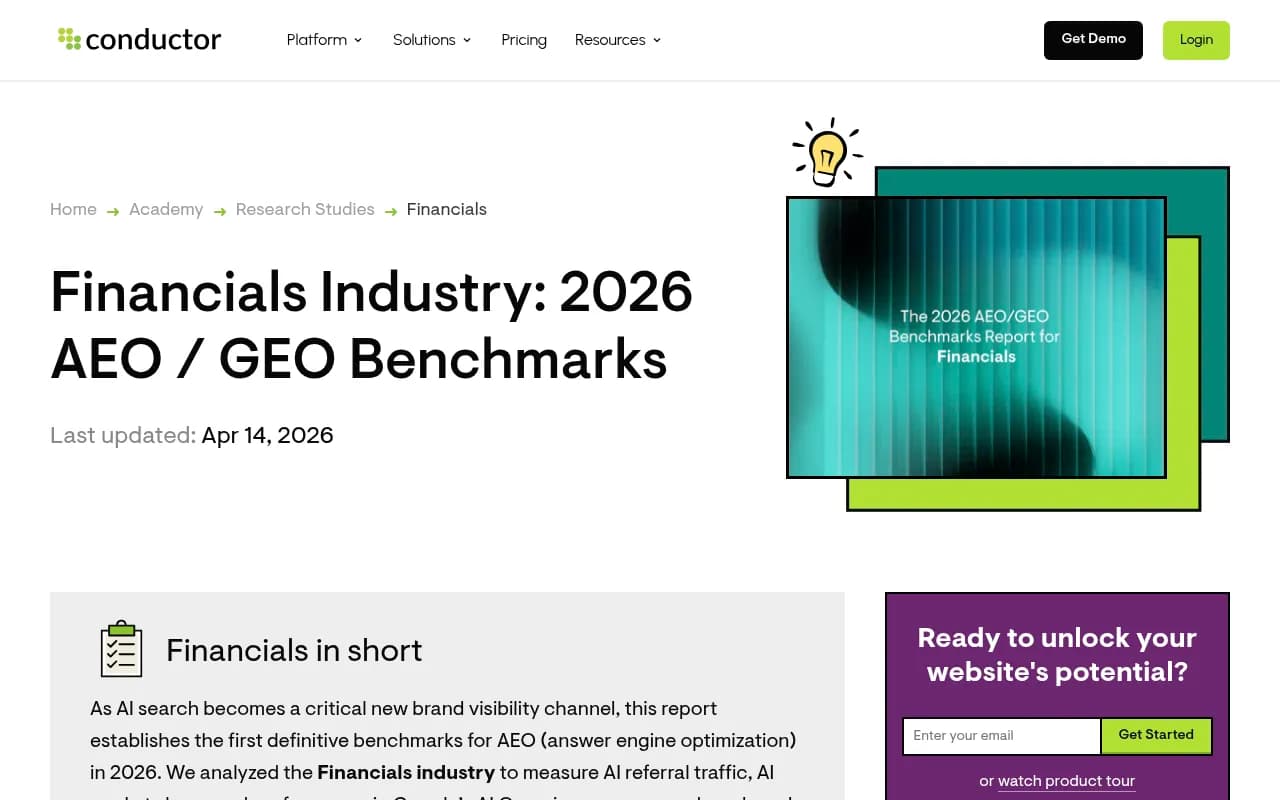
Conductor's Financials industry AEO/GEO benchmarks make the broader point: AI referral traffic is still a small slice of web visits (just over 1% in their data, growing roughly 1% a month), but the visibility happens inside the answer, before anyone clicks. Banks that are absent from those answers lose consideration they never see in analytics.
What AI engines actually cite for finance queries
Before comparing vendors, know what you are trying to influence. There is no finance-specific Promptwatch Data report yet, so the closest evidence is the general ChatGPT content-type data and the vertical reports for healthcare and software.
From Promptwatch Data's ChatGPT citation share by content type report (Sep 28 to Oct 4, 2026):
| Content type | Share of ChatGPT citations |
|---|---|
| Product pages | 22.4% |
| Landing pages | 16.8% |
| Listicles | 13.6% |
| How-tos | 8.7% |
| Documentation | 7.5% |
| General articles | 6.1% |
| Comparisons | 5.9% |
| News | 5.7% |
| FAQ pages | 3.3% |
| Reviews | 1.7% |
For commercial prompts, which is where "best business checking account" or "best credit card for travel" lives, product pages hit 26.0%, landing pages 20.6%, listicles 15.0% and comparisons 7.9%. Those four types are almost 70% of commercial citations.
So for a bank, the unglamorous work matters most: complete, factual product and landing pages with accurate pricing, fees, eligibility and positioning. Branded prompts ("is [bank] good for small business?") lean on the same pages plus reviews, which are 5.6% of branded citations, more than three times their overall share. That is a good argument for getting reviews onto trusted third-party sites.
Two more details from the same research are worth knowing. Promptwatch Data's content half-life report found news loses half its cited pages in about five weeks, while landing pages and docs keep most of theirs for months. Rate announcements and press releases are short-lived assets. Evergreen product pages are not. And in the healthcare citation report, government and public health sites earned almost half of citations, which hints at how ChatGPT treats other regulated, high-trust topics. Expect regulators, comparison sites and marketplaces to compete with you for finance answers.
How to evaluate an enterprise GEO platform when you are a bank
The Meikai buyer's guide (a vendor that ranks itself first, so take its framing with salt) has a useful way to think about buying situations. I have adapted it for financial services.
Measurement: can you trust the numbers
Test repeatability across runs, where prompts come from, geo and language controls, and whether you can open the raw responses. If a vendor will not show you the actual answer behind a score, walk away. Auditors and legal teams will ask for it.
Be suspicious of a single blended score. Meikai's example is a good illustration: after a large publisher removed a directory of articles in March 2026, citations per 1,000 responses by July kept 109.5% on Perplexity, 26.3% on Copilot, 12.2% on ChatGPT, and dropped to zero on Google AI Mode. The four-platform average is about 37%, which describes none of them. Require per-platform and per-market reporting.
Workflow: can it live inside your approval process
This is the bank-specific one. Ask about approval gates, CMS integration, audit history, and whether automation can be held to brand and regulatory review. A content agent with a review inbox where legal can approve, edit or decline each piece is very different from a tool that publishes on a schedule with no human in the loop.
Technical readiness: can AI engines even read your site
Large bank sites have heavy JavaScript, regional subdomains, login walls and legacy platforms. Check whether the vendor identifies AI bots against server logs, whether it handles client-side rendering, and whether crawl activity is tied to what appears in answers. This is where a lot of banks find their real problem is access, not content.
Execution: who does the work
Somebody has to change pages, earn mentions and produce content. If the answer is "your team, after we send a PDF," budget for that. If the platform ships agents that do the work, check how those agents are governed.
Security and compliance
Public vendor pages rarely cover this. I could not verify SOC 2, SSO, data residency or any FINRA, SEC or UDAAP-style review handling for most of the vendors below, so put these in your security questionnaire:
- ISO/IEC 27001 or SOC 2 reports, and a GDPR position
- SSO, role-based access and an audit log of who changed what
- Where data is stored and processed
- Whether prompts or your uploaded brand documents are used for model training
- API and MCP access controls, including read-only keys
Enterprise GEO platforms worth shortlisting
Here is how the main options compare on what they publicly emphasize. Treat the pricing column as a to-do: I did not find reliable public pricing for most of these, so request quotes.
| Platform | Public emphasis | Strongest fit | Watch for |
|---|---|---|---|
| Promptwatch | Monitor, trace, act and measure in one loop, with crawler logs and content agents | Banks that want execution plus measurement | Content Agent is Business and above |
| Profound | Prompt volume data, automated content workflows | Large brands with budget | Higher price points |
| Scrunch | Citation intelligence, serving AI-ready content | Technical teams | Narrower on content execution |
| Bluefish | Broad enterprise marketing suite, AI commerce | Fortune 500 marketing orgs | Breadth over depth |
| AthenaHQ | Cross-LLM monitoring, content agents | Mid-to-large teams | Monitoring-led |
| Peec AI | Focused analytics, source tracking | Analytics-first teams | No execution layer |
| Otterly.AI | Multi-country monitoring, audits | Teams starting out | Basic tracking |
| Conductor | Enterprise SEO with AEO benchmarks | Teams already on Conductor | Check AI depth |
Promptwatch
Promptwatch is the option I would put at the top of a bank's shortlist if the goal is to improve visibility, not just report on it. It tracks ChatGPT, Gemini, Perplexity, Claude, Google AI Overviews, AI Mode, Copilot and others from the real interfaces, per country and language, then goes further than most dashboards.

The parts that matter for a bank:
- IP-verified AI crawler logs show whether bots can actually read your product and rate pages, and where they hit errors. This separates an access problem from a content problem, which is the first question on a legacy bank site. See AI crawler logs.
- Brand Narrative pulls out the individual claims AI makes about you ("high fees", "great mobile app") and groups them by theme. Fact Check lets you mark a claim accurate or inaccurate and finds the pages on your site that state it, so you know which page the model is learning the wrong thing from. Fact Check is on Business and above.
- The Content Agent drafts and publishes to WordPress, Webflow or Framer with a review inbox for approve, edit or decline, so compliance can stay in the loop. The organization audit log (Business and above) records whether each change came from the dashboard, API, MCP or Agent Chat.
- Local GEO/SEO targeting at exact coordinates helps branch-driven "bank near me" queries, and state and city tracking helps with multi-state footprints.
- The company is ISO/IEC 27001 certified and GDPR compliant, with data handled by an EU-based company. That is a useful starting point for procurement.
Pricing (confirm at promptwatch.com/pricing): Essential $95/mo, Professional $245/mo, Business $579/mo. Business is the first plan with the Content Agent, faster-than-daily tracking, state and city tracking, Fact Check and the audit log. Enterprise adds SSO, white-label and a dedicated success manager. There is a 7-day free trial on monthly plans, and a free AI visibility report if you want a first look without a login.
For head-to-head context, see Promptwatch vs Profound and the 2026 platform comparison.
Profound
Profound is the name most enterprise buyers already know. It emphasizes prompt-volume data and automated content workflows and covers a wide set of AI engines.
Profound

In Promptwatch's own positioning, Profound has a strong monitoring set but higher price points, and no Reddit tracking or ChatGPT Shopping. That is a competitor's view, so run your own bake-off. Ask specifically about approval workflows and audit logs, since those decide whether it fits a regulated team.
Scrunch
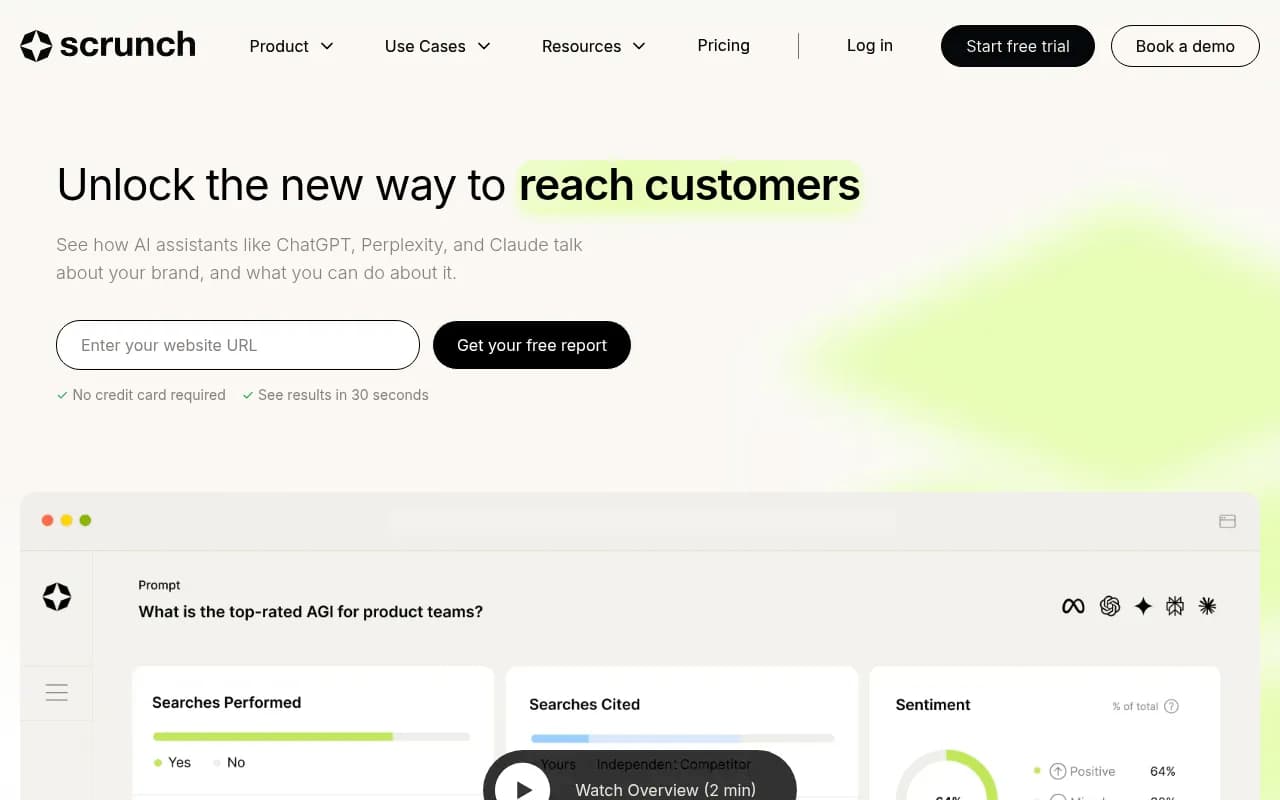
Scrunch leans on citation intelligence and an "Agent Experience Platform" that serves AI-ready content to bots. That is interesting for banks with technically messy sites. Ask how served content is governed, because serving a different version of a page to AI bots needs sign-off from legal and from whoever owns your SEO risk.
Bluefish
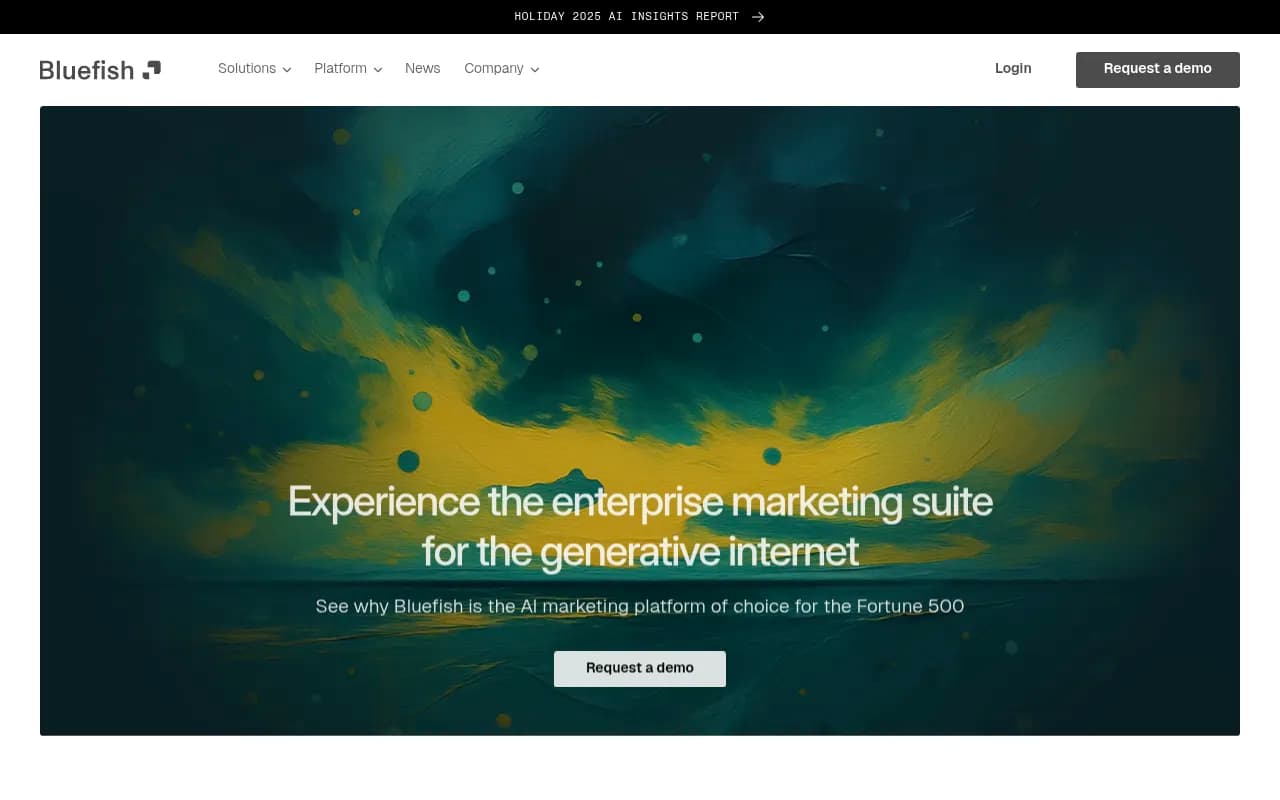
Bluefish pitches a broad enterprise marketing suite with custom measurement and AI commerce. It suits big brands that want one vendor across many functions. The tradeoff with suites is usually depth on any single job.
AthenaHQ, Peec AI and Otterly.AI
These three are monitoring-led. AthenaHQ adds content agents and enterprise controls, Peec focuses on analytics and source tracking, and Otterly is known for accessible multi-country monitoring. They are reasonable for a pilot or a single business line, but if your bank needs crawler logs, AI traffic attribution and governed publishing, check each of those boxes explicitly.


Otterly.AI

Enterprise SEO suites with AI add-ons
If you already run Conductor, BrightEdge, seoClarity or Semrush, check what their AI modules cover before buying a second platform. They often have good integration with your existing SEO reporting but shallower AI-specific data, such as fixed prompt sets and no crawler-to-citation path.
Finance-specific and smaller options
Finseo.ai tracks AI visibility for financial brands. It is worth a look as a niche option, though I have no verified detail on its compliance features.
Evertune is positioned at Fortune 500 brands and may be relevant to larger institutions.
For a wider scan, the directories at bestgeosoftware.com and ai-rank-tools.com list many more options by category.
Schema and on-site work banks should not skip
Platforms tell you where you are weak. The fix is still on your site. AY Rank's fintech guidance recommends Organization, FinancialProduct, FinancialService, BankOrCreditUnion and InvestmentOrDeposit for entity and product coverage, Article and Person for content authority, and FAQPage for common questions. That is sensible. Structured data will not guarantee citations, but it makes your products unambiguous to any system parsing the page.
A practical checklist, based on the content-type data above:
- Make every product page complete: rates, fees, eligibility, terms, and a last-reviewed date
- Build landing pages per audience and use case, not just per product
- Publish comparison and how-to content that legal has approved once and reviews on a schedule
- Keep documentation and help-center pages public and crawlable
- Add FAQ pages for the questions customers ask support
- Earn reviews on trusted third-party sites, since branded prompts cite them
- Fix crawler access first: robots.txt rules for AI bots, rendering of client-side content, and broken or orphaned pages
For JavaScript-heavy bank sites, prerendering can matter. Tools like Prerender.io exist for exactly that, though check with your security team before adding any proxy layer in front of customer-facing pages.
Should you use a platform, an agency, or both
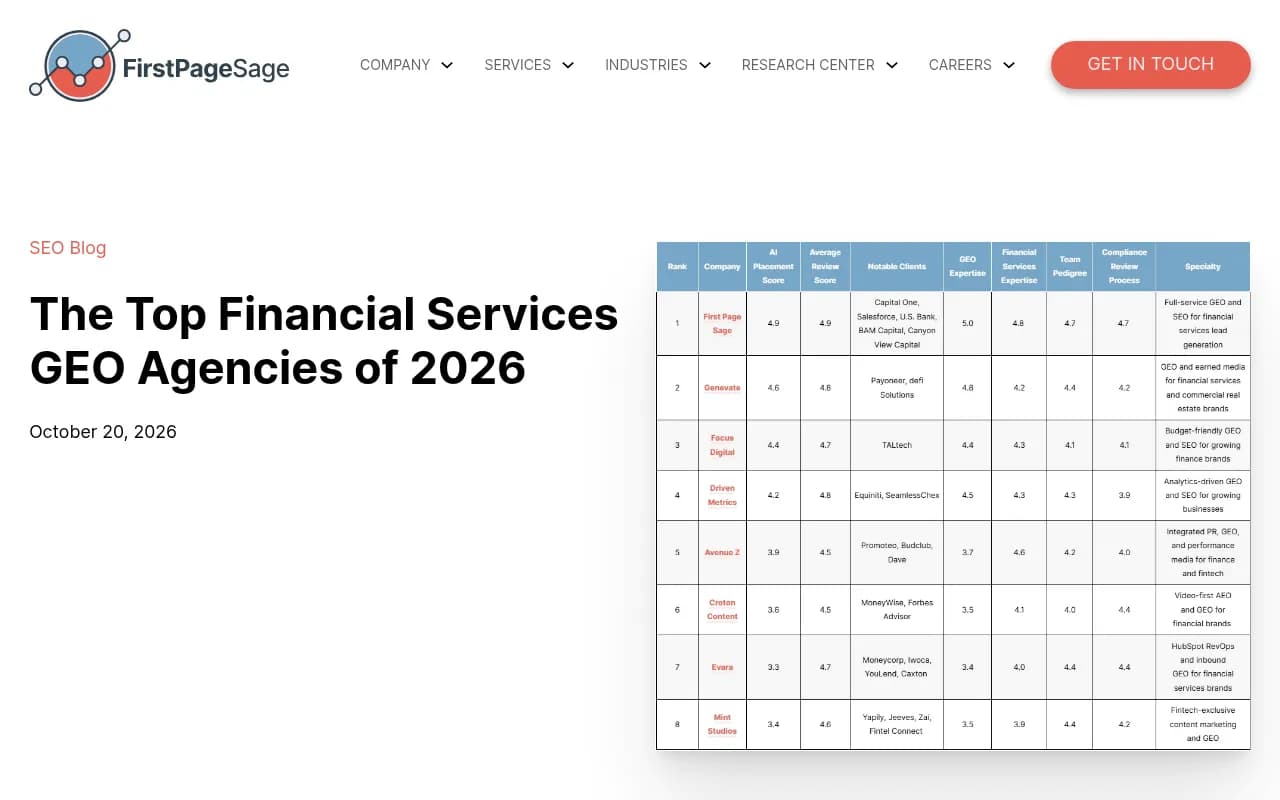
Several agency roundups exist for this niche. First Page Sage ranks itself first in its financial services GEO list (with clients like Capital One and U.S. Bank), and ScaleTheory ranks itself first in its own fintech list while naming iPullRank as the best fit for enterprise banks with large, complex site architectures. Both are vendor-published, so read them as marketing with some useful scoring criteria. The criteria are the good part: compliance review process, financial services expertise and AI placement results are the right things to ask any agency.
My view: an agency without a platform cannot prove its work, and a platform without execution capacity leaves you with a dashboard and a backlog. Most banks end up with both, or with a platform whose agents handle execution under human review. If you want a partner who works alongside a GEO platform, 1001 SEO Media is a senior-led SEO and GEO agency that uses Promptwatch for AI visibility work, with no long-term contracts and monthly reporting.
A 90-day pilot plan
Do not sign an enterprise contract on a demo. Run a bounded pilot.
- Weeks 1 to 2: Pick one product line (say, small business checking) and one or two markets. Build a prompt set from real customer questions, including branded, competitor-comparison and commercial prompts. Include personas, such as a first-time homebuyer versus a CFO.
- Weeks 2 to 4: Baseline visibility, share of voice, position, sentiment and citations per AI platform. Review the raw answers with compliance. Mark inaccurate claims.
- Weeks 4 to 8: Check crawler logs and the site audit. Fix access and rendering issues. Update the product and landing pages that models should be citing.
- Weeks 8 to 12: Publish a small number of governed content pieces through the approval flow. Track whether each page gets crawled, cited and clicked.
- Week 12: Decide using evidence. Did inaccurate claims drop? Did your own pages get cited more? Did AI-referred traffic convert? Promptwatch's 90-day GEO program guide is a useful template.
On measurement, note that ChatGPT stopped sending a referrer on October 8, 2026, so AI traffic attribution needs UTM tagging or a tool that counts utm_source=chatgpt.com visits. Check that any platform you choose handles this.
Questions to put in your RFP
- Which AI platforms are tracked through the real user interface versus API calls, and how do results differ?
- Can we open every underlying response and export it with citations?
- Is reporting available per platform, per market and per language?
- How are non-English prompts created: native or machine-translated?
- What approval gates exist before content is published? Can legal be a required reviewer?
- Is there an audit log covering dashboard, API and agent changes?
- Do you provide IP-verified crawler logs, and are they tied to citations?
- What certifications do you hold, and where is data stored?
- Are our documents and prompts excluded from model training?
- What is the pricing basis: prompts, responses, projects or seats?
The short version
For a bank, the best enterprise GEO platform is the one you can govern. Start with measurement you can audit, check whether AI engines can read your site, and insist on workflows that keep compliance in the loop. If you want monitoring plus crawler visibility plus governed content execution in one product, Promptwatch is the one to test first, then compare it against Profound and Scrunch at the high end, and against Peec, Otterly and AthenaHQ if your needs are narrower. Get security answers in writing, run a 90-day pilot on one product line, and judge by whether your own pages start getting cited. For more of the underlying data, browse Promptwatch Data.