Key takeaways
- GEO tools for solar companies fall into three jobs: tracking where AI mentions you, fixing why it doesn't, and publishing the content that closes the gap.
- Product pages and landing pages are the most cited content types in ChatGPT (22.4% and 16.8% of citations, Sep 28 to Oct 4, 2026), so your service and system pages matter more than a blog.
- Pure monitoring tools tell you that you are invisible. Platforms with crawler logs, citation analysis and content generation tell you why and help you change it.
- Local installers should pair a GEO tool with a local listings tool. National developers and manufacturers need multi-country tracking and competitor comparison.
- Solar design and CRM software (Aurora, HelioScope, OpenSolar) is a separate category. It will not make AI recommend you.
Why solar companies need GEO now
A homeowner who used to search "solar installers near me" now often asks ChatGPT or Google's AI Mode something like "is a battery worth it with a 7 kW system in Arizona, and who installs them?" The answer arrives as a short list of companies, with a handful of cited sources. If your company is not in that list, you never see the lost lead. Nothing shows up in your analytics.
Solar is a good fit for this behaviour. Purchases are large, research cycles are long, and buyers have a lot of questions: incentives, net metering, panel brands, financing, roof suitability. That is exactly the kind of multi-step, comparison-heavy question people hand to an AI assistant.
The measurement problem is real, too. Rank trackers tell you where you sit on Google. They say nothing about whether ChatGPT names you for "best solar installer in Phoenix" or cites a competitor's financing page instead. That gap is what GEO (generative engine optimization) tools fill.
What the data says about how AI cites sources
I could not find a Promptwatch report built specifically on energy or solar prompts, so treat the following as the closest general evidence rather than solar-specific proof.
According to Promptwatch Data (ChatGPT citations, Sep 28 to Oct 4, 2026), the most cited content types were:
| Content type | Share of ChatGPT citations |
|---|---|
| Product pages | 22.4% |
| Landing pages | 16.8% |
| Listicles | 13.6% |
| How-to guides | 8.7% |
| Documentation | 7.5% |
| Comparisons | 5.9% |
| FAQ pages | 3.3% |
| Reviews | 1.7% |
For commercial prompts, where people compare options before buying, product pages hit 26.0% and landing pages 20.6%. Branded prompts (naming a specific company) lean on product and landing pages too, with reviews rising to 5.6%.
What this means for a solar company in practice:
- Your system pages, battery pages and city or state landing pages are the main citation surface. Keep specs, warranty terms, pricing ranges and service areas complete and factual.
- Comparison and how-to content ("solar plus battery vs. solar only", "how net metering works in your state") covers the informational side.
- Reviews on trusted third-party sites matter more for branded questions, when someone asks "is [your company] any good?"
- Time-sensitive content decays. Promptwatch's content half-life report shows news pages losing half their citations in about five weeks, while landing pages and docs hold on for months. Incentive-change posts will fade. Evergreen service pages will not.
As a rough analogy for the software side of solar (design tools, monitoring platforms), Promptwatch's software citation data shows docs and help centers earning the largest share of citations, ahead of vendor sites and review sites. If you sell solar software, keep documentation crawlable and your G2 and Capterra profiles complete.
What to look for in a GEO tool as a solar company
Before comparing products, decide which of these you actually need.
- Prompt tracking against real prompts. Solar buyers ask location-specific, product-specific questions. You need to track "best solar installer in Tampa" and "Enphase vs SolarEdge for a small roof", not generic brand queries.
- Location tracking. Incentives, utilities and competitors differ by state and city. Country-only tracking is too coarse for a regional installer.
- Citation sources. Knowing which pages AI cites for your category (review sites, local directories, utility pages, Reddit threads) tells you where to earn mentions.
- AI crawler visibility. If GPTBot or ClaudeBot hit errors on your site, no amount of content helps. Many solar sites run on heavy JavaScript page builders, which makes this a real risk.
- Content workflow. Seeing the gap is half the job. Someone still has to write the pages.
- Traffic attribution. Leads from AI referrals are small today but tend to convert well. You want to see them.
Best GEO tools for solar and green energy companies in 2026
Promptwatch
Promptwatch is the option I would look at first for a solar company that wants to act on the data rather than just watch it. It tracks the real interfaces of ChatGPT, Google AI Overviews, AI Mode, Gemini, Perplexity and Copilot, supports country tracking on every paid plan and state or city tracking from the Business plan, which matters for regional installers.

The parts that matter most for solar:
- IP-verified AI crawler logs show whether GPTBot, ChatGPT-User or PerplexityBot are reading your quote pages and hitting errors.
- Citation analytics show which pages and third-party sources AI cites for your prompts, including Reddit and YouTube.
- The Content Agent and content gap analysis write and publish pages against the prompts you lose, with publishing to WordPress, Webflow or Framer.
- Visitor analytics connect AI referrals to actual traffic and conversions.
Pricing starts with a free Explore tier, then Essential at $95/mo (50 prompts) and Professional at $245/mo. Business at $579/mo adds state and city tracking and the automated Content Agent. Confirm current numbers at promptwatch.com/pricing. Agencies serving multiple solar clients can look at the agency plans.
Profound
Profound is an enterprise AI visibility platform covering ChatGPT, Perplexity and more. It suits large developers or manufacturers with big budgets and a dedicated team to use the output. For a 15-person installer it is probably more than you need.
Profound

Scrunch AI
Scrunch AI tracks brand mentions across LLMs and is aimed at marketing teams that want structured reporting.
Otterly.AI
Otterly.AI is a simpler monitoring tool tracking brand mentions across ChatGPT, Perplexity and Google AI Overviews. It works if all you need is to know whether you appear. It will not tell you why you don't.
Otterly.AI

Peec AI
Peec AI is a clean, marketing-friendly tracker for AI search visibility. Like Otterly, it is a monitoring tool first.

Semrush and Ahrefs Brand Radar
If you already pay for an SEO suite, the AI add-ons are the lowest-friction way to start. Semrush has an AI toolkit, and Ahrefs has Brand Radar.

The tradeoff: prompt sets tend to be more fixed, and you get less depth on crawler behaviour and citation sources than in dedicated platforms.
Rankshift and LLM Pulse
Both track brand visibility across ChatGPT, Perplexity and other engines. Reasonable for smaller teams that want affordable monitoring.

Comparison table
| Tool | Best for | Crawler logs | Content creation | City/state tracking |
|---|---|---|---|---|
| Promptwatch | Installers and developers who want to fix gaps, not just see them | Yes | Yes, with CMS publishing | Yes, from Business |
| Profound | Large enterprises | Limited | No | Varies |
| Scrunch AI | Marketing teams wanting reports | No | No | Varies |
| Otterly.AI | Basic mention monitoring | No | No | Limited |
| Peec AI | Simple tracking for small teams | No | No | Limited |
| Semrush / Ahrefs Brand Radar | Teams already on those suites | No | Separate tools | Varies |
Check each vendor's current plan details before buying. Features and limits change often.
Local visibility: pair GEO with listings tools
A residential installer lives or dies by local trust signals. AI assistants lean on directories, review profiles and map data when answering "best solar installer near me". A GEO tracker will tell you whether you show up. Keeping your listings consistent is a different job.
BrightLocal and Whitespark are practical for small installers building citations and reviews. Yext is better suited to multi-location operators. Review volume on Google and Trustpilot also feeds AI answers about your reputation, so a steady review process is worth setting up.
Technical basics: make sure AI can read your site
Solar sites are often built on page builders with calculators, interactive quote forms and JavaScript-heavy sliders. If AI crawlers cannot render the content, your pages will not be cited, however good they are.
Things to check first:
- Robots.txt is not blocking GPTBot, OAI-SearchBot, ClaudeBot or PerplexityBot.
- Key pages return real HTML content, not an empty shell that depends on client-side rendering.
- Service area, pricing ranges, warranty and certification details are in plain text on the page, not locked inside images or PDFs.
- Your sitemap lists every service and location page.
A crawler such as Screaming Frog or a rendering service helps here.
What a good solar GEO workflow looks like
Here is a simple monthly loop that works for most solar companies.
- Build a prompt list of 30 to 60 real buyer questions. Mix local ("best solar installer in Austin"), product ("Tesla Powerwall vs Enphase IQ battery"), financial ("is solar worth it with a 25-year loan") and trust ("is [your company] legit").
- Track those prompts across ChatGPT, AI Overviews, AI Mode and Perplexity.
- Look at which sources get cited when you are absent. Often it is a comparison site, a utility page, a state energy office page or a Reddit thread.
- Publish or refresh the page that answers the question better: a city landing page, a battery comparison, a clear incentive explainer.
- Check crawler logs to confirm AI systems actually fetched the new page, then watch for citations over the next few weeks.
- Earn third-party mentions where AI already looks: review sites, local directories, industry publications.
One caution on Reddit. Promptwatch's data shows reddit.com's share of ChatGPT citations dropping from about 4% to 0.5% on August 14, 2026, and social platforms supplied just 0.46% of ChatGPT citations in the week of Sep 28 to Oct 4 versus 12.2% for Google AI Overviews. So community presence matters more for Google's AI surfaces than for ChatGPT right now.
Agencies versus software
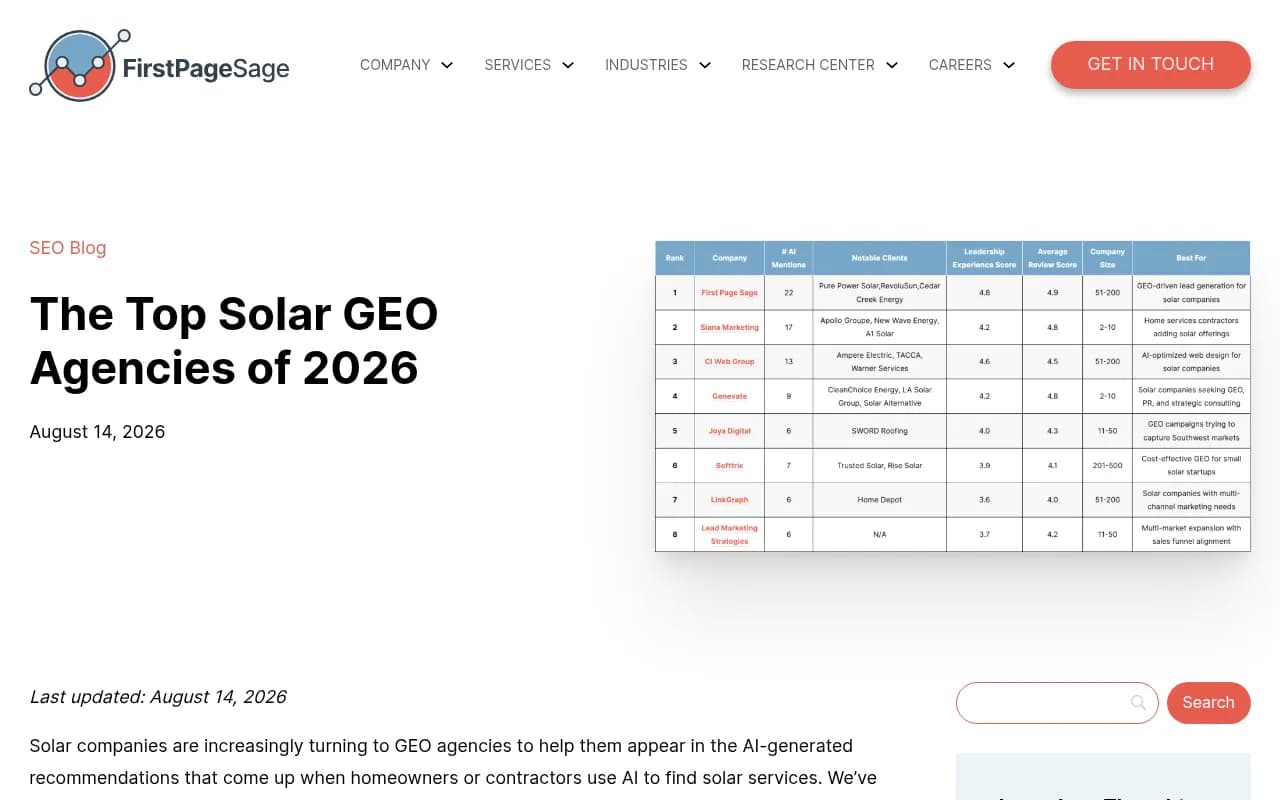
There are plenty of agency roundups for solar GEO. First Page Sage ranked 38 agencies on test mentions in ChatGPT, Gemini and Claude, and Bluelinks reviewed 78 agencies. Both are written by agencies that rank themselves, so read them as marketing as much as research.
If you do not have in-house marketing, an agency can make sense. If you have one marketer, software plus a clear process usually costs less and teaches you more. Agencies such as 1001 SEO Media combine technical SEO, content and GEO work with tools like Promptwatch behind the scenes, which is a reasonable middle path when you want specialists but also want transparent reporting.
For a wider view of the category, the GEO software directory at bestgeosoftware.com lists more options by feature.
Solar software is not GEO software
A lot of "best solar software 2026" articles cover design and operations tools: Aurora Solar, HelioScope, OpenSolar, Solargraf and operations platforms like Scoop. Published per-seat pricing for Aurora and HelioScope runs roughly $1,620 to $2,640 per user per year, and OpenSolar's core platform is free, according to Scoop's 2026 roundup.
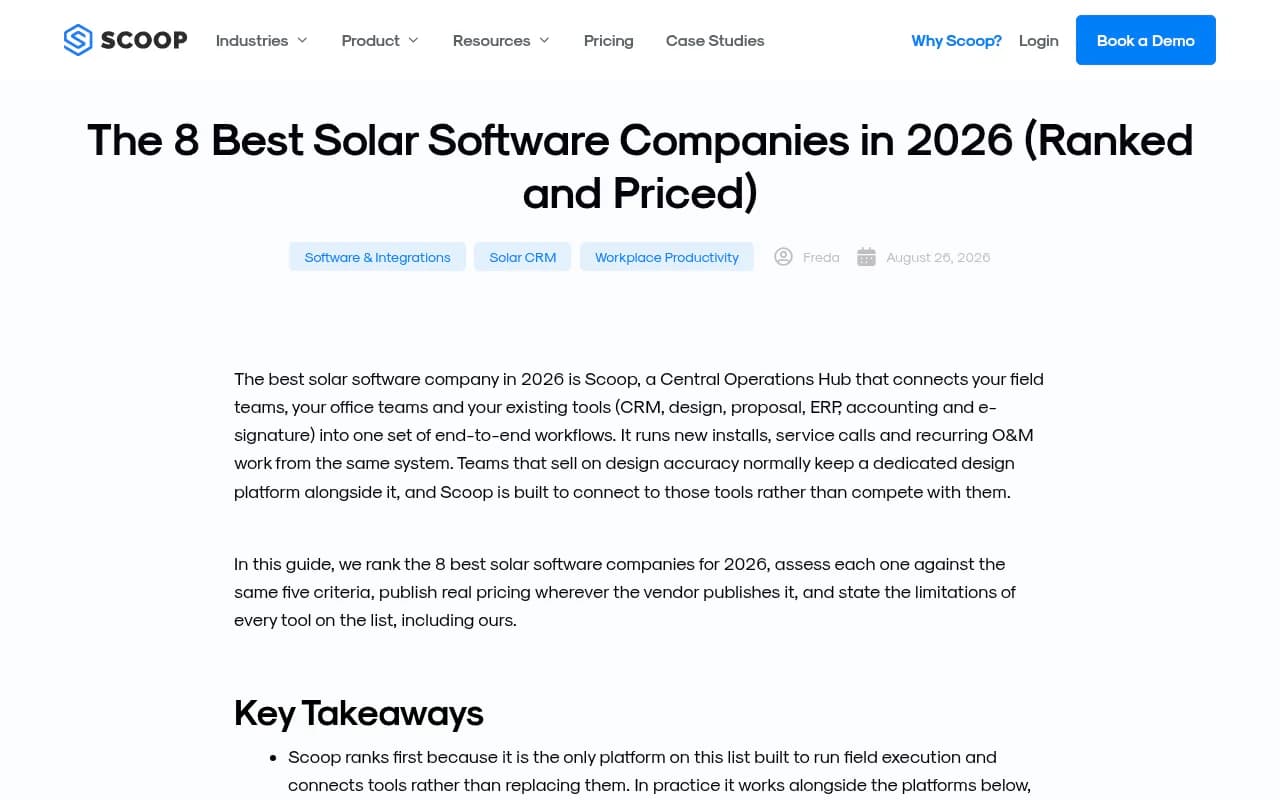
These tools help you design systems, send proposals and run crews. They do nothing for whether ChatGPT recommends you. Treat them as a separate budget line. The only overlap is content: your design tool's output (sample system sizes, typical production numbers) can feed original data pages that AI is more likely to cite than generic copy.
Which tool for which solar business
- Small residential installer, one marketer: start with a free or entry-level tier of a platform that includes site and crawler diagnostics, plus a local listings tool. Track 30 to 50 prompts in your service area.
- Multi-state installer or financing company: you need state and city tracking, competitor comparison and a way to produce location pages at volume. Promptwatch's Business plan or an agency plan fits here.
- Manufacturer or developer: track brand and product prompts across countries, and watch sentiment and citations from trade press. Enterprise tools like Profound can be justified.
- Solar software vendor: focus on documentation, review profiles and comparison pages. Your citation sources look like software, not local services.
- Agency serving solar clients: look for white-label reports, client portals and unlimited projects.
Common mistakes
- Tracking only your brand name. Most buyers have not heard of you yet. Track category and problem prompts.
- Ignoring state-level incentive content. This is one of the highest-intent topics in solar, and it changes. Keep those pages fresh with visible update dates.
- Publishing generic AI-written blog posts. Pages with real local data, real installation costs and named equipment get cited. Filler does not.
- Never checking whether AI crawlers can reach your site. This is cheap to test and expensive to ignore.
- Expecting results in a week. New pages need to be crawled, then cited. Plan on weeks, not days.
Bottom line
For most solar companies, the sensible stack is one GEO platform that goes beyond monitoring, one local listings tool, and a disciplined monthly content loop. Start by running a free visibility scan on your own brand and your top five buyer prompts, see who AI recommends instead of you, and read the pages it cites. That list of pages is your to-do list.
To compare more options, browse the AI rank tracking tools directory or the full GEO software listing, and confirm pricing on each vendor's site before committing.