Summary
- Set up analytics infrastructure to isolate AI traffic from traditional search within the first 12 hours using server logs, tracking pixels, or Google Search Console integration
- Define 10-50 core prompts that match how your prospects actually ask questions, then test baseline citations across ChatGPT, Perplexity, Claude, and Google AI Overviews
- Choose between manual tracking (free, 2-3 hours setup) or automated platforms like Promptwatch (paid, 30 minutes setup) based on scale and budget
- Track what matters: citation frequency, share of voice vs competitors, sentiment analysis, and source attribution -- not vanity metrics
- Turn tracking into action by identifying content gaps, generating AI-optimized content, and monitoring visibility improvements over time

The way people discover brands changed overnight. Over 60% of Google searches now feature AI answers. When someone asks ChatGPT "what's the best CRM for startups," they get a direct answer with brand recommendations. If your brand isn't in that answer, you've lost a high-intent prospect before they ever clicked a link.
Gartner predicts a 50% decline in organic search traffic by 2028. Meanwhile, 80% of consumers resolve 40% of their queries without clicking any links. Traditional SEO metrics like rankings and clicks no longer reflect true brand influence.
This guide walks you through setting up AI visibility tracking in 48 hours -- from infrastructure to insights.
Hour 0-12: Set up infrastructure to track AI traffic
Before you can measure visibility, you need an analytics setup that isolates AI traffic from traditional search. You have three options.
Option 1: Server log analysis (most accurate)
AI crawlers identify themselves in user agent strings. ChatGPT uses GPTBot, Perplexity uses PerplexityBot, Claude uses ClaudeBot. Your server logs capture every request these bots make.
How to set it up:
- Access your server logs (Apache, Nginx, or your CDN provider)
- Filter for AI bot user agents:
GPTBot,PerplexityBot,ClaudeBot,Google-Extended,Applebot-Extended,anthropic-ai,cohere-ai - Track which pages they crawl, how often, and any errors (404s, 500s, timeouts)
- Set up automated reports or dashboards to monitor crawl frequency
Why this matters: If AI bots aren't crawling your content, they can't cite it. Server logs show you exactly what they're reading.
Option 2: Tracking pixel or code snippet (easiest)
Some AI engines execute JavaScript and load tracking pixels. You can detect AI traffic by analyzing referrer data and user behavior patterns.
How to set it up:
- Add a tracking snippet to your site (Google Analytics, Mixpanel, or custom)
- Create segments for traffic with AI-specific referrers:
chat.openai.com,perplexity.ai,gemini.google.com - Look for behavioral signals: zero bounce rate, extremely fast page loads, no mouse movement
- Tag pages that receive AI traffic for further analysis
Limitation: Not all AI engines execute JavaScript. This method captures only a subset of AI traffic.
Option 3: Google Search Console integration (free, partial)
Google Search Console now shows when your pages appear in AI Overviews. It's limited to Google's ecosystem but requires zero technical setup.
How to set it up:
- Verify your site in Google Search Console
- Navigate to Performance > Search Appearance > AI Overviews
- Export data on which queries trigger AI Overviews featuring your content
- Track impressions and clicks over time
Limitation: Only covers Google AI Overviews. Doesn't include ChatGPT, Perplexity, Claude, or other engines.
Hour 12-18: Define your core prompt set
AI visibility isn't about ranking for keywords. It's about being cited in response to questions. You need a list of prompts that match how your prospects actually ask questions.
Start with 10-20 high-value prompts
Don't try to track everything. Focus on prompts that drive pipeline.
How to build your prompt list:
- Mine your sales calls: What questions do prospects ask before they buy? "What's the best [category] for [use case]?" "How do I [solve problem]?"
- Check your search console: Look at queries that already drive traffic. Rephrase them as natural questions.
- Analyze competitor content: What questions are they answering? Use tools like AlsoAsked or AnswerThePublic to map question clusters.
- Test with AI engines: Type your prompts into ChatGPT, Perplexity, and Claude. Do they generate useful answers? Are competitors mentioned?
Example prompt set for a CRM company:
- "What's the best CRM for startups with less than 10 employees?"
- "How do I migrate from Salesforce to a simpler CRM?"
- "What CRM integrates with Slack and has good mobile apps?"
- "Compare HubSpot vs Pipedrive for small sales teams"
- "What's the most affordable CRM with automation features?"
Prioritize prompts by intent and volume
Not all prompts are equal. A prompt with 1,000 monthly searches and high purchase intent beats a prompt with 10,000 searches and zero intent.
How to prioritize:
- Estimate volume: Use keyword tools like Ahrefs or Semrush to estimate search volume for related queries
- Score intent: High intent = ready to buy. Low intent = researching or learning.
- Check difficulty: Test the prompt in AI engines. If 5+ competitors are cited, it's competitive. If 0-2 are cited, it's winnable.
Tools like Promptwatch provide prompt volume estimates and difficulty scores out of the box, saving hours of manual research.
Hour 18-24: Choose your tracking method
You have two paths: manual tracking (free, time-intensive) or automated platforms (paid, scalable).
Manual tracking: Google Sheets + browser testing
Time commitment: 2-3 hours for initial setup, 30-60 minutes weekly for monitoring.
How it works:
- Create a Google Sheet with columns: Prompt, AI Engine, Date, Your Brand Mentioned (Y/N), Competitors Mentioned, Citation Source, Sentiment
- Test each prompt in ChatGPT, Perplexity, Claude, Gemini, and Google AI Overviews
- Record whether your brand is mentioned, how it's positioned, and which sources are cited
- Repeat weekly to track changes over time
Pros: Free, full control, works for small prompt sets (10-20 prompts).
Cons: Doesn't scale, manual data entry is error-prone, no historical data or trend analysis.
Automated platforms: Purpose-built AI visibility tools
Time commitment: 30 minutes for setup, 10 minutes weekly for monitoring.
How it works:
- Sign up for a platform like Promptwatch, Rankshift, or Omnia
- Add your brand and competitors
- Import your prompt list (or use their prompt discovery tools)
- The platform automatically tests prompts across AI engines daily or weekly
- View dashboards showing citation frequency, share of voice, sentiment, and trends

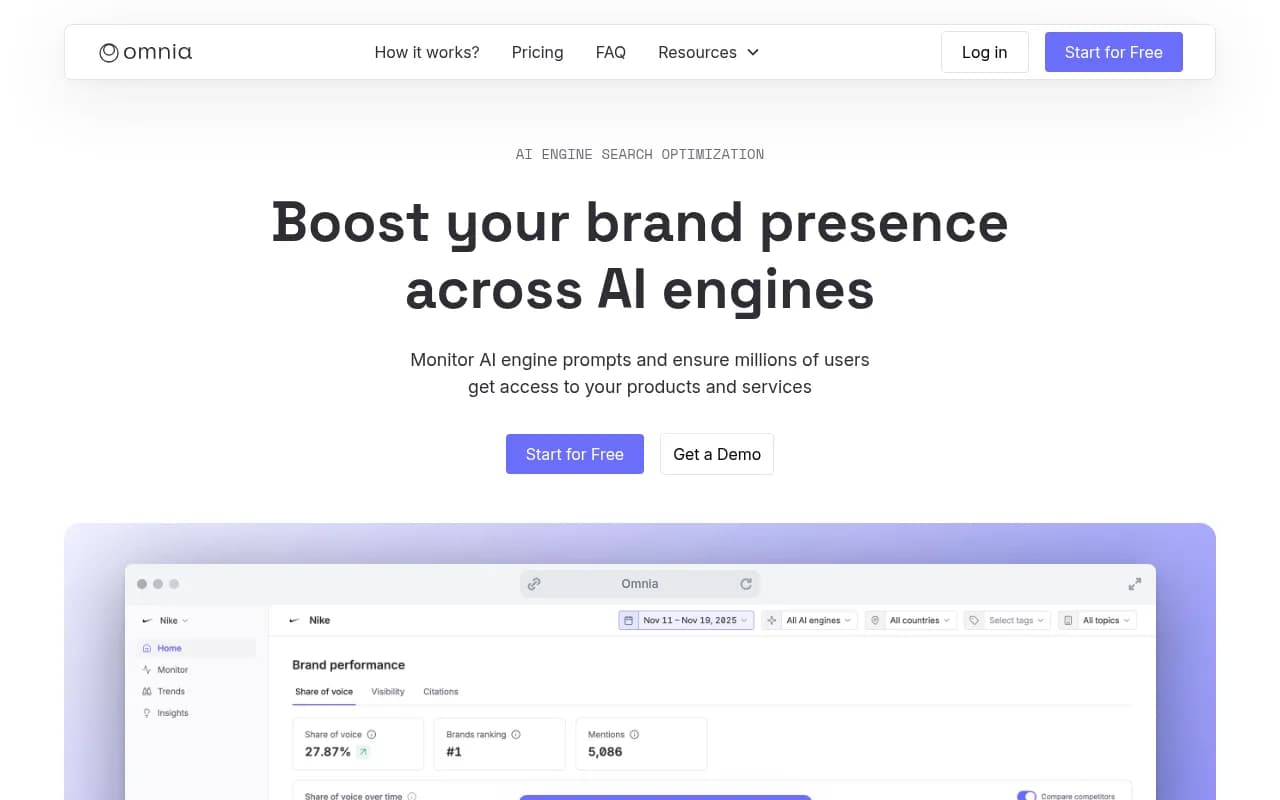
Pros: Scales to hundreds of prompts, historical data, automated alerts, competitor benchmarking, API access for custom reporting.
Cons: Costs $99-$579/month depending on features and scale.
Comparison: Manual vs automated tracking
| Feature | Manual (Google Sheets) | Automated (Promptwatch, etc.) |
|---|---|---|
| Setup time | 2-3 hours | 30 minutes |
| Weekly time | 30-60 minutes | 10 minutes |
| Cost | Free | $99-$579/month |
| Prompt capacity | 10-20 prompts | 50-500+ prompts |
| AI engines covered | 5+ (manual testing) | 10+ (automated) |
| Historical data | Manual tracking only | Automatic |
| Competitor benchmarking | Manual | Automatic |
| Alerts for changes | None | Yes |
| Best for | Small teams, tight budgets | Agencies, enterprise, scale |
For most teams, automated platforms pay for themselves within the first month by saving 2-3 hours of manual work per week.
Hour 24-36: Run your baseline audit
Now that your infrastructure is set up and your prompts are defined, run your first audit.
Test each prompt across AI engines
Engines to test:
- ChatGPT (OpenAI)
- Perplexity
- Claude (Anthropic)
- Gemini (Google)
- Google AI Overviews
- Copilot (Microsoft)
- Meta AI
- Grok (X/Twitter)
What to record for each prompt:
- Is your brand mentioned? Yes/No
- Position: Are you listed first, middle, or last?
- Competitors mentioned: Who else is cited?
- Sentiment: Positive, neutral, or negative?
- Source attribution: Which pages or domains are cited as sources?
- Answer quality: Is the response accurate and helpful?
Calculate your baseline metrics
Citation frequency: What percentage of prompts mention your brand?
Formula: (Prompts mentioning your brand / Total prompts tested) × 100
Example: If your brand is mentioned in 12 out of 50 prompts, your citation frequency is 24%.
Share of voice: How often are you mentioned compared to competitors?
Formula: (Your mentions / Total competitor mentions) × 100
Example: If you're mentioned 12 times and competitors are mentioned 38 times total, your share of voice is 24%.
Sentiment score: What percentage of mentions are positive?
Formula: (Positive mentions / Total mentions) × 100
Example: If 10 out of 12 mentions are positive, your sentiment score is 83%.
Visibility gap: Which prompts are competitors winning but you're not mentioned?
This is your priority list for content creation and optimization.
Hour 36-42: Identify content gaps and opportunities
Your baseline audit reveals where you're invisible. Now you need to understand why.
Analyze competitor citations
For every prompt where competitors are mentioned but you're not, ask:
- What sources are cited? Blog posts, product pages, case studies, documentation?
- What topics do they cover? Are they answering specific sub-questions you're not addressing?
- What format works? Long-form guides, comparison tables, step-by-step tutorials?
- What's their angle? Are they positioning themselves as affordable, enterprise-grade, easy to use?
Map content gaps to your site
For each high-priority prompt, determine:
- Do you have content that answers this question? If not, you need to create it.
- Is your content optimized for AI? Does it directly answer the question in the first paragraph? Does it include structured data, lists, and clear headings?
- Is your content fresh? AI engines prioritize recent content. Pages older than 12 months often lose visibility.
- Is your content crawlable? Check server logs. If AI bots aren't crawling the page, they can't cite it.
Tools like Promptwatch automate this with Answer Gap Analysis -- they show you exactly which prompts competitors rank for but you don't, and which content your site is missing.
Hour 42-48: Set up monitoring and optimization workflows
Tracking visibility is pointless if you don't act on the data. Set up a system to turn insights into action.
Weekly monitoring routine (30 minutes)
- Review citation changes: Which prompts gained or lost visibility this week?
- Check competitor activity: Did competitors publish new content or optimize existing pages?
- Monitor crawler activity: Are AI bots still crawling your site? Any errors or drop-offs?
- Track sentiment shifts: Are mentions becoming more positive or negative?
Monthly optimization cycle (2-4 hours)
- Refresh underperforming content: Update pages that lost visibility with fresh data, examples, and insights
- Create new content for gaps: Write articles, guides, or comparisons targeting prompts where you're invisible
- Optimize high-performers: Pages already getting cited can be optimized further with better structure, more depth, or multimedia
- Build backlinks to key pages: AI engines weight authoritative sources. Earn links from trusted domains to boost citation likelihood.
Automate alerts and reporting
Set up alerts for:
- New citations: When your brand is mentioned in a new prompt
- Lost citations: When you drop out of a response you were previously in
- Competitor activity: When competitors gain visibility for priority prompts
- Crawler errors: When AI bots encounter 404s, 500s, or timeouts on your site
Most automated platforms include alert systems. For manual tracking, use Google Sheets + Zapier to send notifications.
The action loop: From tracking to optimization
The best AI visibility platforms don't just show you data -- they help you fix the problems. Promptwatch is built around this action loop:
- Find the gaps: Answer Gap Analysis shows exactly which prompts competitors are visible for but you're not. You see the specific content your website is missing.
- Create content that ranks in AI: The built-in AI writing agent generates articles, listicles, and comparisons grounded in real citation data (880M+ citations analyzed), prompt volumes, and competitor analysis. This isn't generic SEO filler -- it's content engineered to get cited by ChatGPT, Claude, and Perplexity.
- Track the results: See your visibility scores improve as AI models start citing your new content. Page-level tracking shows exactly which pages are being cited, how often, and by which models.
This cycle -- find gaps, generate content, track results -- is what separates optimization platforms from monitoring-only tools.
Common mistakes to avoid
Tracking vanity metrics
Don't obsess over total mentions or impressions. Focus on high-intent prompts that drive pipeline.
Ignoring negative sentiment
A mention isn't always good. If AI engines cite your brand negatively ("X is expensive" or "X has poor support"), you need to address the root cause.
Testing prompts inconsistently
AI responses vary based on phrasing, context, and even time of day. Test the same prompt multiple times to get reliable data.
Forgetting to refresh content
AI engines prioritize fresh content. Pages older than 12 months often lose visibility. Set a quarterly refresh schedule for high-priority pages.
Not tracking competitors
Your visibility is relative. If competitors improve faster than you, your share of voice drops even if your citation count stays flat.
What to do after 48 hours
You now have:
- Infrastructure to track AI traffic
- A baseline audit showing where you're visible and where you're not
- A list of content gaps and optimization opportunities
- A monitoring workflow to track changes over time
Next steps:
- Prioritize content creation: Start with prompts that have high intent, winnable difficulty, and no existing content on your site
- Optimize existing pages: Refresh underperforming content with better structure, fresh data, and AI-friendly formatting
- Build authority: Earn backlinks to key pages from trusted domains to boost citation likelihood
- Expand your prompt set: As you gain confidence, add more prompts to track (aim for 50-100 within 3 months)
- Tie visibility to revenue: Connect AI traffic to conversions using UTM parameters, CRM integration, or closed-loop attribution
AI search is the future of discovery. The brands that figure out visibility now will dominate the next decade. The ones that wait risk becoming invisible to an entire generation of AI-assisted buyers.
Start tracking today. In 48 hours, you'll know exactly where you stand -- and what to do about it.