Key takeaways
- Traditional keyword volume metrics matter less in AI search -- question-based and intent-driven queries matter more
- AlsoAsked and AnswerThePublic are purpose-built for question discovery, which maps directly to how AI engines generate answers
- Ahrefs and Semrush are still the most complete platforms for data depth, but their AI search features are newer and less mature
- The best 2026 strategy combines a question-discovery tool with a full-suite platform -- not one or the other
- If you want to track whether your content actually gets cited by AI engines after you publish, you need a separate layer of tooling
Keyword research used to be simple. You found a phrase with decent volume and low competition, wrote a page targeting it, and waited for Google to rank you. That loop still works for traditional search. But AI search engines don't work that way.
When someone asks ChatGPT "what's the best CRM for a 10-person sales team," the model doesn't look up a keyword ranking. It synthesizes an answer from content it has crawled, weighted by how authoritative and relevant that content appears. The question isn't whether your page ranks for "best CRM" -- it's whether your content is the kind of thing an AI model would cite when answering that question.
That changes what keyword research is actually for. You're no longer just hunting for search volume. You're mapping the questions AI engines are likely to encounter, identifying gaps where your content doesn't answer those questions, and building material that positions your brand as the source an AI would reach for.
So how do the major keyword research tools hold up against that standard? Let's look at four of the most-used options in 2026.
How AI search changes what you need from keyword research
Before comparing tools, it's worth being specific about what's different.
Traditional SEO keyword research optimizes for ranking signals: volume, difficulty, click-through rate, backlink authority. AI search optimization is more about topical coverage and answer quality. AI models tend to cite content that:
- Directly answers a specific question
- Covers a topic with enough depth that the model trusts it as authoritative
- Appears on sites that AI crawlers visit frequently
This means question-based research -- "what do people actually ask about this topic" -- is more valuable than volume-based research in an AI search context. A phrase with 50 monthly searches but a clear, answerable question format may be more useful for AI visibility than a 5,000-volume head term.
It also means the research workflow has an extra step. You need to know not just what questions exist, but which ones AI engines are already answering, and whether your content appears in those answers. That last part is outside the scope of keyword tools -- we'll come back to it.
Ahrefs
Ahrefs has long been the go-to for backlink analysis, but its keyword research suite is genuinely strong. The Keywords Explorer pulls data from multiple search engines, gives you accurate search volume estimates, and includes a "Questions" filter that surfaces interrogative queries related to your seed term.
Promptwatch users often use Ahrefs alongside AI visibility tracking -- Ahrefs tells you what questions exist and how competitive they are, while a GEO platform tells you which of those questions AI engines are actually answering and whether you're in the response.
For AI search purposes, Ahrefs is most useful for:
- Identifying question-format keywords that map to how AI engines receive queries
- Competitor content gap analysis -- finding topics your competitors cover that you don't
- Understanding which pages on your site have enough authority to be cited by AI crawlers
Where it falls short: Ahrefs doesn't tell you anything about how AI engines actually respond to queries. You can find the question "what's the best project management software for remote teams" in Keywords Explorer, but you can't see whether ChatGPT or Perplexity is citing your page when someone asks it. That's a different kind of data.
Pricing starts at $99/month for the Lite plan, scaling to $399/month for Agency. It's not cheap, but the data quality justifies the cost if SEO is a significant part of your revenue.
Semrush
Semrush is the more comprehensive platform of the two big players. Where Ahrefs wins on backlink data, Semrush wins on breadth: keyword research, site auditing, position tracking, content optimization, and competitor analysis all live in one place.
The Keyword Magic Tool is particularly good for question discovery -- you can filter by question type (who, what, where, when, why, how) and get thousands of related queries organized by intent. For AI search research, the intent classification is useful because AI engines tend to handle informational and navigational queries differently from transactional ones.
Semrush has also been building out AI-specific features. Their ContentShake AI tool generates content briefs with SEO optimization baked in, and the platform has added some AI Overview tracking.
For AI search purposes, Semrush is most useful for:
- Large-scale question mapping across a topic cluster
- Intent classification to prioritize which queries AI engines are likely to handle
- Content brief generation that incorporates keyword data
The limitation is similar to Ahrefs: Semrush shows you the keyword landscape, not what AI engines actually do with it. Their AI Overview tracking is a step in the right direction, but it's not the same as knowing whether Perplexity cites your specific page when answering a query.
Pricing runs from $119/month (Pro) to $449/month (Business), with enterprise options above that.
AlsoAsked
AlsoAsked is a more specialized tool. It pulls live "People Also Ask" data from Google and maps it into a visual tree showing how questions branch from a seed query. The insight it provides is genuinely different from what Ahrefs or Semrush give you.
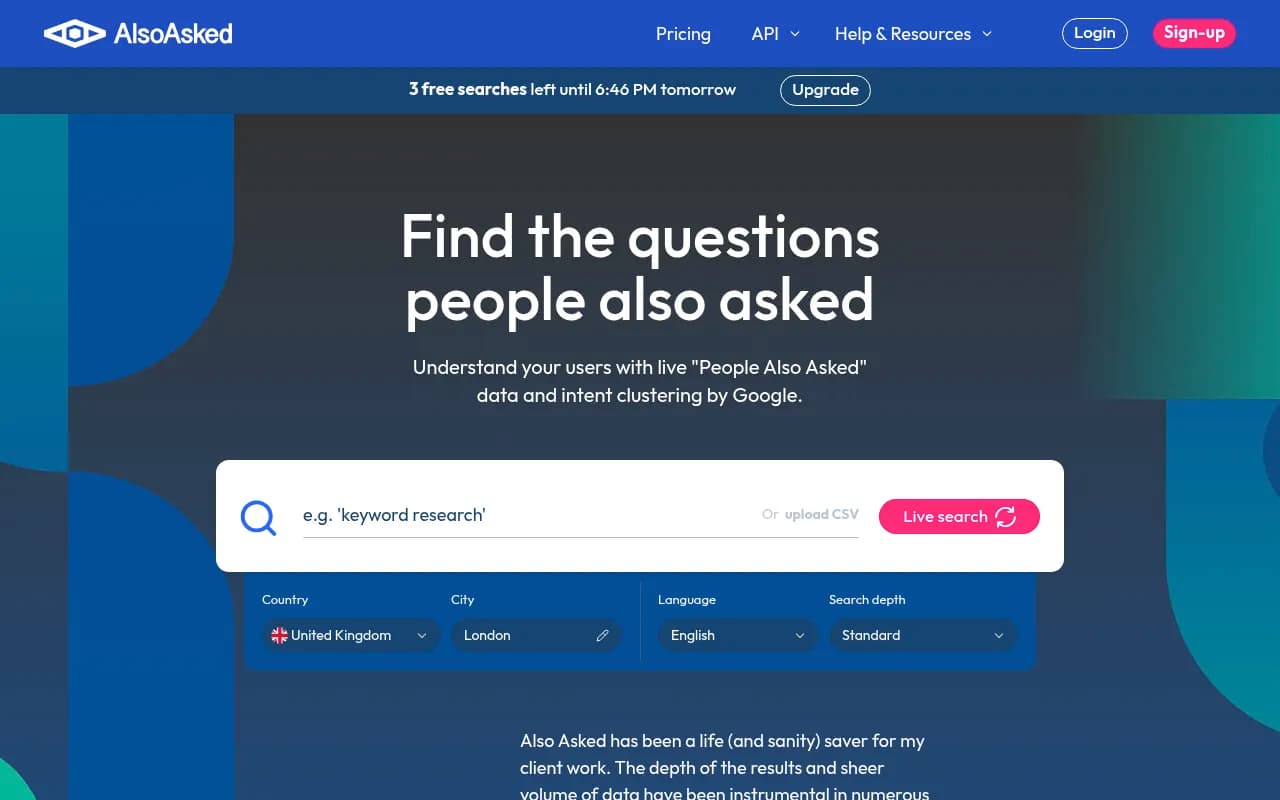
When you search for "content marketing strategy," AlsoAsked shows you not just related questions but the hierarchy of how Google users move through them. Someone asking "what is content marketing" branches into "how do you create a content marketing strategy" which branches into "what tools do you need for content marketing." That branching structure is exactly how AI engines think about query fan-outs -- a single prompt often generates multiple sub-queries before synthesizing an answer.
For AI search purposes, AlsoAsked is most useful for:
- Understanding the question hierarchy around a topic
- Identifying sub-questions AI engines are likely to address when answering a broader query
- Building FAQ sections and structured content that directly answers related questions
The limitation is that AlsoAsked only surfaces questions, with no volume data, difficulty scores, or competitive analysis. It's a research tool, not a full keyword platform. The free plan is quite restricted (a handful of searches per day), and paid plans start at $15/month for 100 searches, going up to $40/month for 300.
That said, for the specific task of question mapping, it's one of the best tools available. The visual output is genuinely useful for content planning.
AnswerThePublic
AnswerThePublic is the older, more established question-discovery tool. It generates a visual "wheel" of questions, prepositions, and comparisons around a seed keyword, pulling from autocomplete data. It was acquired by Neil Patel's NP Digital in 2022 and has been integrated with Ubersuggest since.
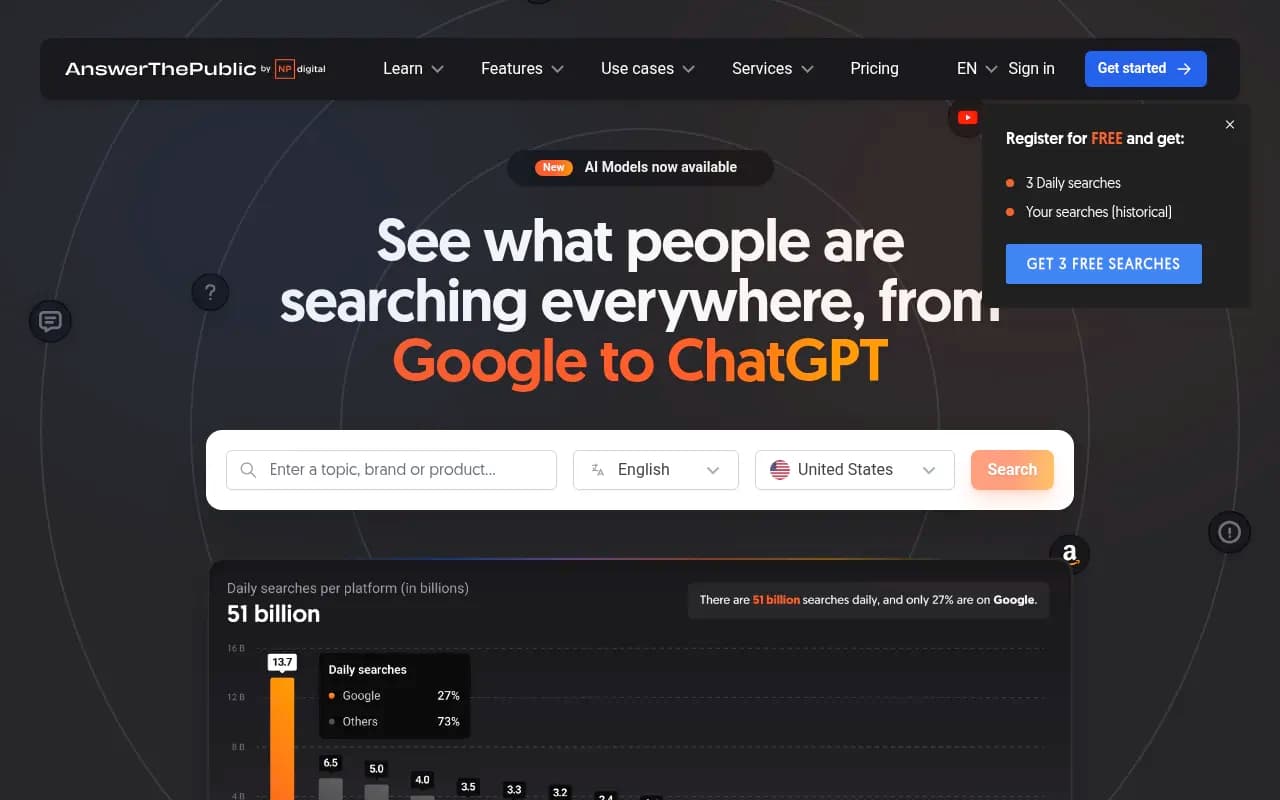
The free plan is limited to a few searches per day, which frustrates a lot of users. The paid plans ($9/month for individual, $99/month for Pro) unlock more searches and historical data comparison.
For AI search purposes, AnswerThePublic is useful for:
- Quick question discovery around a topic
- Identifying the "vs," "for," and "without" comparison queries that AI engines frequently handle
- Getting a broad map of how a topic is discussed before diving into deeper research
The comparison queries are particularly interesting for AI search. When someone asks ChatGPT "Ahrefs vs Semrush for small business," that's exactly the kind of query AnswerThePublic surfaces. Building content that directly addresses those comparisons gives you a reasonable shot at being cited in AI responses.
Where AnswerThePublic falls behind AlsoAsked: the question hierarchy isn't as clear, and there's no live PAA data -- it's autocomplete-based, which captures different signals. For AI search research specifically, AlsoAsked's PAA data tends to be more directly useful because it reflects how Google (and by extension, many AI engines) structures question relationships.
Head-to-head comparison
| Tool | Best for | AI search relevance | Question discovery | Volume data | Pricing |
|---|---|---|---|---|---|
| Ahrefs | Full SEO research + competitor analysis | Medium | Good (Questions filter) | Yes | From $99/mo |
| Semrush | Comprehensive SEO suite + content briefs | Medium-High | Very good (Keyword Magic Tool) | Yes | From $119/mo |
| AlsoAsked | Question hierarchy mapping | High | Excellent (PAA-based) | No | From $15/mo |
| AnswerThePublic | Broad question discovery | Medium-High | Good (autocomplete-based) | No | From $9/mo |
The honest summary: Ahrefs and Semrush give you the most complete data, but they're built around traditional search metrics. AlsoAsked and AnswerThePublic are lighter tools that happen to be better aligned with how AI engines process queries -- because they focus on questions rather than volume.
What these tools miss
All four tools share the same gap: they show you what questions exist, but not what happens after you publish content targeting those questions.
In traditional SEO, you could check your rankings in Google Search Console. In AI search, there's no equivalent built into these platforms. You can't open Ahrefs and see "ChatGPT cited your page 47 times this week when answering questions about content marketing."
That's a separate category of tooling. Platforms like Promptwatch track exactly this -- which AI engines are citing your pages, how often, for which prompts, and how your visibility changes over time as you publish new content.

The workflow that actually works in 2026 looks something like this:
- Use AlsoAsked or AnswerThePublic to map the question landscape around your topic
- Use Ahrefs or Semrush to validate which questions have real search demand and competitive gaps
- Publish content that directly answers those questions with enough depth and structure to be citable
- Use an AI visibility platform to track whether AI engines actually start citing your new pages
Steps 1-3 are covered by the tools in this guide. Step 4 requires something else.
Which tool should you actually use?
It depends on what you already have and what you're trying to do.
If you're starting from scratch and budget is tight, AlsoAsked ($15/month) plus Google Keyword Planner (free) gets you surprisingly far. You get solid question mapping and basic volume data without spending $100+ per month.
If you're running an established site with real SEO investment, Semrush is the better all-in-one choice for AI search work specifically -- the intent classification and content brief tools are more developed than Ahrefs for this use case. Ahrefs is still better for backlink research, but that matters less for AI visibility than it does for traditional rankings.
If you're doing content planning for a specific topic cluster, add AlsoAsked to whatever platform you're using. The $15/month is worth it for the question hierarchy data alone.
AnswerThePublic is useful but increasingly feels like the third choice behind AlsoAsked. The autocomplete data is good, but PAA data is more directly relevant to AI search behavior.
A few other tools worth knowing about in this space:
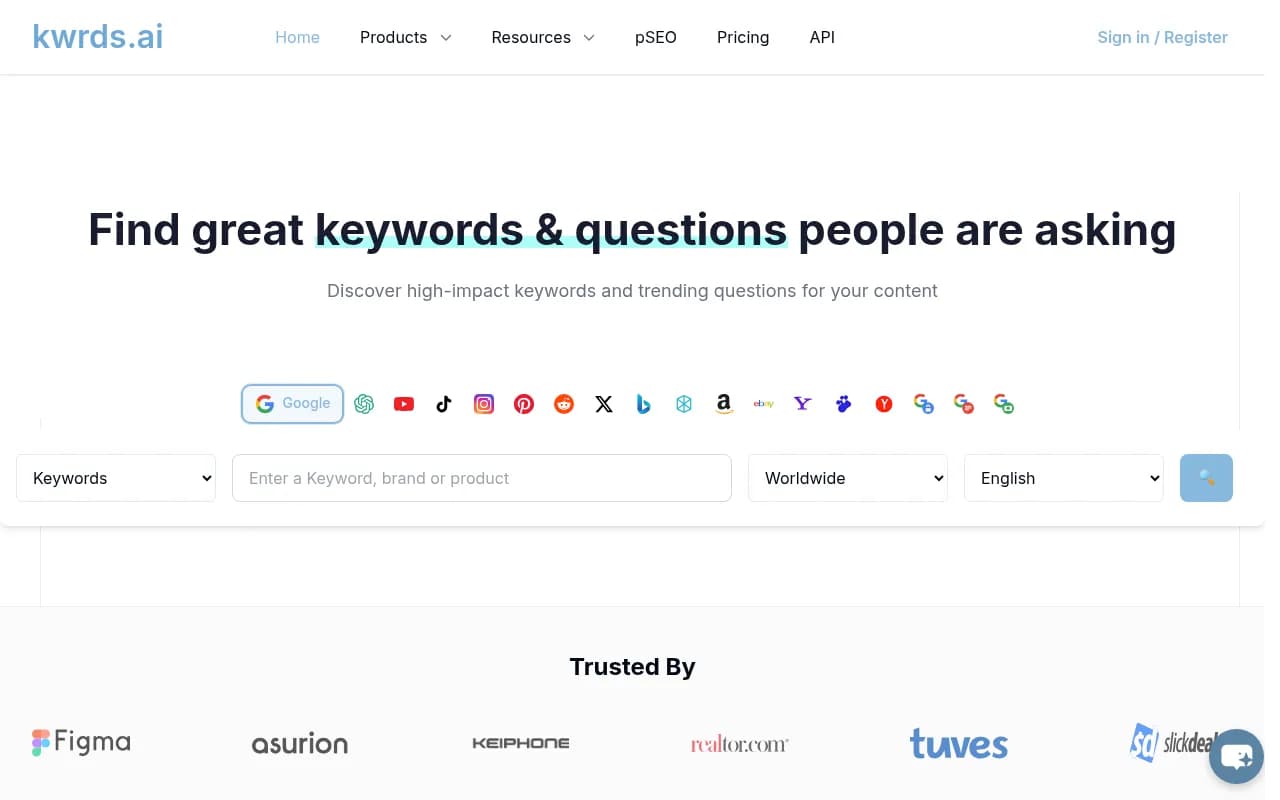
kwrds.ai is a newer option that specifically focuses on multi-platform keyword research and PAA discovery -- worth a look if you want something purpose-built for question-based research.
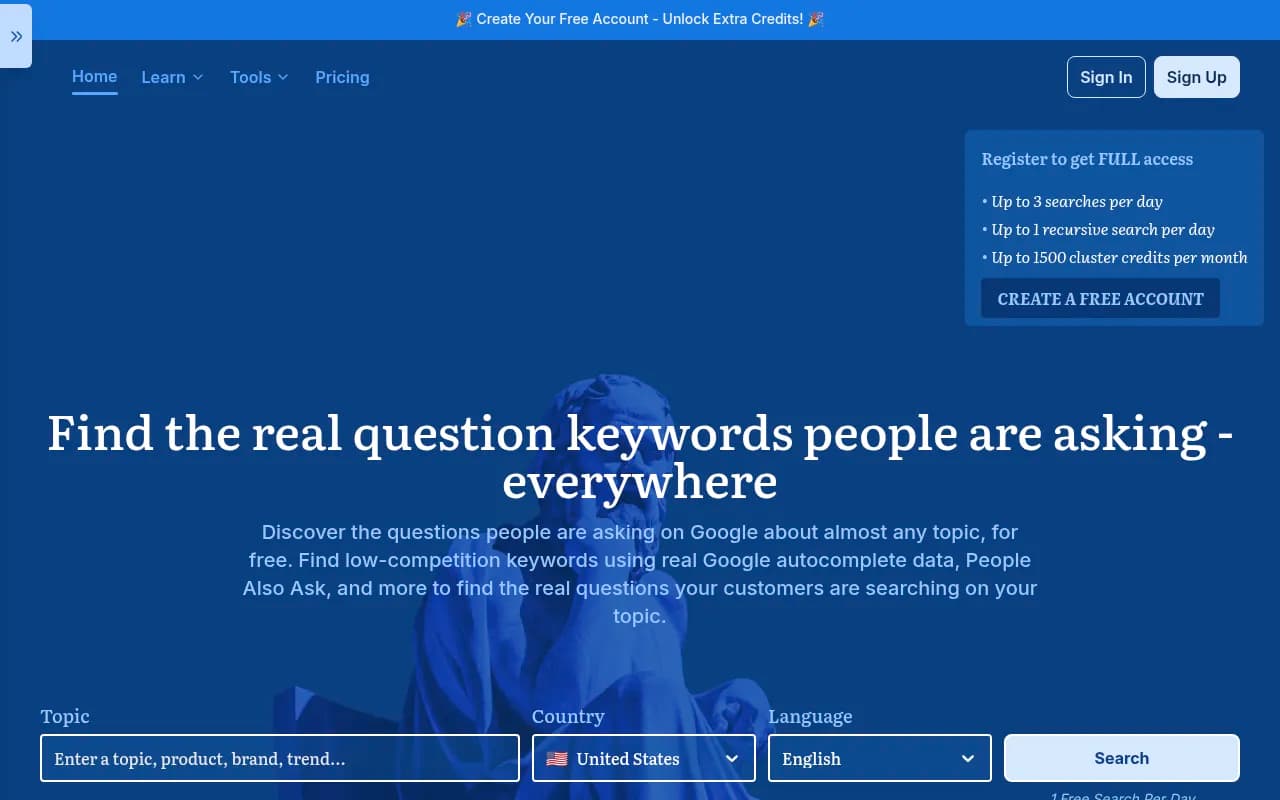
Answer Socrates offers a generous free tier (3 searches per day with 1,000+ keywords each) and includes topic clustering, which makes it a legitimate free alternative to AnswerThePublic for teams that don't need volume data.
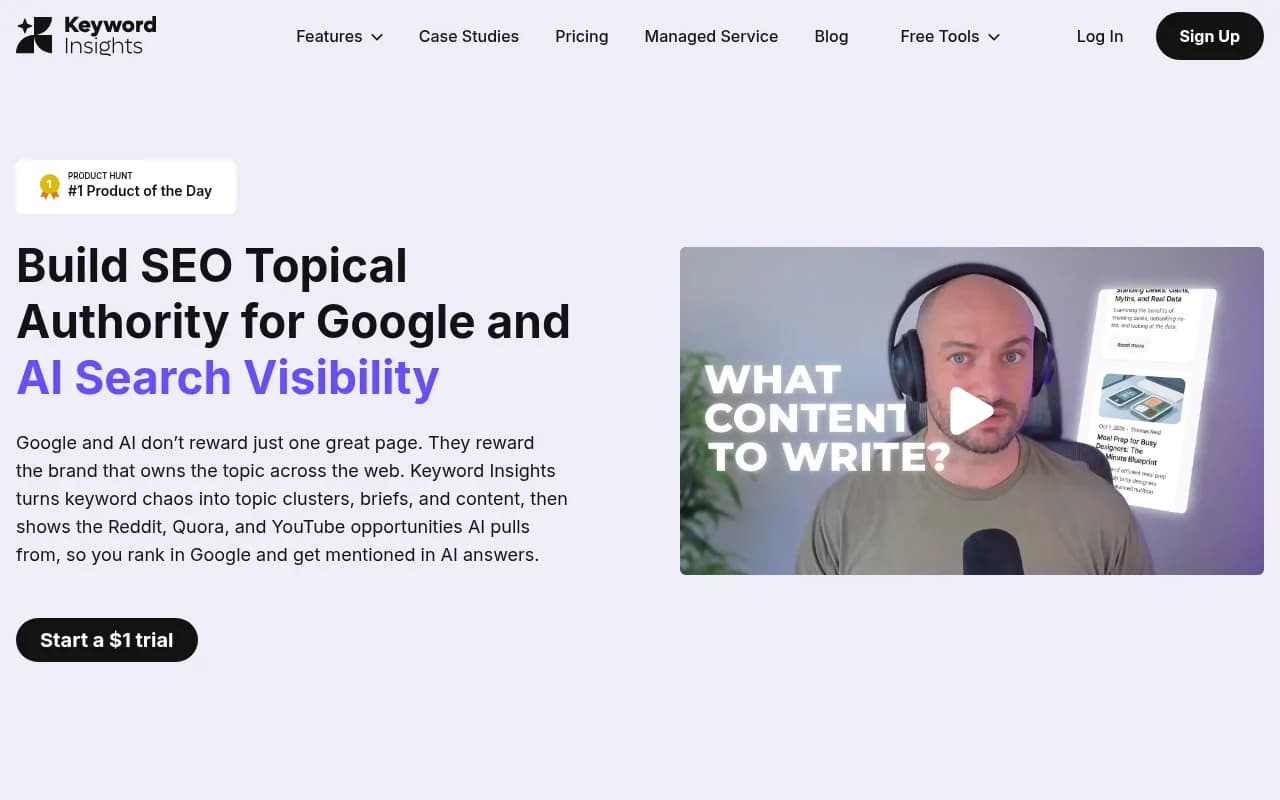
Keyword Insights is strong for clustering large keyword sets into content topics -- useful if you've exported a big list from Ahrefs or Semrush and need to organize it into a content plan.
The bottom line
Keyword research for AI search in 2026 is less about finding high-volume terms and more about mapping the questions your audience asks and ensuring your content answers them completely. The tools in this guide all contribute to that goal in different ways.
None of them tell you whether you're actually winning in AI search. For that, you need to track citations directly -- which is a different problem that requires a different kind of tool.
The combination that makes sense for most teams: one full-suite platform (Semrush or Ahrefs) for data depth, plus AlsoAsked for question hierarchy mapping, plus an AI visibility tracker to close the loop on whether your content is actually getting cited. That's three tools, but they cover genuinely different parts of the workflow.