Key takeaways
- Semrush has the broadest feature set in 2026, including some AI search monitoring, making it the strongest all-in-one choice for agencies and larger teams.
- Ahrefs remains the gold standard for backlink analysis and keyword research, and is the most cost-effective option for individuals and small teams focused on traditional SEO.
- Moz Pro is the most approachable of the three but has fallen behind on data depth and AI search capabilities -- it's best suited for beginners or single-site operators.
- None of the three platforms were built for AI search visibility. For teams that need to track and improve how they appear in ChatGPT, Perplexity, or Google AI Overviews, a dedicated GEO tool like Promptwatch fills the gap these platforms leave.
The SEO tool market hasn't changed this much since Google introduced Panda. AI search -- ChatGPT, Perplexity, Google AI Overviews, Gemini -- is now a meaningful traffic channel for many brands, and the three platforms that have dominated SEO tooling for the past decade (Moz Pro, Semrush, Ahrefs) are all scrambling to stay relevant.
The honest answer to "which one should I use in 2026" depends heavily on what you're actually trying to do. If your team is purely focused on Google rankings, the calculus hasn't changed much. But if you're trying to understand and improve your visibility in AI-generated answers -- which is increasingly where buying decisions start -- you're going to hit real limits with all three.
Let's go through each platform properly, then talk about where the gaps are.
Semrush: the all-in-one that's trying hardest to adapt
Semrush is the most feature-complete platform of the three. It covers keyword research, rank tracking, site audits, backlink analysis, content optimization, local SEO, PPC research, social media, and more. For agencies managing multiple clients across multiple channels, that breadth is genuinely useful -- you can avoid paying for five separate tools.
On AI search specifically, Semrush has made moves. It has an AI Toolkit and ContentShake AI for generating and optimizing content, and it tracks some AI-adjacent signals. But the AI search monitoring is limited: it uses fixed prompts rather than tracking the full range of queries your audience actually uses, and there's no meaningful attribution connecting AI visibility to traffic or revenue.
The pricing reflects the platform's ambition. Semrush Pro starts at around $140/month, Guru at $250/month, and Business at $500/month. That's a significant commitment, and the value depends entirely on how many of those features your team actually uses.
Where Semrush genuinely wins:
- The broadest keyword database and competitive intelligence features
- PPC research that no other SEO tool matches
- Content tools that are actually integrated into the workflow
- Local SEO features for multi-location businesses
Where it falls short:
- Backlink data is good but not as deep as Ahrefs
- AI search monitoring is surface-level and uses fixed prompts
- The interface can feel overwhelming for smaller teams
- Cost adds up fast when you need multiple seats
Best for: Agencies, in-house teams managing multiple sites, anyone who needs SEO + PPC + content in one platform.
Ahrefs: still the backlink king, slowly expanding
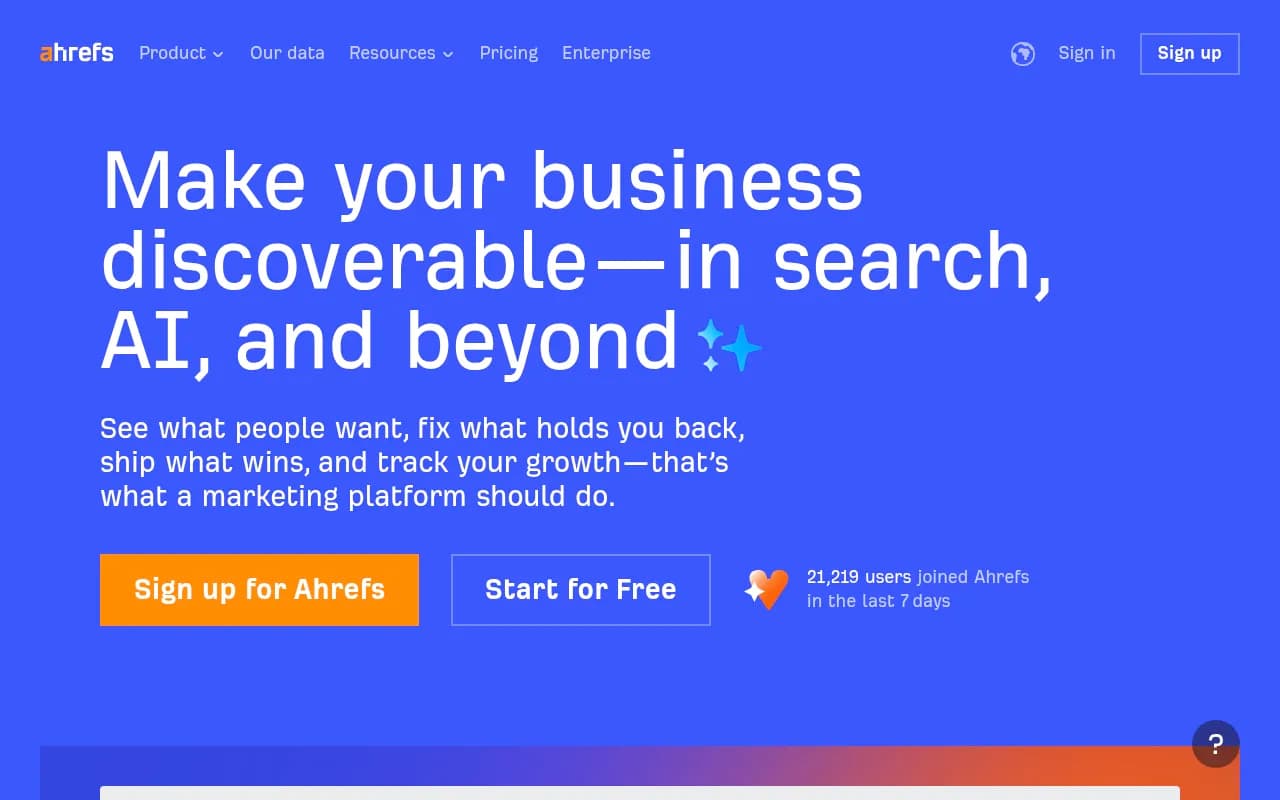
Ahrefs built its reputation on having the best backlink index in the industry, and that reputation is still earned. If you need to understand link profiles -- yours or a competitor's -- Ahrefs is the tool. The keyword explorer is also excellent, with accurate volume data and strong SERP analysis.
The platform has expanded significantly over the past few years. It now includes a site audit tool, rank tracker, content explorer, and a web analytics product. Ahrefs also introduced a Starter plan at $29/month, which makes it accessible for freelancers and small teams who just need the core research features.
On AI search, Ahrefs has been slower to move than Semrush. There's some AI-related functionality in development, but as of mid-2026, it's not a platform you'd choose if AI search visibility is a priority. The focus remains on traditional search, and it does that extremely well.
A Reddit thread from the r/AskMarketing community put it well: "Ahrefs still feels strongest for backlinks + competitor research." That's the consensus view, and it's accurate.
Where Ahrefs genuinely wins:
- The best backlink index, period
- Clean, intuitive interface that's easier to learn than Semrush
- Accurate keyword data with strong SERP analysis
- Better value at the entry level with the Starter plan
- Content Explorer for finding link-worthy content ideas
Where it falls short:
- Limited AI search visibility features
- No PPC research (Semrush has a clear edge here)
- Site audit tool is functional but not as detailed as dedicated crawlers like Screaming Frog
- Fewer content optimization features
Best for: SEO specialists, small teams, anyone who prioritizes backlink analysis and keyword research over breadth.
Moz Pro: approachable but falling behind
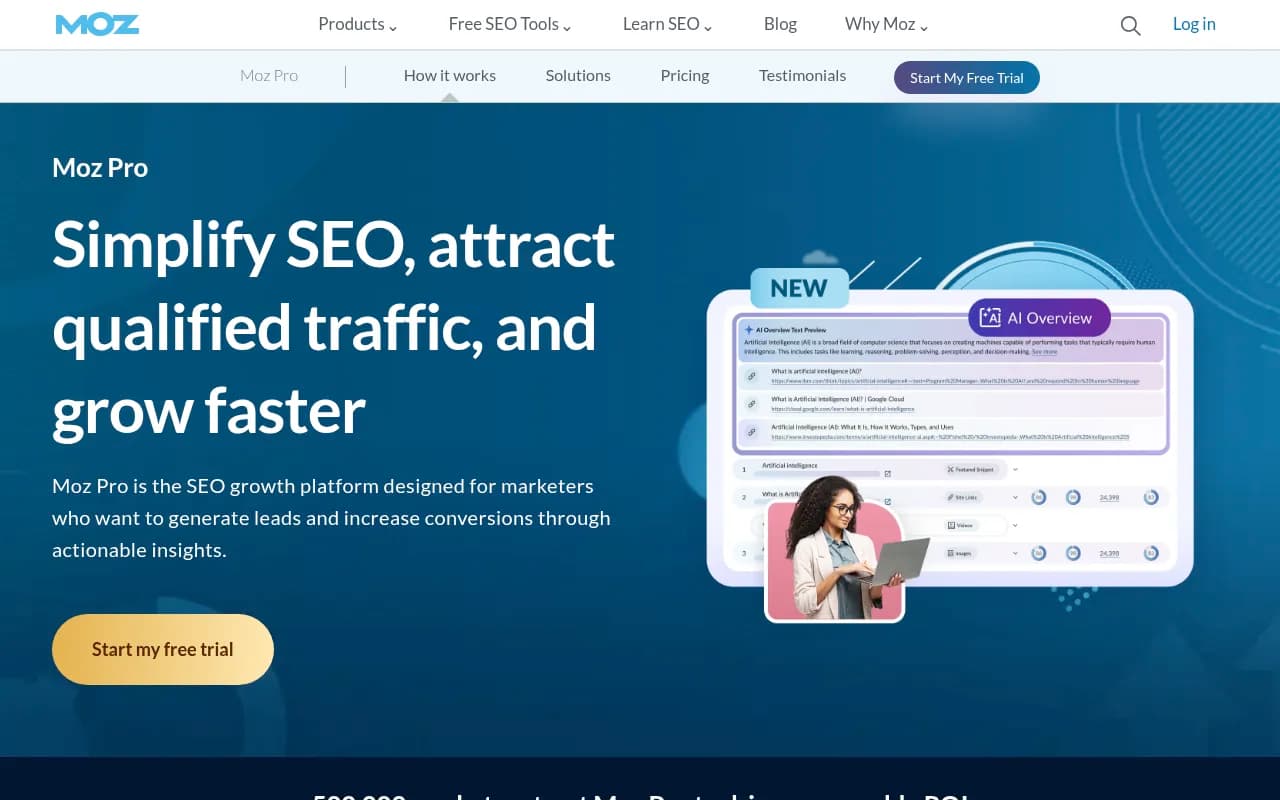
Moz Pro is the most beginner-friendly of the three. The interface is clean, the documentation is excellent, and features like Domain Authority (DA) have become industry-standard metrics even outside the Moz ecosystem. For someone new to SEO, or a small business managing a single site, Moz Pro is genuinely a good starting point.
The problem is data depth. Moz's backlink index is smaller than both Semrush and Ahrefs, and its keyword database doesn't match either at the higher tiers. The platform has been slower to add new features, and AI search capabilities are minimal.
Pricing starts at $39/month (annual billing) for the Starter plan, which is competitive. But at that price point, you're getting less data than you'd get from Ahrefs' Starter plan, which is similarly priced.
Where Moz Pro genuinely wins:
- The most approachable UX in the category
- Domain Authority is a useful, widely-understood metric
- Good link opportunity discovery features
- Solid local SEO integration through Moz Local
Where it falls short:
- Smaller backlink index than competitors
- Keyword data depth lags behind Semrush and Ahrefs
- Minimal AI search features
- Slower product development cadence
Best for: Beginners, single-site operators, teams that prioritize ease of use over data depth.
Head-to-head comparison
| Feature | Semrush | Ahrefs | Moz Pro |
|---|---|---|---|
| Keyword research | Excellent | Excellent | Good |
| Backlink analysis | Very good | Best in class | Good |
| Site audit | Very good | Good | Good |
| Rank tracking | Very good | Good | Good |
| Content tools | Strong | Basic | Basic |
| PPC research | Best in class | None | None |
| Local SEO | Strong | Limited | Good (via Moz Local) |
| AI search monitoring | Basic (fixed prompts) | Minimal | Minimal |
| AI content generation | Yes (ContentShake AI) | Limited | No |
| Interface complexity | High | Medium | Low |
| Entry-level pricing | ~$140/mo | $29/mo (Starter) | $39/mo (annual) |
| Best for | Agencies, multi-channel | SEO specialists, small teams | Beginners, single sites |
The AI search gap all three platforms share
Here's the uncomfortable truth: none of these platforms were built for AI search, and none of them have meaningfully closed that gap in 2026.
What does "AI search visibility" actually mean? When someone asks ChatGPT "what's the best project management tool for remote teams?" or asks Perplexity "which CRM should I use for a B2B SaaS company?" -- your brand either appears in that answer or it doesn't. That's a traffic and revenue question, not just a vanity metric.
Semrush tracks some AI-adjacent signals, but it uses fixed prompts and doesn't show you which specific AI-generated answers mention your brand, which pages are being cited, or what content gaps are causing you to be invisible for certain queries. Ahrefs and Moz Pro are even further behind.
The teams that are taking AI search seriously in 2026 are running a separate stack alongside their traditional SEO tool. Platforms like Promptwatch were built specifically for this problem -- tracking brand visibility across ChatGPT, Perplexity, Google AI Overviews, Gemini, and other AI engines, identifying which prompts competitors rank for that you don't, and generating content designed to close those gaps.

That's a fundamentally different workflow from what Semrush, Ahrefs, or Moz Pro offer. It's not a replacement for those tools -- it's what fills the gap they leave.
Which platform should you choose?
The decision comes down to your team's primary use case:
Choose Semrush if you're an agency or in-house team that needs one platform covering SEO, content, PPC, and local. The breadth justifies the cost if you're actually using most of it. It also has the most developed (if still limited) AI search features of the three.
Choose Ahrefs if your primary focus is traditional SEO -- keyword research, backlink analysis, and competitive research. It's the best value for pure SEO work, especially at the Starter tier. The interface is cleaner, and the data quality is excellent.
Choose Moz Pro if you're new to SEO, managing a single site, or working with a team that needs a gentle learning curve. It's not the most powerful option, but it's the most approachable, and Domain Authority is a useful metric for reporting to non-SEO stakeholders.
Add a dedicated AI search tool if your team is serious about AI search visibility. None of the three platforms above will tell you why you're invisible in ChatGPT answers, which content gaps are costing you AI citations, or how your visibility compares to competitors across 10+ AI models. That's a separate problem requiring a separate tool.
What about alternatives?
If you're reconsidering your stack entirely, a few other tools are worth knowing about:
SE Ranking has emerged as a strong mid-market option -- it delivers most of Semrush's features at a significantly lower price point, which matters for smaller agencies.
Screaming Frog remains the best dedicated technical crawler, and many teams run it alongside one of the big three rather than relying on built-in audit tools.
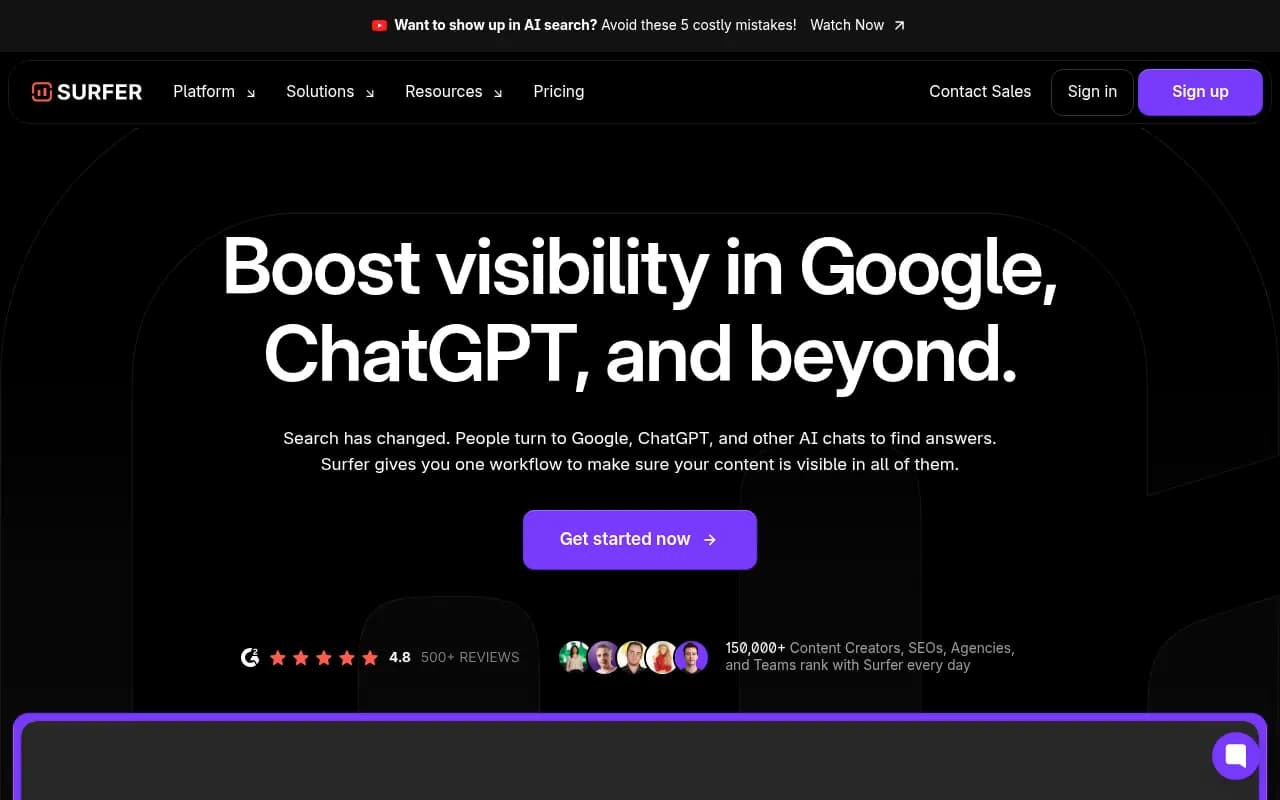
For content optimization specifically, Surfer SEO and Clearscope are both stronger than what Semrush or Ahrefs offer natively.

And for AI search visibility specifically -- tracking citations across LLMs, identifying content gaps, and generating content that actually gets cited -- Promptwatch is the most complete platform available, with crawler logs, prompt volume data, and content generation built around real AI search behavior rather than traditional keyword metrics.
The bottom line
Semrush, Ahrefs, and Moz Pro are all solid tools for traditional SEO in 2026. Semrush wins on breadth, Ahrefs wins on backlink depth and value, and Moz Pro wins on approachability. None of them win on AI search.
If your team is still primarily optimizing for Google's blue links, pick the tool that fits your budget and workflow. If you're trying to understand why you're not appearing in AI-generated answers -- and what to do about it -- you need something built for that problem specifically.
The teams that figure this out early will have a meaningful advantage. AI search isn't replacing traditional search overnight, but it's already influencing enough buying decisions that ignoring it is a real risk.