Mentionlytics Review 2026
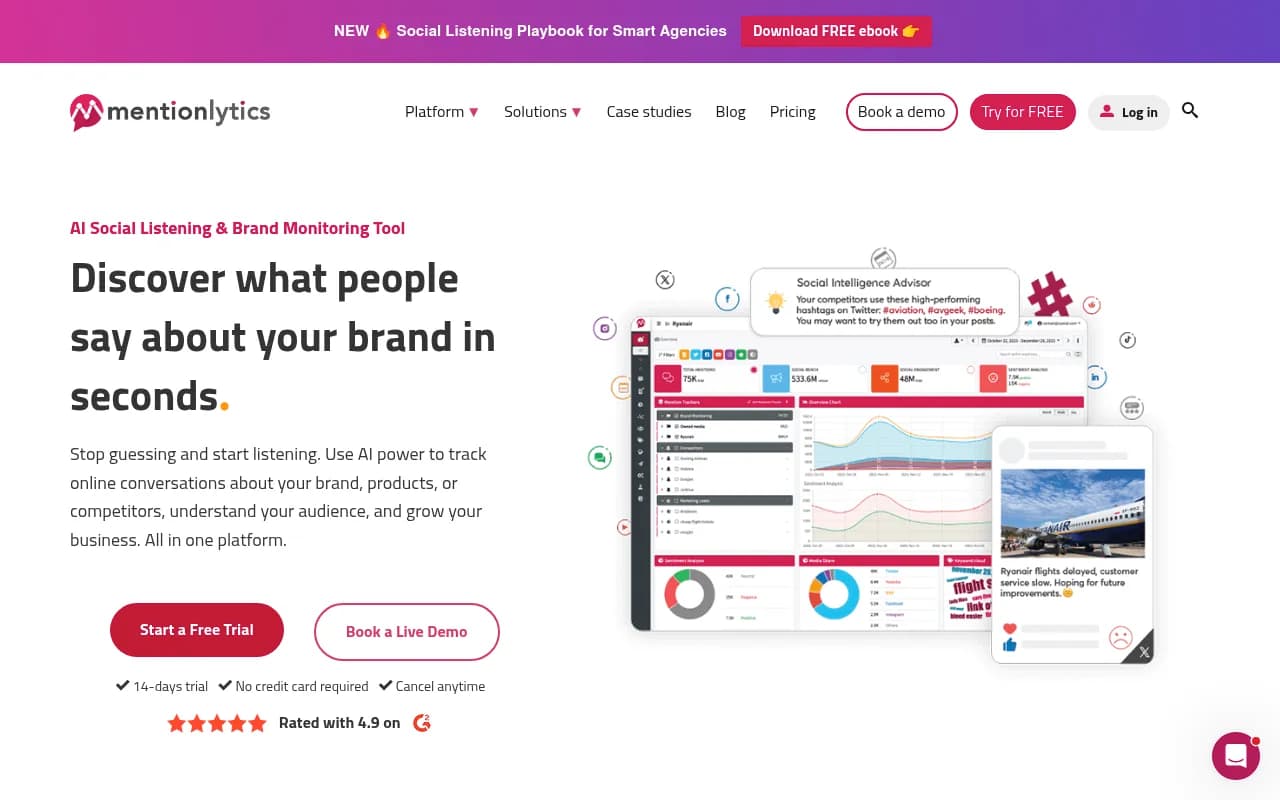
Mentionlytics is an AI-powered social listening and brand monitoring platform tracking mentions across social media, news, blogs, and forums. Ideal for agencies and SMBs needing real-time reputation management, sentiment analysis, and competitor tracking.
Key takeaways
- Mentionlytics monitors brand mentions across social media (X, Facebook, TikTok, LinkedIn, Instagram, YouTube, Reddit) and the broader web including news, blogs, forums, and review sites
- Solid AI features including sentiment analysis, mention clustering, and SIA (Social Intelligent Advisor) for automated insights and strategy suggestions
- Rated 4.9 on G2 with strong reviews from marketing managers and agencies -- the customer support reputation is a genuine differentiator at this price point
- Pricing runs from $69/month (Basic) to $999/month (Agency/Enterprise tiers), with a 14-day free trial and no credit card required
- Not a GEO or AI search visibility tool -- if you need to track how your brand appears in ChatGPT, Perplexity, or Google AI Overviews, Mentionlytics doesn't cover that; Promptwatch is built specifically for that use case
Mentionlytics is a social listening and brand monitoring platform built by a Cyprus-based team that has been operating since around 2017. The core pitch is straightforward: stop manually searching for what people are saying about your brand and let the platform do it automatically across every major social channel and a wide swath of the open web. It's trusted by a mix of enterprise names (Zurich, Lidl, Ogilvy) and smaller agencies, which tells you something about its flexibility across company sizes.
The target audience is broad by design. Marketing managers at mid-sized companies, PR teams managing reputation, digital agencies running monitoring for multiple clients, and even political campaigns or nonprofits all show up in Mentionlytics' positioning. That breadth is both a strength and a limitation -- the platform does a lot of things reasonably well, but specialists in any one area (say, deep competitive intelligence or influencer CRM) will eventually bump into its ceiling.
The tool sits in a crowded market alongside Brandwatch, Mention, Talkwalker, and Sprout Social's listening features. Mentionlytics competes primarily on price and ease of use rather than raw data depth. For a team that needs solid brand monitoring without a five-figure annual contract, it's a credible option.
Key features
Web and social media monitoring Mentionlytics covers the expected social channels -- X (Twitter), Facebook, Instagram, LinkedIn, TikTok, YouTube, and Reddit -- plus a genuinely broad web sweep that includes news sites, blogs, forums, and review platforms. The web monitoring is one of the stronger aspects here: unlike some competitors that rely on curated site lists, Mentionlytics claims to scan the open web more comprehensively. In practice, this means you're more likely to catch a mention on an obscure industry forum or a regional news outlet than you would with a tool that only monitors a fixed source list.
Sentiment analysis The platform uses AI to classify mentions as positive, negative, or neutral. This is table stakes for any monitoring tool in 2026, but Mentionlytics' implementation gets decent marks from users for accuracy. The sentiment engine handles multiple languages, which matters for brands operating across markets. You can filter your dashboard by sentiment to quickly surface the complaints or the praise, and the trend view shows how sentiment shifts over time -- useful for measuring the aftermath of a PR event or product launch.
SIA (Social Intelligent Advisor) SIA is Mentionlytics' AI layer that sits on top of the raw data. It analyzes your mentions, surfaces unusual spikes or patterns, suggests strategic responses, and evaluates the performance of your online actions. Think of it as an automated analyst that flags things you might miss when you're looking at a dashboard full of numbers. It's not a replacement for a human strategist, but for smaller teams without a dedicated analyst, it adds real value. SIA sends notifications when something out of the ordinary happens -- a sudden spike in negative mentions, for instance -- so you're not relying on manually checking the dashboard.
AI mention clustering Rather than scrolling through hundreds of individual mentions, the clustering feature groups them by topic automatically. If your brand is being discussed in the context of a product recall, a new campaign, and general customer service complaints all at once, clustering separates those conversations so you can address each one appropriately. This is a time-saver that becomes more valuable as your mention volume grows.
Share of voice The competitive analysis side of Mentionlytics lets you track multiple brands simultaneously and compare their mention volumes, sentiment, and reach. The share of voice metric shows you what percentage of the total conversation in your space belongs to you versus competitors. This is useful for agency reporting and for internal strategy reviews -- it gives you a concrete number to track over time rather than a vague sense of "we're getting more mentions."
Influencer identification Within the monitoring data, Mentionlytics surfaces accounts and authors who are generating the most reach and engagement when they mention your brand or relevant keywords. This isn't a full influencer marketing platform -- you won't find detailed audience demographics or outreach CRM features here -- but it's useful for identifying who's already talking about you and who has the most amplification potential.
Custom reporting and report builder The report builder lets you create branded, shareable reports from your monitoring data. For agencies, this is a practical feature: you can configure reports per client, schedule them to send automatically, and present data in a format that makes sense to non-technical stakeholders. The customization options are solid without being overwhelming.
Alerts and notifications You can configure alerts based on mention volume thresholds, sentiment shifts, or specific keywords. Notifications go out via email on a schedule you define, or as instant alerts for significant spikes. This is the crisis management backbone -- if something goes wrong and your brand starts getting hammered on social media, you want to know within minutes, not hours.
Hashtag tracking Beyond brand names, you can track hashtags tied to campaigns or industry conversations. This is useful for measuring campaign reach and for monitoring trending topics in your niche. The data shows how a hashtag is being used, by whom, and with what sentiment.
Who is it for
Mentionlytics fits best for marketing teams at small to mid-sized companies who need reliable brand monitoring without the complexity or cost of enterprise tools like Brandwatch or Talkwalker. A marketing manager at a 50-person SaaS company who wants to track brand mentions, monitor a handful of competitors, and generate monthly reports for leadership is the sweet spot. The interface is clean enough that you don't need a data analyst to interpret the dashboards.
Digital agencies managing social listening for multiple clients are another strong fit. The multi-brand tracking, white-label reporting, and tiered pricing (with higher plans supporting more tracked keywords and brands) make it workable for an agency running 5-15 client accounts. The report builder in particular saves time on the deliverable side of client work.
Enterprises with complex needs -- deep historical data, custom data integrations, advanced audience segmentation, or very high mention volumes -- will likely find Mentionlytics' higher tiers adequate but may eventually want something more powerful. Brands in highly regulated industries that need audit trails or specific compliance features should evaluate carefully. And if your primary concern is how your brand appears in AI-generated answers from ChatGPT, Perplexity, or Google AI Overviews, Mentionlytics doesn't address that at all -- that's a different category of tool entirely.
Integrations and ecosystem
Mentionlytics connects to the major social platforms for data ingestion -- X, Facebook, Instagram, LinkedIn, TikTok, YouTube, Reddit. On the output side, it integrates with Slack for notifications, which is the most commonly used workflow integration for monitoring tools. There's a REST API available on higher-tier plans, which lets teams pull mention data into their own dashboards, CRMs, or data warehouses.
The platform doesn't have a native Zapier integration listed prominently, though API access enables custom workflow automation for teams with developer resources. Export options include CSV and PDF reports. There's no dedicated mobile app mentioned, though the web interface is accessible on mobile browsers.
For agencies, the white-label reporting capability is effectively an integration with client workflows -- you can produce branded PDFs that look like they came from your agency rather than a third-party tool.
Pricing and value
Mentionlytics runs six pricing tiers:
- Basic: $69/month -- entry-level, suited for very small brands or individuals testing the platform
- Essential: $141/month (billed yearly, around $169/month monthly) -- small to mid-size brands
- Advanced: approximately $299/month -- mid-market teams with more keyword and source needs
- Pro: approximately $499/month -- larger teams or agencies with multiple clients
- Business: approximately $749/month -- enterprise-level monitoring needs
- Agency/Enterprise: up to $999/month and above, with custom options available
A 14-day free trial is available with no credit card required, which is a low-friction way to evaluate the platform. Annual billing saves a meaningful amount -- the Essential plan drops from ~$169 to ~$141/month on annual billing.
Compared to Brandwatch (which starts in the thousands per month) or Talkwalker, Mentionlytics is significantly cheaper. Against direct competitors like Mention.com or Brand24, the pricing is competitive and the feature set is comparable or slightly stronger on the AI side. For a small agency or a marketing team at a growth-stage company, the Essential or Advanced tiers represent reasonable value.
Strengths and limitations
What it does well:
- Breadth of web monitoring: The claim to scan beyond fixed site lists is meaningful -- catching mentions on obscure forums and regional publications is genuinely harder than it sounds, and Mentionlytics does it better than several competitors at this price point
- SIA and AI features: The AI advisor layer adds practical value for teams without dedicated analysts; automated anomaly detection and strategy suggestions are more useful than raw data dumps
- Customer support reputation: The 4.9 G2 rating with consistent mentions of responsive support is a real differentiator -- at this price tier, support quality varies wildly across competitors
- Report builder for agencies: Clean, customizable, and saves time on client deliverables
Limitations:
- No AI search visibility: Mentionlytics tracks what people say about your brand on social media and the web, but it has no visibility into how AI models like ChatGPT, Perplexity, or Google AI Overviews represent your brand. As AI search becomes a primary discovery channel, this is a growing gap. Promptwatch is purpose-built for that use case.
- Influencer features are shallow: The influencer identification is useful for discovery but there's no outreach management, relationship tracking, or audience analytics -- you'd need a dedicated influencer platform alongside it
- Historical data depth: Depending on your plan, historical data access can be limited, which matters if you're trying to do trend analysis going back more than a year
- No content optimization: Unlike some newer platforms, Mentionlytics is purely a monitoring and analytics tool -- it doesn't help you create content based on what it finds
Bottom line
Mentionlytics is a solid, well-priced social listening and brand monitoring tool that works well for marketing teams and agencies who need reliable mention tracking, sentiment analysis, and competitive monitoring without enterprise-level complexity or cost. The AI features -- particularly SIA and mention clustering -- add genuine utility beyond basic keyword alerts.
Best for: Digital agencies and marketing teams at SMBs who need multi-channel brand monitoring, competitive share-of-voice tracking, and clean client reporting at a price that doesn't require a procurement process.
Tags:
Frequently asked questions
What is Mentionlytics?
How much does Mentionlytics cost?
Does Mentionlytics track AI search results like ChatGPT or Perplexity?
Who is Mentionlytics best suited for?
What makes Mentionlytics different from competitors like Brand24 or Mention?
Is there a free trial available?
Similar and alternative tools to Mentionlytics